Skip to content
MathsGenie logo
Quick links
Open app

Course home

  1. IGCSE
  2. Physics Edexcel
  3. Question bank

Motion in the universe

EasyMediumHard
123456789101112131415161718192021222324252627282930313233343536
Question 33

This question is about planets and satellites in exoplanetary systems.

a.

Planets in distant solar systems have different sizes and masses. The bar chart shows the gravitational field strength of several bodies compared to Earth.
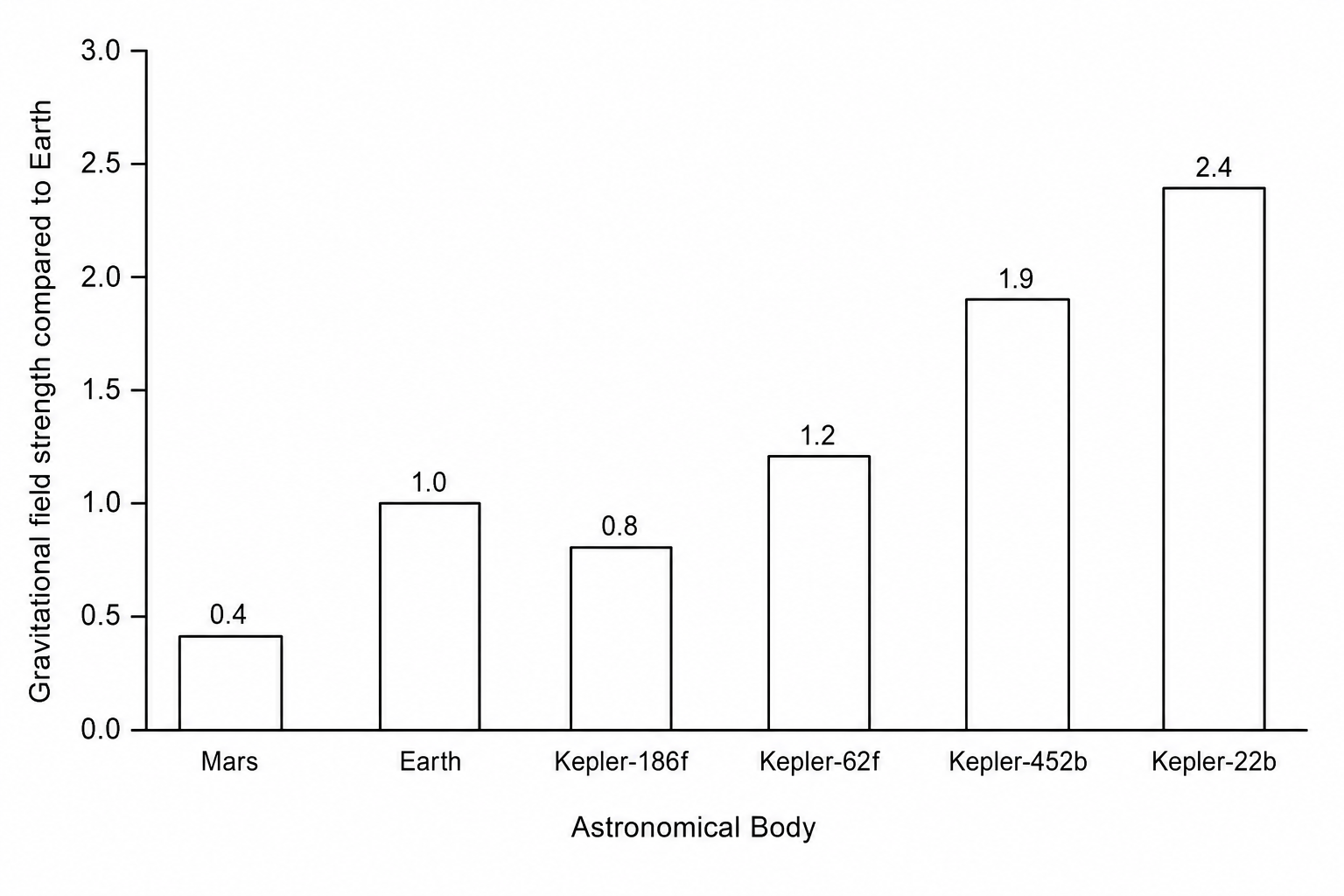
A bar chart showing the gravitational field strength compared to Earth.

Which of these statements is correct?

  • A A 1 kg1\text{ kg}1 kg mass would weigh less on Kepler-452b than on Kepler-62f
  • B A 1 kg1\text{ kg}1 kg mass would weigh less on Kepler-186f than on Mars
  • C A 1 kg1\text{ kg}1 kg mass would weigh more on Kepler-22b than on Kepler-452b
  • D A 1 kg1\text{ kg}1 kg mass would weigh more on Mars than on Earth
[1]
b.

On Earth, the gravitational field strength is 10 N/kg10\text{ N/kg}10 N/kg. Which of these is the value for the gravitational field strength on Kepler-62f?

  • A 1.2 N/kg1.2\text{ N/kg}1.2 N/kg
  • B 8.3 N/kg8.3\text{ N/kg}8.3 N/kg
  • C 12 N/kg12\text{ N/kg}12 N/kg
  • D 120 N/kg120\text{ N/kg}120 N/kg
[1]
c.

Eos is a natural satellite of the exoplanet Kepler-62f. Eos has an orbital time period of 1250 minutes1250\text{ minutes}1250 minutes and an orbital speed of 1850 m/s1850\text{ m/s}1850 m/s.

Calculate the orbital radius of Eos.

[3]
d.

The diagram shows Eos in orbit around Kepler-62f.
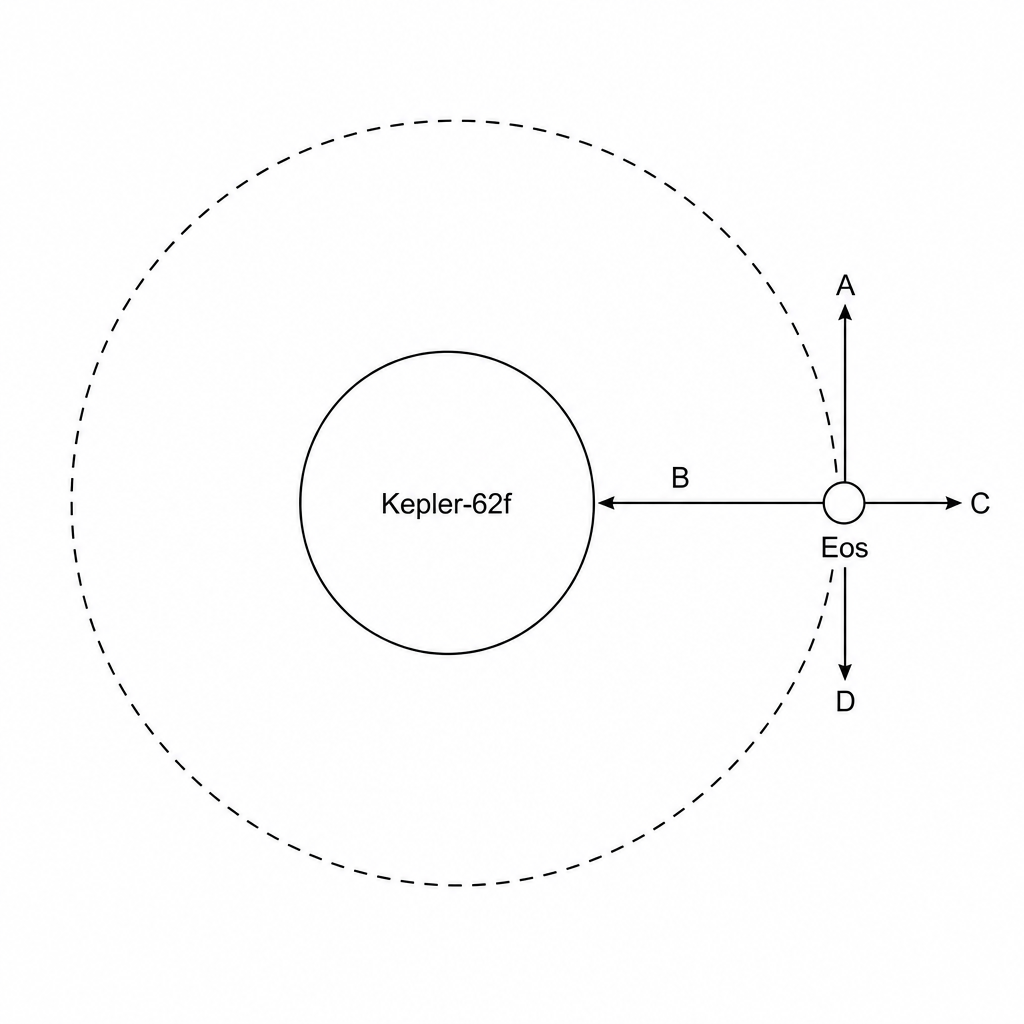
A diagram showing Eos in orbit around Kepler-62f.

Which arrow shows the direction of the force of gravity that Kepler-62f exerts on Eos?


  • A Arrow A
  • B Arrow B
  • C Arrow C
  • D Arrow D
[1]

Motion in the universe Questions

  1. IGCSE
  2. /Physics
  3. /Motion in the universe