

What you'll learn
- What a unit is, and why physics answers need both a number and a unit.
- How to use ampere (A) for current, volt (V) for voltage, and watt (W) for power.
- How these units connect to charge, energy and time.
- How to avoid common unit mistakes in calculations.
Why units matter
In physics, a measurement is not complete unless it has a number and a unit.
For example, writing “12” on its own is not enough. It could mean 12 V, 12 A, 12 W, 12 N, or something else entirely.
Unit
A unit is an agreed standard used to measure a physical quantity. For example, the ampere is the unit used to measure electric current.
A physical quantity is something that can be measured, such as current, voltage, power, energy, time or force.
In this part of Edexcel IGCSE Physics 4PH1 section 6.1, you need to use three electrical units correctly:
- ampere (A) for current
- volt (V) for voltage or potential difference
- watt (W) for power
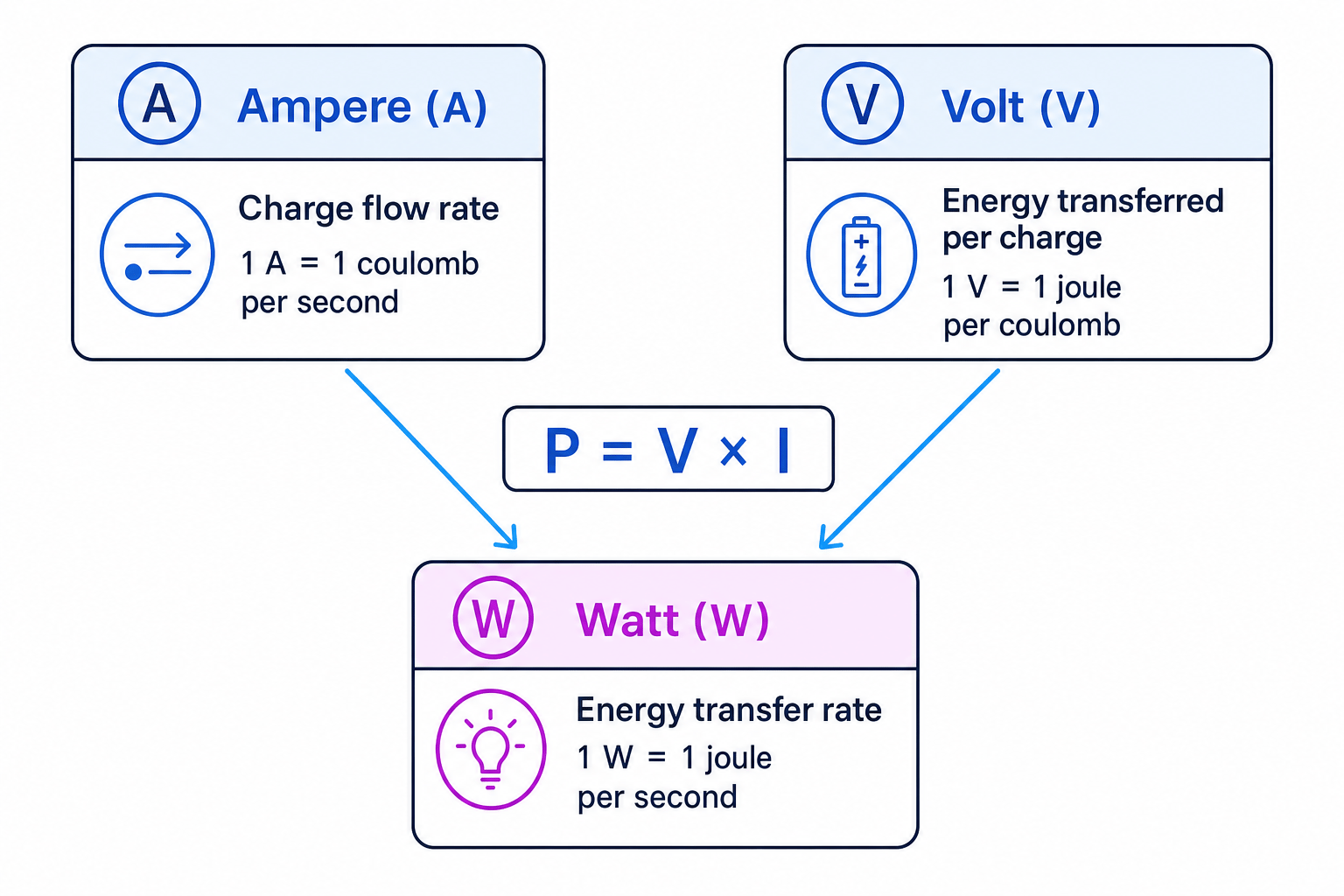
This diagram links the three units to the ideas behind them.
The big distinction
- Ampere (A) tells you how much charge flows each second.
- Volt (V) tells you how much energy is transferred per coulomb of charge.
- Watt (W) tells you how quickly energy is being transferred.
Ampere (A): the unit of current
Electric current is the rate of flow of electric charge.
Ampere
The ampere (A) is the unit of electric current. A current of 1 A means 1 coulomb of charge passes a point each second.
The relationship between charge, current and time is:
charge = current × time
Q=I×tQ = I \times tQ=I×twhere:
- QQQ is charge in coulombs, C
- III is current in amperes, A
- ttt is time in seconds, s
You can rearrange it to find current:
I=QtI = \frac{Q}{t}I=tQSo an ampere is really a “coulomb per second” unit:
1 A=1 C/s1\ \text{A} = 1\ \text{C/s}1 A=1 C/sIn electromagnetism, current is especially important because a current in a wire or coil can produce a magnetic field.
Finding charge from a current
A steady current of 0.50 A flows for 2.0 minutes. Calculate the charge transferred.
- Convert the time into seconds because the equation uses seconds: 2.0 minutes = 120 s.
- Use charge = current × time, Q=I×tQ = I \times tQ=I×t, because current tells you how much charge flows each second.
- Substitute the values with units: Q=0.50 A×120 s=60 CQ = 0.50\ \text{A} \times 120\ \text{s} = 60\ \text{C}Q=0.50 A×120 s=60 C.
- Check the unit: since A means C/s, multiplying A by s leaves C, so the charge transferred is 60 C.
Writing amps instead of amperes
In everyday speech, people often say “amps”, but in exam answers the correct unit name is ampere and the unit symbol is A. Write 3 A, not 3 amps and not 3 As.
Volt (V): the unit of voltage
Voltage is also called potential difference. It is linked to the energy transferred by each coulomb of charge.
Volt
The volt (V) is the unit of voltage or potential difference. A voltage of 1 V means 1 joule of energy is transferred for each coulomb of charge.
The useful relationship is:
energy transferred = charge × voltage
E=Q×VE = Q \times VE=Q×Vwhere:
- EEE is energy transferred in joules, J
- QQQ is charge in coulombs, C
- VVV is voltage in volts, V
You can rearrange it to find voltage:
V=EQV = \frac{E}{Q}V=QESo a volt can be thought of as a joule per coulomb:
1 V=1 J/C1\ \text{V} = 1\ \text{J/C}1 V=1 J/CA higher voltage means each coulomb of charge transfers more energy as it moves through a component.
Finding voltage from energy and charge
A battery transfers 90 J of energy to 15 C of charge. Calculate the voltage.
- Use energy transferred = charge × voltage, E=Q×VE = Q \times VE=Q×V, because the question links energy, charge and voltage.
- Rearrange to make voltage the subject: V=EQV = \frac{E}{Q}V=QE.
- Substitute the values with units: V=90 J15 C=6.0 VV = \frac{90\ \text{J}}{15\ \text{C}} = 6.0\ \text{V}V=15 C90 J=6.0 V.
- Interpret the answer: each coulomb of charge receives 6.0 J of energy from the battery.
Voltage is not the same as energy
Voltage is energy per coulomb, not total energy. A 12 V supply transfers 12 J to each coulomb of charge, but the total energy depends on how much charge flows.
Watt (W): the unit of power
Power is the rate at which energy is transferred.
Watt
The watt (W) is the unit of power. A power of 1 W means energy is transferred at a rate of 1 joule per second.
The general relationship is:
power = energy transferred ÷ time taken
P=EtP = \frac{E}{t}P=tEwhere:
- PPP is power in watts, W
- EEE is energy transferred in joules, J
- ttt is time in seconds, s
So:
1 W=1 J/s1\ \text{W} = 1\ \text{J/s}1 W=1 J/sFor electrical devices, another very useful relationship is:
power = current × voltage
P=I×VP = I \times VP=I×VThis is the same as writing P=V×IP = V \times IP=V×I because multiplication can be done in either order.
Finding power from current and voltage
A motor has a current of 3.0 A through it when connected to a 12 V supply. Calculate its power.
- Choose power = current × voltage, P=I×VP = I \times VP=I×V, because the question gives current and voltage.
- Substitute the values with units: P=3.0 A×12 VP = 3.0\ \text{A} \times 12\ \text{V}P=3.0 A×12 V.
- Calculate the value: P=36 WP = 36\ \text{W}P=36 W.
- Interpret the answer: the motor transfers energy at a rate of 36 J every second.
Keeping the symbols separate
Physics uses symbols for both quantities and units, and they are not always the same thing.
For example:
- Current has quantity symbol III and unit symbol A.
- Voltage has quantity symbol VVV and unit symbol V.
- Power has quantity symbol PPP and unit symbol W.
The letter V can therefore mean two things depending on where it appears. In the equation P=I×VP = I \times VP=I×V, VVV means the quantity voltage. In the answer 12 V, V means the unit volt.
Mixing up V and W
A voltage rating, such as 230 V, tells you energy transferred per coulomb. A power rating, such as 60 W, tells you energy transferred per second. They are different quantities, so the units are not interchangeable.
Unit style in exam answers
Use unit symbols carefully:
- Write A, V and W as capital letters.
- Do not pluralise symbols: write 5 W, not 5 Ws.
- Put a space between the number and the unit: write 12 V, not 12V.
- Use the correct unit for the quantity being asked for.
Sometimes power is given in kilowatts, kW.
1 kW=1000 W1\ \text{kW} = 1000\ \text{W}1 kW=1000 WSo 2.5 kW means 2500 W. If an equation uses joules and seconds, convert kW into W first.
Converting kilowatts to watts
A heater has a power rating of 1.8 kW. Convert this power into watts.
- Use the conversion 1 kW=1000 W1\ \text{kW} = 1000\ \text{W}1 kW=1000 W.
- Multiply by 1000: 1.8 kW=1.8×1000 W1.8\ \text{kW} = 1.8 \times 1000\ \text{W}1.8 kW=1.8×1000 W.
- Calculate the value: 1.8 kW=1800 W1.8\ \text{kW} = 1800\ \text{W}1.8 kW=1800 W.
In the exam
- Match the quantity to the unit: current → A, voltage or potential difference → V, power → W.
- Carry units through calculations so you can spot mistakes, especially when rearranging equations.
- Check whether any prefix conversion is needed, such as kW to W, before substituting into an equation.
Check yourself
- What does a current of 2 A mean in terms of charge flowing each second?
- Why is a voltage of 12 V not the same thing as an energy of 12 J?
- A device is labelled 60 W. What does this tell you about the rate of energy transfer?
