

What you'll learn
- How random molecular motion produces gas pressure.
- Why absolute zero is −273 °C and why the Kelvin scale starts there.
- How temperature affects the average kinetic energy and speed of gas molecules.
- How to use the gas relationships p1T1=p2T2\frac{p_1}{T_1}=\frac{p_2}{T_2}T1p1=T2p2 and p1V1=p2V2p_1V_1=p_2V_2p1V1=p2V2.
1. The particle picture of a gas
A gas is made of particles, usually molecules, that are far apart compared with their size. A molecule is a small particle made from atoms joined together.
Gas molecules are in random motion. This means they move in many different directions, with no fixed pattern. They continually collide with each other and with the walls of their container.
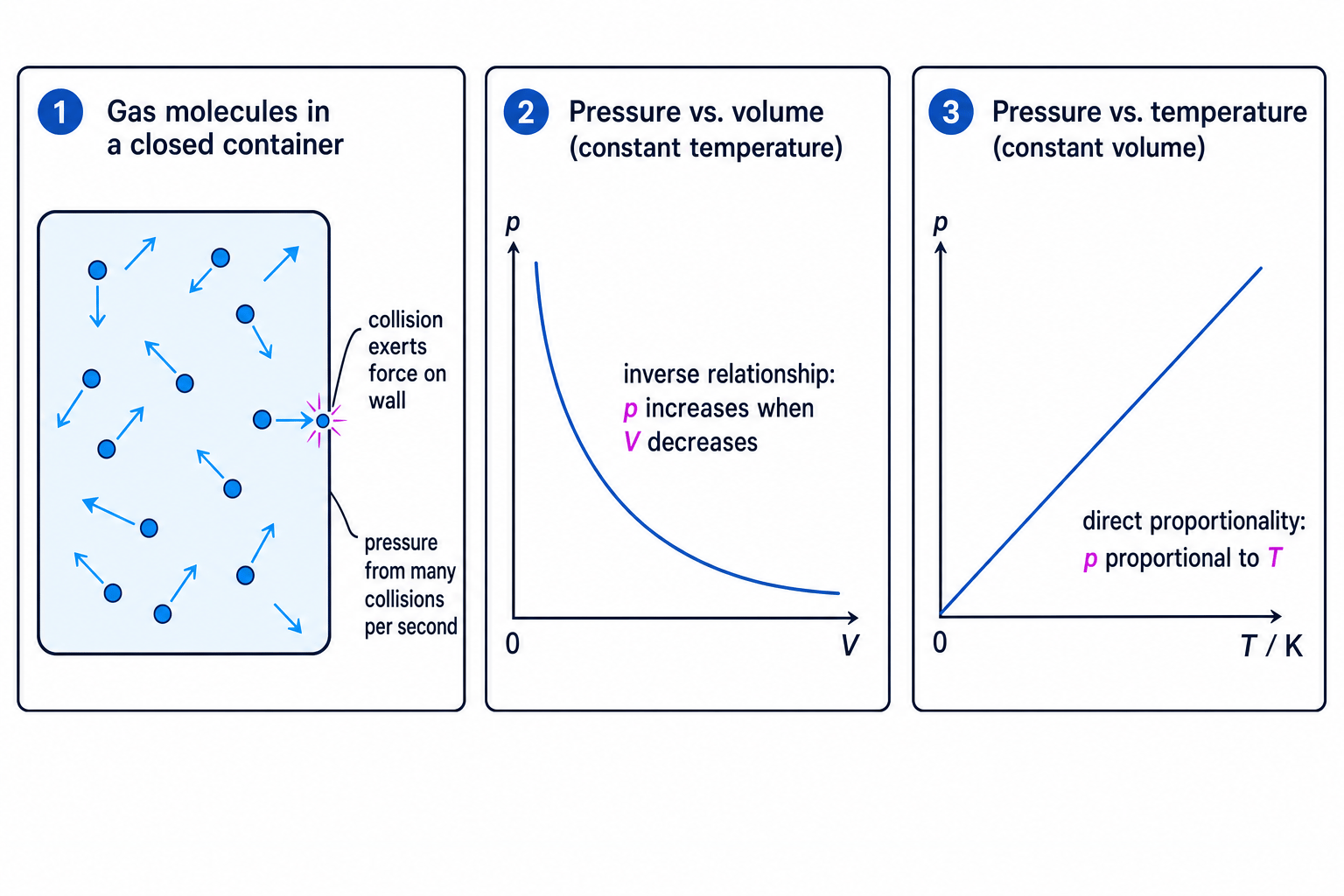
When a gas molecule hits a wall, it changes direction. During the collision, it exerts a force on the wall. One molecule gives a tiny force, but a gas contains huge numbers of molecules, so the combined effect of many collisions each second produces a measurable pressure.
Gas pressure
Pressure is force per unit area on a surface. In a gas, pressure is caused by molecules colliding with the walls of the container. The SI unit of pressure is the pascal, Pa; kPa is also commonly used.
The diagram links the particle model to the two gas relationships you need for this topic.
Explaining pressure in a tyre
A bicycle tyre is pumped up with more air at roughly the same temperature. Explain why the pressure increases.
- Adding air increases the number of gas molecules in the fixed volume of the tyre.
- With more molecules moving randomly, more molecules strike each square metre of tyre wall each second.
- More collisions per second means a larger total force per unit area on the wall, so the gas pressure increases.
2. Temperature and molecular motion
A moving object has kinetic energy, which is energy due to motion. Gas molecules have kinetic energy because they are constantly moving.
Temperature is linked to the motion of molecules. If you heat a gas, energy is transferred to its molecules. Their average kinetic energy increases, so their average speed increases.
Heating a gas
An increase in temperature means the gas molecules have greater average kinetic energy and therefore a greater average speed.
The word average matters. Not every molecule in a gas moves at the same speed. Some are faster and some are slower, but increasing the temperature raises the average.
Not every molecule speeds up equally
Do not write that “all molecules move at the same speed”. In a gas, molecules have a range of speeds; temperature tells you about their average kinetic energy.
3. Absolute zero
If cooling a gas reduces the average kinetic energy of its molecules, there must be a lowest possible temperature. In the IGCSE particle model, this is where the molecules have the minimum possible kinetic energy.
Absolute zero
Absolute zero is the lowest possible temperature. It is −273 °C, which is 0 K on the Kelvin scale.
There cannot be a temperature below absolute zero because average kinetic energy cannot be negative.
4. The Kelvin scale
The Kelvin scale is the temperature scale used in gas calculations. It starts at absolute zero:
- 0 K = −273 °C
- 273 K = 0 °C
- 373 K = 100 °C
A temperature change of 1 K is the same size as a temperature change of 1 °C, but Kelvin temperatures start from a different zero point.
Writing Kelvin units
Write Kelvin temperatures as 300 K, not 300 °K. Kelvin does not use a degree symbol.
To convert between Celsius and Kelvin:
Kelvin temperature = Celsius temperature + 273
TK=TC+273T_\text{K}=T_\text{C}+273TK=TC+273Celsius temperature = Kelvin temperature − 273
TC=TK−273T_\text{C}=T_\text{K}-273TC=TK−273Converting between Celsius and Kelvin
Convert 27 °C to K, and convert 250 K to °C.
- For Celsius to Kelvin, add 273: TK=27+273=300 KT_\text{K}=27+273=300\ \text{K}TK=27+273=300 K.
- For Kelvin to Celsius, subtract 273: TC=250−273=−23∘CT_\text{C}=250-273=-23^\circ\text{C}TC=250−273=−23∘C.
5. Kelvin temperature and average kinetic energy
For a gas, the Kelvin temperature is proportional to the average kinetic energy of its molecules.
Proportional
Two quantities are proportional if multiplying one by a certain factor multiplies the other by the same factor. For an ideal gas, average kinetic energy is proportional to Kelvin temperature.
So if the Kelvin temperature doubles, the average kinetic energy doubles. This is why you must use Kelvin, not Celsius, when comparing gas temperatures.
Comparing average kinetic energies
A gas warms from 20 °C to 40 °C. By what factor does the average kinetic energy increase?
- Convert both temperatures to Kelvin because average kinetic energy is proportional to Kelvin temperature: 20 °C is 293 K, and 40 °C is 313 K.
- Compare the Kelvin temperatures: factor =313 K293 K=1.07=\frac{313\ \text{K}}{293\ \text{K}}=1.07=293 K313 K=1.07.
- The average kinetic energy increases by a factor of 1.07, so it is about 7% greater, not twice as large.
Using Celsius as if it starts at zero energy
A gas at 40 °C does not have twice the average kinetic energy of a gas at 20 °C. You must convert to Kelvin before comparing temperatures in gas questions.
6. Gas relationships for a fixed mass
A fixed mass of gas means the amount of gas stays the same: no gas enters or leaves. The same idea is often described as a fixed amount of gas.
You need two ideal gas relationships in this topic:
- pressure and volume at constant temperature
- pressure and Kelvin temperature at constant volume
When the simple gas laws apply
These relationships assume a fixed mass of gas. If gas is added or removed, or if the gas changes state into a liquid, the simple relationships no longer apply.
7. Pressure and volume at constant temperature
At constant temperature, the average kinetic energy and average speed of the gas molecules stay the same.
If the volume decreases, the molecules have less space to move around in. They hit the walls more often. Since the molecules are not slower, the increased collision rate causes a higher pressure.
So, for a fixed mass of gas at constant temperature:
- smaller volume means larger pressure
- larger volume means smaller pressure
- pressure and volume have an inverse relationship
The equation is:
pressure 1 multiplied by volume 1 = pressure 2 multiplied by volume 2
p1V1=p2V2p_1V_1=p_2V_2p1V1=p2V2where:
- p1p_1p1 is the initial pressure
- V1V_1V1 is the initial volume
- p2p_2p2 is the final pressure
- V2V_2V2 is the final volume
Useful rearrangements are:
p2=p1V1V2V2=p1V1p2\begin{aligned} p_2 &= \frac{p_1V_1}{V_2}\\ V_2 &= \frac{p_1V_1}{p_2} \end{aligned}p2V2=V2p1V1=p2p1V1Compressing a gas at constant temperature
A sealed syringe contains gas at a pressure of 100 kPa and a volume of 0.060 m³. It is compressed slowly at constant temperature to a volume of 0.020 m³. Calculate the final pressure.
- Choose p1V1=p2V2p_1V_1=p_2V_2p1V1=p2V2 because the mass of gas is fixed and the temperature is constant.
- Rearrange for final pressure: p2=p1V1V2p_2=\frac{p_1V_1}{V_2}p2=V2p1V1.
- Substitute with units: p2=100 kPa×0.060 m30.020 m3=300 kPap_2=\frac{100\ \text{kPa}\times 0.060\ \text{m}^3}{0.020\ \text{m}^3}=300\ \text{kPa}p2=0.020 m3100 kPa×0.060 m3=300 kPa.
- The volume has become one-third of its original value, so the pressure becoming three times larger matches the inverse relationship.
8. Pressure and Kelvin temperature at constant volume
At constant volume, the container size does not change. If the gas is heated, its molecules have greater average kinetic energy and move faster on average.
Faster molecules collide with the walls more often and with a greater effect each time. This increases the pressure.
So, for a fixed mass of gas at constant volume:
- higher Kelvin temperature means higher pressure
- lower Kelvin temperature means lower pressure
- pressure is directly proportional to Kelvin temperature
The equation is:
pressure 1 divided by Kelvin temperature 1 = pressure 2 divided by Kelvin temperature 2
p1T1=p2T2\frac{p_1}{T_1}=\frac{p_2}{T_2}T1p1=T2p2where temperature must be in K.
Useful rearrangements are:
p2=p1T2T1T2=p2T1p1\begin{aligned} p_2 &= \frac{p_1T_2}{T_1}\\ T_2 &= \frac{p_2T_1}{p_1} \end{aligned}p2T2=T1p1T2=p1p2T1Heating a gas at constant volume
A sealed metal cylinder contains gas at 100 kPa at 27 °C. It is heated to 87 °C. Calculate the new pressure.
- Convert to Kelvin: T1=27+273=300 KT_1=27+273=300\ \text{K}T1=27+273=300 K and T2=87+273=360 KT_2=87+273=360\ \text{K}T2=87+273=360 K.
- Choose p1T1=p2T2\frac{p_1}{T_1}=\frac{p_2}{T_2}T1p1=T2p2 because the gas mass and volume stay fixed.
- Rearrange for final pressure: p2=p1T2T1p_2=\frac{p_1T_2}{T_1}p2=T1p1T2.
- Substitute with units: p2=100 kPa×360 K300 K=120 kPap_2=\frac{100\ \text{kPa}\times 360\ \text{K}}{300\ \text{K}}=120\ \text{kPa}p2=300 K100 kPa×360 K=120 kPa.
Choosing the right gas relationship
If volume changes but temperature is constant, use p1V1=p2V2p_1V_1=p_2V_2p1V1=p2V2. If temperature changes but volume is constant, use p1T1=p2T2\frac{p_1}{T_1}=\frac{p_2}{T_2}T1p1=T2p2. In both cases, the mass of gas must be fixed.
In the exam
- Always convert °C to K before using any pressure-temperature gas equation.
- Check what is being kept constant: constant temperature points to p1V1=p2V2p_1V_1=p_2V_2p1V1=p2V2, while constant volume points to p1T1=p2T2\frac{p_1}{T_1}=\frac{p_2}{T_2}T1p1=T2p2.
- Keep pressure units consistent, such as using kPa throughout or Pa throughout, and carry the units through your substitution.
Check yourself
- Why do gas molecules create pressure on the walls of a container?
- What is 35 °C in Kelvin, and why is Kelvin needed in gas calculations?
- A fixed mass of gas is compressed at constant temperature. What happens to its pressure, and why?

