An aerospace engineering student is conducting tests on a landing system prototype. She suspends a model capsule from a structural frame using an elastic shock cord, as shown in the diagram.
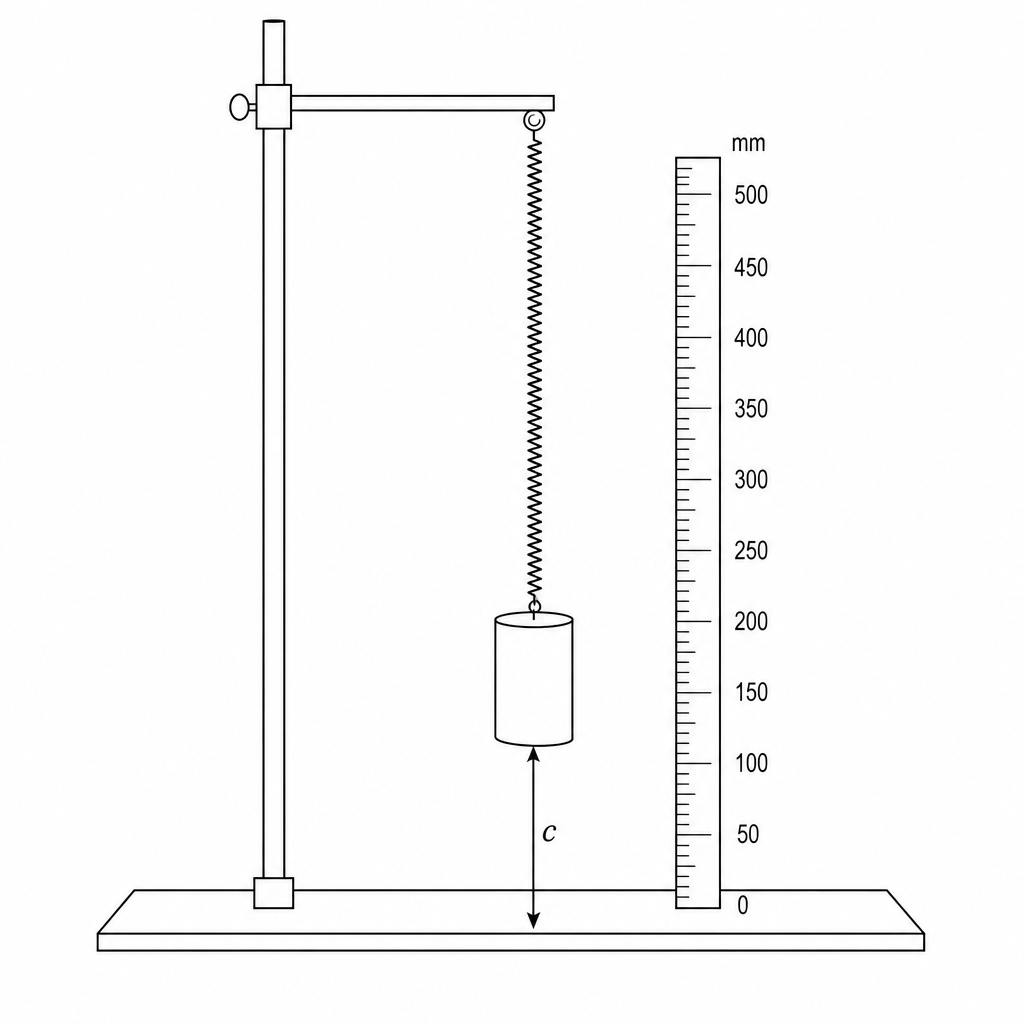
She uses a vertical millimeter ruler positioned on the landing pad to measure the vertical clearance distance, ccc, between the flat bottom of the suspended capsule and the landing pad.
Suggest two ways that the student can measure distance ccc more accurately.
The student continues her investigation by adding cargo masses inside the capsule, which increases the downward force acting on the shock cord. Her measured results are shown in the table below:
| Added Mass (g\text{g}g) | Force (N\text{N}N) | Clearance Distance ccc (cm\text{cm}cm) |
|---|---|---|
| 200 | 1.96 | 38.5 |
| 400 | 3.92 | 32.0 |
| 600 | 5.88 | 25.3 |
| 800 | 7.84 | 18.8 |
| 1000 | 9.80 | 12.2 |
| 1200 | 11.76 | 5.7 |
Name the dependent variable in this investigation.
Explain how the force values in the table are calculated from the added masses. Take g=9.8 N/kgg = 9.8\text{ N/kg}g=9.8 N/kg.
If a line of best fit is drawn for this data of ccc against force, determine the force at which the clearance distance becomes c=0 cmc = 0\text{ cm}c=0 cm.
Explain whether the elastic shock cord obeys Hooke's law in this range of forces.