

What you'll learn
- How to describe energy changes using energy stores and transfer pathways.
- How to apply conservation of energy and calculate efficiency.
- How to read and draw Sankey diagrams.
- How thermal energy transfers by conduction, convection and radiation, and how insulation reduces unwanted transfers.
Energy stores and transfer pathways
Before you describe an energy transfer, choose the system: the object or group of objects you are focusing on.
Energy store
An energy store is a way energy can be stored in a system. In this topic, the stores are: chemical, kinetic, gravitational, elastic, thermal, magnetic, electrostatic and nuclear.
Useful examples:
- chemical: food, fuels, batteries
- kinetic: moving objects
- gravitational: objects raised in a gravitational field
- elastic: stretched springs, compressed rubber
- thermal: hot objects, internal energy of particles
- magnetic: magnets and magnetic fields
- electrostatic: separated electric charges
- nuclear: atomic nuclei, the Sun, nuclear fuels
Energy moves between stores by transfer pathways.
Energy transfer pathway
An energy transfer pathway describes how energy is transferred: mechanically, electrically, by heating, or by radiation such as light and sound.
For example, energy is transferred mechanically when a force moves something, electrically when charges move in a circuit, by heating when there is a temperature difference, and by radiation when waves carry energy away.
Tracing energy in a falling ball
-
At the top, the ball has energy in its gravitational store because it is high above the ground.
-
As it falls, gravity transfers energy mechanically from the gravitational store to the ball’s kinetic store.
-
When the ball hits the floor, energy is transferred to the thermal stores of the ball, floor and air, and some is transferred away by sound. If it squashes briefly, some energy is also stored elastically for a moment.
Energy is not used up
Do not write “energy is used up”. Energy is transferred or dissipated. Dissipated means spread out into less useful stores, usually the thermal store of the surroundings.
Conservation of energy
The principle of conservation of energy says that energy cannot be created or destroyed. It can only be transferred between stores.
Energy always adds up
For a complete system, the total energy before a change equals the total energy after the change.
This is why “wasted” energy still exists. It has usually been transferred to the surroundings in a way that is not useful.
Finding missing energy
A motor receives 240 J of electrical energy. It transfers 180 J usefully to the kinetic store of a load and 30 J by sound. How much is transferred to the thermal store of the surroundings?
-
Use conservation of energy: the total output energy must equal the total input energy, so the outputs must add to 240 J.
-
Add the known outputs:
Eknown=180 J+30 J=210 JE_\text{known} = 180\ \text{J} + 30\ \text{J} = 210\ \text{J}Eknown=180 J+30 J=210 J -
Find the missing energy:
Ethermal=240 J−210 J=30 JE_\text{thermal} = 240\ \text{J} - 210\ \text{J} = 30\ \text{J}Ethermal=240 J−210 J=30 J
Efficiency
Useful energy output is the energy transferred in the way you want. Wasted energy output is energy transferred in unwanted ways.
Efficiency
Efficiency tells you what percentage of the total energy output is useful.
The Edexcel equation is:
efficiency = useful energy output ÷ total energy output × 100%
efficiency=useful energy outputtotal energy output×100%\text{efficiency} = \frac{\text{useful energy output}}{\text{total energy output}} \times 100\%efficiency=total energy outputuseful energy output×100%Rearrangements:
useful energy output=efficiency100%×total energy outputtotal energy output=useful energy output×100%efficiency\begin{aligned} \text{useful energy output} &= \frac{\text{efficiency}}{100\%} \times \text{total energy output} \\ \text{total energy output} &= \frac{\text{useful energy output} \times 100\%}{\text{efficiency}} \end{aligned}useful energy outputtotal energy output=100%efficiency×total energy output=efficiencyuseful energy output×100%In practice, the total energy output is the useful output plus all wasted outputs. By conservation of energy, it is equal to the total input energy for the device.
Calculating efficiency
An electric kettle transfers 200 kJ of energy in total. 180 kJ is usefully transferred to the thermal store of the water. Calculate the efficiency.
-
Identify the useful and total energy outputs:
Euseful=180 kJE_\text{useful} = 180\ \text{kJ}Euseful=180 kJ Etotal=200 kJE_\text{total} = 200\ \text{kJ}Etotal=200 kJ -
Substitute into the efficiency equation:
efficiency=180 kJ200 kJ×100%=90%\text{efficiency} = \frac{180\ \text{kJ}}{200\ \text{kJ}} \times 100\% = 90\%efficiency=200 kJ180 kJ×100%=90% -
Interpret the answer: 90% of the transferred energy is useful, so 10% is wasted. The wasted energy is:
Ewasted=200 kJ−180 kJ=20 kJE_\text{wasted} = 200\ \text{kJ} - 180\ \text{kJ} = 20\ \text{kJ}Ewasted=200 kJ−180 kJ=20 kJ
Forgetting the percentage
If your calculator gives 0.72, the efficiency is 72%, not 0.72%. The multiplication by 100% matters.
Sankey diagrams
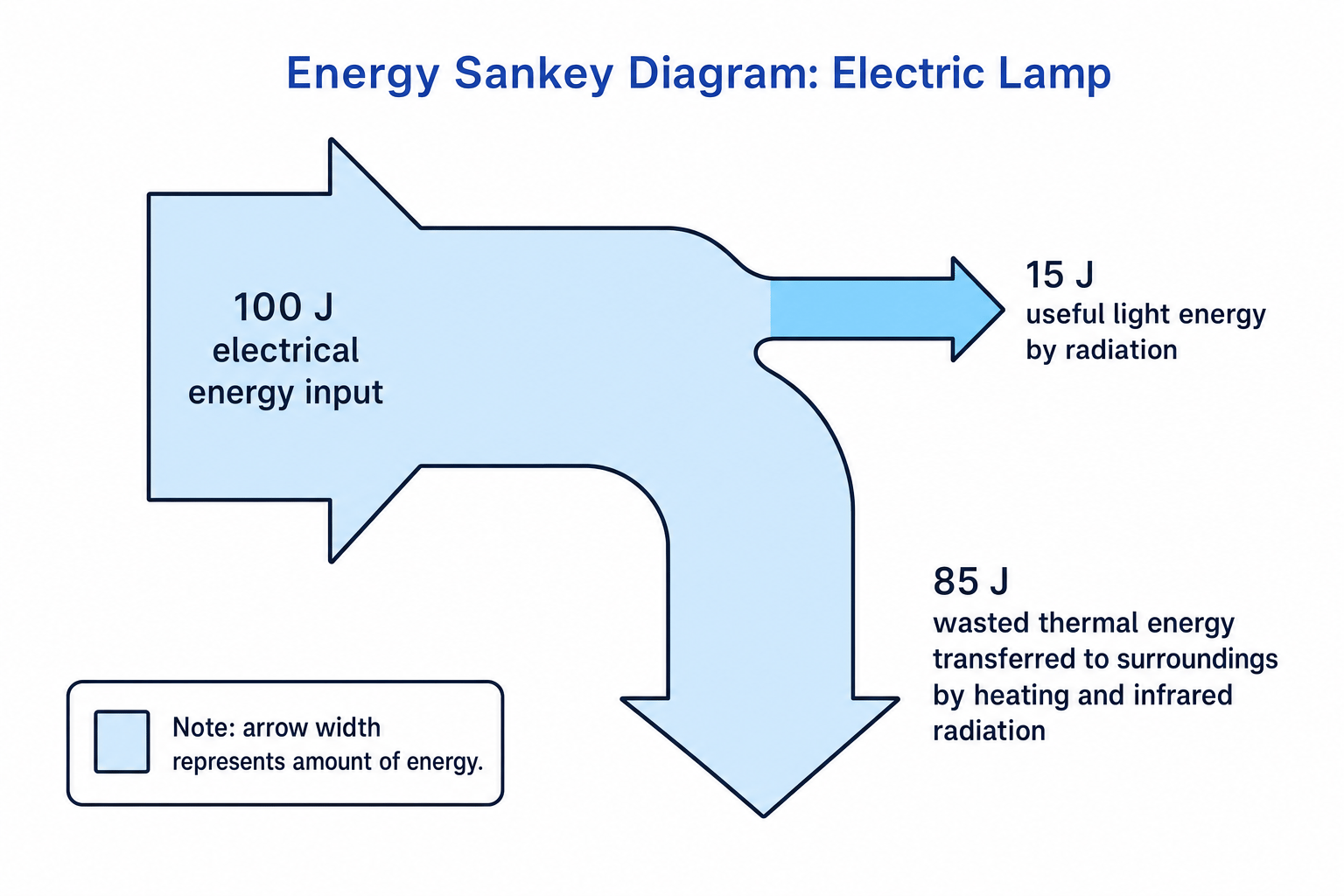
A Sankey diagram shows energy transfers using arrows. The width of each arrow represents the amount of energy transferred.
Usually:
- the input arrow enters from the left
- useful output continues forwards
- wasted outputs branch off, often downwards
- all output arrows should add up to the total input
Everyday and scientific examples include:
- lamp: electrical transfer in; useful light by radiation; wasted thermal energy by heating
- kettle: electrical transfer in; useful heating of water; wasted heating of kettle and surroundings
- electric motor: electrical transfer in; useful kinetic energy; wasted sound and heating
- nuclear power station: nuclear store of fuel decreases; energy is transferred by heating, then mechanically in turbines, then electrically to the grid
Checking a Sankey diagram
The total width of the output arrows should match the input arrow. If the numbers are given, useful energy plus wasted energy should equal the total.
Thermal energy transfer
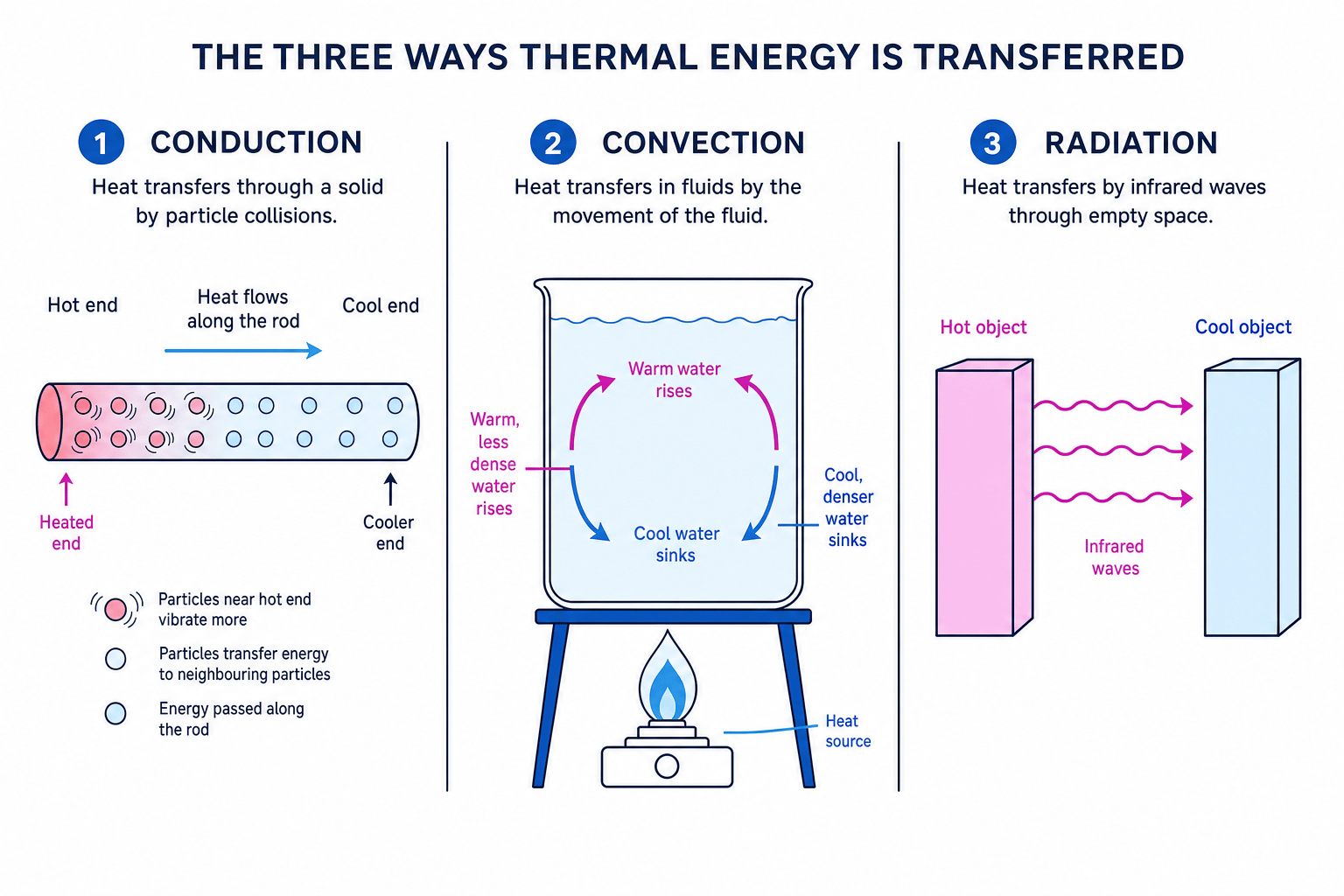
Thermal energy transfer happens when energy moves from a hotter object or region to a cooler one because of a temperature difference.
There are three ways: conduction, convection and radiation.
Conduction
Conduction is thermal energy transfer through a material without the material as a whole moving.
In solids, particles vibrate about fixed positions. When one end is heated, particles there vibrate more and transfer energy to neighbouring particles. Metals are especially good conductors because they also contain mobile electrons that transfer energy quickly.
Convection
Convection is thermal energy transfer by the movement of a fluid. A fluid is a liquid or a gas.
When a fluid is heated, it expands and becomes less dense. The warmer, less dense fluid rises. Cooler, denser fluid sinks to replace it, forming a convection current.
Explaining convection in a room
-
Air next to a radiator is heated, so its particles move faster and spread further apart. The warm air becomes less dense.
-
The less dense warm air rises. Cooler, denser air moves down to replace it.
-
This circulation forms a convection current, transferring thermal energy around the room.
Everyday convection examples include radiators warming rooms, water circulating in a kettle or saucepan, and sea breezes caused by warm air rising over land.
Radiation
Thermal radiation is energy transferred by infrared waves. It does not need particles, so it can travel through a vacuum.
All objects emit and absorb infrared radiation. The hotter an object is, the more infrared radiation it emits per second.
Emission and absorption of radiation
Surface type matters:
- black, dull or matt surfaces are good absorbers and good emitters of infrared radiation
- white, light, shiny or silver surfaces are poor absorbers and poor emitters, but good reflectors
Temperature also matters. A hotter object emits radiation faster than a cooler object. The net transfer is from the hotter object to the cooler surroundings.
Choosing a surface for a solar water heater
-
A solar water heater should absorb as much radiation from the Sun as possible.
-
A black, matt surface is best because it absorbs more radiation and reflects less.
-
If you wanted to reduce radiation loss instead, a shiny silver surface would be better because it is a poor emitter of infrared radiation.
Black surfaces can also lose energy faster
A black surface is a good absorber, but it is also a good emitter. Whether it gains or loses energy depends on its temperature compared with its surroundings.
Practical: investigating thermal energy transfer
For named practicals, written questions often ask about apparatus, variables, graphs and errors.
The independent variable is what you change. The dependent variable is what you measure. Control variables are kept the same to make the test fair.
Investigating conduction
Use rods of different materials, such as copper, aluminium and glass. Attach drawing pins to each rod using small blobs of wax at equal distances from the heated end, then heat one end of each rod.
The better the conductor, the faster thermal energy travels along the rod, so the wax melts sooner and the pins fall off sooner.
Key variables:
- independent variable: material of the rod
- dependent variable: time for wax to melt, or temperature change along the rod
- control variables: rod length, rod diameter, starting temperature, heating power, wax amount, distance of pins from the heat source
Graph ideas:
- temperature against time for each material
- distance reached by melted wax against time
A steeper temperature rise means faster thermal energy transfer.
Investigating convection
Use a beaker of water with a small crystal of potassium manganate(VII) or a drop of dye near the bottom. Heat the water gently from one side underneath.
The coloured water rises above the heated region, then spreads and sinks as it cools, showing a convection current.
To collect numerical data, place temperature probes near the top and bottom of the beaker and record temperature against time.
Key variables:
- independent variable: heating position or time
- dependent variable: dye movement or temperature at different positions
- control variables: water volume, starting temperature, beaker size, heating power
Investigating radiation
One method is to use two identical metal cans: one black and one shiny silver. Put the same volume of hot water at the same starting temperature in each can, then record temperature every minute.
Key variables:
- independent variable: surface type
- dependent variable: temperature decrease or rate of cooling
- control variables: water volume, starting temperature, room temperature, can size, lids, thermometer position
Graph temperature against time. The can with the steeper cooling curve loses thermal energy faster by radiation.
Unfair radiation tests
If the cans start at different temperatures or contain different volumes of water, you cannot fairly compare their cooling rates.
Reducing unwanted energy transfer
Insulation
Insulation means using materials or arrangements to reduce unwanted thermal energy transfer.
Different insulation methods target different transfer pathways:
- reduce conduction using poor conductors, such as plastic, foam, fibreglass or trapped air
- reduce convection by stopping fluids moving, such as using lids, draught excluders or cavity wall insulation
- reduce radiation using shiny silver surfaces, such as foil behind radiators or silvered vacuum flask walls
A vacuum flask uses several ideas at once: a vacuum reduces conduction and convection, silvered surfaces reduce radiation, and a plastic stopper reduces conduction and convection through the top.
Choosing insulation for a hot water tank
-
The unwanted transfer is from the hot water to the cooler surroundings.
-
Foam around the tank reduces conduction because foam contains trapped air, which is a poor conductor.
-
The trapped air also reduces convection because the air cannot circulate easily. A shiny outer layer can reduce energy loss by infrared radiation.
In the exam
-
Describe transfers using store + pathway + store, not vague phrases like “energy goes into motion”.
-
For efficiency, identify the useful energy first, then divide by the total energy and multiply by 100%.
-
For thermal questions, name the process and explain the particle or wave idea: vibrating particles for conduction, moving fluid for convection, infrared waves for radiation.
Check yourself
- Can you describe the energy transfers in a battery-powered torch using stores and pathways?
- Why does a shiny silver surface reduce heat loss by radiation?
- In a cooling practical, which variables must be kept the same to compare two surfaces fairly?
