

What you'll learn
- What a unit is, and why physics answers need one.
- How to use the Edexcel 4PH1 units: kg, J, m, m/s, m/s², N, s and W.
- How “derived units” like m/s, N, J and W are built from simpler units.
- How to keep units correct in calculations.
Why units matter
A number on its own is usually not a complete physics answer. If you write “12”, it could mean 12 m, 12 s, 12 J, 12 W, or many other things. The unit tells the examiner what physical quantity you have measured or calculated.
Unit
A unit is an agreed standard used to measure a physical quantity. A physical quantity is something measurable, such as mass, time, distance, force, energy or power.
For Edexcel IGCSE Physics, you should be confident using the correct unit symbol and writing it after your numerical answer, for example 5 kg, 20 J or 8 m/s.
Number plus unit
In physics, a full measurement is normally a value and a unit. The value tells you “how much”; the unit tells you “of what”.
Quantity symbols and unit symbols
Physics uses letters in two different ways:
- A quantity symbol is the letter used in an equation, such as mmm for mass or PPP for power.
- A unit symbol is the abbreviation written after the number, such as kg for kilogram or W for watt.
For example, in m=2.0 kgm = 2.0\,\text{kg}m=2.0kg, the italic mmm is the quantity symbol for mass, while kg is the unit symbol.
Capital letters matter
Use kg, m and s in lower case. Use N, J and W with capitals because their unit symbols are named after Newton, Joule and Watt.
The units in specification point 4.1
You need to be able to use these units accurately:
| Physical quantity | Unit name | Unit symbol | What it measures |
|---|---|---|---|
| Mass | kilogram | kg | Amount of matter / inertia of an object |
| Energy or work done | joule | J | Energy stored or transferred |
| Distance or length | metre | m | Length, height, distance moved |
| Speed or velocity | metre per second | m/s | Distance travelled each second |
| Acceleration | metre per second squared | m/s² | Change in velocity each second |
| Force | newton | N | Pushes, pulls and weight |
| Time | second | s | Time intervals |
| Power | watt | W | Energy transferred each second |
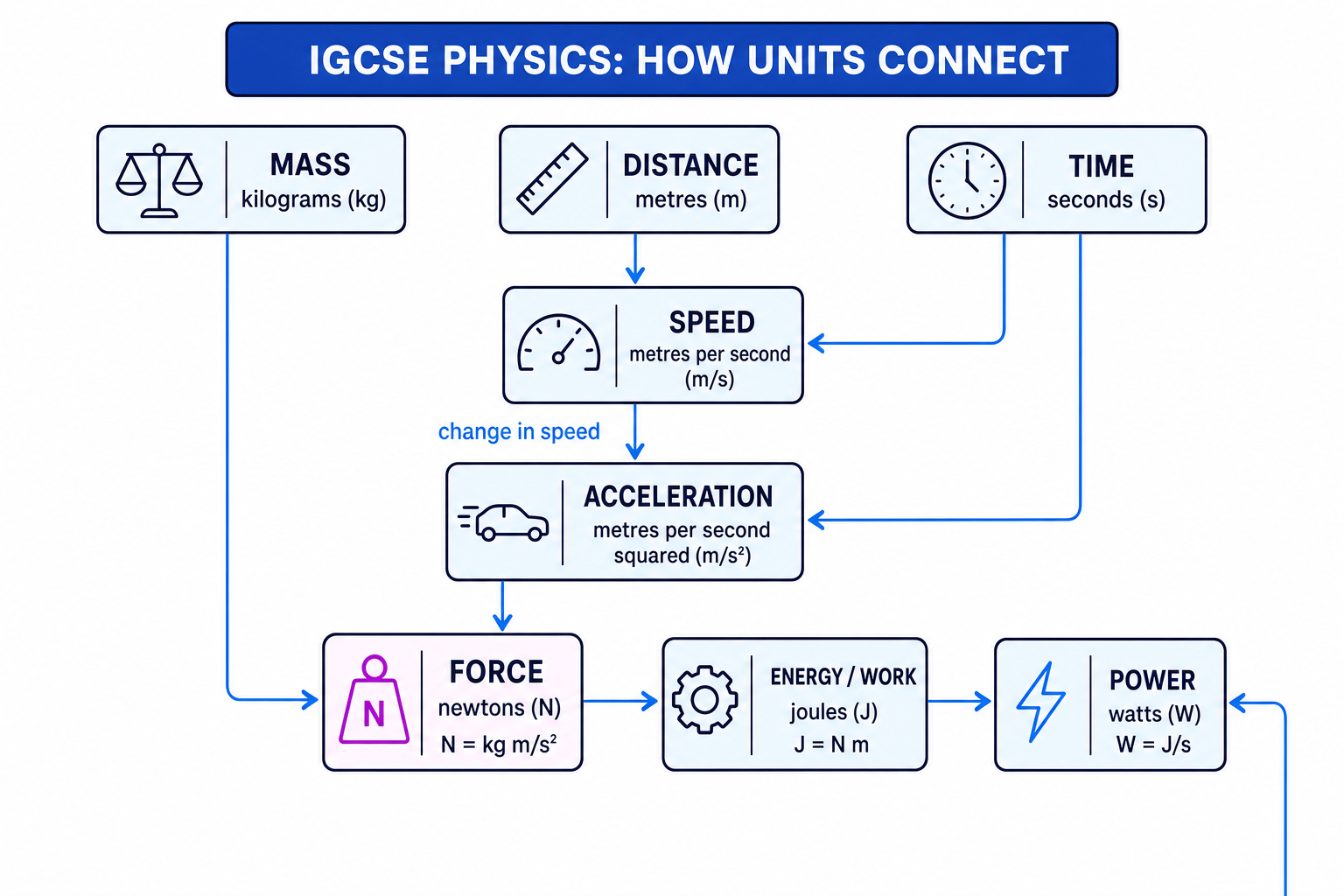
Some of these are simpler units, such as kg, m and s. Others are derived units, meaning they are made by combining other units through equations.
Derived unit
A derived unit is made from other units. For example, m/s is made from metres divided by seconds, because speed depends on distance and time.
The diagram shows how the units connect through common IGCSE physics equations.
The base-style units: kg, m and s
Kilogram, kg
The kilogram is the SI unit of mass. Mass is a measure of how much matter an object contains, and also how difficult it is to change its motion.
In calculations, mass should usually be in kg. If you are given grams, convert first: 1000 g = 1 kg.
Metre, m
The metre is the SI unit of distance and length. In mechanics and energy questions, distances such as height, extension and distance moved are usually measured in m.
If you are given kilometres, convert first: 1 km = 1000 m.
Second, s
The second is the SI unit of time. In calculations, time is usually measured in s, not minutes or hours.
If you are given minutes, convert first: 1 min = 60 s.
Convert before calculating
If an equation is meant to give SI units, convert to kg, m and s before substituting numbers. This makes the final unit much more likely to come out correctly.
Speed: metres per second, m/s
Speed tells you how quickly distance is covered. The unit m/s means “metres per second”: how many metres are travelled in each second.
The equation is:
average speed = distance moved ÷ time taken, v=stv = \frac{s}{t}v=ts
where:
- vvv is average speed in m/s
- sss is distance moved in m
- ttt is time taken in s
Calculating speed in m/s
A runner travels 0.30 km in 1.5 min. Calculate the average speed in m/s.
-
Convert the distance and time into SI units: 0.30×1000=300 m0.30 \times 1000 = 300\,\text{m}0.30×1000=300m and 1.5×60=90 s1.5 \times 60 = 90\,\text{s}1.5×60=90s.
-
Use average speed = distance moved ÷ time taken, so v=stv = \frac{s}{t}v=ts.
-
Substitute the values with units: v=300 m90 s=3.3 m/sv = \frac{300\,\text{m}}{90\,\text{s}} = 3.3\,\text{m/s}v=90s300m=3.3m/s.
Read per as divided by
The word per means “for each” or “divided by”. So m/s means metres divided by seconds.
Acceleration: metres per second squared, m/s²
Acceleration is the rate of change of velocity. In other words, it tells you how quickly velocity changes.
The unit m/s² can be read as “metres per second per second”. If an object has an acceleration of 2 m/s², its velocity changes by 2 m/s every second.
The equation is:
acceleration = change in velocity ÷ time taken, a=v−uta = \frac{v - u}{t}a=tv−u
where:
- aaa is acceleration in m/s²
- vvv is final velocity in m/s
- uuu is initial velocity in m/s
- ttt is time taken in s
Calculating acceleration
A car increases its velocity from 6.0 m/s to 18 m/s in 4.0 s. Calculate its acceleration.
-
Find the change in velocity: v−u=18 m/s−6.0 m/s=12 m/sv - u = 18\,\text{m/s} - 6.0\,\text{m/s} = 12\,\text{m/s}v−u=18m/s−6.0m/s=12m/s.
-
Use acceleration = change in velocity ÷ time taken, so a=v−uta = \frac{v - u}{t}a=tv−u.
-
Substitute and calculate: a=12 m/s4.0 s=3.0 m/s2a = \frac{12\,\text{m/s}}{4.0\,\text{s}} = 3.0\,\text{m/s}^2a=4.0s12m/s=3.0m/s2.
m/s² is not m/s multiplied by 2
The ² means the seconds are squared in the denominator. m/s² means “metres per second per second”, not “metres per second times 2”.
Force: newtons, N
A force is a push or pull. Forces can change an object’s speed, direction of motion or shape. The SI unit of force is the newton, N.
The equation is:
force = mass × acceleration, F=m×aF = m \times aF=m×a
where:
- FFF is force in N
- mmm is mass in kg
- aaa is acceleration in m/s²
This means 1 N is the force needed to give a mass of 1 kg an acceleration of 1 m/s².
Energy and work done: joules, J
Energy is measured in joules, J. Energy can be stored or transferred.
Work done is a way of transferring energy when a force moves an object through a distance. One useful unit link is:
1 J = 1 N m
So if a force of 1 N moves an object 1 m in the direction of the force, 1 J of energy is transferred.
Power: watts, W
Power is the rate of energy transfer. A more powerful device transfers energy more quickly.
The equation is:
power = energy transferred ÷ time taken, P=EtP = \frac{E}{t}P=tE
where:
- PPP is power in W
- EEE is energy transferred in J
- ttt is time taken in s
A watt means one joule per second:
1 W = 1 J/s
J and W are different quantities
A joule, J, measures an amount of energy. A watt, W, measures how quickly energy is transferred. A 100 W lamp transfers 100 J of energy every second, not 100 J in total.
Linking newtons, joules and watts
A 2.0 kg trolley accelerates at 1.5 m/s². The force moves it 8.0 m, and the energy transfer takes 4.0 s. Find the force, energy transferred and average power.
-
Use force = mass × acceleration: F=m×a=2.0 kg×1.5 m/s2=3.0 NF = m \times a = 2.0\,\text{kg} \times 1.5\,\text{m/s}^2 = 3.0\,\text{N}F=m×a=2.0kg×1.5m/s2=3.0N.
-
Energy transferred by work done is force multiplied by distance moved in the direction of the force: E=F×d=3.0 N×8.0 m=24 JE = F \times d = 3.0\,\text{N} \times 8.0\,\text{m} = 24\,\text{J}E=F×d=3.0N×8.0m=24J.
-
Use power = energy transferred ÷ time taken: P=Et=24 J4.0 s=6.0 WP = \frac{E}{t} = \frac{24\,\text{J}}{4.0\,\text{s}} = 6.0\,\text{W}P=tE=4.0s24J=6.0W.
Unit checks: a quick way to spot errors
Units often tell you whether your method makes sense.
If you divide distance in m by time in s, your answer must be in m/s. If you divide energy in J by time in s, your answer must be in W. If you multiply mass in kg by acceleration in m/s², your answer must be in N.
Equations create units
The unit of your answer comes from the operation in the equation. Dividing by time often gives a “per second” unit, while multiplying force by distance gives energy in joules.
In the exam
-
Write a unit with every numerical answer unless the question clearly asks for a ratio or percentage.
-
Convert to kg, m and s before substituting into equations, especially if the question gives g, km, minutes or hours.
-
Use the unit as a check: distance divided by time gives m/s, energy divided by time gives W, and mass multiplied by acceleration gives N.
Check yourself
- Which unit would you use for mass, force, energy and power?
- A velocity changes by 12 m/s in 3 s. What unit should the acceleration have?
- Why is 200 W not the same type of quantity as 200 J?
