

What you'll learn
- What work done means in physics, and why it is an energy transfer.
- How to calculate work done, gravitational potential energy, kinetic energy and power.
- How conservation of energy links falling, lifting and moving objects.
- How to keep units straight in calculation questions.
The starting point: forces transfer energy
A force is a push or pull on an object, measured in newtons (N). If a force makes an object move, energy is transferred.
For example, if you push a box along the floor, chemical energy from your muscles is transferred. Some becomes kinetic energy of the box, and some is transferred to thermal energy because of friction.
Work done
In physics, work done has a specific meaning. It is not just “effort”; it is an energy transfer caused by a force moving something.
Work done
Work done is the energy transferred when a force causes an object to move through a distance in the direction of the force.
The required relationship is:
work done = force × distance moved
W=F×dW = F \times dW=F×d
where:
- WWW is work done, in joules (J)
- FFF is force, in newtons (N)
- ddd is distance moved in the direction of the force, in metres (m)
Because work done is energy transferred, both are measured in joules. One joule is the work done when a force of 1 N moves an object 1 m in the direction of the force.
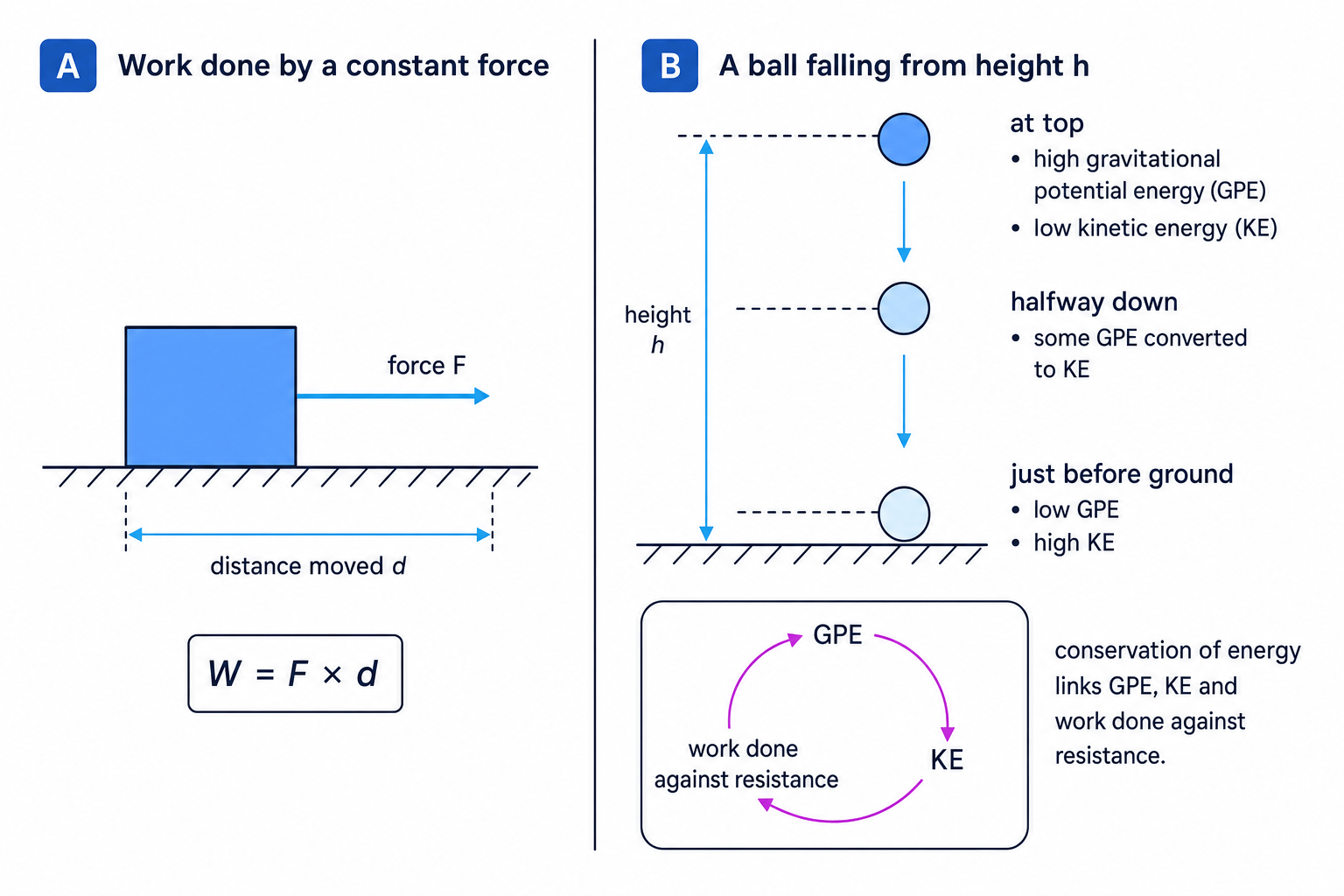
The diagram shows the key idea: only the distance moved in the direction of the force counts.
Work is energy transfer
Whenever work is done, energy is transferred. So a value of 200 J of work done means 200 J of energy has been transferred.
Useful rearrangements:
d=WFd = \frac{W}{F}d=FW F=WdF = \frac{W}{d}F=dWCalculating work done
A student pushes a box with a force of 80 N. The box moves 5.0 m in the direction of the force. Calculate the work done.
-
Use the work done relationship because a force moves an object through a distance:
W=F×dW = F \times dW=F×d -
Substitute the values with units:
W=80 N×5.0 mW = 80\ \text{N} \times 5.0\ \text{m}W=80 N×5.0 m -
Calculate the energy transferred:
W=400 JW = 400\ \text{J}W=400 J
Direction matters
Do not automatically use the total distance travelled. Use the distance moved in the direction of the force. If a force does not cause movement in its direction, that force does no work.
Gravitational potential energy
When an object is lifted, energy is transferred to its gravitational potential energy.
Gravitational potential energy
Gravitational potential energy, or GPE, is energy stored by an object because of its position in a gravitational field.
Gravitational field strength, ggg, is the force per kilogram on a mass in a gravitational field. Near Earth, IGCSE questions commonly use 10 N/kg unless another value is given.
Height, hhh, means vertical height above a chosen reference level, measured in metres.
The required relationship is:
gravitational potential energy = mass × gravitational field strength × height
GPE=m×g×hGPE = m \times g \times hGPE=m×g×h
where:
- GPEGPEGPE is gravitational potential energy, in joules (J)
- mmm is mass, in kilograms (kg)
- ggg is gravitational field strength, in newtons per kilogram (N/kg)
- hhh is height, in metres (m)
Useful rearrangement for height:
h=GPEm×gh = \frac{GPE}{m \times g}h=m×gGPECalculating gravitational potential energy
A 15 kg suitcase is lifted onto a shelf 2.0 m above the floor. Take g=10 N/kgg = 10\ \text{N/kg}g=10 N/kg. Calculate the gain in gravitational potential energy.
-
Choose the GPE equation because the object is lifted vertically:
GPE=m×g×hGPE = m \times g \times hGPE=m×g×h -
Substitute the values with units:
GPE=15 kg×10 N/kg×2.0 mGPE = 15\ \text{kg} \times 10\ \text{N/kg} \times 2.0\ \text{m}GPE=15 kg×10 N/kg×2.0 m -
Calculate the energy gained:
GPE=300 JGPE = 300\ \text{J}GPE=300 J
Height is vertical
For GPE, use the vertical height gained, not the length of a ramp or slope.
Kinetic energy
An object that is moving has kinetic energy.
Kinetic energy
Kinetic energy, or KE, is the energy an object has because it is moving.
Speed, vvv, means how fast an object is moving, measured in metres per second (m/s).
The required relationship is:
kinetic energy = 1/2 × mass × speed²
KE=12×m×v2KE = \frac{1}{2} \times m \times v^2KE=21×m×v2
where:
- KEKEKE is kinetic energy, in joules (J)
- mmm is mass, in kilograms (kg)
- vvv is speed, in metres per second (m/s)
Useful rearrangements:
m=2KEv2m = \frac{2KE}{v^2}m=v22KE v=2KEmv = \sqrt{\frac{2KE}{m}}v=m2KESpeed is squared
Kinetic energy depends on speed squared. If speed doubles, kinetic energy becomes four times larger.
Calculating kinetic energy
A cyclist and bicycle have a total mass of 70 kg and travel at 6.0 m/s. Calculate their kinetic energy.
-
Choose the kinetic energy equation because the object is moving:
KE=12×m×v2KE = \frac{1}{2} \times m \times v^2KE=21×m×v2 -
Square the speed first:
v2=(6.0 m/s)2=36 m2/s2v^2 = \left(6.0\ \text{m/s}\right)^2 = 36\ \text{m}^2\text{/s}^2v2=(6.0 m/s)2=36 m2/s2 -
Substitute and calculate:
KE=12×70 kg×36 m2/s2=1260 JKE = \frac{1}{2} \times 70\ \text{kg} \times 36\ \text{m}^2\text{/s}^2 = 1260\ \text{J}KE=21×70 kg×36 m2/s2=1260 J
Forgetting to square the speed
In KE=12×m×v2KE = \frac{1}{2} \times m \times v^2KE=21×m×v2, only the speed is squared. The mass is not squared.
Conservation of energy: linking GPE, KE and work
Conservation of energy
Conservation of energy means energy cannot be created or destroyed; it can only be transferred usefully, stored, or dissipated to the surroundings.
When an object falls, gravitational potential energy decreases and kinetic energy increases. If there is no air resistance, the loss of GPE equals the gain in KE.
If there are resistive forces, such as friction or air resistance, some energy is transferred to thermal energy of the surroundings. Work is done against these resistive forces.
So, in real situations:
- energy lost from GPE can become KE
- some energy may be transferred by work done against friction or air resistance
- the total energy is still conserved
Finding work done against friction
A 50 kg child slides down from a height of 4.0 m. At the bottom, the child has 1600 J of kinetic energy. Take g=10 N/kgg = 10\ \text{N/kg}g=10 N/kg. Calculate the work done against friction.
-
Calculate the gravitational potential energy lost:
GPE=m×g×h=50 kg×10 N/kg×4.0 m=2000 JGPE = m \times g \times h = 50\ \text{kg} \times 10\ \text{N/kg} \times 4.0\ \text{m} = 2000\ \text{J}GPE=m×g×h=50 kg×10 N/kg×4.0 m=2000 J -
Apply conservation of energy: the lost GPE becomes kinetic energy plus energy transferred by work done against friction.
2000 J=1600 J+work done against friction2000\ \text{J} = 1600\ \text{J} + \text{work done against friction}2000 J=1600 J+work done against friction -
Find the work done against friction:
work done against friction=2000 J−1600 J=400 J\text{work done against friction} = 2000\ \text{J} - 1600\ \text{J} = 400\ \text{J}work done against friction=2000 J−1600 J=400 J
Power
Power tells you how quickly energy is transferred.
Power
Power is the rate of transfer of energy or the rate of doing work. “Rate” means “per second”.
The unit of power is the watt (W). One watt means one joule of energy transferred every second. One kilowatt is 1000 W.
The required relationship is:
power = work done / time taken
P=WtP = \frac{W}{t}P=tW
where:
- PPP is power, in watts (W)
- WWW is work done, in joules (J)
- ttt is time taken, in seconds (s)
Because work done is equal to energy transferred, this equation can also describe how quickly energy is transferred.
Useful rearrangements:
W=P×tW = P \times tW=P×t t=WPt = \frac{W}{P}t=PWCalculating power
A motor does 12 kJ of work in 30 s. Calculate its power in watts and kilowatts.
-
Convert the work done into joules:
12 kJ = 12000 J -
Use the power equation and substitute:
P=Wt=12000 J30 sP = \frac{W}{t} = \frac{12000\ \text{J}}{30\ \text{s}}P=tW=30 s12000 J -
Calculate the power:
P=400 WP = 400\ \text{W}P=400 W -
Convert to kilowatts:
400 W = 0.40 kW
W can mean two things
An italic WWW in an equation usually means work done. A plain W after a number means the unit watt. For example, W=500 JW = 500\ \text{J}W=500 J but power = 500 W.
The big picture
Work, energy and power are closely connected:
- Work done is energy transferred by a force.
- Lifting an object transfers energy to gravitational potential energy.
- Moving objects have kinetic energy.
- Energy can shift between GPE and KE, but the total is conserved.
- Power tells you how fast the work is done or energy is transferred.
In the exam
- Write the equation first, then substitute values with units before calculating.
- Check units carefully: mass in kg, distance or height in m, time in s, energy in J, and power in W.
- For energy conservation questions, decide where the energy starts, where it ends, and whether any work is done against friction or air resistance.
Check yourself
- Why is work done measured in joules rather than newtons?
- A ball falls without air resistance. What happens to its GPE and KE?
- What does a higher power rating tell you about the rate of energy transfer?
