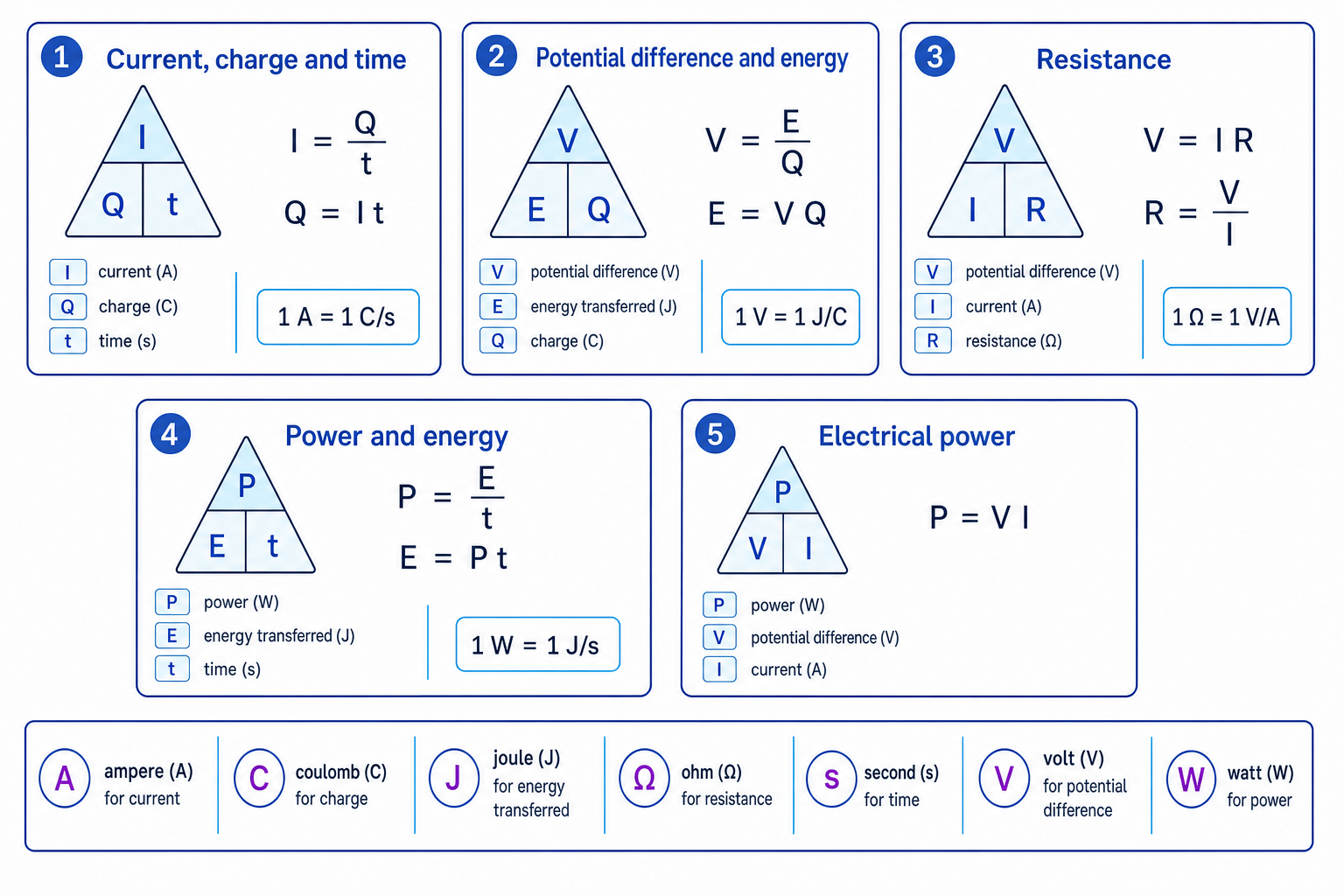
What you'll learn
- The seven electricity units in spec point 2.1: ampere (A), coulomb (C), joule (J), ohm (Ω), second (s), volt (V) and watt (W).
- What physical quantity each unit measures.
- How units connect to the main electricity equations you will use later.
- How to avoid common unit mix-ups in calculations.
Why units matter
In physics, a number on its own is not enough. If you write “6”, that could mean 6 A, 6 V, 6 C, 6 J, or something else entirely.
A unit tells you what kind of measurement the number represents.
Unit
A unit is a standard amount used to measure a physical quantity. For example, the ampere is the unit of current, and the second is the unit of time.
A number is not enough
Always write the unit with your answer. In electricity, using the wrong unit can change the meaning completely: 12 V is a voltage, 12 A is a current, and 12 C is a charge.
Quantities, symbols and units
A physical quantity is something that can be measured, such as time, current or energy.
A quantity symbol is the letter used in equations. For example, current is usually represented by III.
A unit symbol is the shortened form of the unit. For example, ampere is written as A.
Symbols can look similar
The letter VVV is used as the quantity symbol for potential difference, and V is also the unit symbol for volts. In equations, VVV means the quantity; after a number, V means the unit.
The seven electricity units
For Edexcel IGCSE Physics, you need to use these units confidently:
- ampere (A) — unit of electric current, symbol III
- coulomb (C) — unit of electric charge, symbol QQQ
- joule (J) — unit of energy transferred, symbol EEE
- ohm (Ω) — unit of resistance, symbol RRR
- second (s) — unit of time, symbol ttt
- volt (V) — unit of potential difference, also called voltage, symbol VVV
- watt (W) — unit of power, symbol PPP
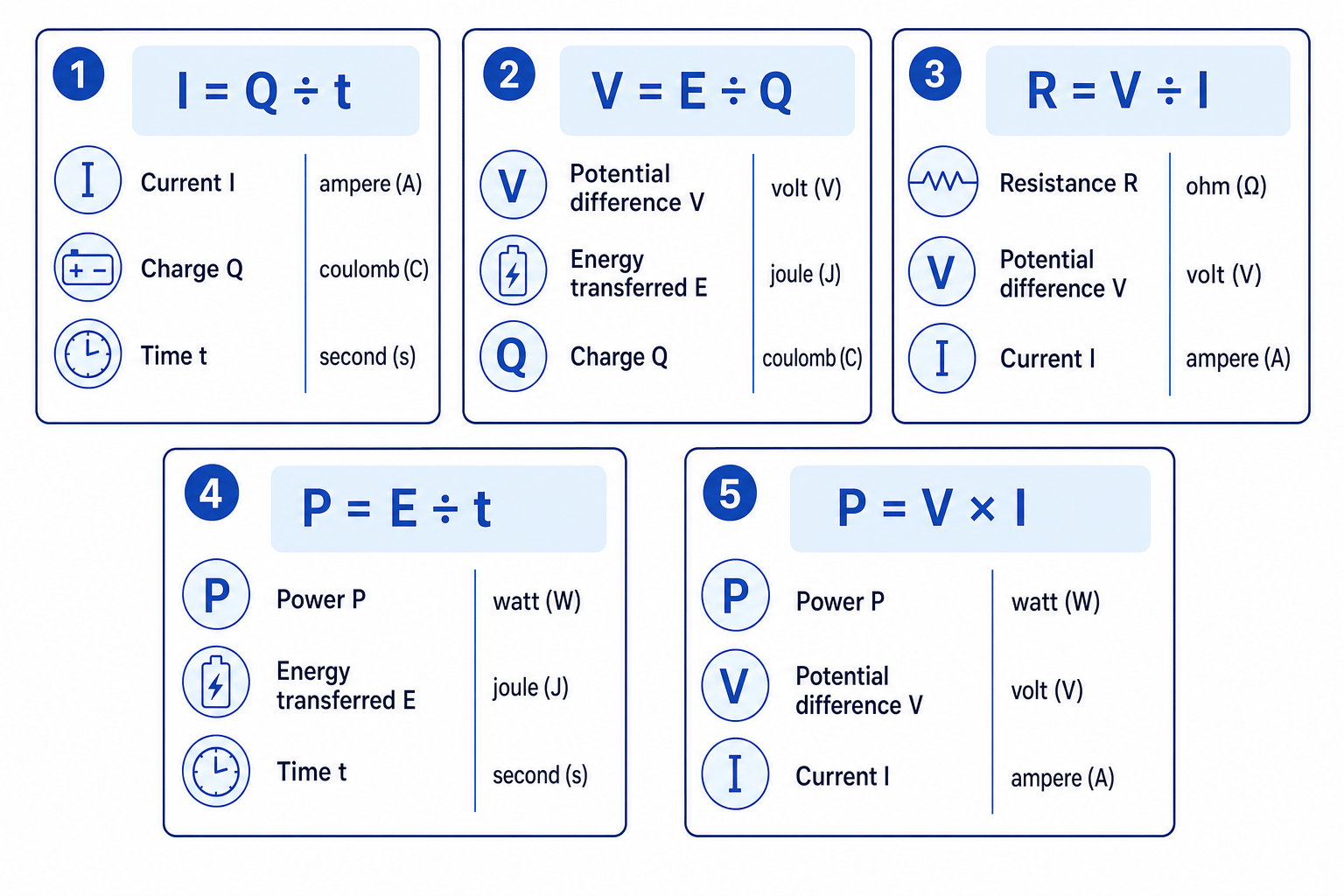
Here is a unit map showing how the units connect to the common electricity relationships you will meet.
Unit symbols are case-sensitive
Write A, C, J, V and W as capital letters, but write second as lower-case s. The ohm uses the Greek capital omega, Ω. Do not add a plural “s” to unit symbols: write 5 A, not 5 As.
Ampere and coulomb: current and charge
Coulomb (C)
Electric charge is a property of particles. In circuits, we often talk about the amount of charge that flows past a point.
The unit of charge is the coulomb (C).
Ampere (A)
Electric current is the rate of flow of charge. In other words, it tells you how much charge passes a point each second.
The unit of current is the ampere (A).
A current of 1 A means 1 C of charge flows past a point every second.
The equation is:
current = charge ÷ time
I=QtI = \frac{Q}{t}I=tQwhere III is current in A, QQQ is charge in C, and ttt is time in s.
Rearranging gives:
Q=I×tQ = I \times tQ=I×tCalculating charge from current and time
A lamp has a current of 0.50 A for 120 s. Calculate the charge that flows through it.
-
Use the equation I=QtI = \frac{Q}{t}I=tQ, then rearrange it to make charge the subject: Q=I×tQ = I \times tQ=I×t.
-
Substitute the values with units: Q=0.50 A×120 sQ = 0.50\ \text{A} \times 120\ \text{s}Q=0.50 A×120 s.
-
Calculate and give the correct unit: Q=60 CQ = 60\ \text{C}Q=60 C.
C is not the unit of current
C stands for coulomb, the unit of charge. Current is measured in amperes, A.
Second: the unit of time
The second (s) is the SI unit of time. SI means the International System of Units, the standard unit system used in science.
In electricity calculations, time should usually be in seconds unless the question clearly says otherwise.
For example:
- 1 minute = 60 s
- 2 minutes = 120 s
- 0.5 minutes = 30 s
Forgetting to convert minutes
If a question gives time in minutes, convert to seconds before using equations like I=QtI = \frac{Q}{t}I=tQ or E=P×tE = P \times tE=P×t.
Joule and volt: energy transferred per charge
Joule (J)
Energy transferred is the energy moved from one store to another. In circuits, electrical energy may be transferred to thermal energy, light, sound or kinetic energy.
The unit of energy transferred is the joule (J).
Volt (V)
Potential difference, often called voltage, tells you how much energy is transferred per coulomb of charge.
The unit of potential difference is the volt (V).
A potential difference of 1 V means 1 J of energy is transferred for each coulomb of charge.
The equation is:
potential difference = energy transferred ÷ charge
V=EQV = \frac{E}{Q}V=QEwhere VVV is potential difference in V, EEE is energy transferred in J, and QQQ is charge in C.
Rearranging gives:
E=V×QE = V \times QE=V×QUsing volts as joules per coulomb
A 12 V battery transfers energy to 5.0 C of charge. Calculate the energy transferred.
-
Use the equation V=EQV = \frac{E}{Q}V=QE, then rearrange it to make energy the subject: E=V×QE = V \times QE=V×Q.
-
Substitute the values with units: E=12 V×5.0 CE = 12\ \text{V} \times 5.0\ \text{C}E=12 V×5.0 C.
-
Since a volt means joules per coulomb, the coulombs cancel in the unit meaning: E=60 JE = 60\ \text{J}E=60 J.
Ohm: the unit of resistance
Resistance is a measure of how much a component opposes the flow of current.
The unit of resistance is the ohm (Ω).
The important relationship is:
voltage = current × resistance
V=I×RV = I \times RV=I×RRearranging to find resistance:
R=VIR = \frac{V}{I}R=IVSo, one ohm means one volt per ampere.
Calculating resistance
A resistor has a potential difference of 6.0 V across it and a current of 0.20 A through it. Calculate its resistance.
-
Use the equation V=I×RV = I \times RV=I×R, then rearrange it: R=VIR = \frac{V}{I}R=IV.
-
Substitute the values with units: R=6.0 V0.20 AR = \frac{6.0\ \text{V}}{0.20\ \text{A}}R=0.20 A6.0 V.
-
Calculate the resistance: R=30 ΩR = 30\ \OmegaR=30 Ω.
Ohm symbol confusion
The ohm symbol Ω is not the letter W. W is the unit watt, used for power.
Watt: the unit of power
Power is the rate of energy transfer. It tells you how quickly energy is being transferred.
The unit of power is the watt (W).
A power of 1 W means 1 J of energy is transferred every second.
The equation is:
energy transferred = power × time
E=P×tE = P \times tE=P×tRearranging gives:
P=EtP = \frac{E}{t}P=tEAnother useful electricity equation is:
electrical power = voltage × current
P=V×IP = V \times IP=V×ICalculating electrical power
A small lamp has a potential difference of 3.0 V across it and a current of 0.20 A through it. Calculate its power.
-
Use the equation for electrical power: P=V×IP = V \times IP=V×I.
-
Substitute the values with units: P=3.0 V×0.20 AP = 3.0\ \text{V} \times 0.20\ \text{A}P=3.0 V×0.20 A.
-
Calculate and include the unit: P=0.60 WP = 0.60\ \text{W}P=0.60 W.
Watts are not joules
A watt is not an amount of energy. It is a rate of energy transfer. A 60 W lamp transfers 60 J of energy every second.
Choosing the correct unit
When a question asks for a quantity, match it to the correct unit:
- current → ampere (A)
- charge → coulomb (C)
- energy transferred → joule (J)
- resistance → ohm (Ω)
- time → second (s)
- potential difference or voltage → volt (V)
- power → watt (W)
A good habit is to check whether your unit makes physical sense. For example, if you calculate a current and your answer is in joules, something has gone wrong.
In the exam
-
Identify the quantity being asked for before choosing the unit: current is A, charge is C, energy is J, resistance is Ω, time is s, potential difference is V, and power is W.
-
Convert time into seconds before substituting into electricity equations, unless the question clearly uses another unit.
-
Carry units through your calculation and write the final unit clearly; a correct number with the wrong unit may lose marks.
Check yourself
- What quantity is measured in coulombs, and what quantity is measured in amperes?
- Why is a watt not the same thing as a joule?
- A component has a potential difference of 10 V and a current of 2 A. Which unit should the resistance be given in?