

What you'll learn
- How forces change an object’s speed, shape or direction.
- How scalar and vector quantities differ, and how to calculate a resultant force.
- How to use force, weight, momentum and moment equations with units.
- How stopping distance, terminal velocity, stretching materials, safety features and balancing beams work.
Forces: pushes, pulls and interactions
A force is a push or pull between bodies. Forces can:
- change an object’s speed: speed it up or slow it down
- change an object’s direction
- change an object’s shape, such as stretching, compressing or bending it
Forces are measured in newtons, N.
Examples of different types of force include:
- gravitational force: attraction due to mass, such as weight
- electrostatic force: force between charged objects
- magnetic force: force involving magnets or magnetic materials
- friction: a contact force that opposes motion
- air resistance or drag: friction from moving through air
- tension: a pulling force in a string, rope or cable
- normal contact force: a support force from a surface
- upthrust: an upward force from a fluid, such as water or air
Scalars and vectors
A scalar quantity has size only. A vector quantity has size and direction. Force is a vector quantity, so a complete force description may need both a magnitude, such as 20 N, and a direction, such as to the right.
Because force is a vector, force arrows should point in the direction the force acts. Longer arrows usually mean larger forces.
Friction’s direction
Friction opposes motion, or the tendency to move, between surfaces. It is not automatically “to the left” or “against the applied force” in every situation.
Resultant force along a line
The resultant force is the single overall force that has the same effect as all the forces acting together.
For forces acting along one straight line:
- forces in the same direction are added
- forces in opposite directions are subtracted
- the direction of the resultant is the direction of the larger force
If the resultant force is zero, the forces are balanced. If the resultant force is not zero, the forces are unbalanced, so the object may accelerate, slow down or change direction.
Finding a resultant force
A box is pulled with 40 N to the right. Friction acts with 15 N to the left.
- Choose right as the positive direction because the larger force acts to the right.
- Subtract the opposing forces: Fresultant=40 N−15 N=25 NF_{\text{resultant}} = 40\ \text{N} - 15\ \text{N} = 25\ \text{N}Fresultant=40 N−15 N=25 N.
- The resultant force is 25 N to the right, so the forces are unbalanced.
Force, mass and acceleration
Acceleration is the rate of change of velocity. It is measured in m/s².
The Edexcel equation is:
force = mass × acceleration
F=m×aF = m \times aF=m×awhere:
- force, FFF, is in N
- mass, mmm, is in kg
- acceleration, aaa, is in m/s²
Useful rearrangements are:
a=Fma = \frac{F}{m}a=mF m=Fam = \frac{F}{a}m=aFCalculating acceleration
A 1200 kg car has a driving force of 2500 N forwards and resistive forces of 700 N backwards.
- Find the resultant force: 2500 N−700 N=1800 N2500\ \text{N} - 700\ \text{N} = 1800\ \text{N}2500 N−700 N=1800 N forwards.
- Rearrange force = mass × acceleration to a=Fma = \frac{F}{m}a=mF.
- Substitute with units: a=1800 N1200 kg=1.5 m/s2a = \frac{1800\ \text{N}}{1200\ \text{kg}} = 1.5\ \text{m/s}^2a=1200 kg1800 N=1.5 m/s2 forwards.
Weight, mass and gravitational field strength
Mass is the amount of matter in an object, measured in kg. Weight is the gravitational force on a mass, measured in N.
The Edexcel equation is:
weight = mass × gravitational field strength
W=m×gW = m \times gW=m×gwhere:
- weight, WWW, is in N
- mass, mmm, is in kg
- gravitational field strength, ggg, is in N/kg
On Earth, ggg is about 9.8 N/kg.
Calculating weight
A student has a mass of 65 kg on Earth.
- Use weight = mass × gravitational field strength.
- Substitute: W=65 kg×9.8 N/kgW = 65\ \text{kg} \times 9.8\ \text{N/kg}W=65 kg×9.8 N/kg.
- Calculate: W=637 NW = 637\ \text{N}W=637 N.
Mass is not weight
Mass is measured in kg and does not depend on location. Weight is a force measured in N and depends on gravitational field strength.
Vehicle stopping distance
The stopping distance of a vehicle is:
stopping distance = thinking distance + braking distance
Thinking distance is the distance travelled while the driver reacts. Braking distance is the distance travelled after the brakes are applied.
Stopping distance is affected by:
- speed: higher speed increases both thinking distance and braking distance
- mass: a larger mass usually increases braking distance for the same braking force
- road condition: wet, icy or loose roads reduce friction, increasing braking distance
- reaction time: tiredness, alcohol, drugs, distractions and poor visibility increase thinking distance
Calculating stopping distance
A car travels at 20 m/s. The driver’s reaction time is 0.75 s and the braking distance is 24 m.
- Calculate thinking distance using distance = speed × time: 20 m/s×0.75 s=15 m20\ \text{m/s} \times 0.75\ \text{s} = 15\ \text{m}20 m/s×0.75 s=15 m.
- Add thinking distance and braking distance: 15 m+24 m=39 m15\ \text{m} + 24\ \text{m} = 39\ \text{m}15 m+24 m=39 m.
- The stopping distance is 39 m.
Falling objects and terminal velocity
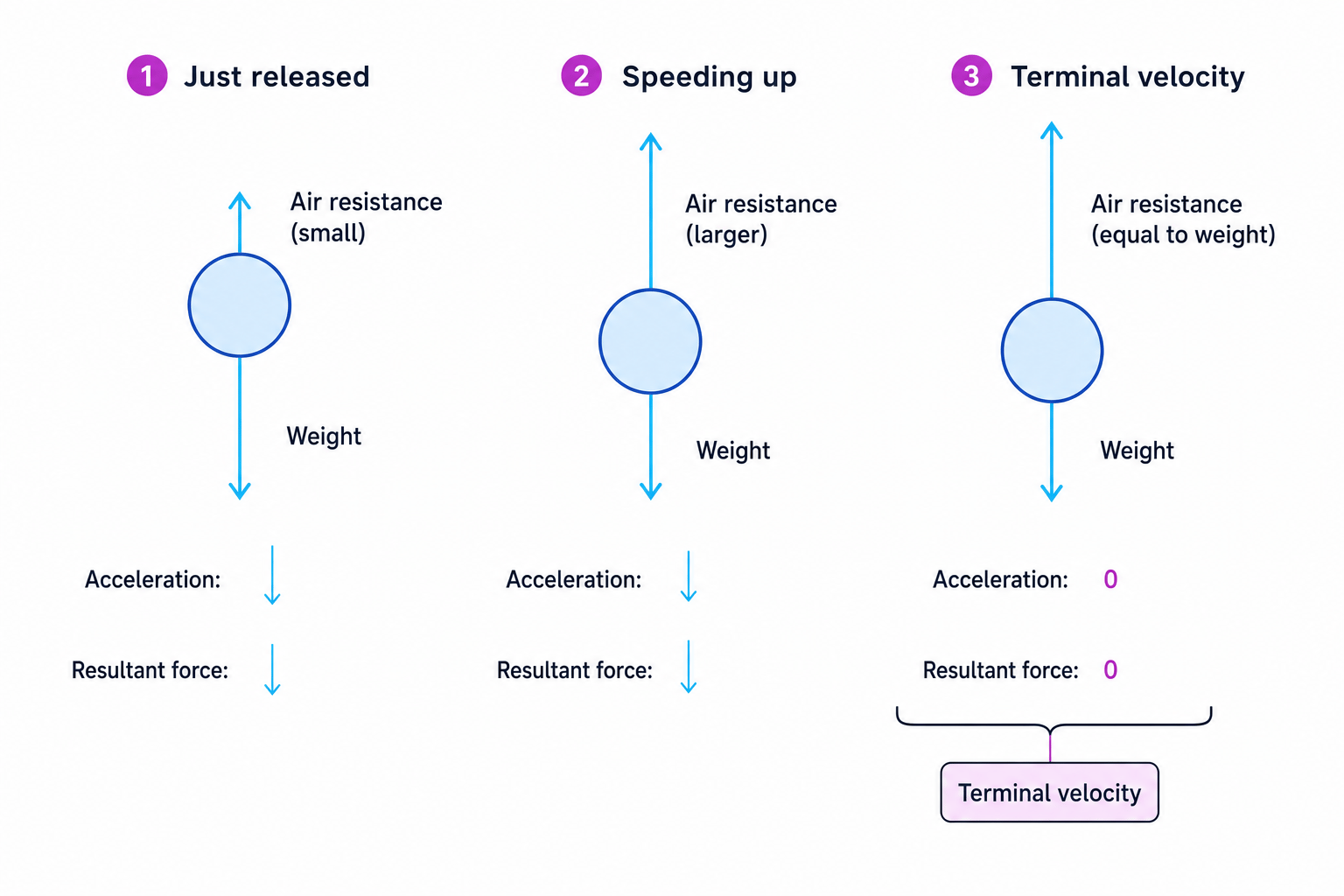
A falling object has weight acting downwards. If it falls through air, air resistance acts upwards. As the object gets faster, air resistance increases.
At first, weight is larger than air resistance, so there is a downward resultant force and the object accelerates. Eventually, air resistance becomes equal to weight. The resultant force is then zero, so the object continues at a constant speed called terminal velocity.
Terminal velocity
Terminal velocity does not mean the object has stopped. It means the object is moving at a constant velocity because the forces are balanced.
Explaining terminal velocity
A skydiver has a weight of 750 N. At one moment, air resistance is 500 N upwards.
- Compare the forces: weight is larger than air resistance by 750 N−500 N=250 N750\ \text{N} - 500\ \text{N} = 250\ \text{N}750 N−500 N=250 N.
- The resultant force is 250 N downwards, so the skydiver accelerates downwards.
- Later, when air resistance becomes 750 N, the resultant force is zero, so the skydiver moves at terminal velocity.
Stretching materials: springs, wires and rubber bands
Extension is the increase in length of an object when it is stretched.
Elastic behaviour means a material can recover its original shape after the forces causing deformation are removed.
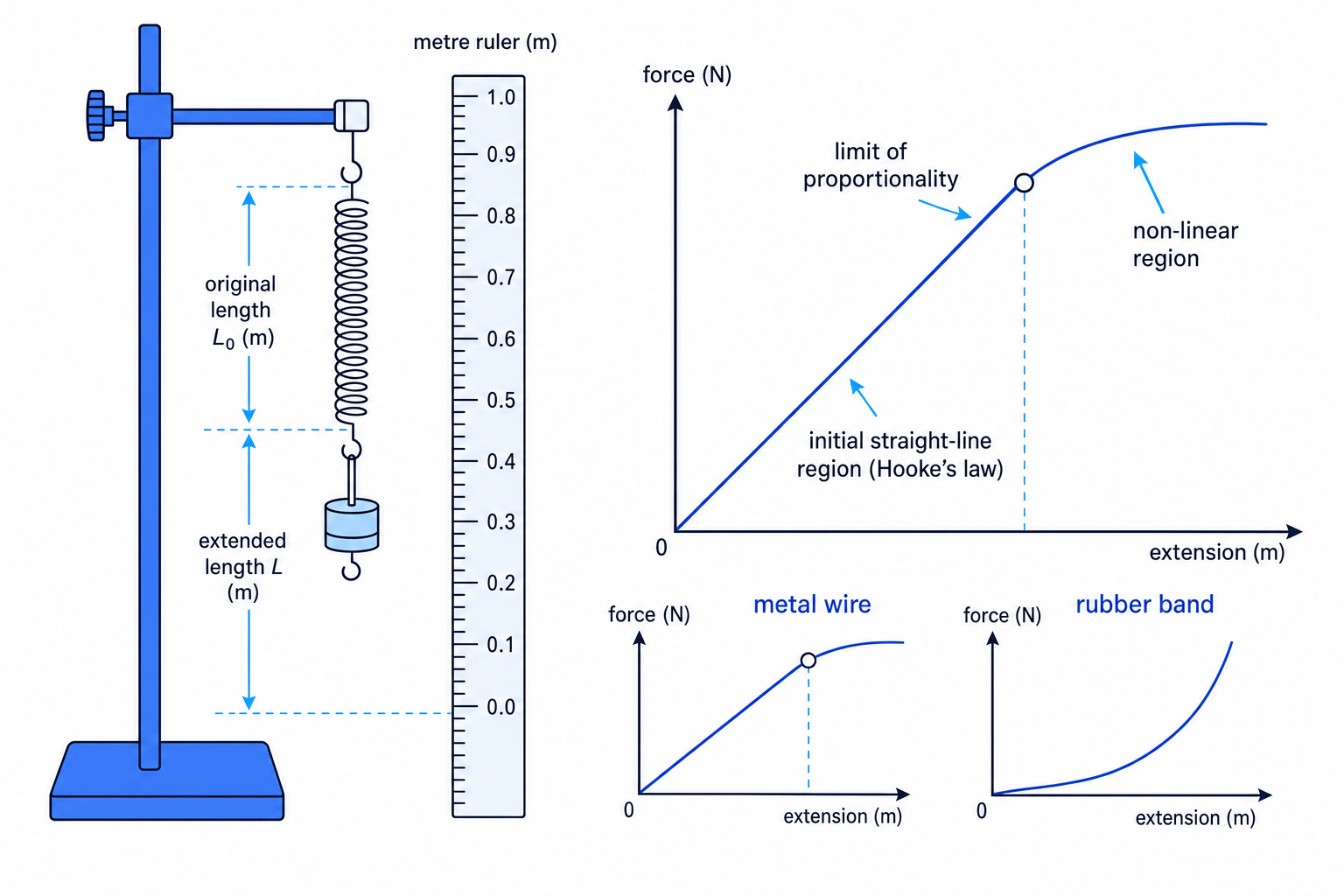
For many materials, the first part of a force-extension graph is a straight line through the origin. This initial linear region is associated with Hooke’s law: extension is proportional to applied force.
Named practical: extension and applied force
You need to know how to investigate how extension varies with applied force for helical springs, metal wires and rubber bands.
Use apparatus such as a clamp stand, spring or rubber band, mass hanger, slotted masses, metre ruler and pointer marker.
A good method is:
- Measure the original length with no load.
- Add masses one at a time.
- Convert each mass to force using weight = mass × gravitational field strength, W=m×gW = m \times gW=m×g.
- Wait for the object to stop oscillating, then measure the new length.
- Calculate extension using extended length minus original length.
- Repeat readings and, if needed, remove masses to see whether the material returns to its original length.
The independent variable is the applied force. The dependent variable is the extension. Control variables include the material, original length, thickness and temperature.
For the graph, plot force and extension with clearly labelled axes and units. In the initial straight-line region, the material obeys Hooke’s law. Rubber bands often give a curved graph and may behave differently when loading and unloading.
Processing spring data
A spring has original length 0.120 m. When a 0.200 kg mass is added, its length becomes 0.165 m.
- Convert mass to force: W=0.200 kg×9.8 N/kg=1.96 NW = 0.200\ \text{kg} \times 9.8\ \text{N/kg} = 1.96\ \text{N}W=0.200 kg×9.8 N/kg=1.96 N.
- Calculate extension: 0.165 m−0.120 m=0.045 m0.165\ \text{m} - 0.120\ \text{m} = 0.045\ \text{m}0.165 m−0.120 m=0.045 m.
- Plot the point using force 1.96 N and extension 0.045 m.
Practical accuracy
Read the ruler at eye level to avoid parallax error, keep the ruler parallel to the spring, wait for oscillations to stop, and do not overload the material.
Momentum and safety features
The momentum points in this section are Paper 2 only, but they are very useful for understanding collisions.
Momentum depends on mass and velocity. Since velocity has direction, momentum also has direction.
momentum = mass × velocity
p=m×vp = m \times vp=m×vMomentum, ppp, is measured in kg m/s when mass is in kg and velocity is in m/s.
In a closed system with no external resultant force, total momentum is conserved:
total momentum before = total momentum after
Using conservation of momentum
A 0.50 kg trolley moving at 4.0 m/s collides with a stationary 1.50 kg trolley. They stick together.
- Calculate total momentum before: p=0.50 kg×4.0 m/s+1.50 kg×0 m/s=2.0 kg m/sp = 0.50\ \text{kg} \times 4.0\ \text{m/s} + 1.50\ \text{kg} \times 0\ \text{m/s} = 2.0\ \text{kg m/s}p=0.50 kg×4.0 m/s+1.50 kg×0 m/s=2.0 kg m/s.
- After the collision, the combined mass is 0.50 kg+1.50 kg=2.00 kg0.50\ \text{kg} + 1.50\ \text{kg} = 2.00\ \text{kg}0.50 kg+1.50 kg=2.00 kg.
- Use conservation of momentum: 2.00 kg×v=2.0 kg m/s2.00\ \text{kg} \times v = 2.0\ \text{kg m/s}2.00 kg×v=2.0 kg m/s, so v=1.0 m/sv = 1.0\ \text{m/s}v=1.0 m/s in the original direction.
Safety features such as airbags, seat belts, helmets and crumple zones reduce injury by increasing the time taken for momentum to change. For the same change in momentum, a longer time means a smaller force.
force = change in momentum ÷ time taken
F=(mv−mu)tF = \frac{(mv - mu)}{t}F=t(mv−mu)Here, uuu is the initial velocity, vvv is the final velocity and ttt is the time taken.
Reducing force in a crash
A 70 kg passenger slows from 15 m/s to rest. Without an airbag, the stopping time is 0.10 s. With an airbag, the stopping time is 0.50 s.
- Calculate the change in momentum: mv−mu=70 kg×0 m/s−70 kg×15 m/s=−1050 kg m/smv - mu = 70\ \text{kg} \times 0\ \text{m/s} - 70\ \text{kg} \times 15\ \text{m/s} = -1050\ \text{kg m/s}mv−mu=70 kg×0 m/s−70 kg×15 m/s=−1050 kg m/s.
- Without the airbag, the force magnitude is 1050 kg m/s0.10 s=10500 N\frac{1050\ \text{kg m/s}}{0.10\ \text{s}} = 10500\ \text{N}0.10 s1050 kg m/s=10500 N.
- With the airbag, the force magnitude is 1050 kg m/s0.50 s=2100 N\frac{1050\ \text{kg m/s}}{0.50\ \text{s}} = 2100\ \text{N}0.50 s1050 kg m/s=2100 N, so the average force is much smaller.
Newton’s third law
Newton’s third law is also Paper 2 only.
When object A exerts a force on object B, object B exerts an equal and opposite force on object A. The two forces are the same type and act on different objects, so they do not cancel each other out.
Identifying a Newton’s third-law pair
A book rests on a table.
- Choose one force: the table pushes upwards on the book.
- Swap the objects to find the pair: the book pushes downwards on the table.
- The book’s weight is not the third-law pair of the normal contact force, because both weight and normal contact force act on the book.
Moments, centre of gravity and beams
A moment is the turning effect of a force about a pivot.
moment = force × perpendicular distance from the pivot
M=F×dM = F \times dM=F×dMoment is measured in N m. The distance must be the perpendicular distance from the pivot to the line of action of the force.
The centre of gravity is the point through which the weight of a body acts.
The principle of moments says that, for an object in equilibrium:
total clockwise moments = total anticlockwise moments
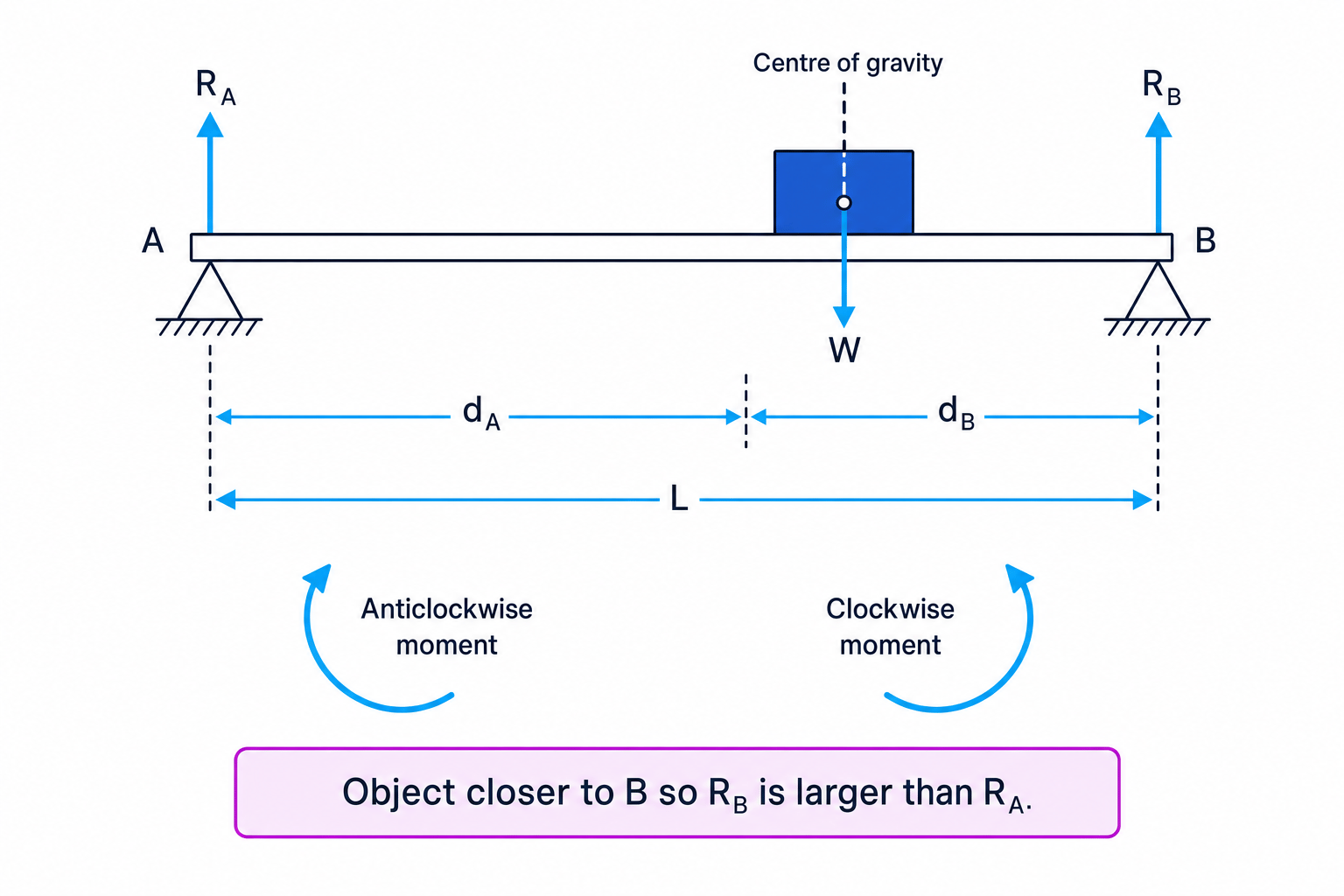
For a light beam supported at both ends, the upward support forces change depending on where the heavy object is placed. The support nearer the object provides the larger upward force.
Calculating support forces on a light beam
A light beam is 4.0 m long and supported at both ends. A 120 N object is placed 3.0 m from support A and 1.0 m from support B.
- Use vertical force balance: RA+RB=120 NR_A + R_B = 120\ \text{N}RA+RB=120 N.
- Take moments about support A: RB×4.0 m=120 N×3.0 mR_B \times 4.0\ \text{m} = 120\ \text{N} \times 3.0\ \text{m}RB×4.0 m=120 N×3.0 m.
- Solve: RB=90 NR_B = 90\ \text{N}RB=90 N, so RA=120 N−90 N=30 NR_A = 120\ \text{N} - 90\ \text{N} = 30\ \text{N}RA=120 N−90 N=30 N. The object is closer to B, so support B gives the larger upward force.
Moment distance
Do not use the length of the object unless it is the perpendicular distance from the pivot to the force’s line of action.
In the exam
- Draw force arrows first: label the size, direction and object each force acts on.
- For calculations, write the word equation and symbol equation before substituting numbers with units.
- Convert masses in grams to kg and distances in cm to m before using equations.
- For momentum and moments questions, choose a positive direction or a pivot, then keep directions clear.
- For practical questions, describe apparatus, variables, graphing and one real source of error.
Check yourself
- What is the difference between a scalar and a vector, and why is force a vector?
- Why does a falling object eventually reach terminal velocity?
- How would you decide which support force is larger for a load on a light beam?
