

What you'll learn
- What mains electricity is, and how a.c. differs from d.c.
- Why current in a resistor transfers energy and can cause heating.
- How insulation, double insulation, earthing, fuses and circuit breakers protect people and appliances.
- How to use P=I×VP = I \times VP=I×V and E=I×V×tE = I \times V \times tE=I×V×t in domestic electricity questions.
Starting point: current, voltage and mains supply
An electric current is the flow of electric charge around a circuit. It is measured in amperes, A.
A potential difference, often called voltage, is the energy transferred per unit charge between two points. It is measured in volts, V.
Mains electricity
Mains electricity is the electrical supply delivered to homes, schools and businesses. In the UK, the mains supply is about 230 V and has a frequency of 50 Hz.
In a normal domestic circuit, current flows through an appliance only when there is a complete path from the supply, through the appliance, and back to the supply.
Alternating current and direct current
Alternating current and direct current
Alternating current, a.c., repeatedly changes direction. Direct current, d.c., flows in one direction only. Mains electricity is a.c.; cells and batteries supply d.c.
A frequency of 50 Hz means 50 complete cycles each second. For mains a.c., the current changes direction every half-cycle. A battery-powered torch, however, has d.c. current: the current stays in one direction while the circuit is connected.
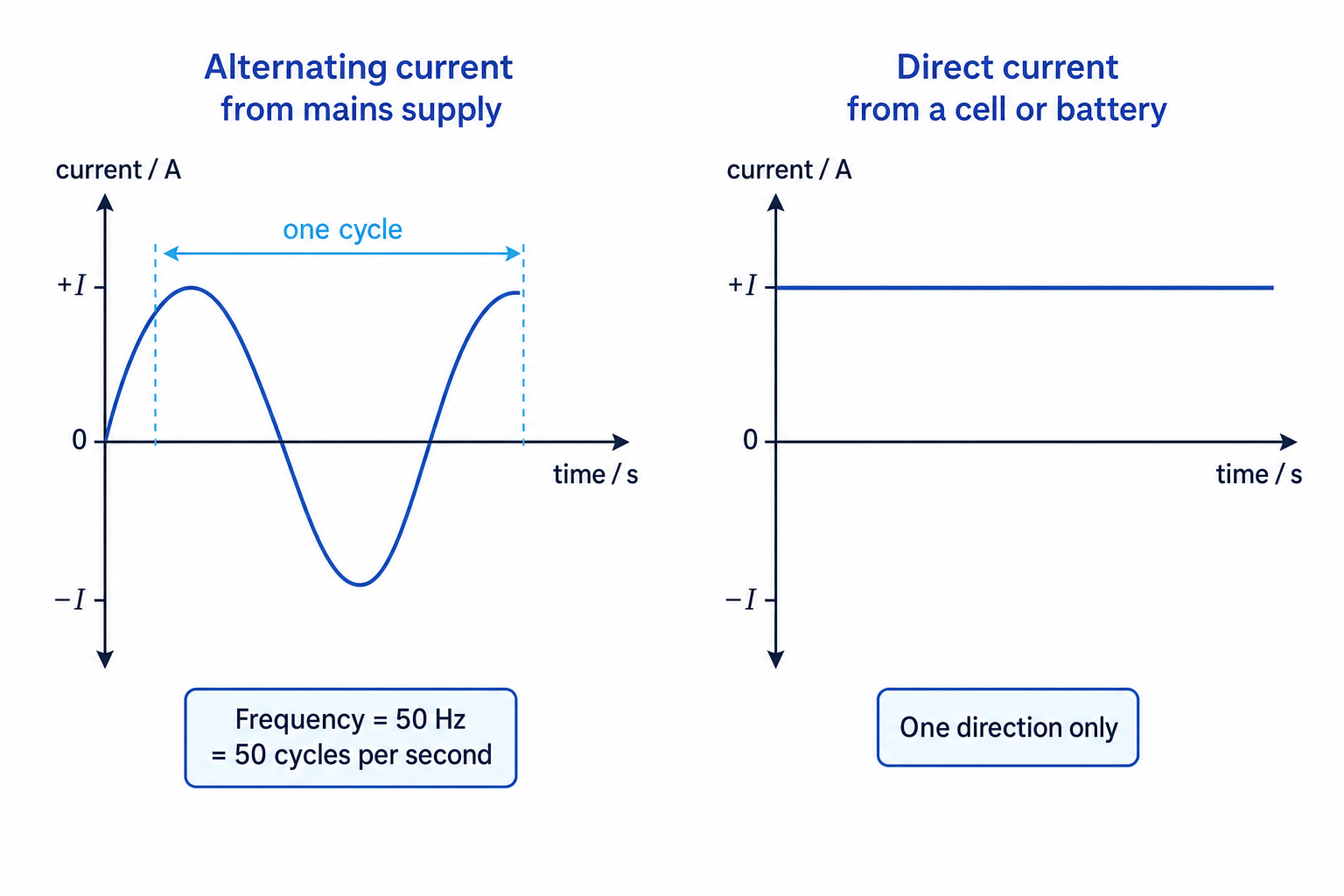
a.c. versus d.c.
The key difference is direction: a.c. reverses direction repeatedly, while d.c. flows one way around the circuit.
Why resistors get hot
A resistor is a component, or part of a component, that makes it harder for current to flow. When current flows through a resistor, electrical energy is transferred to the resistor’s internal energy store. Its temperature rises.
This happens because moving charges transfer energy to the material of the resistor. In domestic appliances, this heating can be useful or unwanted.
Useful heating is used in:
- electric kettles
- toasters
- electric ovens
- hairdryers
- fan heaters
- filament lamps
Unwanted heating can happen in wires if the current is too large. That is dangerous because overheated insulation may melt or catch fire.
Explaining heating in a toaster
- The toaster contains a heating element, which acts as a resistor, so current through it transfers electrical energy to thermal energy.
- The element’s temperature rises and it transfers energy to the bread by heating.
- Parts such as the handle are made from insulating material and are not designed to carry the main current, so they should not heat up in the same way.
Electrical power in appliances
Power is the rate at which energy is transferred. It is measured in watts, W. A higher-power appliance transfers more energy each second.
For this specification, you need:
power = current × voltage
P=I×VP = I \times VP=I×Vwhere:
- PPP is power in W
- III is current in A
- VVV is voltage in V
Useful rearrangements are:
I=PVI = \frac{P}{V}I=VP V=PIV = \frac{P}{I}V=IPFor domestic appliances, the voltage is often 230 V unless the question gives another value.
Choosing a fuse
A fuse is a safety device containing a thin wire that melts if the current becomes too large. This breaks the circuit and stops the current.
When choosing a fuse, calculate the appliance’s normal operating current, then choose the smallest fuse rating above that current.
Choosing a fuse
A 1200 W toaster is connected to the 230 V mains. Choose a fuse from 3 A, 5 A and 13 A.
- Use the power equation and rearrange it to find current:
I=PVI = \frac{P}{V}I=VP. - Substitute the values with units:
I=1200 W230 V=5.2 AI = \frac{1200\ \text{W}}{230\ \text{V}} = 5.2\ \text{A}I=230 V1200 W=5.2 A. - The normal current is 5.2 A, so 3 A and 5 A are too low. The best choice is the smallest fuse above 5.2 A, which is 13 A.
Choosing the biggest fuse automatically
Do not just pick the largest fuse. A fuse rating should be just above the normal operating current, so it allows normal use but still breaks the circuit during a fault.
Energy transferred over time
You also need this relationship:
energy transferred = current × voltage × time
E=I×V×tE = I \times V \times tE=I×V×twhere:
- EEE is energy transferred in J
- III is current in A
- VVV is voltage in V
- ttt is time in s
Calculating energy transferred
An electric heater has a current of 8.0 A when connected to a 230 V supply. Calculate the energy transferred in 10 minutes.
- Convert the time into seconds:
10 minutes = 600 s. - Substitute into E=I×V×tE = I \times V \times tE=I×V×t:
E=8.0 A×230 V×600 sE = 8.0\ \text{A} \times 230\ \text{V} \times 600\ \text{s}E=8.0 A×230 V×600 s. - Calculate the energy:
E=1 104 000 J≈1.1×10⁶ JE = 1\,104\,000\ \text{J} \approx 1.1 \times 10^{6}\ \text{J}E=1104000 J≈1.1×10⁶ J.
Time units
If you want energy in joules, J, make sure time is in seconds, s. Minutes and hours must be converted first.
Protection in domestic appliances
Mains electricity can be dangerous because a large current through the body can cause injury, and large currents in wires can cause overheating and fire.
Domestic appliances use several safety features.
Insulation
Insulation means surrounding conducting parts with a non-conducting material, such as plastic or rubber. This prevents users from touching live conductors and helps stop wires touching each other.
The outer casing of many plugs and cables is insulating. Damaged insulation is dangerous because it may expose a live wire.
Double insulation
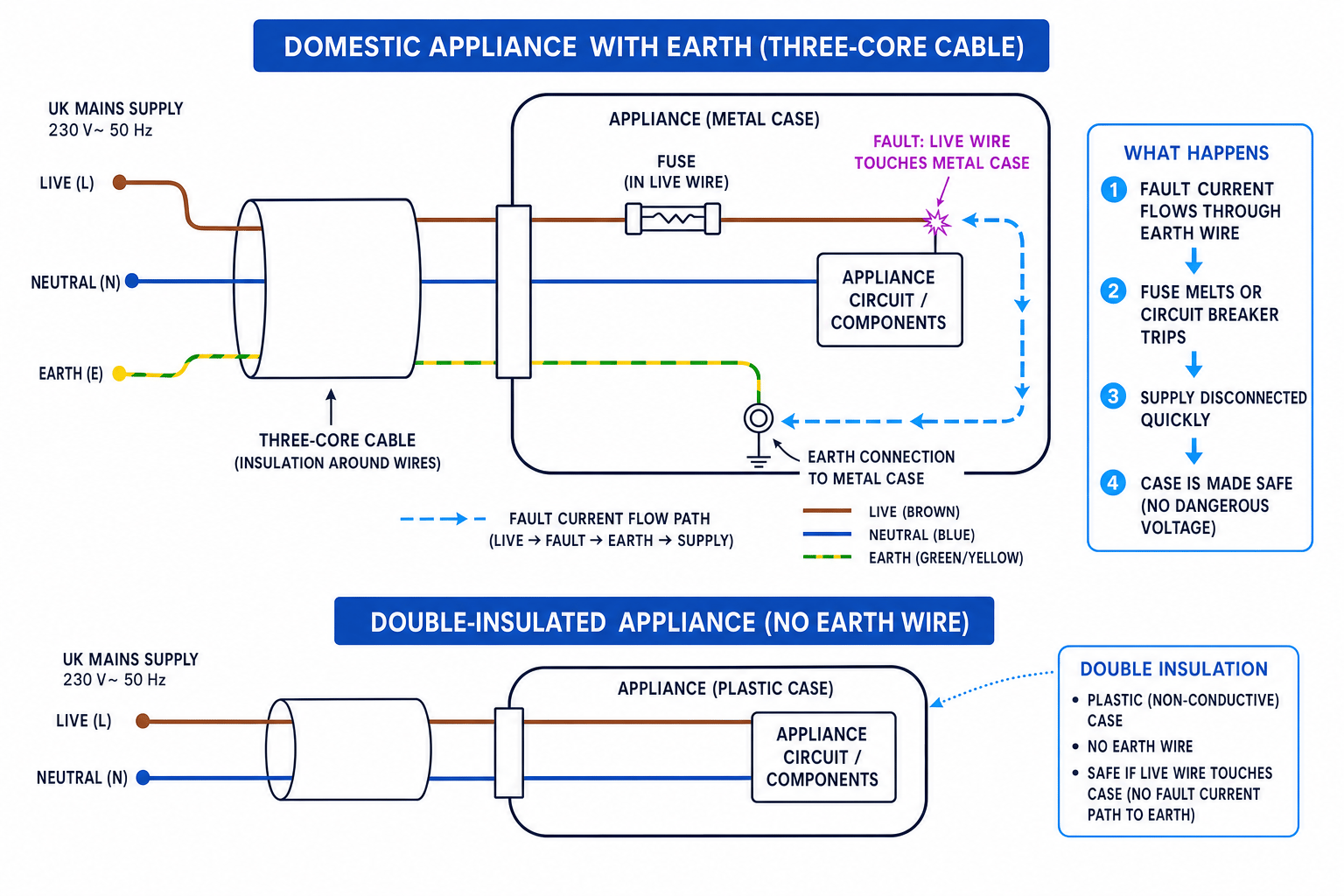
A double-insulated appliance has two layers of insulation, or an insulating outer case, so the user cannot touch any live metal part. These appliances do not need an earth wire.
Examples include many phone chargers, hairdryers and plastic-cased power tools.
Earthing
Earthing means connecting the metal case of an appliance to the earth wire. The earth wire is a safety wire and normally carries no current.
If the live wire touches the metal case, the case could become live. With an earth wire connected, a large fault current flows through the low-resistance earth path. This causes the fuse to melt or the circuit breaker to trip, disconnecting the supply.
Fuses and circuit breakers
A fuse is connected in the live wire. If the current is too high, the fuse wire heats up and melts, breaking the circuit.
A circuit breaker is a safety switch that opens the circuit when the current becomes too large. Unlike a fuse, it can be reset after the fault has been fixed.
How safety devices protect you
Insulation prevents contact with live parts. Earthing provides a safe fault path. Fuses and circuit breakers disconnect the live supply if the current becomes dangerously large.
Deciding if an earth wire is needed
A washing machine has a metal case and is connected to the mains.
- The metal case can conduct electricity, so if the live wire touched it, the whole case could become live.
- An earth wire connects the case to earth, giving fault current a low-resistance path away from the user.
- The large fault current melts the fuse or trips the circuit breaker, so the supply is disconnected quickly.
Putting the fuse in the neutral wire
The fuse must be in the live wire. If a fuse in the neutral wire melted, parts of the appliance could still be connected to the live supply and remain dangerous.
In the exam
- For fuse questions, calculate the normal current using I=PVI = \frac{P}{V}I=VP, then choose the smallest fuse rating above it.
- For earthing questions, describe the full fault sequence: live wire touches metal case, fault current flows through earth wire, fuse melts or circuit breaker trips.
- For energy calculations, convert time into seconds before using E=I×V×tE = I \times V \times tE=I×V×t.
- For a.c. and d.c. questions, focus on current direction: a.c. reverses direction, d.c. flows one way.
Check yourself
- Why does a metal-cased appliance usually need an earth wire?
- A 900 W appliance is connected to a 230 V supply. Which fuse would be most suitable from 3 A, 5 A and 13 A?
- How would a current-time graph for a.c. differ from one for d.c.?

