

What you'll learn
- How particles are arranged and move in solids, liquids and gases.
- Why heating can either raise temperature or cause a change of state.
- How to interpret and obtain a temperature–time graph during melting or boiling.
- How to use specific heat capacity and investigate it for water and solids.
In Edexcel IGCSE Physics 4PH1, these specification points are Paper 2 only, but the ideas connect strongly to the particle model you use throughout the course.
The particle model: the starting point
Matter is made of tiny particles, such as atoms or molecules. The particle model explains the properties of solids, liquids and gases by thinking about:
- how close together the particles are
- how regularly they are arranged
- how they move
- how strong the forces between them are
System and internal energy
A system is the object or substance you are studying. The internal energy of a system is the total energy stored by its particles, mainly because of their movement and their positions relative to each other.
Temperature is linked to the average kinetic energy of the particles. Kinetic energy is the energy a particle has because it is moving. When particles move faster on average, the temperature is higher.
Solids, liquids and gases
In a solid, particles are close together in a regular arrangement. They cannot move from place to place, but they vibrate about fixed positions.
In a liquid, particles are still close together, but the arrangement is irregular. The particles can move around and slide past each other, so a liquid can flow.
In a gas, particles are far apart and move rapidly in random directions. The forces between gas particles are usually negligible except during collisions.
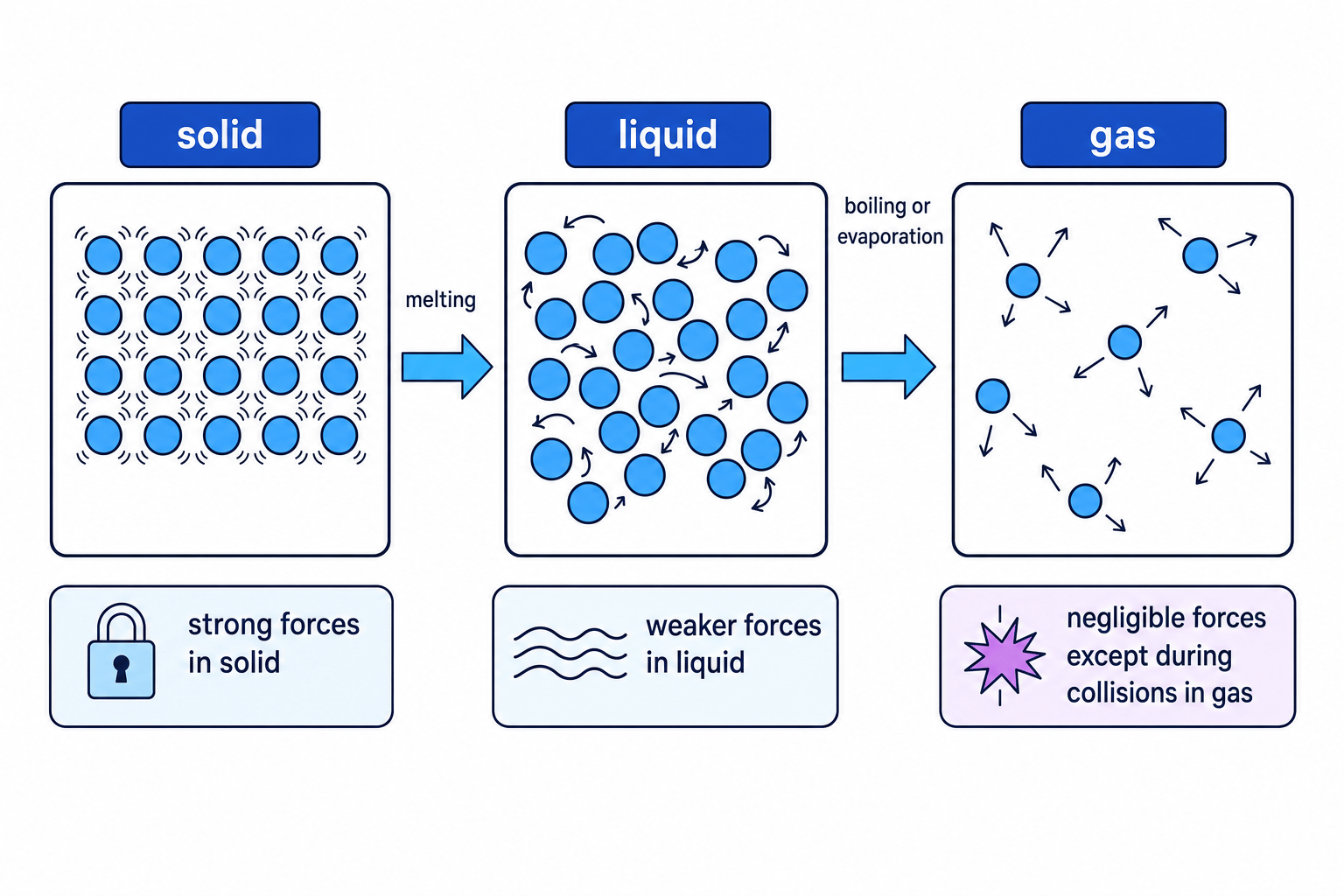
Particles explain properties
Solids have a fixed shape and volume because their particles vibrate in fixed positions; liquids have a fixed volume but no fixed shape because particles can move past each other; gases have no fixed shape or volume because particles are far apart and move freely.
What heating does to a system
When you heat a system, energy is transferred into it. This increases the energy stored within the system.
That energy can do one of two main things:
- Raise the temperature: particles gain kinetic energy and move or vibrate faster.
- Cause a change of state: energy is used to change the arrangement or separation of particles, rather than increasing their average kinetic energy.
Change of state
A change of state is a physical change where a substance changes between solid, liquid and gas. The substance is still the same material; only the particle arrangement and motion change.
During a change of state, the temperature of a pure substance stays constant even though energy is still being transferred in. The energy is used to overcome forces between particles and change their positions.
Heating does not always mean temperature rises
If a substance is melting or boiling, added energy changes the particle arrangement instead of increasing the average kinetic energy, so the temperature stays constant during the change of state.
Melting, evaporation and boiling
Melting: solid to liquid
Melting happens when a solid changes into a liquid.
As a solid is heated, its particles vibrate more strongly. At the melting point, the particles have enough energy to break out of their fixed positions. The regular solid structure collapses, and the particles can move around each other as a liquid.
Evaporation: liquid to gas at the surface
Evaporation is when particles escape from the surface of a liquid to become gas particles.
Evaporation can happen at temperatures below the boiling point. The fastest-moving particles at the surface may have enough energy to escape from the liquid.
Boiling: liquid to gas throughout the liquid
Boiling happens when a liquid changes into a gas throughout the liquid, not just at the surface. Bubbles of gas form inside the liquid and rise to the surface.
For pure water at normal atmospheric pressure, boiling happens at 100 °C. While water is boiling, its temperature stays at 100 °C.
Evaporation is not boiling
Evaporation happens only at the surface and can happen below the boiling point. Boiling happens throughout the liquid at the boiling point, with bubbles forming inside the liquid.
Explaining constant temperature during boiling
-
The water is already at its boiling point, so the liquid is changing state into a gas.
-
Energy is still being transferred from the heater to the water, so the internal energy of the system increases.
-
That energy is used to separate particles and form gas bubbles, not to increase the average kinetic energy of the particles, so the temperature stays constant.
Temperature–time graphs during changes of state
A temperature–time graph shows how temperature changes as time passes. The temperature goes on the vertical axis, and time goes on the horizontal axis.
A flat section of the graph is called a plateau. A plateau shows that the temperature is constant. On a heating curve, this usually means a change of state is happening.
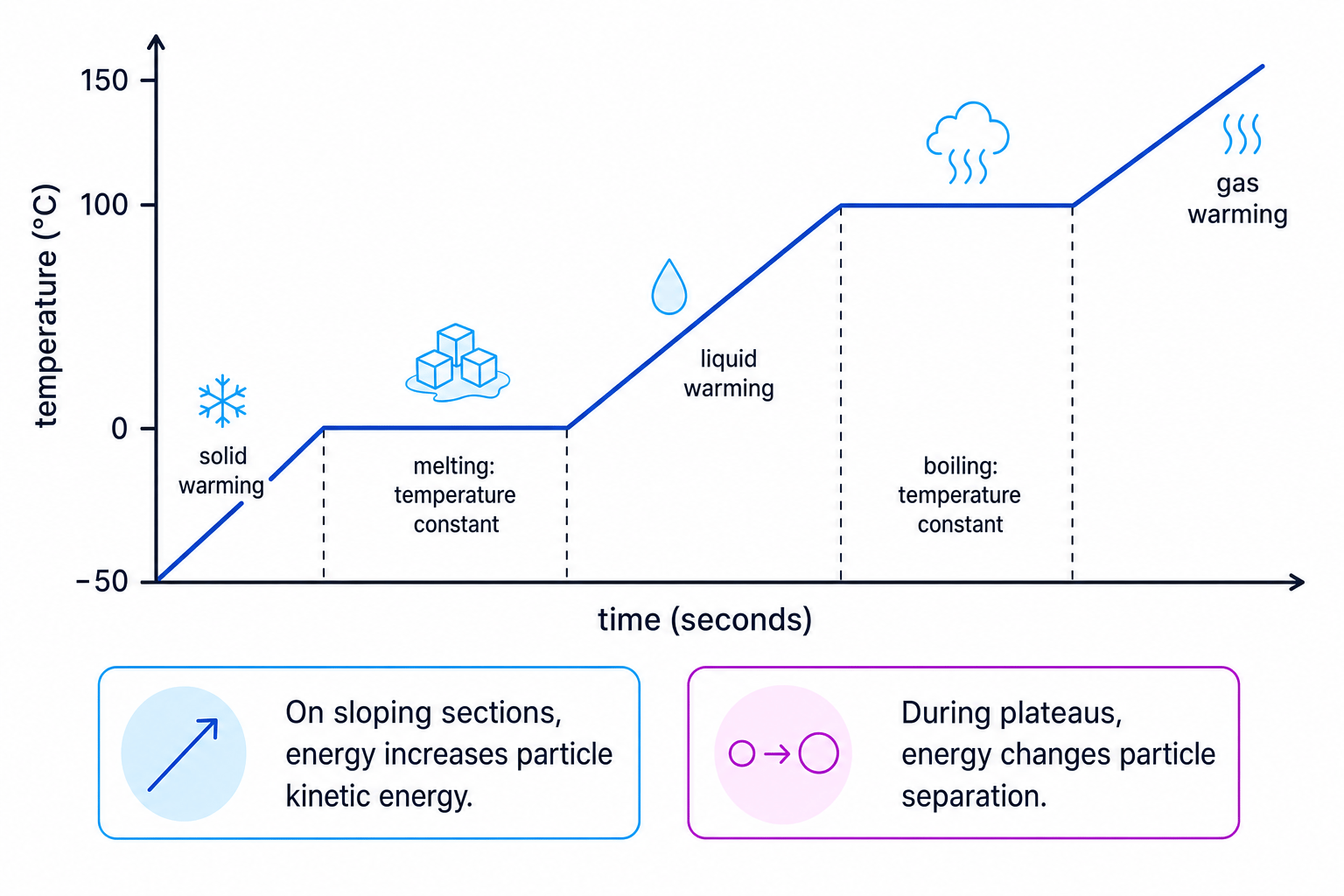
On the sloping sections, the temperature rises because particle kinetic energy increases. On the flat sections, the temperature stays constant because energy is being used to change the state.
Interpreting a heating curve
A substance is heated steadily. Its temperature rises from 20 °C to 80 °C, stays at 80 °C for several minutes, then rises again.
-
The flat section at 80 °C shows that the temperature is constant while energy is still being supplied.
-
A constant temperature during heating indicates a change of state, such as melting or boiling.
-
If the substance was a solid before 80 °C, the plateau is melting; if it was a liquid before 80 °C, the plateau is boiling.
Practical: obtaining a temperature–time graph
One common method is to heat crushed ice and record the temperature as it melts and then warms. Your teacher may use a different substance, such as wax or stearic acid, but the graph idea is the same.
Apparatus
You may use:
- crushed ice and a small amount of water in a beaker
- thermometer or temperature probe
- hot plate or Bunsen burner with tripod and gauze
- stopwatch
- stirrer
- heatproof mat and eye protection
Method
-
Place crushed ice and a little water in a beaker, with the thermometer bulb fully surrounded by the mixture.
-
Start the stopwatch and record the temperature at regular intervals, such as every 30 s.
-
Heat gently and steadily, stirring carefully so the temperature is as even as possible.
-
Continue recording as the ice melts and the liquid water warms.
-
Plot temperature in °C on the vertical axis against time in s on the horizontal axis.
Variables and graphing
The independent variable is time. The dependent variable is temperature. Important control variables include the heating power, mass of substance, stirring method and pressure.
The graph should show a flat section during melting. If you continue to boiling, a second flat section may appear during boiling.
Thermometer position
Do not let the thermometer touch the bottom of the beaker. The glass may be hotter than the substance, so the reading can be too high.
Specific heat capacity
Different materials need different amounts of energy to warm up. For example, water needs a lot of energy for a small temperature rise, which is why it is useful in heating systems and cooling systems.
Specific heat capacity
Specific heat capacity is the energy required to change the temperature of an object by one degree Celsius per kilogram of mass. Its unit is J/kg °C.
The Edexcel equation is:
change in thermal energy = mass × specific heat capacity × change in temperature
ΔQ=m×c×ΔT\Delta Q = m \times c \times \Delta TΔQ=m×c×ΔTwhere:
- ΔQ\Delta QΔQ is the change in thermal energy in J
- mmm is the mass in kg
- ccc is the specific heat capacity in J/kg °C
- ΔT\Delta TΔT is the change in temperature in °C
You may need to rearrange the equation:
c=ΔQm×ΔTm=ΔQc×ΔTΔT=ΔQm×c\begin{aligned} c &= \frac{\Delta Q}{m \times \Delta T} \\ m &= \frac{\Delta Q}{c \times \Delta T} \\ \Delta T &= \frac{\Delta Q}{m \times c} \end{aligned}cmΔT=m×ΔTΔQ=c×ΔTΔQ=m×cΔQTemperature change
For a temperature change, a rise of 1 °C is the same size as a rise of 1 K. In this topic, use °C because the specific heat capacity unit is J/kg °C.
Calculating thermal energy change
A 0.50 kg mass of water is heated from 20 °C to 80 °C. The specific heat capacity of water is 4200 J/kg °C. Calculate the change in thermal energy.
-
Find the temperature change:
ΔT=80∘C−20∘C=60∘C\Delta T = 80^\circ\text{C} - 20^\circ\text{C} = 60^\circ\text{C}ΔT=80∘C−20∘C=60∘C
-
Substitute into ΔQ=m×c×ΔT\Delta Q = m \times c \times \Delta TΔQ=m×c×ΔT:
ΔQ=0.50 kg×4200 J kg−1 ∘C−1×60∘C\Delta Q = 0.50\ \text{kg} \times 4200\ \text{J kg}^{-1}\,^\circ\text{C}^{-1} \times 60^\circ\text{C}ΔQ=0.50 kg×4200 J kg−1∘C−1×60∘C
-
Calculate the energy, with kg and °C cancelling:
ΔQ=126000 J=126 kJ\Delta Q = 126000\ \text{J} = 126\ \text{kJ}ΔQ=126000 J=126 kJ
Using the final temperature instead of the temperature change
In ΔQ=m×c×ΔT\Delta Q = m \times c \times \Delta TΔQ=m×c×ΔT, you must use the temperature change. If water warms from 20 °C to 80 °C, ΔT\Delta TΔT is 60 °C, not 80 °C.
Practical: investigating specific heat capacity
You can investigate specific heat capacity for both solids and water by supplying electrical energy and measuring the temperature rise.
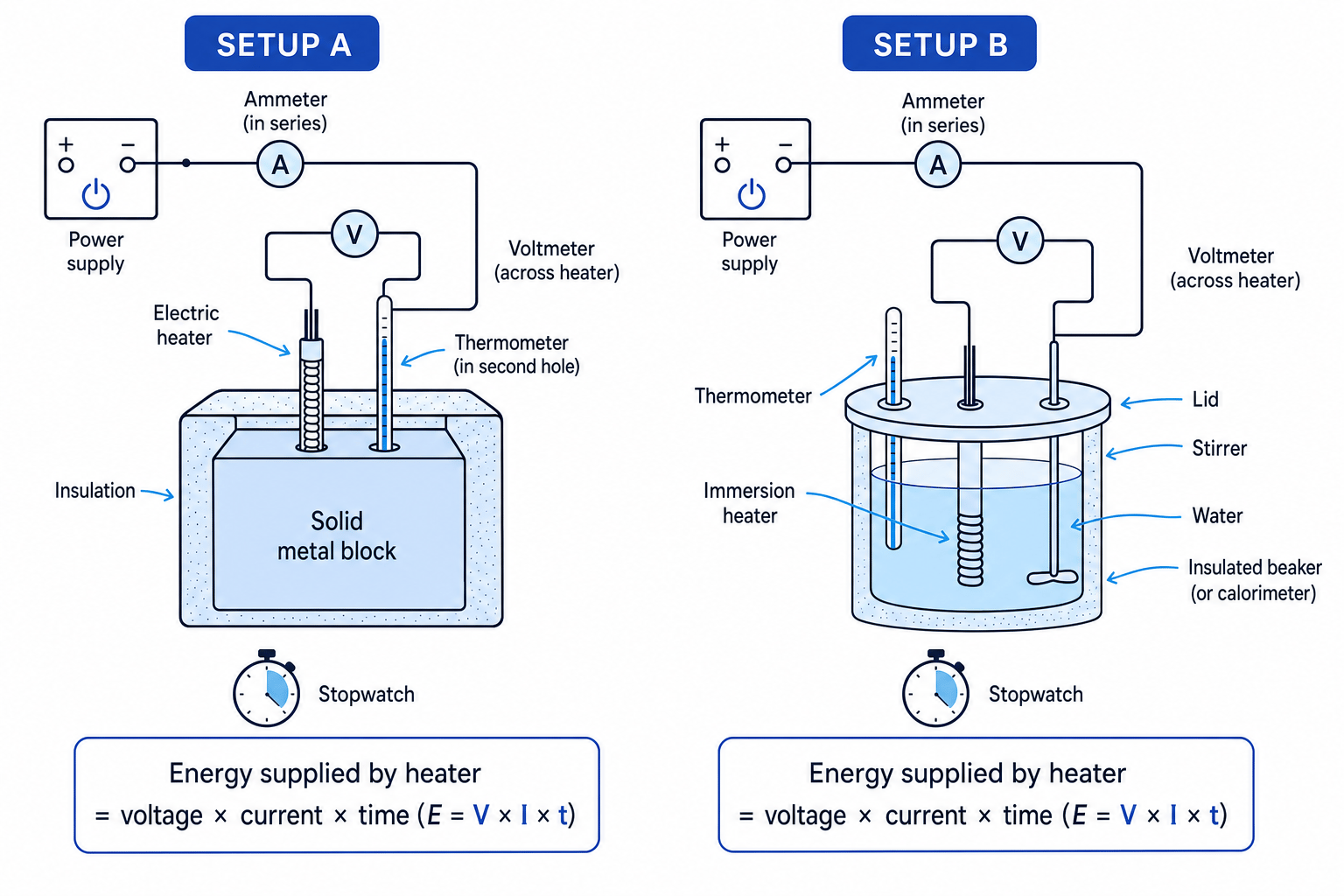
From electricity:
energy transferred = voltage × current × time
E=V×I×tE = V \times I \times tE=V×I×tIf heat losses are small, the electrical energy transferred by the heater is approximately equal to the change in thermal energy of the material: E≈ΔQE \approx \Delta QE≈ΔQ.
Solid block method
-
Measure the mass of the metal block in kg.
-
Place an electric heater into one hole and a thermometer into another hole. Use a small amount of oil or thermal paste to improve thermal contact.
-
Wrap the block in insulation to reduce energy loss to the surroundings.
-
Connect the heater to a power supply with an ammeter in series and a voltmeter across the heater.
-
Record the initial temperature, then switch on the heater and start the stopwatch.
-
Record the voltage, current, time and temperature rise.
-
Calculate E=V×I×tE = V \times I \times tE=V×I×t, then use c=ΔQm×ΔTc = \frac{\Delta Q}{m \times \Delta T}c=m×ΔTΔQ.
Water method
For water, use an insulated beaker or calorimeter with a lid, immersion heater, thermometer and stirrer. Measure the mass of the water, not just the volume, unless you are told to assume 1 cm³ of water has a mass of 1 g. Stir gently so the water temperature is uniform.
Variables and graphing
The independent variable can be time or energy supplied. The dependent variable is temperature rise. Control variables include mass, insulation, heater power and starting temperature.
For a good graph, calculate the energy supplied at each time using E=V×I×tE = V \times I \times tE=V×I×t. Plot energy supplied in J on the vertical axis against temperature change in °C on the horizontal axis. From ΔQ=m×c×ΔT\Delta Q = m \times c \times \Delta TΔQ=m×c×ΔT, the gradient is m×cm \times cm×c, so:
c=gradientmc = \frac{\text{gradient}}{m}c=mgradientCalculating specific heat capacity from electrical data
A 0.40 kg metal block is heated using a 12.0 V heater with a current of 2.0 A for 150 s. Its temperature rises from 20.0 °C to 30.0 °C. Calculate the specific heat capacity of the metal.
-
Calculate the electrical energy supplied:
E=V×I×t=12.0 V×2.0 A×150 s=3600 JE = V \times I \times t = 12.0\ \text{V} \times 2.0\ \text{A} \times 150\ \text{s} = 3600\ \text{J}E=V×I×t=12.0 V×2.0 A×150 s=3600 J
-
Find the temperature change:
ΔT=30.0∘C−20.0∘C=10.0∘C\Delta T = 30.0^\circ\text{C} - 20.0^\circ\text{C} = 10.0^\circ\text{C}ΔT=30.0∘C−20.0∘C=10.0∘C
-
Use E≈ΔQE \approx \Delta QE≈ΔQ and rearrange ΔQ=m×c×ΔT\Delta Q = m \times c \times \Delta TΔQ=m×c×ΔT:
c=3600 J0.40 kg×10.0∘C=900 J/kg °Cc = \frac{3600\ \text{J}}{0.40\ \text{kg} \times 10.0^\circ\text{C}} = 900\ \text{J/kg °C}c=0.40 kg×10.0∘C3600 J=900 J/kg °C
Ignoring heat losses
If some energy heats the surroundings, the thermometer or the container, not all the electrical energy heats the material. This usually makes the calculated specific heat capacity too large.
Reducing errors in the practicals
To improve the investigation:
- use insulation and a lid where possible
- stir liquids gently before reading the temperature
- make sure the thermometer or probe is in good contact with the substance
- use a larger temperature rise to reduce percentage uncertainty
- record voltage and current rather than just trusting the power supply setting
- repeat readings and calculate a mean where suitable
In the exam
-
For change of state questions, always link the flat part of a temperature–time graph to energy changing particle arrangement, not increasing particle kinetic energy.
-
In specific heat capacity calculations, write down ΔT\Delta TΔT first and check that mass is in kg before substituting into ΔQ=m×c×ΔT\Delta Q = m \times c \times \Delta TΔQ=m×c×ΔT.
-
In practical questions, mention insulation, stirring or good thermal contact when asked how to reduce errors.
Check yourself
- Why does the temperature stay constant while a pure substance is melting?
- How is boiling different from evaporation?
- A 2.0 kg object gains 5000 J and warms by 5 °C. What equation would you use to find its specific heat capacity?

