

What you'll learn
- How to calculate density using mass and volume.
- How to investigate density by direct measurement in the lab.
- How pressure depends on force and area.
- How pressure behaves in liquids and gases, including pressure difference with depth.
The basic quantities you need first
Before density and pressure, you need four everyday physics quantities.
Key quantities
Mass is the amount of matter in an object, measured in kg. Volume is the space an object takes up, measured in m³. Force is a push or pull, measured in N. Area is the size of a surface, measured in m².
A useful habit in this topic is to check the units before calculating. Density uses kg and m³. Pressure uses N and m².
Density
Density tells you how much mass is packed into a certain volume. A small object can have a large density if it contains a lot of mass in a small space.
Density
Density is mass per unit volume. The symbol for density is ρ\rhoρ, pronounced “rho”.
The Edexcel equation is:
density=massvolume\text{density} = \frac{\text{mass}}{\text{volume}}density=volumemass ρ=mV\rho = \frac{m}{V}ρ=Vmwhere:
- ρ\rhoρ is density in kg/m³
- mmm is mass in kg
- VVV is volume in m³
You can rearrange the equation when needed:
m=ρ×Vm = \rho \times Vm=ρ×V V=mρV = \frac{m}{\rho}V=ρmDensity meaning
A material with a larger density has more mass in each m³ of volume.
Calculating density
A metal block has mass 2.70 kg and volume 0.00100 m³. Find its density.
- Choose the density equation because the question gives mass and volume: ρ=mV\rho = \frac{m}{V}ρ=Vm.
- Substitute the values with units: ρ=2.70 kg0.00100 m3\rho = \frac{2.70\ \text{kg}}{0.00100\ \text{m}^3}ρ=0.00100 m32.70 kg.
- Calculate the answer: ρ=2700 kg/m3\rho = 2700\ \text{kg/m}^3ρ=2700 kg/m3.
Mixing volume units
Do not put a volume measured in mL straight into ρ=mV\rho = \frac{m}{V}ρ=Vm if the answer needs kg/m³. Use 1 mL=1×10⁻⁶ m31\ \text{mL} = 1 \times 10^{-6}\ \text{m}^31 mL=1×10⁻⁶ m3.
Practical: investigating density using direct measurements
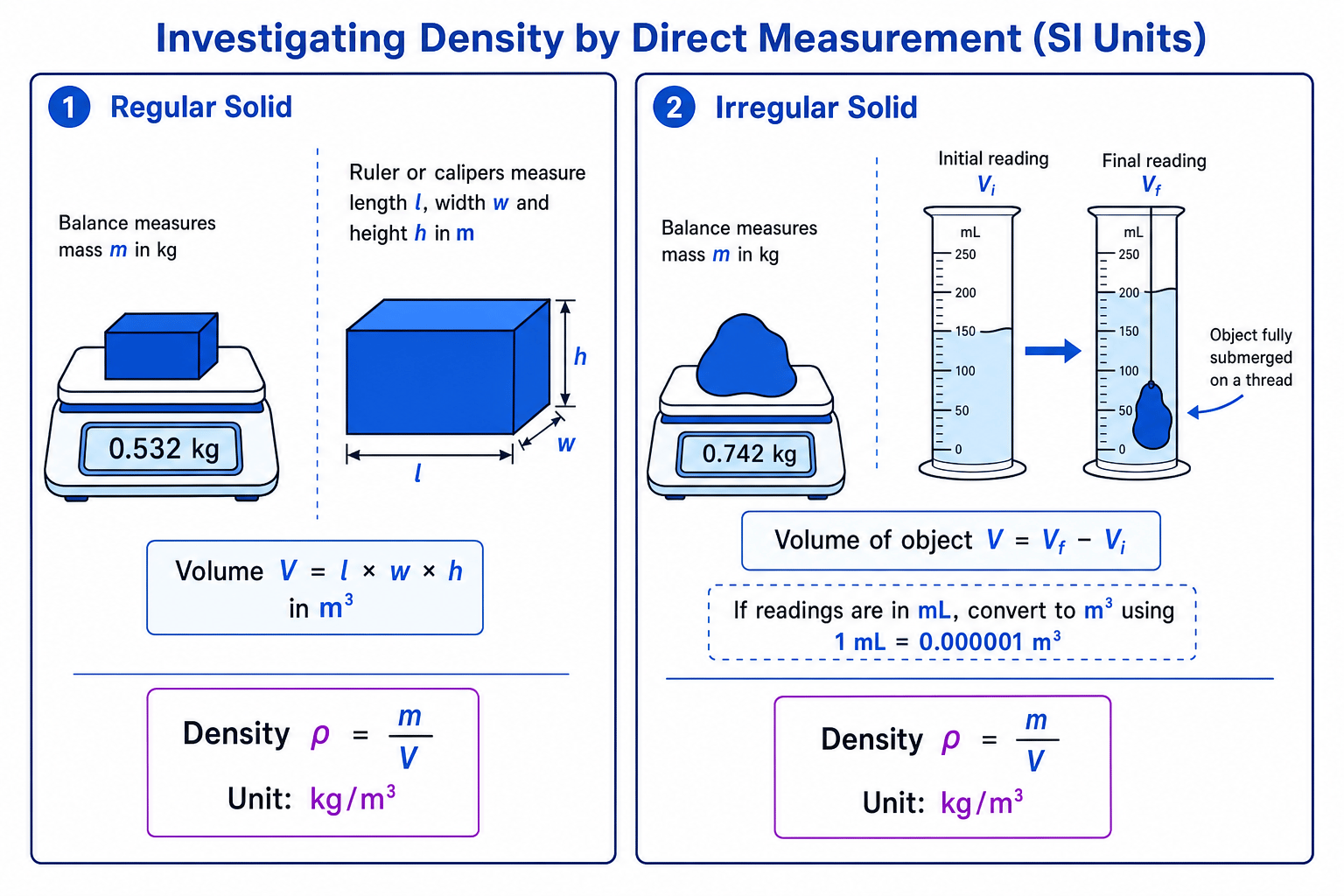
In the named practical, you investigate density by measuring mass and volume directly, then using ρ=mV\rho = \frac{m}{V}ρ=Vm.
The method depends on whether the object has a regular shape, like a cuboid, or an irregular shape, like a stone.
Apparatus
You may use:
- a balance to measure mass
- a ruler or calipers to measure length, width and height
- a measuring cylinder for water displacement
- water and a thread for lowering an irregular object into the water
Regular solid method
For a regular cuboid:
- Measure its mass using a balance.
- Measure length, width and height in m.
- Calculate volume using:
- Calculate density using:
Irregular solid method
For an irregular object:
- Measure its mass using a balance.
- Put water in a measuring cylinder and record the initial volume reading.
- Lower the object fully into the water using a thread.
- Record the final volume reading.
- The object’s volume is:
where VfV_fVf is final volume and ViV_iVi is initial volume.
Variables and graphing
If you test several pieces of the same material, you can plot a graph of mass against volume.
- Independent variable: volume
- Dependent variable: mass
- Control variable: material, because density depends on the material
- Graph: mass on the y-axis and volume on the x-axis
- Gradient: density
This works because:
ρ=mV\rho = \frac{m}{V}ρ=VmSo on a mass-volume graph, the gradient is:
gradient=change in masschange in volume\text{gradient} = \frac{\text{change in mass}}{\text{change in volume}}gradient=change in volumechange in massFinding density from a graph
A mass-volume graph for a material passes through the points 0.000020 m³, 0.054 kg and 0.000050 m³, 0.135 kg. Find the density.
- Use the gradient because density is mass divided by volume: ρ=change in masschange in volume\rho = \frac{\text{change in mass}}{\text{change in volume}}ρ=change in volumechange in mass.
- Calculate the changes: Δm=0.135 kg−0.054 kg=0.081 kg\Delta m = 0.135\ \text{kg} - 0.054\ \text{kg} = 0.081\ \text{kg}Δm=0.135 kg−0.054 kg=0.081 kg and ΔV=0.000050 m3−0.000020 m3=3.0×10⁻⁵ m3\Delta V = 0.000050\ \text{m}^3 - 0.000020\ \text{m}^3 = 3.0 \times 10^{-5}\ \text{m}^3ΔV=0.000050 m3−0.000020 m3=3.0×10⁻⁵ m3.
- Divide to find the gradient: ρ=0.081 kg3.0×10−5 m3=2700 kg/m3\rho = \frac{0.081\ \text{kg}}{3.0 \times 10^{-5}\ \text{m}^3} = 2700\ \text{kg/m}^3ρ=3.0×10−5 m30.081 kg=2700 kg/m3.
Practical errors to watch for
Common sources of error include:
- reading the water level from above or below instead of at eye level
- air bubbles sticking to the object in the measuring cylinder
- not fully submerging the object
- spilling water during displacement
- measuring a cuboid’s dimensions only once when its edges are not perfectly even
Improving reliability
Repeat measurements, calculate a mean, and use calipers rather than a ruler for small dimensions when possible.
Pressure
Pressure tells you how concentrated a force is on a surface.
Pressure
Pressure is force per unit area. It is measured in pascals, Pa, where 1 Pa means 1 N/m².
The Edexcel equation is:
pressure=forcearea\text{pressure} = \frac{\text{force}}{\text{area}}pressure=areaforce p=FAp = \frac{F}{A}p=AFwhere:
- ppp is pressure in Pa
- FFF is force in N
- AAA is area in m²
You can rearrange this to:
F=p×AF = p \times AF=p×A A=FpA = \frac{F}{p}A=pFA small area gives a larger pressure for the same force. This is why a sharp knife cuts better than a blunt knife: the force is spread over a much smaller area.
Calculating pressure
A person exerts a downward force of 600 N on the floor. The total contact area of both shoes is 0.030 m². Find the pressure on the floor.
- Use the total contact area because both shoes are touching the floor: A=0.030 m2A = 0.030\ \text{m}^2A=0.030 m2.
- Substitute into p=FAp = \frac{F}{A}p=AF: p=600 N0.030 m2p = \frac{600\ \text{N}}{0.030\ \text{m}^2}p=0.030 m2600 N.
- Calculate the pressure: p=2.0×10⁴ Pap = 2.0 \times 10^4\ \text{Pa}p=2.0×10⁴ Pa.
Using the wrong area
For pressure, use the contact area actually touching the surface. If both feet are on the ground, use the total area of both feet.
Pressure in liquids and gases at rest
A fluid is a liquid or a gas. When a fluid is at rest, it is not flowing overall.
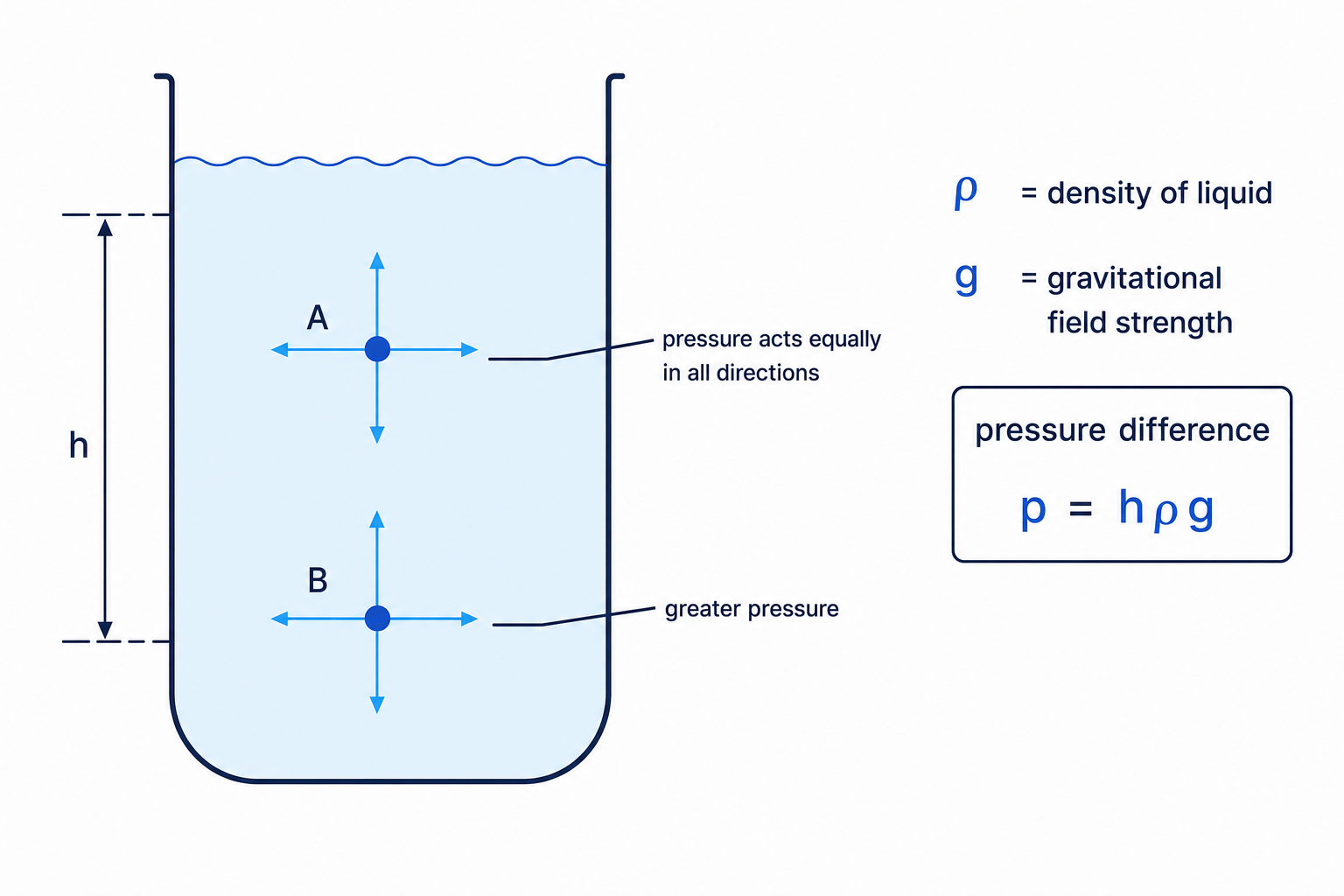
In a liquid or gas at rest, the pressure at a point acts equally in all directions. That means a tiny object placed at that point would be pushed from above, below and sideways. The force due to pressure on a surface acts at right angles to that surface.
At the same depth in a liquid, pressure is the same in all directions. But pressure increases with depth, so a lower point in the liquid has a greater pressure than a higher point.
Fluid pressure direction
Pressure in a liquid or gas at rest does not just act downward; at a single point, it acts equally in all directions.
Pressure difference with depth
In a liquid, pressure increases with depth because there is more liquid above pressing down. The pressure difference between two levels depends on the vertical height between them.
Pressure difference
Pressure difference means the extra pressure between two points in a fluid, often between the surface and a point below the surface.
The Edexcel equation is:
pressure difference=height×density×gravitational field strength\text{pressure difference} = \text{height} \times \text{density} \times \text{gravitational field strength}pressure difference=height×density×gravitational field strength p=h×ρ×gp = h \times \rho \times gp=h×ρ×gwhere:
- ppp is pressure difference in Pa
- hhh is vertical height or depth in m
- ρ\rhoρ is density of the fluid in kg/m³
- ggg is gravitational field strength in N/kg
Calculating pressure difference
A diver is 3.0 m below the surface of fresh water. The density of water is 1000 kg/m³ and g=10 N/kgg = 10\ \text{N/kg}g=10 N/kg. Find the pressure difference between the surface and the diver.
- Use the vertical depth as the height: h=3.0 mh = 3.0\ \text{m}h=3.0 m.
- Substitute into p=h×ρ×gp = h \times \rho \times gp=h×ρ×g: p=3.0 m×1000 kg/m3×10 N/kgp = 3.0\ \text{m} \times 1000\ \text{kg/m}^3 \times 10\ \text{N/kg}p=3.0 m×1000 kg/m3×10 N/kg.
- Calculate the pressure difference: p=30000 Pa=30 kPap = 30000\ \text{Pa} = 30\ \text{kPa}p=30000 Pa=30 kPa.
Height means vertical depth
In p=h×ρ×gp = h \times \rho \times gp=h×ρ×g, hhh is the vertical depth below the surface, not the distance along a sloping wall or pipe.
Pressure difference, not total pressure
The equation p=h×ρ×gp = h \times \rho \times gp=h×ρ×g gives the pressure difference due to the fluid. In an open container, the total pressure would also include atmospheric pressure if the question asks for it.
In the exam
- Write the equation first, then substitute values with units before calculating.
- Convert volumes to m³ and areas to m² before using density or pressure equations.
- For fluids, check whether the question asks about pressure direction, pressure increasing with depth, or a numerical pressure difference.
Check yourself
- How would you find the density of an irregular stone using a balance and water displacement?
- Why does standing on one foot create more pressure on the floor than standing on two feet?
- In p=h×ρ×gp = h \times \rho \times gp=h×ρ×g, what does the height hhh actually represent?
