This question is about the production of ethanol and its conversion into a synthetic polymer.
Sucrose contains the sugar C12H22O11\text{C}_{12}\text{H}_{22}\text{O}_{11}C12H22O11. When yeast is added, water reacts with sucrose to form glucose, C6H12O6\text{C}_6\text{H}_{12}\text{O}_6C6H12O6, and fructose, C6H12O6\text{C}_6\text{H}_{12}\text{O}_6C6H12O6. Write a chemical equation for this reaction.
The mixture of glucose and fructose is then converted into ethanol by the yeast:
C6H12O6(aq)→2C2H5OH(aq)+2CO2(g) \text{C}_6\text{H}_{12}\text{O}_6\text{(aq)} \rightarrow 2\text{C}_2\text{H}_5\text{OH(aq)} + 2\text{CO}_2\text{(g)} C6H12O6(aq)→2C2H5OH(aq)+2CO2(g)State how you would know when this fermentation reaction has completely stopped.
State how the solid yeast could be removed from the liquid mixture.
Ethanol can be converted into chloroethene, CH2=CHCl\text{CH}_2=\text{CHCl}CH2=CHCl, in three stages:
Explain why the reaction in Stage 1 is described as a dehydration reaction.
Identify a catalyst used for the reaction in Stage 1.
Suggest the name or formula of the substance used to react with ethene in Stage 2.
Write a chemical equation for the reaction in Stage 3.
Chloroethene can be used to manufacture the addition polymer poly(chloroethene) (PVC). The diagram shows part of a poly(chloroethene) molecule:
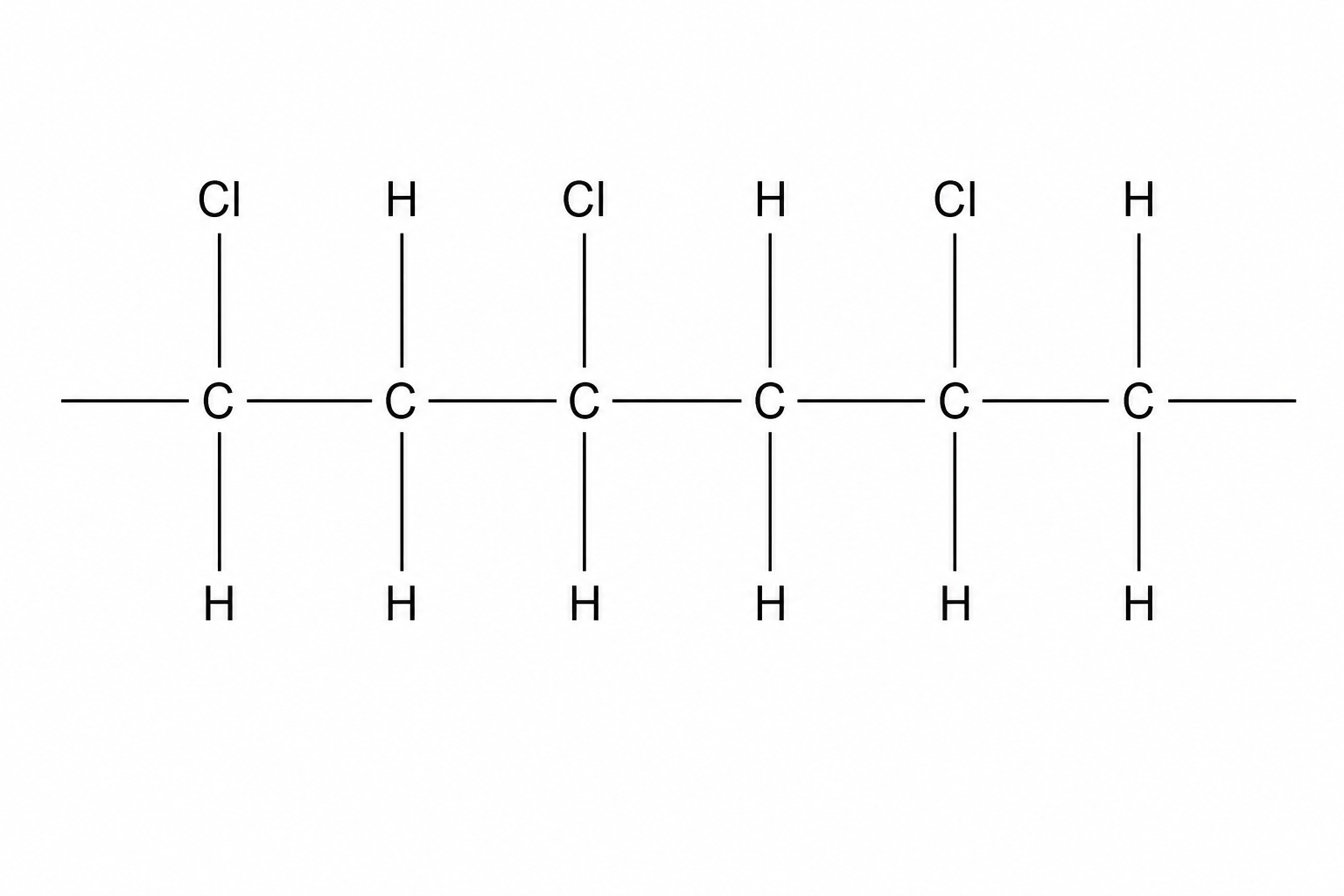
Draw the displayed formula for a chloroethene molecule.
Describe, in terms of structure and bonding, what happens when chloroethene molecules are converted into poly(chloroethene).

