

What you'll learn
- How to recognise a reversible reaction and write it using the ⇌\rightleftharpoons⇌ symbol.
- What dynamic equilibrium means in a sealed container.
- How temperature, pressure and catalysts affect an equilibrium mixture.
- How to predict the direction an equilibrium shifts.
Before we start: forward and reverse reactions
In a normal chemical equation, the substances on the left are the reactants and the substances on the right are the products.
For example:
2H2(g)+O2(g)→2H2O(l)2H_2(g) + O_2(g) \rightarrow 2H_2O(l)2H2(g)+O2(g)→2H2O(l)
The arrow shows the reaction mainly going from left to right.
But in some reactions, the products can react together to make the original reactants again. These are reversible reactions.
Reversible reaction
A reversible reaction is a reaction that can go in both directions: reactants can form products, and products can form reactants.
The reversible reaction symbol
Reversible reactions are shown using the symbol ⇌\rightleftharpoons⇌ instead of a one-way arrow.
For a general reaction:
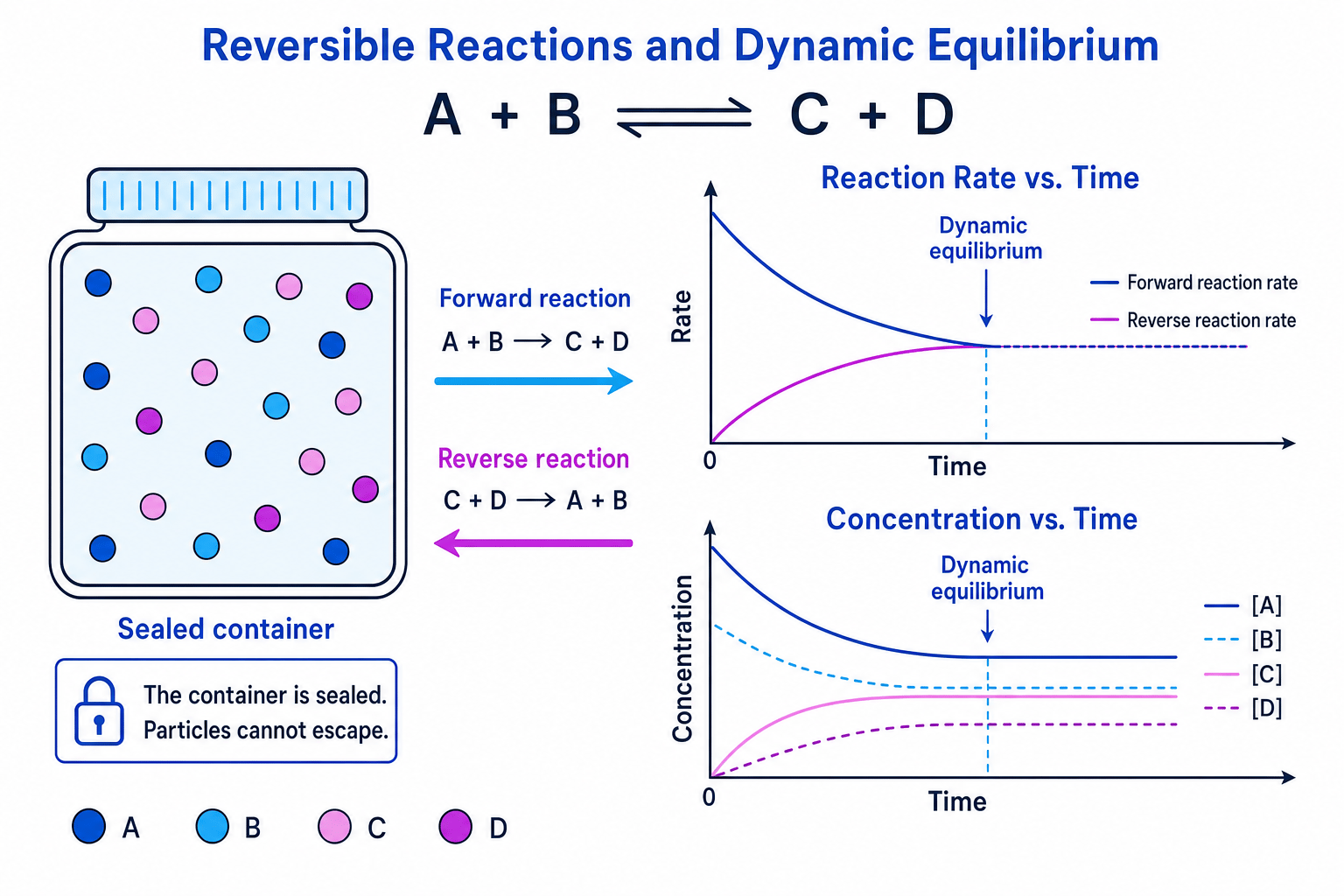
A+B⇌C+DA + B \rightleftharpoons C + DA+B⇌C+D
- The forward reaction is A+B→C+DA + B \rightarrow C + DA+B→C+D.
- The reverse reaction is C+D→A+BC + D \rightarrow A + BC+D→A+B.
The double arrow
The ⇌\rightleftharpoons⇌ symbol means the reaction can happen in both directions. It does not automatically mean the two sides are present in equal amounts.
Interpreting a reversible equation
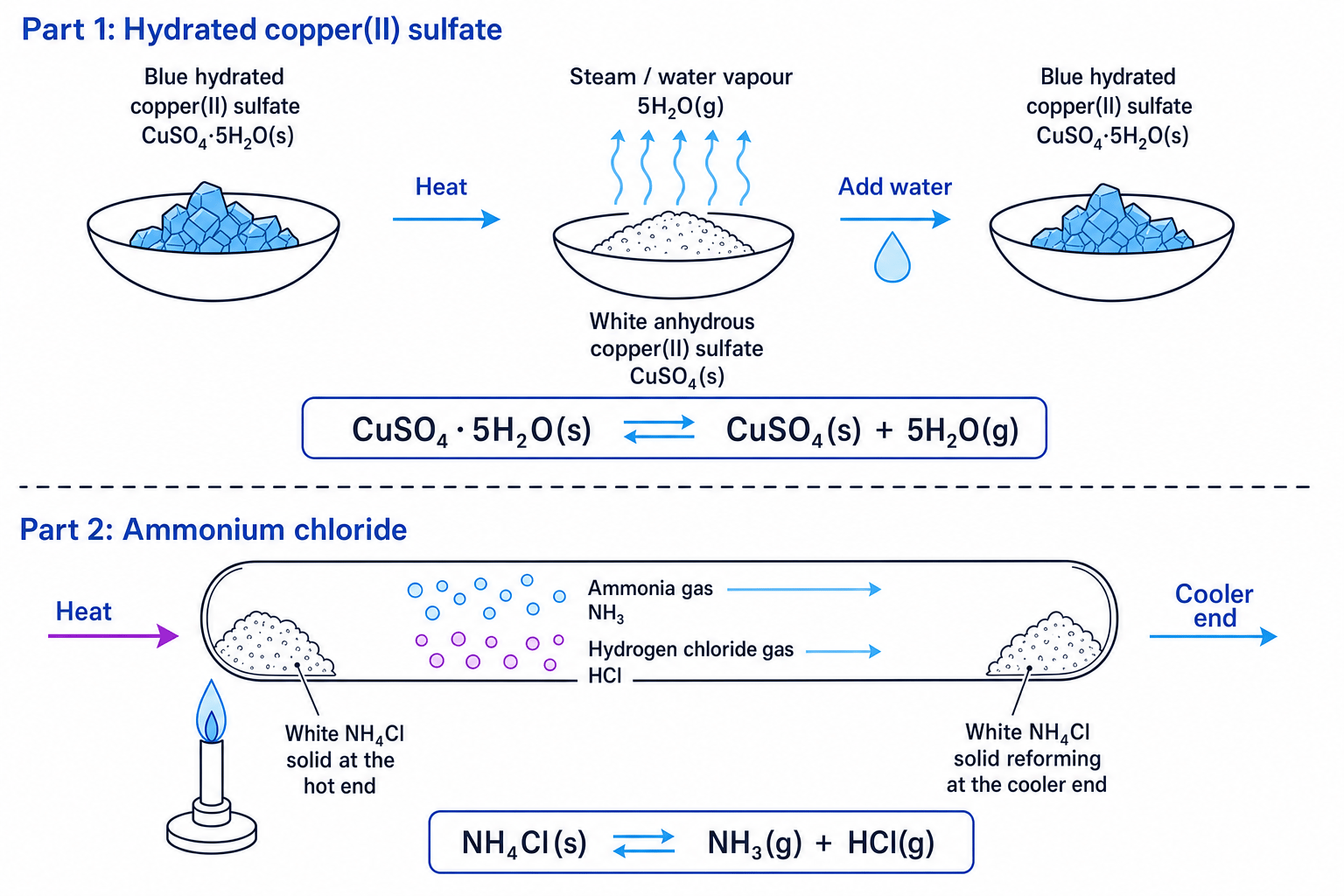
For the reaction NH4Cl(s)⇌NH3(g)+HCl(g)NH_4Cl(s) \rightleftharpoons NH_3(g) + HCl(g)NH4Cl(s)⇌NH3(g)+HCl(g), identify the forward and reverse reactions.
-
Treat the left-to-right direction as the forward reaction, so solid ammonium chloride breaks down: NH4Cl(s)→NH3(g)+HCl(g)NH_4Cl(s) \rightarrow NH_3(g) + HCl(g)NH4Cl(s)→NH3(g)+HCl(g)
-
Treat the right-to-left direction as the reverse reaction, so ammonia and hydrogen chloride join together: NH3(g)+HCl(g)→NH4Cl(s)NH_3(g) + HCl(g) \rightarrow NH_4Cl(s)NH3(g)+HCl(g)→NH4Cl(s)
-
Use the state symbols to understand the observation: gases can move through the tube, then form white solid ammonium chloride again in a cooler place.
Example 1: hydrated copper(II) sulfate
Hydrated copper(II) sulfate contains water of crystallisation and is blue. When it is heated, it loses water and forms white anhydrous copper(II) sulfate.
CuSO4⋅5H2O(s)⇌CuSO4(s)+5H2O(g)CuSO_4 \cdot 5H_2O(s) \rightleftharpoons CuSO_4(s) + 5H_2O(g)CuSO4⋅5H2O(s)⇌CuSO4(s)+5H2O(g)
- Hydrated copper(II) sulfate: blue crystals, CuSO4⋅5H2O(s)CuSO_4 \cdot 5H_2O(s)CuSO4⋅5H2O(s)
- Anhydrous copper(II) sulfate: white solid, CuSO4(s)CuSO_4(s)CuSO4(s)
- Heating drives off water.
- Adding water changes the white solid back to blue.
Open dish is not equilibrium
When hydrated copper(II) sulfate is heated in an open dish, the water vapour escapes. The reaction is still reversible, but the system is not sealed, so it does not settle into dynamic equilibrium.
Example 2: heating ammonium chloride
Ammonium chloride is a white solid. When heated, it breaks down into ammonia gas and hydrogen chloride gas.
NH4Cl(s)⇌NH3(g)+HCl(g)NH_4Cl(s) \rightleftharpoons NH_3(g) + HCl(g)NH4Cl(s)⇌NH3(g)+HCl(g)
At the cooler end of the tube, the gases react again to form white ammonium chloride solid.
Typical observations:
- White solid ammonium chloride disappears from the hot part.
- Colourless gases move along the tube.
- White solid ammonium chloride reforms in the cooler part.
Reversible does not mean identical conditions
A reversible reaction can go both ways, but the conditions often decide which direction is favoured. Heating may favour one direction; cooling may favour the reverse direction.
Dynamic equilibrium in a sealed container
This part is Paper 2 only, but it is still important.
A sealed container is a closed system: substances cannot enter or leave. This matters because gases or vapours must stay inside for the reverse reaction to continue.
Dynamic equilibrium
Dynamic equilibrium is reached in a reversible reaction in a sealed container when the forward and reverse reactions happen at the same rate, so the concentrations of reactants and products remain constant.
At the start, there may be lots of reactants and very little product. The forward reaction is fast. As products build up, the reverse reaction becomes faster. Eventually, the two rates become equal.
At dynamic equilibrium:
- The forward reaction is still happening.
- The reverse reaction is still happening.
- The two rates are equal.
- The concentrations stay constant.
- The mixture does not look as if it is changing overall.
Equal rates, not equal amounts
At equilibrium, the rates of the forward and reverse reactions are equal. The concentrations of reactants and products are constant, but they do not have to be equal to each other.
Deciding whether equilibrium can be reached
A reversible reaction produces a gas. The reaction is carried out first in an open beaker, then in a sealed flask. Decide where dynamic equilibrium is more likely.
-
In the open beaker, gas particles can escape, so the reverse reaction has fewer product particles available to react.
-
In the sealed flask, gas particles cannot escape, so both forward and reverse reactions can continue.
-
Dynamic equilibrium is more likely in the sealed flask because the forward and reverse reactions can eventually occur at the same rate.
Position of equilibrium
The position of equilibrium describes which side of a reversible reaction is favoured at equilibrium.
Position of equilibrium
The position of equilibrium tells you the relative amounts of reactants and products in the equilibrium mixture. If it lies to the right, there are more products. If it lies to the left, there are more reactants.
If a change causes more products to form, we say the equilibrium shifts to the right. If more reactants form, it shifts to the left.
Effect of a catalyst
A catalyst is a substance that increases the rate of a reaction without being used up.
In a reversible reaction, a catalyst speeds up both the forward and reverse reactions. This means equilibrium is reached faster, but the final equilibrium mixture is unchanged.
Catalysts and equilibrium
A catalyst does not change the position of equilibrium. It only helps the reaction reach equilibrium more quickly.
Predicting the effect of a catalyst
A reversible reaction is at equilibrium. A catalyst is added. Predict what happens to the position of equilibrium.
-
A catalyst increases the rate of reaction by providing a lower activation energy pathway.
-
In a reversible reaction, this affects both the forward and reverse reactions, so neither side is favoured overall.
-
The position of equilibrium stays the same, but if the system was not already at equilibrium, it would get there faster.
Effect of temperature
Temperature changes can shift the position of equilibrium. You need to know which direction is endothermic and which is exothermic.
Endothermic and exothermic
An endothermic reaction takes in heat energy from the surroundings. An exothermic reaction releases heat energy to the surroundings.
For reversible reactions:
- Increasing temperature shifts equilibrium in the endothermic direction.
- Decreasing temperature shifts equilibrium in the exothermic direction.
For hydrated copper(II) sulfate, heating favours dehydration:
CuSO4⋅5H2O(s)⇌CuSO4(s)+5H2O(g)CuSO_4 \cdot 5H_2O(s) \rightleftharpoons CuSO_4(s) + 5H_2O(g)CuSO4⋅5H2O(s)⇌CuSO4(s)+5H2O(g)
The forward reaction is endothermic because heat is needed to drive off water.
Predicting the effect of temperature
For this equilibrium, the forward reaction is endothermic:
CuSO4⋅5H2O(s)⇌CuSO4(s)+5H2O(g)CuSO_4 \cdot 5H_2O(s) \rightleftharpoons CuSO_4(s) + 5H_2O(g)CuSO4⋅5H2O(s)⇌CuSO4(s)+5H2O(g)
Predict the effect of increasing temperature.
-
Identify the direction that takes in heat: the forward reaction is endothermic.
-
Increasing temperature favours the endothermic direction, so the equilibrium shifts to the right.
-
More CuSO4(s)CuSO_4(s)CuSO4(s) and H2O(g)H_2O(g)H2O(g) form, so the blue hydrated solid is more likely to become white anhydrous copper(II) sulfate.
Temperature shortcut
Think of heat as helping the endothermic direction. More temperature favours the heat-taking direction; less temperature favours the heat-releasing direction.
Effect of pressure
Pressure only matters for equilibria involving gases. When pressure changes, look at the number of moles of gas on each side of the equation.
For gases, the big numbers in front of formulae tell you the number of moles.
Example:
N2(g)+3H2(g)⇌2NH3(g)N_2(g) + 3H_2(g) \rightleftharpoons 2NH_3(g)N2(g)+3H2(g)⇌2NH3(g)
- Left side: 1 mole of N2N_2N2 plus 3 moles of H2H_2H2 = 4 moles of gas.
- Right side: 2 moles of NH3NH_3NH3 = 2 moles of gas.
For reversible reactions involving gases:
- Increasing pressure shifts equilibrium towards the side with fewer moles of gas.
- Decreasing pressure shifts equilibrium towards the side with more moles of gas.
Predicting the effect of pressure
For the equilibrium N2(g)+3H2(g)⇌2NH3(g)N_2(g) + 3H_2(g) \rightleftharpoons 2NH_3(g)N2(g)+3H2(g)⇌2NH3(g), predict the effect of increasing pressure.
-
Count gaseous moles on the left: 1 mole of N2N_2N2 plus 3 moles of H2H_2H2 gives 4 moles of gas.
-
Count gaseous moles on the right: 2 moles of NH3NH_3NH3 gives 2 moles of gas.
-
Increasing pressure favours the side with fewer moles of gas, so equilibrium shifts to the right and more ammonia forms.
Counting solids and liquids for pressure
When predicting the effect of pressure, count only gases. Solids and liquids are not counted for this rule.
If both sides have the same number of moles of gas, changing pressure has no effect on the position of equilibrium.
Putting it all together
For any equilibrium question, ask:
- Is the system sealed? If not, dynamic equilibrium may not be reached.
- Which direction is endothermic and which is exothermic?
- How many moles of gas are on each side?
- Is a catalyst involved? If yes, it changes rate but not equilibrium position.
In the exam
-
For a reversible reaction, use the ⇌\rightleftharpoons⇌ symbol and include state symbols when equations are requested.
-
For dynamic equilibrium, always state both key features: the forward and reverse reactions occur at the same rate, and concentrations remain constant.
-
For temperature or pressure changes, give the direction of shift and the reason: endothermic/exothermic for temperature, fewer/more moles of gas for pressure.
Check yourself
- Why must a reversible reaction be in a sealed container to reach dynamic equilibrium?
- In 2SO2(g)+O2(g)⇌2SO3(g)2SO_2(g) + O_2(g) \rightleftharpoons 2SO_3(g)2SO2(g)+O2(g)⇌2SO3(g), which direction is favoured by increasing pressure?
- Why does adding a catalyst not change the final amounts of reactants and products at equilibrium?
