

What you'll learn
- What rate of reaction means and how to calculate it from data.
- How surface area, concentration, pressure, temperature and catalysts affect rate.
- How to explain rate changes using collision theory.
- How the required practicals for marble chips and hydrogen peroxide work.
What does “rate of reaction” mean?
A chemical reaction is a process where reactants are changed into products. Some reactions are very fast, such as explosions. Others are slow, such as rusting.
Rate of reaction
The rate of reaction is the change in amount of reactant used up, or product formed, per unit time.
For a reaction that makes a gas, a very common way to measure rate is:
rate=volume of gas producedtime taken\text{rate} = \frac{\text{volume of gas produced}}{\text{time taken}}rate=time takenvolume of gas producedTypical units are cm³/s. If you are measuring mass lost, the units might be g/s.
On a graph of product formed against time, the gradient means the rate. A steeper line means a faster reaction. When the graph becomes horizontal, the reaction has stopped because no more product is being made.
Calculating average rate from gas volume
A reaction produces 48 cm³ of carbon dioxide in the first 60 s. Calculate the average rate during this time.
- Choose the correct rate expression for the measurement: gas is being collected, so use rate=volumetime\text{rate} = \frac{\text{volume}}{\text{time}}rate=timevolume.
- Substitute the values with units: rate=48 cm360 s=0.80 cm3/s\text{rate} = \frac{48\ \text{cm}^3}{60\ \text{s}} = 0.80\ \text{cm}^3/\text{s}rate=60 s48 cm3=0.80 cm3/s.
- Interpret the answer: on average, 0.80 cm³ of carbon dioxide was produced each second during the first 60 s.
Final volume is not the same as rate
A higher final gas volume does not automatically mean a faster reaction. Rate is about how quickly gas is produced, so compare the gradient or the time taken to collect a fixed volume.
Collision theory
Chemical reactions happen when particles collide.
Successful collision
A successful collision is a collision between reacting particles that has enough energy to form products.
Activation energy
The activation energy, usually written as EaE_aEa, is the minimum energy that particles must have when they collide for a reaction to occur.
If a change makes more successful collisions happen each second, the reaction is faster.
The collision theory test
To explain a faster reaction, link the change to more frequent collisions or to more collisions with energy greater than or equal to EaE_aEa.
Factors that affect rate
Surface area of a solid
Surface area means the exposed area of a solid that can touch other reactants.
For the same mass of solid, small pieces or powder have a larger surface area than large lumps. This means more solid particles are exposed, so reacting particles collide with the solid more frequently. The rate increases.
Example: powdered calcium carbonate reacts faster with hydrochloric acid than large marble chips.
Concentration of a solution
Concentration is the amount of solute dissolved in a certain volume of solution. It is often measured in mol/dm³ or g/dm³.
A more concentrated solution contains more reacting particles in each cm³. The particles are closer together, so collisions happen more often. The rate increases.
If changing concentration also changes the amount of a limiting reactant, the final amount of product may change too. The limiting reactant is the reactant that runs out first.
Pressure of a gas
For reactions involving gases, increasing pressure pushes gas particles closer together. This increases the number of particles in a given volume, so collisions happen more frequently. The rate increases.
This explanation only applies to gases, not to solids or liquids in the same simple way.
Temperature
When temperature increases, particles have more kinetic energy. Kinetic energy is the energy particles have because they are moving.
At a higher temperature:
- particles move faster, so they collide more often
- a larger fraction of collisions have energy greater than or equal to EaE_aEa
This usually gives a large increase in rate.
Explaining why warming increases rate
Magnesium reacts faster with warm dilute hydrochloric acid than with cold dilute hydrochloric acid. Explain why.
- Identify the particle change: at higher temperature, acid particles and magnesium particles have more kinetic energy.
- Link this to collisions: the particles move faster, so they collide more frequently.
- Link this to activation energy: more collisions have energy greater than or equal to EaE_aEa, so there are more successful collisions per second and the reaction is faster.
To investigate temperature experimentally, you could repeat the same gas-producing reaction at different temperatures, using a water bath to warm the reactants. Keep the mass and surface area of solid, acid concentration, acid volume and apparatus the same each time.
Catalysts
Catalyst
A catalyst is a substance that increases the rate of a reaction but is chemically unchanged at the end of the reaction.
A catalyst works by providing an alternative reaction pathway with a lower activation energy. Because the new EaE_aEa is lower, more collisions are successful at the same temperature.
A catalyst does not get used up in the reaction, and it does not increase the maximum amount of product made from a fixed amount of reactants.
Catalysts are not reactants
Do not write a catalyst as if it is used up. It may appear above a reaction arrow, but it should not be shown as a reactant that turns into products.
Reaction profile diagrams
A reaction profile diagram shows how the energy changes during a reaction. This part is Paper 2 only, but it is very useful for understanding catalysts.
The y-axis is energy. The x-axis is progress of reaction.
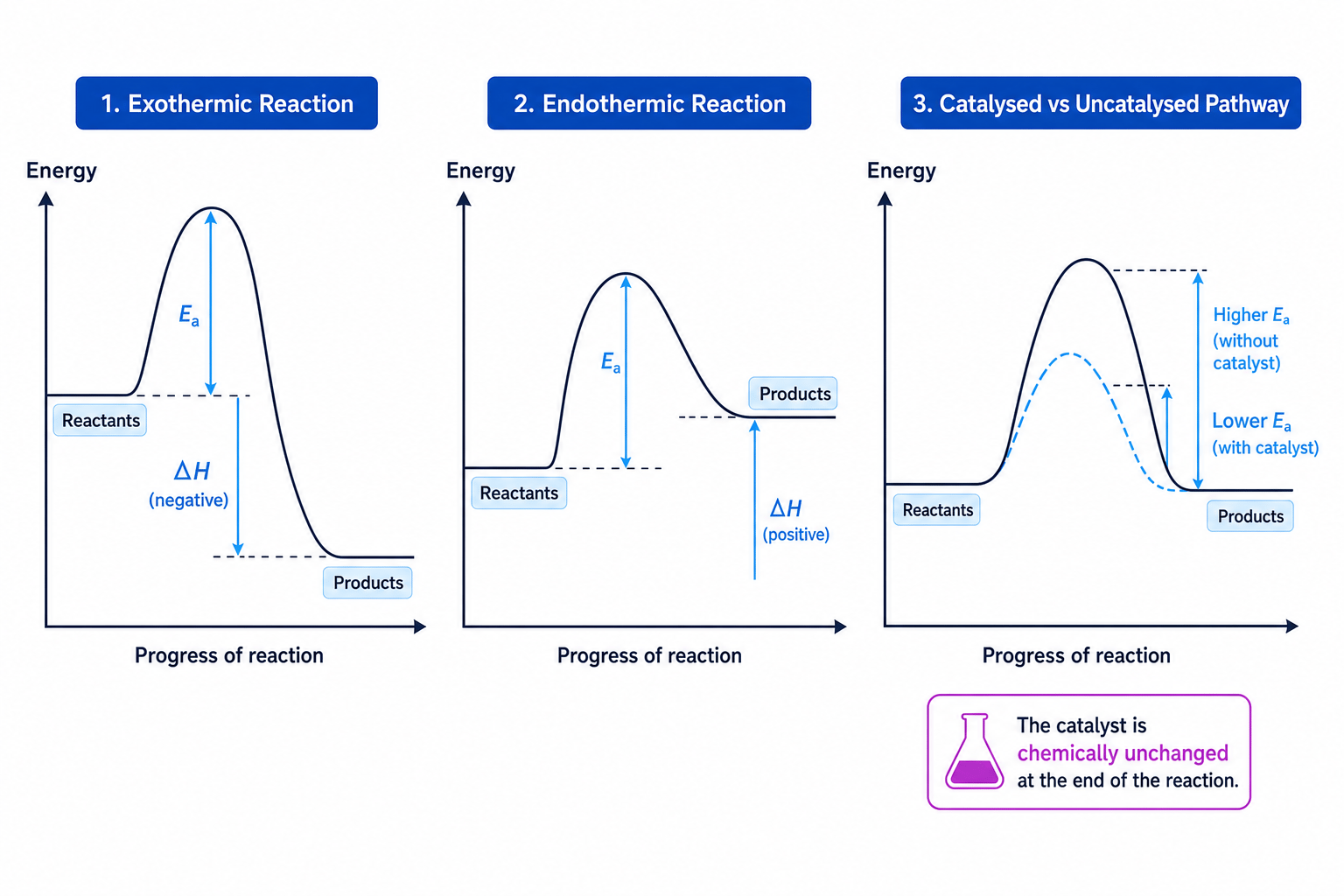
The peak of the curve represents the highest-energy point in the reaction pathway.
- EaE_aEa is measured from the reactants’ energy level up to the peak.
- ΔH\Delta HΔH is the energy change between reactants and products.
- For an exothermic reaction, products are lower than reactants, so ΔH\Delta HΔH is negative.
- For an endothermic reaction, products are higher than reactants, so ΔH\Delta HΔH is positive.
- A catalyst lowers EaE_aEa, but does not change ΔH\Delta HΔH.
Calculating activation energy and energy change
A reaction profile has reactants at 50 kJ/mol, products at 20 kJ/mol and a peak at 125 kJ/mol.
- Calculate activation energy from reactants to peak: Ea=125−50=75 kJ/molE_a = 125 - 50 = 75\ \text{kJ/mol}Ea=125−50=75 kJ/mol.
- Calculate energy change from reactants to products: ΔH=20−50=−30 kJ/mol\Delta H = 20 - 50 = -30\ \text{kJ/mol}ΔH=20−50=−30 kJ/mol.
- Interpret the sign: ΔH\Delta HΔH is negative, so the reaction is exothermic.
Drawing reaction profiles
Always draw EaE_aEa from the reactant level to the peak, not from the x-axis. Draw ΔH\Delta HΔH between the reactant level and product level.
Practical: marble chips and hydrochloric acid
This required practical investigates how changing the surface area of marble chips and the concentration of hydrochloric acid affects rate.
Marble chips are mostly calcium carbonate, CaCO3CaCO_3CaCO3. They react with dilute hydrochloric acid:
CaCO3(s)+2HCl(aq)→CaCl2(aq)+H2O(l)+CO2(g)CaCO_3(s) + 2HCl(aq) \rightarrow CaCl_2(aq) + H_2O(l) + CO_2(g)CaCO3(s)+2HCl(aq)→CaCl2(aq)+H2O(l)+CO2(g)The carbon dioxide gas can be collected in a gas syringe.
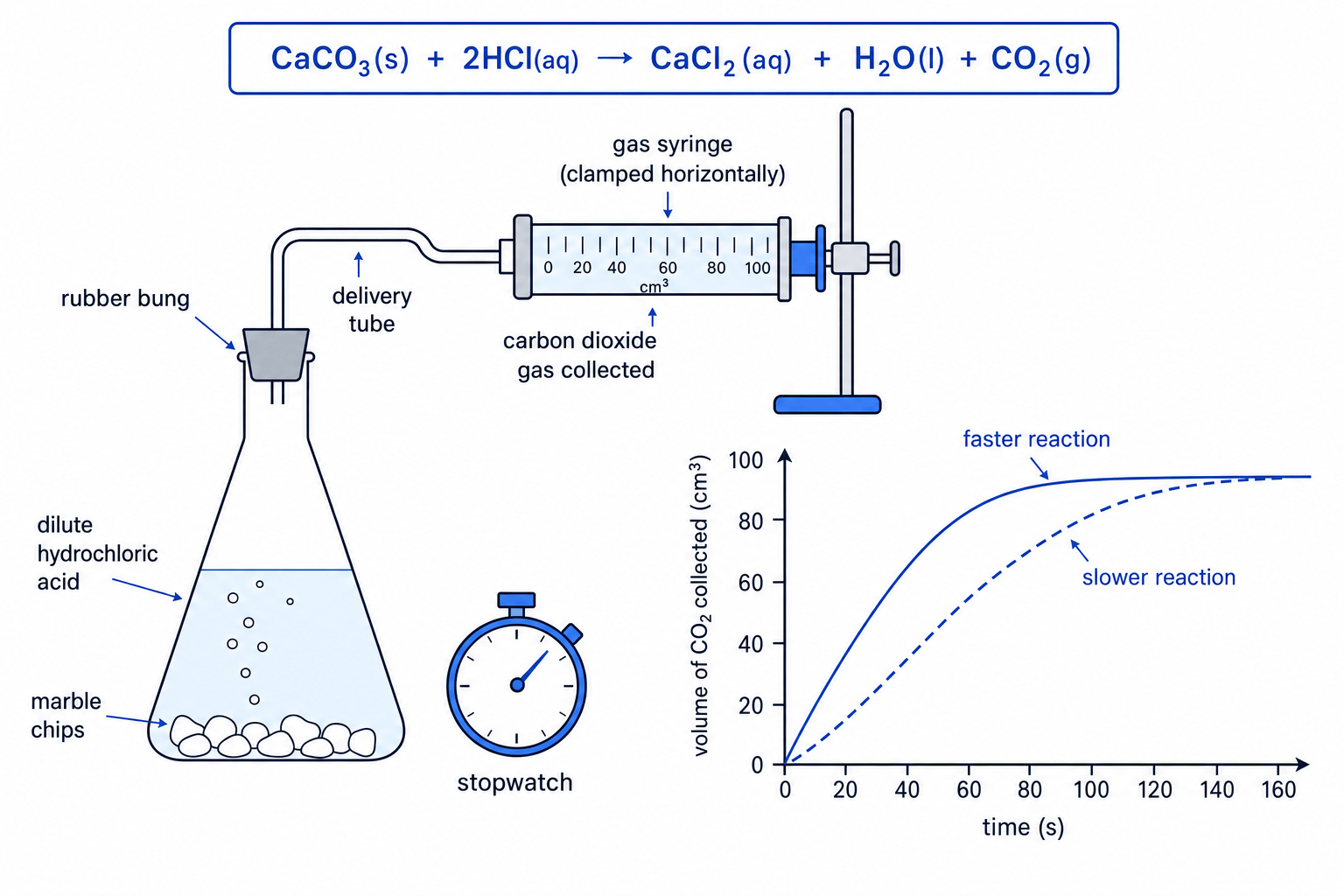
Method
- Add a measured volume and concentration of dilute hydrochloric acid to a conical flask.
- Add a measured mass of marble chips.
- Quickly fit the bung connected to a gas syringe and start the stopwatch.
- Record the volume of carbon dioxide every 10 or 20 s until no more gas is produced.
- Repeat and calculate a mean result.
Changing surface area
To test surface area, use the same mass of calcium carbonate but in different forms, such as large chips, small chips and powder.
- Independent variable: surface area of marble chips.
- Dependent variable: rate of carbon dioxide production.
- Control variables: mass of marble, acid volume, acid concentration, temperature and apparatus.
Expected result: smaller chips or powder give a steeper gas-volume graph, so the rate is faster.
Changing concentration
To test concentration, keep the same mass and size of marble chips but use different concentrations of hydrochloric acid.
- Independent variable: concentration of hydrochloric acid.
- Dependent variable: rate of carbon dioxide production.
- Control variables: marble mass, marble surface area, acid volume, temperature and apparatus.
Expected result: higher acid concentration gives a faster rate because there are more acid particles per cm³.
Gas can escape at the start
If the bung is fitted slowly after adding the marble chips, some carbon dioxide escapes before measurement begins. This makes the measured gas volume too low, especially near the start.
Practical: catalytic decomposition of hydrogen peroxide
Hydrogen peroxide solution slowly decomposes to form water and oxygen:
2H2O2(aq)→2H2O(l)+O2(g)2H_2O_2(aq) \rightarrow 2H_2O(l) + O_2(g)2H2O2(aq)→2H2O(l)+O2(g)Different solids can be tested to see how well they catalyse this reaction. Manganese(IV) oxide, MnO2MnO_2MnO2, is often an effective catalyst.
Method
- Add a fixed volume and concentration of hydrogen peroxide solution to a conical flask.
- Add a fixed mass of the solid being tested.
- Quickly fit a bung connected to a gas syringe and start the stopwatch.
- Measure the volume of oxygen produced in a fixed time, or record oxygen volume at regular time intervals.
- Repeat with different solids, keeping conditions the same.
Variables and expected results
- Independent variable: the solid added.
- Dependent variable: rate of oxygen production.
- Control variables: volume and concentration of hydrogen peroxide, mass of solid, temperature and apparatus.
A better catalyst gives a steeper graph and produces more oxygen in the same time. The catalyst should be chemically unchanged at the end, although some solid may be lost during transfer or filtration.
Common errors include gas leaks, delay in fitting the bung, using different particle sizes of solid catalysts, and temperature changes during the experiment.
In the exam
- For “explain the effect on rate” questions, always use collision theory: say how collisions change and whether more collisions are successful.
- For practical questions, state the independent variable, dependent variable and at least two sensible control variables.
- For rate graphs, compare gradients; for reaction profiles, label EaE_aEa from reactants to peak and ΔH\Delta HΔH between reactants and products.
Check yourself
- Why does powdered marble react faster than large marble chips of the same mass?
- How does increasing temperature affect both collision frequency and activation energy?
- In the hydrogen peroxide practical, why must the same mass of each solid be used?
