

What you'll learn
- What hydrocarbons are, and why carbon is so important in organic chemistry.
- How to represent organic molecules using empirical, molecular, general, structural and displayed formulae.
- What homologous series, functional groups and isomerism mean.
- How to name simple organic compounds and classify substitution, addition and combustion reactions.
Organic chemistry: the carbon chemistry topic
Organic chemistry is the study of carbon-containing compounds. In IGCSE Chemistry, you mainly meet molecules made from carbon, hydrogen and sometimes oxygen or halogens.
Carbon is useful because each carbon atom forms four covalent bonds. This lets carbon atoms join together in chains, branches and rings, making many different compounds.
Hydrocarbon
A hydrocarbon is a compound made of hydrogen and carbon only. For example, methane, CH4CH_4CH4, and ethene, C2H4C_2H_4C2H4, are hydrocarbons. Ethanol, C2H5OHC_2H_5OHC2H5OH, is not a hydrocarbon because it contains oxygen.
Not every carbon compound is a hydrocarbon
Carbon dioxide, CO2CO_2CO2, contains carbon but no hydrogen, so it is not a hydrocarbon. Ethanol contains carbon and hydrogen, but also oxygen, so it is not a hydrocarbon either.
Ways to write organic formulae
Chemists use different types of formula depending on what they want to show. The same molecule can be represented in several ways.
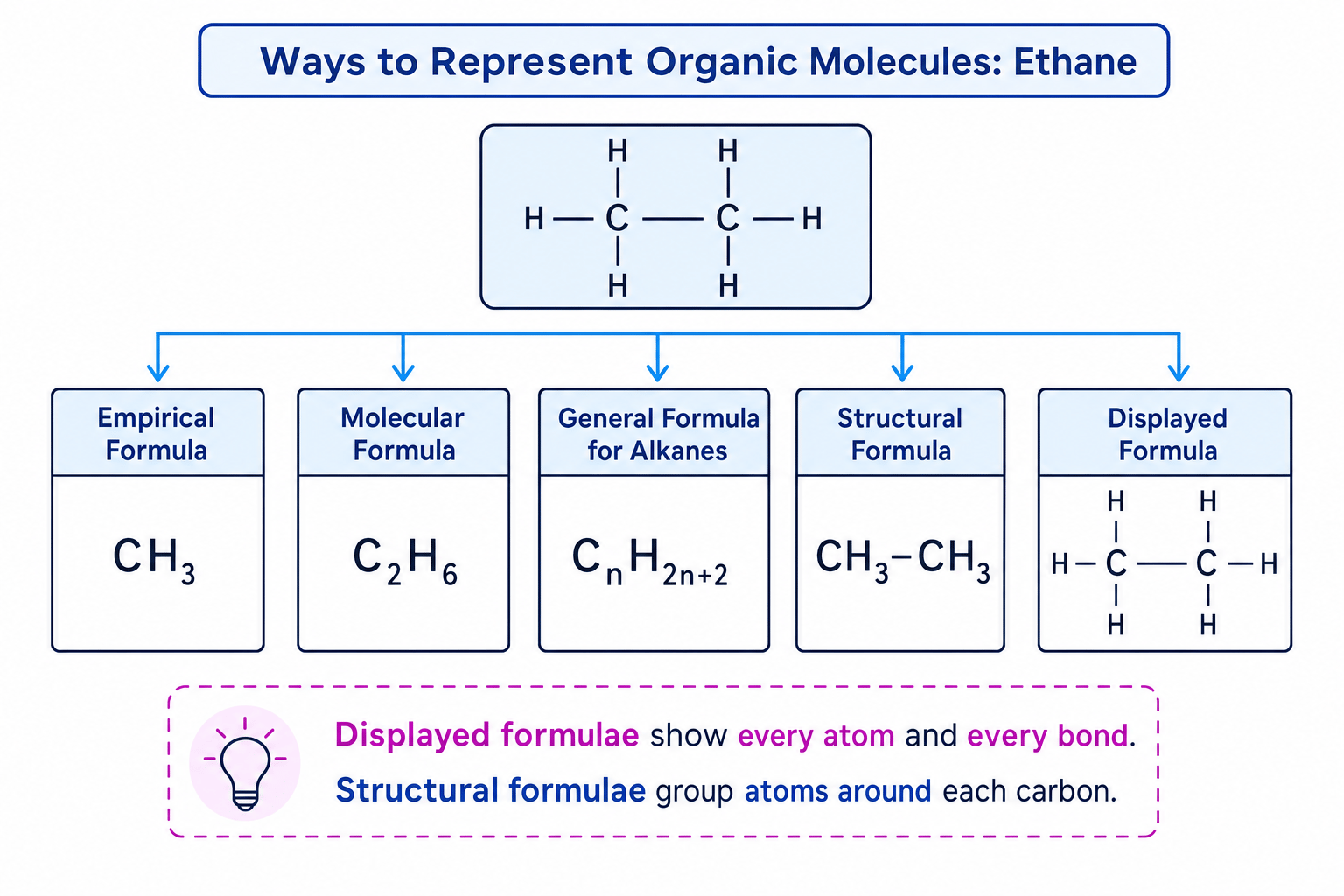
The diagram below compares the main formula types using ethane, which is a simple alkane.
Empirical formula
The empirical formula shows the simplest whole-number ratio of atoms in a compound.
For ethane, the molecular formula is C2H6C_2H_6C2H6. The ratio 2 carbon : 6 hydrogen simplifies to 1 carbon : 3 hydrogen, so the empirical formula is CH3CH_3CH3.
Molecular formula
The molecular formula shows the actual number of atoms of each element in one molecule.
For example, propane has molecular formula C3H8C_3H_8C3H8, meaning one molecule contains 3 carbon atoms and 8 hydrogen atoms.
General formula
A general formula describes every member of a homologous series using nnn for the number of carbon atoms.
For example, alkanes have the general formula CnH2n+2C_nH_{2n+2}CnH2n+2. If n=3n=3n=3, the formula is C3H8C_3H_8C3H8, which is propane.
Structural formula
A structural formula shows how atoms are arranged, but groups atoms together to save space.
For example, propane can be written as CH3CH2CH3CH_3CH_2CH_3CH3CH2CH3.
Displayed formula
A displayed formula shows every atom and every covalent bond.
Displayed formulae are especially useful when you need to show a double bond, a branch, or the exact position of a functional group.
Finding formulae for propene
Propene has molecular formula C3H6C_3H_6C3H6.
- Compare the numbers of atoms to find the empirical formula: the ratio 3 carbon : 6 hydrogen divides by 3, giving 1 carbon : 2 hydrogen, so the empirical formula is CH2CH_2CH2.
- Check the general formula for alkenes: alkenes have formula CnH2nC_nH_{2n}CnH2n, and when n=3n=3n=3, this gives C3H6C_3H_6C3H6.
- Write a structural formula by arranging 3 carbons with one C=C double bond and enough hydrogens for each carbon to have four bonds: CH2=CHCH3CH_2=CHCH_3CH2=CHCH3.
General formulae have limits
A general formula only applies to the correct homologous series. Do not use the alkane formula CnH2n+2C_nH_{2n+2}CnH2n+2 for alkenes, alcohols or carboxylic acids.
Homologous series and functional groups
A homologous series is a family of organic compounds with the same functional group and similar chemical reactions. Consecutive members usually differ by CH2CH_2CH2.
Functional group
A functional group is the atom, group of atoms, or bond that gives an organic compound its characteristic chemical reactions. For example, alkenes contain a C=C double bond, and alcohols contain the -OH group.
Important homologous series in this specification include:
- Alkanes: saturated hydrocarbons with only single C-C bonds, such as methane and ethane.
- Alkenes: unsaturated hydrocarbons with a C=C double bond, such as ethene and propene.
- Alcohols: compounds containing the -OH functional group, such as ethanol.
- Carboxylic acids: compounds containing the -COOH functional group, such as ethanoic acid.
- Esters: compounds containing the -COO- group, often with sweet or fruity smells.
The big pattern
Members of the same homologous series have similar chemical reactions because they have the same functional group. Their physical properties, such as boiling point, change gradually as the carbon chain gets longer.
Naming organic compounds: IUPAC basics
The International Union of Pure and Applied Chemistry, usually shortened to IUPAC, provides systematic rules for naming compounds. In this specification, you should be able to name compounds containing up to six carbon atoms.
Carbon chain prefixes
Learn these six prefixes very securely:
- 1 carbon: meth-
- 2 carbons: eth-
- 3 carbons: prop-
- 4 carbons: but-
- 5 carbons: pent-
- 6 carbons: hex-
Suffixes show the homologous series
The ending of the name shows the type of compound:
- -ane means alkane, for example propane.
- -ene means alkene, for example propene.
- -anol means alcohol, for example ethanol or propan-1-ol.
- -anoic acid means carboxylic acid, for example ethanoic acid.
- alkyl alkanoate means ester, for example ethyl ethanoate.
If a functional group or double bond could be in more than one position, use a number to show where it is. Number the chain from the end that gives the important group the lowest possible number.
Naming an alkene
Name the compound CH3CH2CH=CH2CH_3CH_2CH=CH_2CH3CH2CH=CH2.
- Find the longest chain: there are 4 carbon atoms, so the prefix is but-.
- Identify the functional group: there is a C=C double bond, so the suffix is -ene.
- Number from the end nearest the double bond: the double bond starts at carbon 1, so the name is but-1-ene.
Name = chain length + family
Most simple organic names are built from two clues: the prefix tells you the number of carbon atoms, and the suffix tells you the homologous series.
Isomerism
Sometimes two molecules have the same molecular formula but different arrangements of atoms. This is why organic chemistry has so many different compounds.
Isomerism
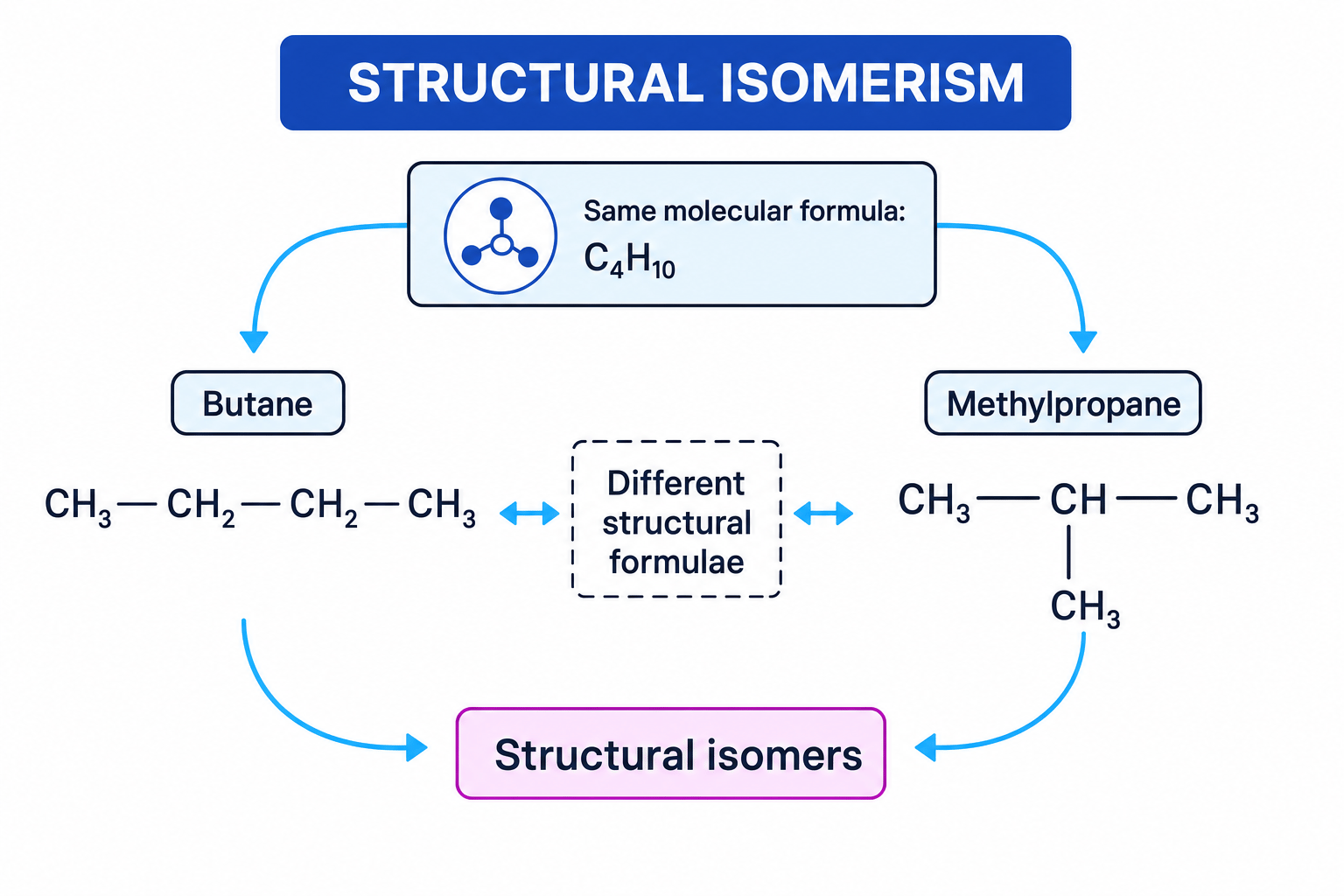
Isomerism occurs when compounds have the same molecular formula but different structural formulae. These compounds are called isomers.
The diagram below shows structural isomerism for C4H10C_4H_{10}C4H10.
Writing possible formulae from a molecular formula
When you are asked to write possible structural or displayed formulae, work systematically:
- Use all atoms in the molecular formula.
- Check carbon forms four bonds.
- Check hydrogen forms one bond.
- Try a straight chain first, then try branched chains.
- Do not count the same structure twice just because it has been drawn backwards.
Writing isomers of C4H10
Write the possible structural formulae for C4H10C_4H_{10}C4H10.
- Start with a straight chain of 4 carbon atoms. Add enough hydrogens so every carbon has four bonds: CH3CH2CH2CH3CH_3CH_2CH_2CH_3CH3CH2CH2CH3, called butane.
- Try a shorter main chain of 3 carbon atoms with the fourth carbon as a branch on the middle carbon: CH3CH(CH3)CH3CH_3CH(CH_3)CH_3CH3CH(CH3)CH3, called methylpropane.
- Check for duplicates: putting the branch on either end of the 3-carbon chain just gives the straight-chain structure again, so there are only two structural isomers of C4H10C_4H_{10}C4H10.
Carbon cannot have five bonds
When drawing displayed formulae, count carefully around each carbon. A carbon atom should have four covalent bonds in these organic molecules.
Classifying organic reactions
You do not need reaction mechanisms for this topic. That means you do not need to show exactly how electrons move during the reaction. You do need to recognise the type of reaction.
Substitution reactions
A substitution reaction happens when one atom or group of atoms is replaced by another.
Alkanes can react with halogens in ultraviolet light. For example, methane reacts with chlorine to form chloromethane and hydrogen chloride:
CH4(g)+Cl2(g)→CH3Cl(g)+HCl(g)CH_4\text{(g)} + Cl_2\text{(g)} \to CH_3Cl\text{(g)} + HCl\text{(g)}CH4(g)+Cl2(g)→CH3Cl(g)+HCl(g)One hydrogen atom in methane has been replaced by a chlorine atom.
Addition reactions
An addition reaction happens when atoms are added across a C=C double bond. Alkenes do addition reactions because they are unsaturated.
For example, ethene reacts with hydrogen to form ethane:
C2H4(g)+H2(g)→C2H6(g)C_2H_4\text{(g)} + H_2\text{(g)} \to C_2H_6\text{(g)}C2H4(g)+H2(g)→C2H6(g)The double bond becomes a single bond, and the extra atoms are added to the molecule.
Combustion reactions
A combustion reaction is a reaction with oxygen that releases energy. Complete combustion of hydrocarbons produces carbon dioxide and water.
For example, methane burns completely in oxygen:
CH4(g)+2O2(g)→CO2(g)+2H2O(l)CH_4\text{(g)} + 2O_2\text{(g)} \to CO_2\text{(g)} + 2H_2O\text{(l)}CH4(g)+2O2(g)→CO2(g)+2H2O(l)Classifying reaction types
Classify each reaction.
A: C3H8(g)+5O2(g)→3CO2(g)+4H2O(l)C_3H_8\text{(g)} + 5O_2\text{(g)} \to 3CO_2\text{(g)} + 4H_2O\text{(l)}C3H8(g)+5O2(g)→3CO2(g)+4H2O(l)
B: C2H4(g)+H2(g)→C2H6(g)C_2H_4\text{(g)} + H_2\text{(g)} \to C_2H_6\text{(g)}C2H4(g)+H2(g)→C2H6(g)
C: C2H6(g)+Cl2(g)→C2H5Cl(g)+HCl(g)C_2H_6\text{(g)} + Cl_2\text{(g)} \to C_2H_5Cl\text{(g)} + HCl\text{(g)}C2H6(g)+Cl2(g)→C2H5Cl(g)+HCl(g)
- In A, the hydrocarbon reacts with oxygen and forms carbon dioxide and water, so A is combustion.
- In B, hydrogen is added to an alkene and the formula changes from C2H4C_2H_4C2H4 to C2H6C_2H_6C2H6, so B is addition.
- In C, one hydrogen atom in ethane is replaced by chlorine and hydrogen chloride is also formed, so C is substitution.
In the exam
- For formula questions, decide what each formula type is being tested: simplest ratio, actual atoms, family pattern, atom arrangement, or all bonds.
- For naming, count the longest carbon chain first, then identify the functional group, then number the chain if needed.
- For reaction classification, look for the chemical change: replacement means substitution, adding across C=C means addition, and reaction with oxygen forming CO2CO_2CO2 and H2OH_2OH2O means combustion.
Check yourself
- Why is C2H5OHC_2H_5OHC2H5OH not a hydrocarbon?
- What is the difference between a molecular formula and a displayed formula?
- How would you recognise an addition reaction from a balanced equation?
