

What you'll learn
- Why lithium, sodium and potassium are placed together in Group 1.
- How their reactions with water and air show a trend in reactivity.
- How to predict the properties of other Group 1 metals.
- How electronic configurations explain the reactivity trend (Paper 2 only).
The big idea: a chemical family
The elements in Group 1 of the Periodic Table are called the alkali metals. The main ones you need for this topic are lithium, sodium and potassium.
They are called alkali metals because they react with water to form alkaline solutions.
Alkali
An alkali is a soluble base. In water, Group 1 metals form soluble metal hydroxides, which make alkaline solutions with pH greater than 7.
Lithium, sodium and potassium are recognised as a family of elements because they have very similar chemical reactions. Their similarities come from their atoms all having one electron in the outer shell.
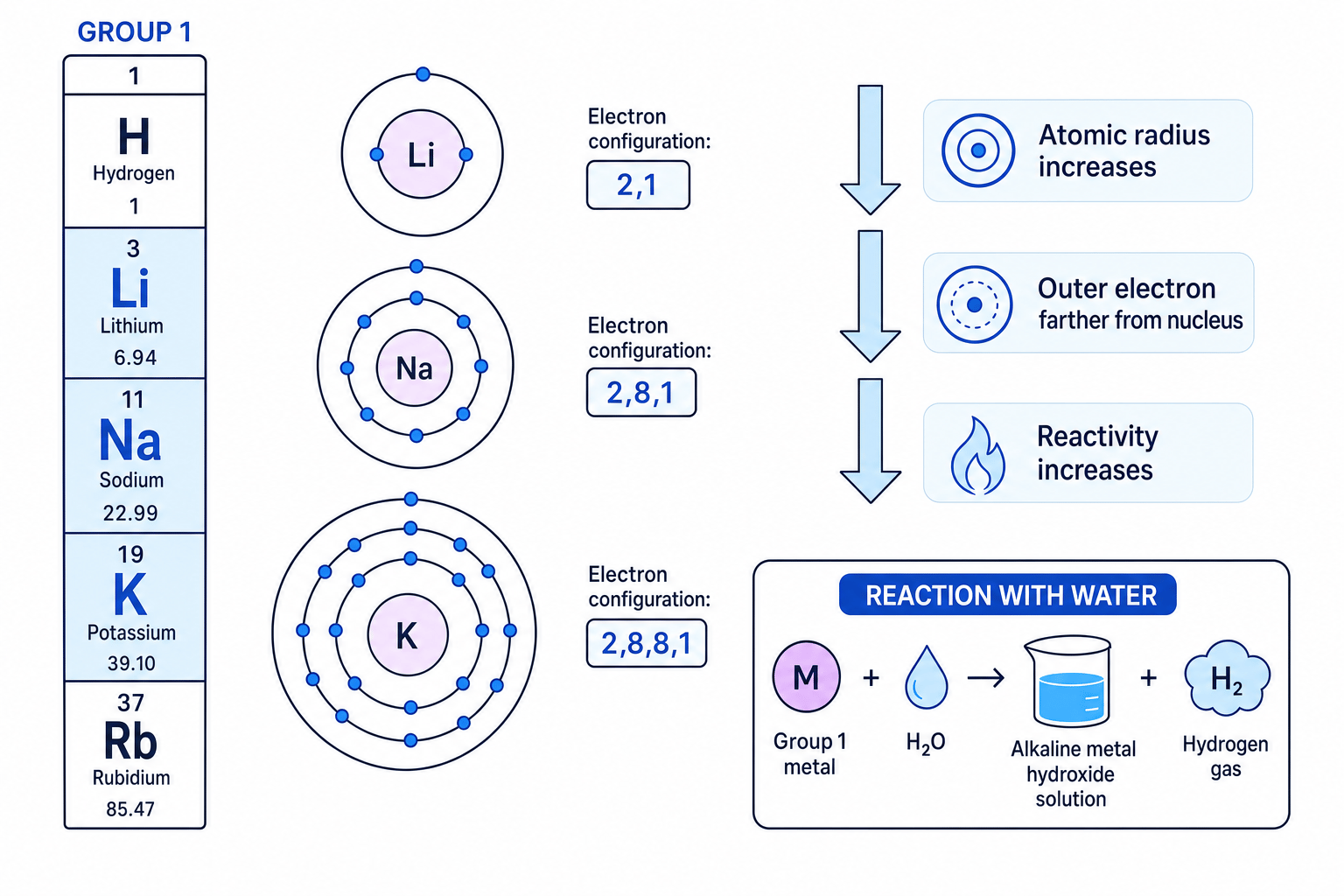
Why Group 1 elements behave similarly
Lithium, sodium and potassium all have one outer-shell electron, so they react in similar ways and form ions with a charge of +1+1+1.
Basic physical properties of Group 1 metals
Group 1 metals are:
- soft — they can be cut with a knife
- shiny when freshly cut
- low density compared with most metals
- good conductors of heat and electricity
- stored under oil because they react with oxygen and water vapour in air
They are still metals, but they are much softer and more reactive than typical transition metals such as iron or copper.
Reaction with water: the key family reaction
All three metals react with cold water to produce:
- a metal hydroxide solution
- hydrogen gas
The general word equation is:
Group 1 metal + water → metal hydroxide + hydrogen
For lithium:
2Li(s)+2H2O(l)→2LiOH(aq)+H2(g)2Li(s) + 2H_2O(l) \to 2LiOH(aq) + H_2(g)2Li(s)+2H2O(l)→2LiOH(aq)+H2(g)For sodium:
2Na(s)+2H2O(l)→2NaOH(aq)+H2(g)2Na(s) + 2H_2O(l) \to 2NaOH(aq) + H_2(g)2Na(s)+2H2O(l)→2NaOH(aq)+H2(g)For potassium:
2K(s)+2H2O(l)→2KOH(aq)+H2(g)2K(s) + 2H_2O(l) \to 2KOH(aq) + H_2(g)2K(s)+2H2O(l)→2KOH(aq)+H2(g)The hydroxides formed are alkaline, so universal indicator would turn blue or purple.
State symbols
State symbols show the physical state of a substance: (s) solid, (l) liquid, (g) gas and (aq) aqueous, meaning dissolved in water.
Observations with water
Lithium reacts gently:
- floats on water
- fizzes slowly
- moves slowly on the surface
- gradually disappears
Sodium reacts more vigorously:
- floats and fizzes
- melts into a silvery ball because the reaction releases heat
- moves quickly around the surface
- disappears faster than lithium
Potassium reacts very vigorously:
- floats and fizzes rapidly
- moves quickly
- may produce a lilac flame
- disappears very quickly
Evidence they are a family
Lithium, sodium and potassium all react with water in the same general way: they produce hydrogen gas and an alkaline metal hydroxide solution.
Writing the equation for sodium reacting with water
-
Identify the products from the Group 1 pattern: sodium reacts with water to form sodium hydroxide and hydrogen.
-
Write the unbalanced symbol equation:
- Balance the hydrogen atoms by placing 2 in front of sodium hydroxide and water, then balance sodium with 2 sodium atoms:
Forgetting hydrogen gas
The gas made when a Group 1 metal reacts with water is hydrogen, not oxygen. Hydrogen gives a squeaky pop with a lit splint.
Reaction with air: tarnishing and oxides
Freshly cut lithium, sodium and potassium are shiny. In air, they quickly become dull because they react with oxygen and other gases in the air. This is called tarnishing.
Tarnishing
Tarnishing is the loss of shine from a metal surface when it reacts with substances in the air, forming a dull surface layer.
The main idea for IGCSE is that the metals react with oxygen to form metal oxides.
For lithium oxide:
4Li(s)+O2(g)→2Li2O(s)4Li(s) + O_2(g) \to 2Li_2O(s)4Li(s)+O2(g)→2Li2O(s)A simplified equation for sodium oxide is:
4Na(s)+O2(g)→2Na2O(s)4Na(s) + O_2(g) \to 2Na_2O(s)4Na(s)+O2(g)→2Na2O(s)Potassium also reacts very quickly with oxygen in air, forming oxide-type products. The exact product can be more complicated, but for this topic the important evidence is the increasing speed of reaction.
Trend in reaction with air
Down Group 1:
- lithium tarnishes slowly
- sodium tarnishes faster
- potassium tarnishes very quickly
This shows that reactivity increases down Group 1.
Easy order to remember
Reactivity increases as you go Li → Na → K. Potassium is the most reactive of the three, lithium is the least reactive.
Comparing reactions with water and air
Both air and water reactions show the same trend.
With water
The reaction becomes more vigorous:
lithium < sodium < potassium
This means:
- fizzing becomes faster
- movement becomes faster
- more heat is released
- flames become more likely
With air
The metals tarnish faster:
lithium < sodium < potassium
So the differences in their reactions are evidence for the trend in reactivity.
Group 1 reactivity trend
The Group 1 metals become more reactive down the group. Potassium reacts more vigorously than sodium, and sodium reacts more vigorously than lithium.
Using observations to rank reactivity
A student observes three Group 1 metals reacting with water. Metal A fizzes gently, metal B melts into a ball and moves quickly, and metal C reacts very rapidly with a lilac flame. Identify which is lithium, sodium and potassium.
-
Compare the vigour of the reactions: gentle fizzing is the least reactive, rapid reaction with a flame is the most reactive.
-
Apply the Group 1 trend: lithium is less reactive than sodium, and sodium is less reactive than potassium.
-
Match the observations: A is lithium, B is sodium, and C is potassium.
Predicting properties of other alkali metals
You can use the Group 1 trend to predict the properties of other alkali metals, such as rubidium and caesium, which are below potassium.
Because reactivity increases down Group 1:
- rubidium is more reactive than potassium
- caesium is more reactive than rubidium
- both would react extremely vigorously with water
- both would tarnish very quickly in air
They would also form hydroxides with water:
rubidium + water → rubidium hydroxide + hydrogen
2Rb(s)+2H2O(l)→2RbOH(aq)+H2(g)2Rb(s) + 2H_2O(l) \to 2RbOH(aq) + H_2(g)2Rb(s)+2H2O(l)→2RbOH(aq)+H2(g)caesium + water → caesium hydroxide + hydrogen
2Cs(s)+2H2O(l)→2CsOH(aq)+H2(g)2Cs(s) + 2H_2O(l) \to 2CsOH(aq) + H_2(g)2Cs(s)+2H2O(l)→2CsOH(aq)+H2(g)Do not suggest doing these reactions casually
Rubidium and caesium are so reactive that their reactions with water can be explosive. At IGCSE, you predict their behaviour from trends rather than handling them in a school demonstration.
Predicting rubidium’s reaction with water
-
Locate rubidium in Group 1: it is below potassium.
-
Apply the trend: reactivity increases down Group 1, so rubidium is more reactive than potassium.
-
Predict the products using the family reaction: rubidium hydroxide solution and hydrogen gas are formed.
-
Write the balanced equation:
Explaining the trend using electronic configurations
This explanation is Paper 2 only, but it is a very useful way to understand the chemistry.
Electronic configuration
An electronic configuration shows how electrons are arranged in shells around the nucleus of an atom. For example, sodium has the electronic configuration 2,8,1.
The electronic configurations are:
- lithium: 2,1
- sodium: 2,8,1
- potassium: 2,8,8,1
Each atom has one electron in its outer shell. When a Group 1 metal reacts, it loses this outer electron to form a positive ion.
For example:
Na→Na++e−Na \to Na^+ + e^-Na→Na++e−The easier it is to lose the outer electron, the more reactive the metal is.
Why the outer electron is lost more easily down the group
As you go down Group 1:
- The atoms have more electron shells.
- The outer electron is further from the positive nucleus.
- Inner shells reduce the attraction between the nucleus and the outer electron.
- The outer electron is lost more easily.
- The metal is more reactive.
Nucleus
The nucleus is the tiny central part of an atom containing protons and neutrons. It is positively charged because protons are positive.
Electron shell
An electron shell is an energy level around the nucleus where electrons are found.
Electronic explanation
Down Group 1, the outer electron is further from the nucleus and more shielded by inner shells, so it is lost more easily. This makes the metals more reactive down the group.
Saying the nucleus gets weaker
The nucleus does not become “weaker” down the group. The outer electron is less strongly attracted because it is further away and shielded by more inner electron shells.
Explaining why potassium is more reactive than sodium
-
Compare the electronic configurations: sodium is 2,8,1, while potassium is 2,8,8,1.
-
Potassium has one more occupied electron shell than sodium, so potassium’s outer electron is further from the nucleus.
-
The inner shells in potassium shield the outer electron more, reducing the attraction between the positive nucleus and the outer electron.
-
Potassium loses its outer electron more easily than sodium, so potassium is more reactive.
Linking structure to reactions
The Group 1 pattern is powerful because it links three ideas:
1. Same group means same outer electrons
Lithium, sodium and potassium all have one outer electron.
2. Same outer electrons means similar reactions
They all form +1+1+1 ions and react with water to form alkaline hydroxides and hydrogen.
3. More shells down the group means higher reactivity
The outer electron is lost more easily down the group, so reactions become more vigorous.
A strong exam sentence
“Reactivity increases down Group 1 because the outer electron is further from the nucleus and more shielded, so it is lost more easily.”
In the exam
-
For reactions with water, always give both products: metal hydroxide and hydrogen.
-
To describe the trend, compare the metals directly: potassium reacts more vigorously than sodium, which reacts more vigorously than lithium.
-
For the electronic explanation, mention outer electron further from the nucleus, more shielding, and lost more easily.
Check yourself
- What observations show that potassium is more reactive than sodium?
- What are the products when lithium reacts with water?
- Why is the outer electron in potassium lost more easily than the outer electron in lithium?

