

What you'll learn
- The colours, room-temperature states and physical trends of chlorine, bromine and iodine.
- How to predict properties of other halogens using Group 7 patterns.
- How halogen displacement reactions show the reactivity order.
- Why reactivity decreases down Group 7 using electron shells.
Starting point: why Group 7 behaves as a family
Atoms have a central nucleus: the tiny positive centre containing protons and neutrons. Electrons are arranged in shells around the nucleus. The outer shell is the furthest occupied electron shell from the nucleus.
Group
A group is a vertical column in the Periodic Table. Elements in the same group have the same number of outer-shell electrons, so they often have similar chemical properties.
Halogens
The halogens are the non-metal elements in Group 7. They include fluorine, chlorine, bromine, iodine and astatine. Halogen atoms have seven electrons in their outer shell.
Because halogen atoms have seven outer-shell electrons, they are one electron short of a full outer shell. They often react by gaining one electron.
An ion is an atom or group of atoms with an electrical charge. If a halogen atom gains one electron, it becomes a negative ion.
Halide ion
A halide ion is the negative ion formed when a halogen atom gains one electron. Examples are chloride Cl−Cl^-Cl−, bromide Br−Br^-Br− and iodide I−I^-I−.
Halogen elements exist as diatomic molecules, which means each molecule contains two atoms. So chlorine is Cl2Cl_2Cl2, bromine is Br2Br_2Br2 and iodine is I2I_2I2.
Colours and states at room temperature
A physical property is something you can observe or measure without making a new substance. Examples include colour, state, melting point, boiling point and density.
Use this diagram to anchor the key Group 7 trends.
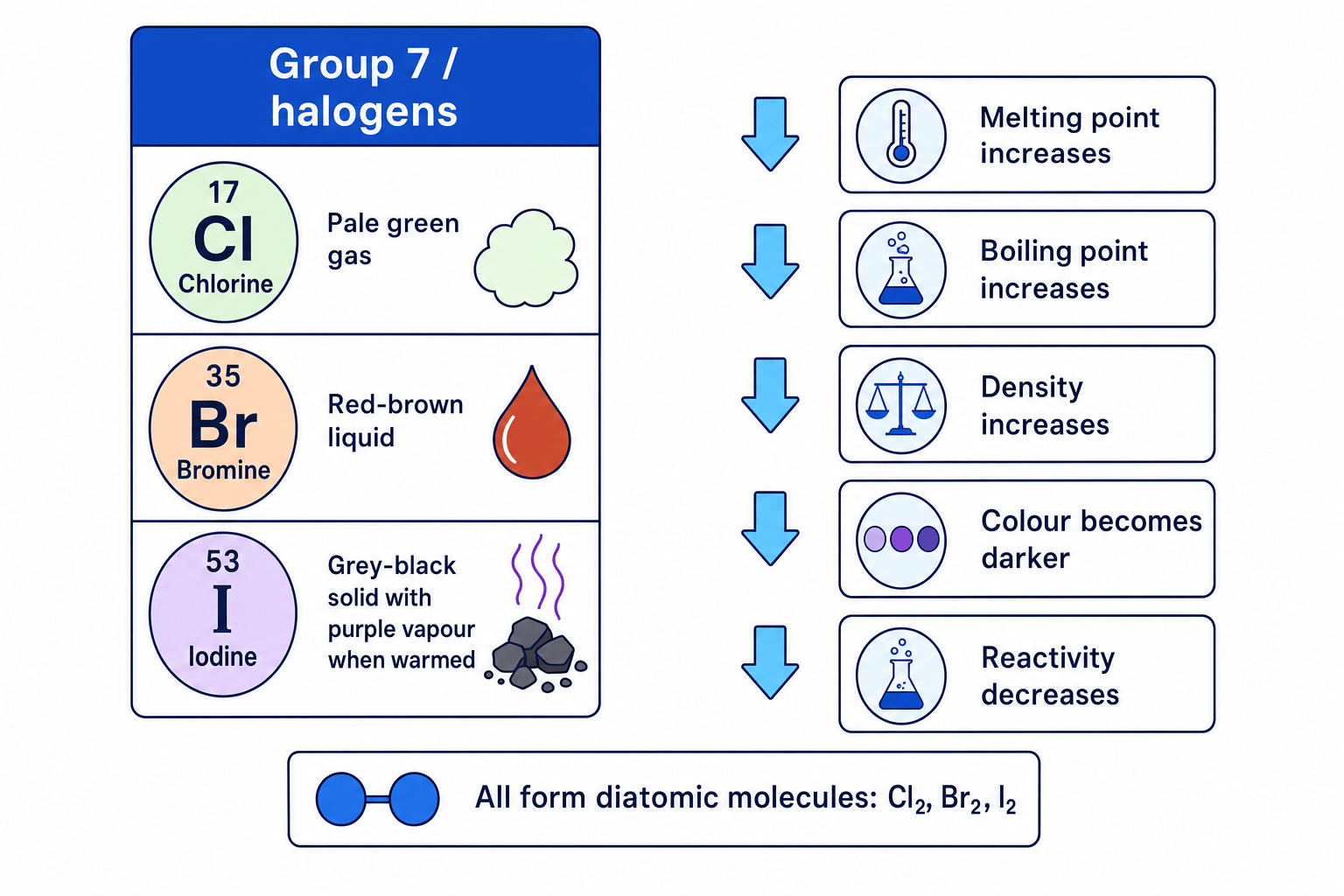
At room temperature, about 20 °C:
- Chlorine, Cl2(g)Cl_2\text{(g)}Cl2(g), is a pale green gas.
- Bromine, Br2(l)Br_2\text{(l)}Br2(l), is a red-brown liquid.
- Iodine, I2(s)I_2\text{(s)}I2(s), is a grey-black solid. When warmed, it gives a purple vapour.
Going down Group 7 from chlorine to iodine:
- the colour becomes darker
- melting point increases
- boiling point increases
- density increases
- reactivity decreases
The melting point is the temperature at which a solid melts. The boiling point is the temperature at which a liquid boils. Density means how much mass is packed into a given volume.
Larger halogen molecules have stronger intermolecular forces, which are attractions between separate molecules. More energy is needed to separate the molecules, so melting and boiling points increase down the group.
Group 7 physical trends
Down Group 7, the halogens become darker and denser, with higher melting and boiling points. Their physical state changes from gas to liquid to solid.
Element colour vs solution colour
Do not confuse the colour of the pure element with the colour seen in solutions. Iodine is a grey-black solid, but iodine in water is brown and iodine in an organic solvent can look purple.
Predicting astatine from trends
Astatine is below iodine in Group 7. Predict its likely state, colour and reactivity.
- Down Group 7, melting and boiling points increase, so astatine should have higher melting and boiling points than iodine.
- Iodine is already a solid at room temperature, so astatine is predicted to be a solid too.
- The colour becomes darker down the group, so astatine is predicted to be very dark, often described as black.
- Reactivity decreases down the group, so astatine is predicted to be less reactive than iodine.
Reactivity in Group 7
Reactivity means how readily a substance takes part in chemical reactions.
For the halogens in this topic, the reactivity order is:
Cl2>Br2>I2Cl_2 > Br_2 > I_2Cl2>Br2>I2This means chlorine is more reactive than bromine, and bromine is more reactive than iodine.
Predicting up or down the group
If you go up Group 7, reactivity increases. Fluorine is above chlorine, so fluorine is more reactive than chlorine. If you go down, reactivity decreases.
Displacement reactions: evidence for reactivity
A displacement reaction happens when a more reactive element takes the place of a less reactive element in a compound.
Displacement reaction
In Group 7, a more reactive halogen displaces a less reactive halogen from its halide ions in solution.
For example, chlorine can displace bromine from bromide ions because chlorine is more reactive than bromine.
An aqueous substance, shown by the state symbol (aq), is dissolved in water. In these reactions, halogen “water” means a solution of the halogen in water, such as chlorine water.
The diagram summarises which displacement reactions happen.
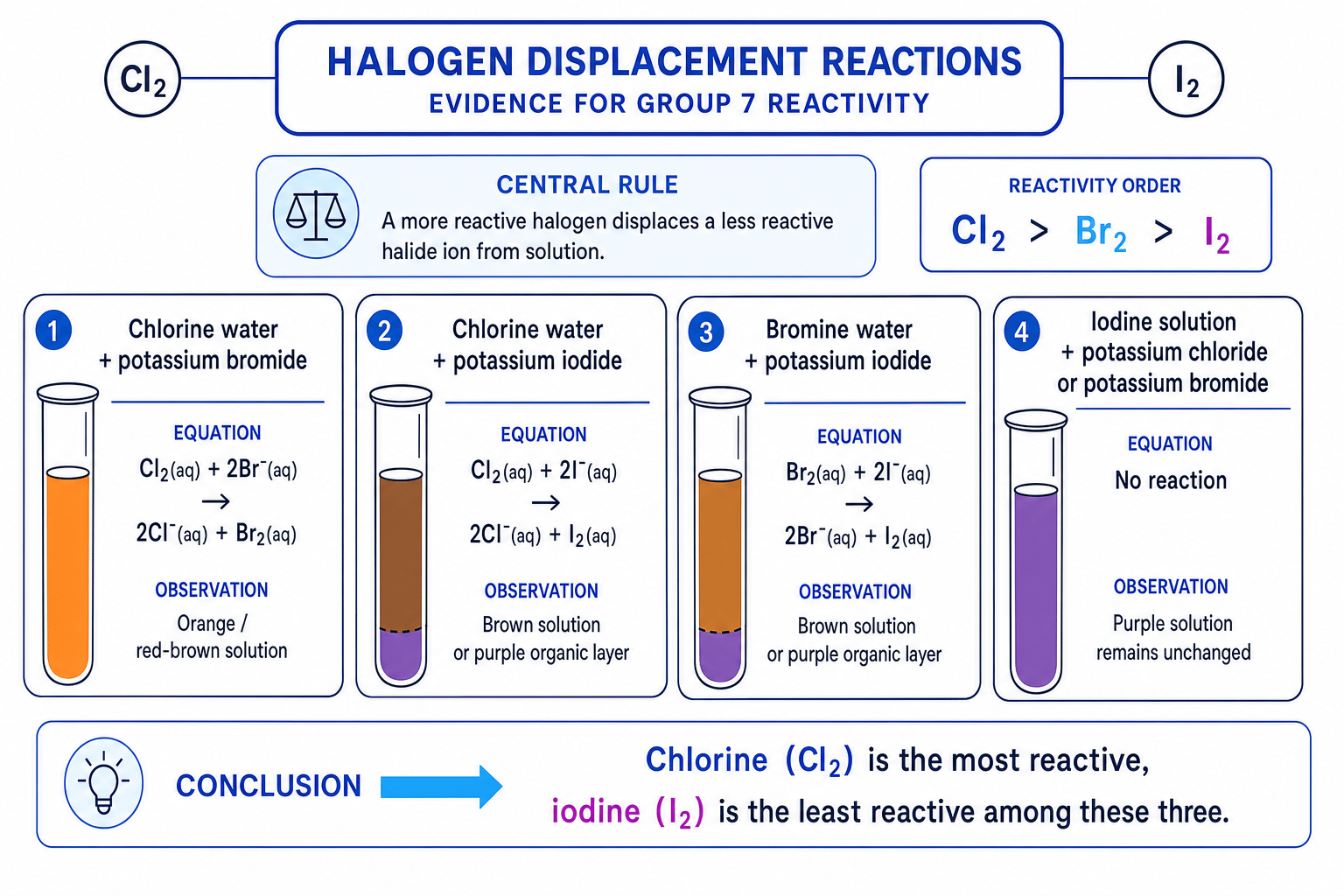
Reactions that happen
Chlorine displaces bromine from bromide ions:
Cl2(aq)+2KBr(aq)→2KCl(aq)+Br2(aq)Cl_2\text{(aq)} + 2KBr\text{(aq)} \rightarrow 2KCl\text{(aq)} + Br_2\text{(aq)}Cl2(aq)+2KBr(aq)→2KCl(aq)+Br2(aq)The ionic equation is:
Cl2(aq)+2Br−(aq)→2Cl−(aq)+Br2(aq)Cl_2\text{(aq)} + 2Br^-\text{(aq)} \rightarrow 2Cl^-\text{(aq)} + Br_2\text{(aq)}Cl2(aq)+2Br−(aq)→2Cl−(aq)+Br2(aq)Chlorine also displaces iodine from iodide ions:
Cl2(aq)+2KI(aq)→2KCl(aq)+I2(aq)Cl_2\text{(aq)} + 2KI\text{(aq)} \rightarrow 2KCl\text{(aq)} + I_2\text{(aq)}Cl2(aq)+2KI(aq)→2KCl(aq)+I2(aq)The ionic equation is:
Cl2(aq)+2I−(aq)→2Cl−(aq)+I2(aq)Cl_2\text{(aq)} + 2I^-\text{(aq)} \rightarrow 2Cl^-\text{(aq)} + I_2\text{(aq)}Cl2(aq)+2I−(aq)→2Cl−(aq)+I2(aq)Bromine displaces iodine from iodide ions:
Br2(aq)+2KI(aq)→2KBr(aq)+I2(aq)Br_2\text{(aq)} + 2KI\text{(aq)} \rightarrow 2KBr\text{(aq)} + I_2\text{(aq)}Br2(aq)+2KI(aq)→2KBr(aq)+I2(aq)The ionic equation is:
Br2(aq)+2I−(aq)→2Br−(aq)+I2(aq)Br_2\text{(aq)} + 2I^-\text{(aq)} \rightarrow 2Br^-\text{(aq)} + I_2\text{(aq)}Br2(aq)+2I−(aq)→2Br−(aq)+I2(aq)A spectator ion is an ion present in the mixture but unchanged by the reaction. In these examples, K+K^+K+ ions are spectator ions, so they do not appear in the ionic equations.
Reactions that do not happen
A less reactive halogen cannot displace a more reactive halide ion.
- Bromine does not displace chloride ions.
- Iodine does not displace chloride ions.
- Iodine does not displace bromide ions.
So bromine water added to potassium chloride solution gives no reaction, and iodine solution added to potassium bromide solution gives no reaction.
Observations
The observations give evidence for which halogen has been formed:
- If bromine forms, the solution becomes orange or red-brown.
- If iodine forms, the solution becomes brown in water, or purple if an organic solvent layer is used.
- If there is no reaction, the original halogen colour remains unchanged.
Displacement rule
A halogen can displace the halide ion of any halogen below it in Group 7, but not one above it.
Wrong state symbol
In displacement reactions using halogen water, write the halogen as aqueous, such as Cl2(aq)Cl_2\text{(aq)}Cl2(aq). Do not write Br2(l)Br_2\text{(l)}Br2(l) if bromine water is being used.
Deciding whether bromine displaces iodide
Bromine water is added to potassium iodide solution. Decide whether a reaction happens and write the ionic equation.
-
The halogen present is bromine, Br2Br_2Br2, and the halide ion present is iodide, I−I^-I−, which comes from iodine.
-
Bromine is above iodine in Group 7, so bromine is more reactive than iodine and can displace iodine from iodide ions.
-
Two iodide ions are needed to form one iodine molecule, so the balanced ionic equation is:
Br2(aq)+2I−(aq)→2Br−(aq)+I2(aq)Br_2\text{(aq)} + 2I^-\text{(aq)} \rightarrow 2Br^-\text{(aq)} + I_2\text{(aq)}Br2(aq)+2I−(aq)→2Br−(aq)+I2(aq) -
Iodine forms, so the solution turns brown in water or purple in an organic layer.
Why reactivity decreases down Group 7
This electronic-configuration explanation is the 2.8C point, assessed on Paper 2 only.
Electronic configuration
The electronic configuration of an atom is the arrangement of its electrons in shells. For example, chlorine has the electronic configuration 2,8,7.
The important pattern is that all Group 7 atoms have seven outer-shell electrons:
- chlorine: 2,8,7
- bromine: 2,8,18,7
- iodine: 2,8,18,18,7
Each halogen atom needs to gain one electron to complete its outer shell. The easier it is to gain that electron, the more reactive the halogen is.
As you go down Group 7, the atoms have more occupied electron shells. This means the outer shell is further from the positive nucleus.
Shielding
Shielding is the reduction in attraction between the positive nucleus and an outer or incoming electron caused by inner electron shells.
More inner shells mean more shielding. So down Group 7, the nucleus attracts an incoming electron less strongly. It becomes harder for the atom to gain an electron, so reactivity decreases.
This diagram shows the key electron-shell reasoning.
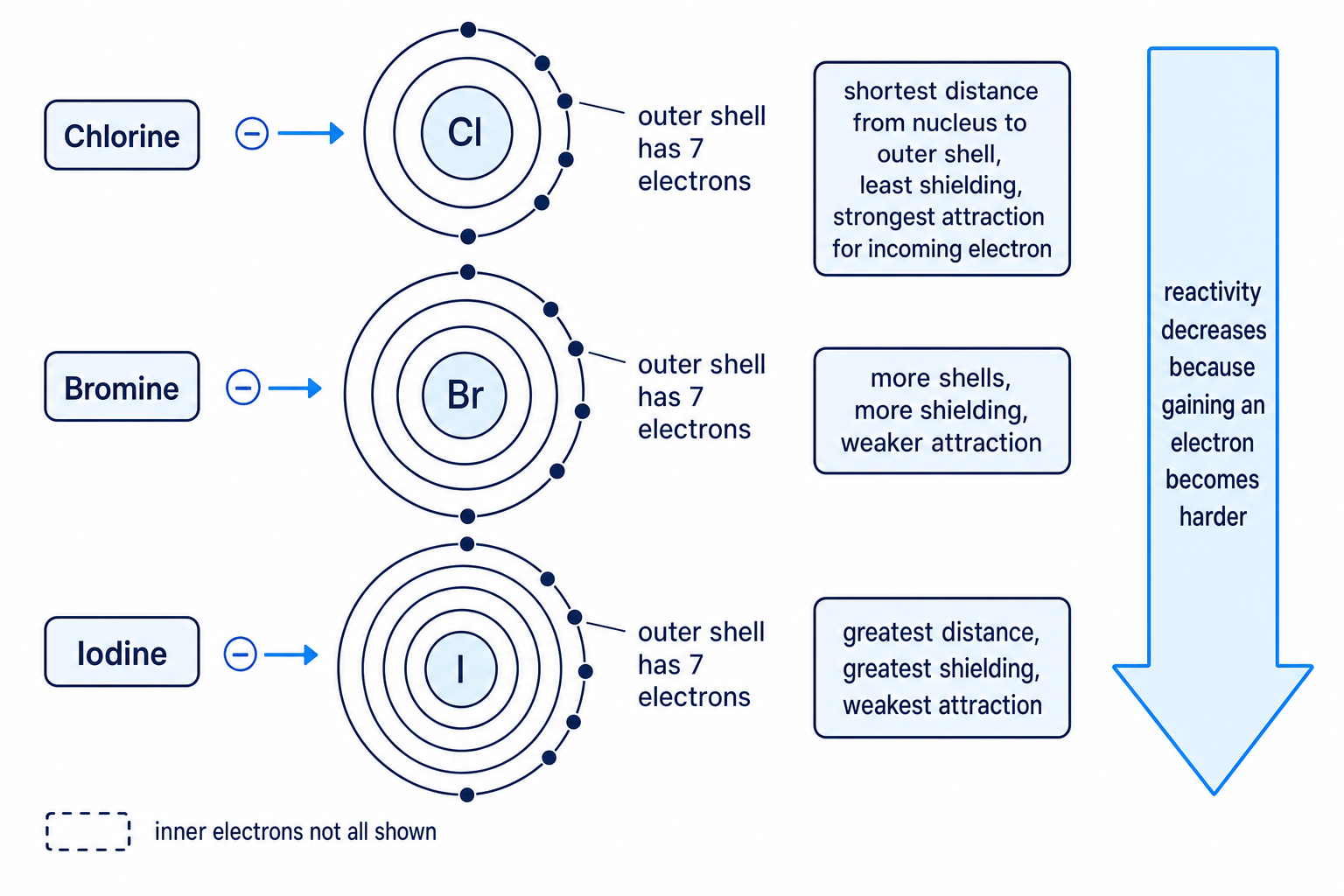
Paper 2 wording
For full explanation marks, use the ideas of more shells, more shielding, weaker attraction for the incoming electron, and therefore less reactive.
Explaining why chlorine is more reactive than iodine
Compare chlorine and iodine using electronic configurations.
- Both chlorine and iodine atoms have seven electrons in their outer shell, so both need to gain one electron to form a full outer shell.
- Chlorine has fewer occupied electron shells than iodine, so chlorine’s outer shell is closer to the nucleus and has less shielding.
- Iodine has more occupied electron shells, so the incoming electron is further from the nucleus and is more shielded by inner electrons.
- The chlorine nucleus attracts the incoming electron more strongly, so chlorine gains an electron more easily and is more reactive than iodine.
Bringing it together
Group 7 trends link together neatly:
- The halogens are non-metals with seven outer-shell electrons.
- They form diatomic molecules: Cl2Cl_2Cl2, Br2Br_2Br2 and I2I_2I2.
- Down the group, physical properties change: darker colour, higher melting point, higher boiling point and higher density.
- Down the group, chemical reactivity decreases.
- Displacement reactions prove the reactivity order because a more reactive halogen displaces a less reactive halide ion.
In the exam
- For trend questions, state the direction clearly: “down Group 7” or “up Group 7”, then give the correct trend.
- For displacement questions, compare the halogen molecule with the halide ion’s element: a halogen only displaces halide ions from elements below it.
- For electronic-configuration explanations, include all three ideas: more shells down the group, more shielding, and weaker attraction for the incoming electron.
Check yourself
- What are the colour and state of chlorine, bromine and iodine at room temperature?
- Chlorine water is added to potassium iodide solution. What product forms, and what observation would you expect?
- Why is iodine less reactive than bromine in terms of electron shells?
