

What you'll learn
- Why covalent compounds and ionic compounds behave differently when you test them for electrical conductivity.
- How electrolysis uses electricity to decompose molten or dissolved ionic compounds.
- How to predict products at the cathode and anode.
- How to write half-equations and link them to oxidation and reduction.
This Edexcel IGCSE electrolysis section is marked with a C suffix, so it is assessed on Paper 2 only — but learn it properly, because it is very predictable once the rules are clear.
The key idea: electricity needs moving charged particles
A substance conducts electricity only if it contains charged particles that can move.
In metals, the moving charged particles are delocalised electrons. In ionic substances, the moving charged particles are ions — but only if the ions are free to move.
Covalent compounds do not conduct electricity
A covalent compound is made when atoms share pairs of electrons. Most covalent compounds are made of neutral molecules, such as water, carbon dioxide or sugar molecules.
Because these molecules have no overall charge, they cannot carry electric current through the substance.
Covalent compounds
Covalent compounds do not conduct electricity because they do not contain mobile charged particles.
A useful exception to know from bonding is graphite, which conducts because it has delocalised electrons — but graphite is an element, not a covalent compound.
Ionic compounds: solid vs molten vs aqueous
An ionic compound is made of positive and negative ions held together in a giant ionic lattice.
Anions and cations
An anion is a negatively charged ion. A cation is a positively charged ion.
In a solid ionic compound, the ions are fixed in place in the lattice. They vibrate, but they cannot move around the structure, so the solid does not conduct electricity.
When the ionic compound is molten or aqueous, the ions can move.
- Molten means melted.
- Aqueous means dissolved in water, shown by the state symbol (aq)\text{(aq)}(aq).
Ionic conductivity
Ionic compounds conduct electricity only when molten or in aqueous solution because their ions are then free to move and carry charge.
Deciding whether a substance conducts
Predict whether solid sodium chloride, molten sodium chloride, and sugar solution conduct electricity.
- Solid sodium chloride is ionic, but its Na+Na^+Na+ and Cl−Cl^-Cl− ions are fixed in a lattice, so it does not conduct.
- Molten sodium chloride is ionic and its ions can move freely, so it does conduct.
- Sugar solution contains covalent sugar molecules, not ions, so it does not conduct.
What electrolysis is
Electrolysis
Electrolysis is the decomposition of an ionic compound, when molten or in aqueous solution, by passing an electric current through it.
The liquid or solution being electrolysed is called the electrolyte.
The current enters and leaves through electrodes. In this topic, you usually use inert electrodes, such as graphite or platinum, which do not react with the electrolyte.
- The cathode is the negative electrode.
- The anode is the positive electrode.
- Positive ions, called cations, move to the cathode.
- Negative ions, called anions, move to the anode.
Remembering the electrodes
In electrolysis: PANIC = Positive Anode, Negative Is Cathode.
Electrolysis of molten lead(II) bromide
Lead(II) bromide, PbBr2PbBr_2PbBr2, is ionic. When solid, it does not conduct. When molten, its ions can move, so it can be electrolysed.
The molten compound contains:
- Pb2+Pb^{2+}Pb2+ cations
- Br−Br^-Br− anions
Here is the cell for molten lead(II) bromide using inert graphite electrodes.
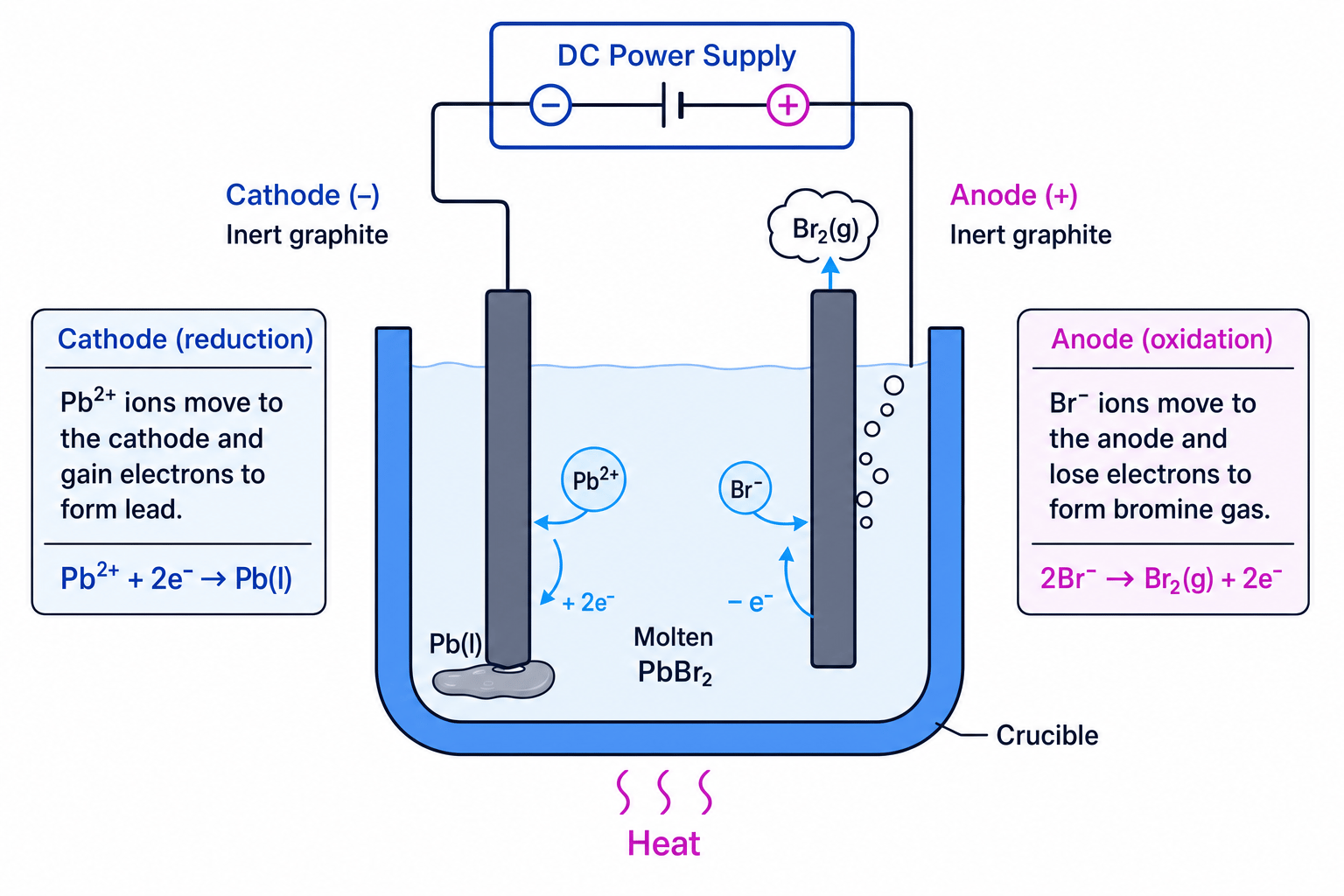
At the cathode, Pb2+Pb^{2+}Pb2+ ions gain electrons and form molten lead:
Pb2+(l)+2e−→Pb(l)Pb^{2+}\text{(l)} + 2e^- \rightarrow Pb\text{(l)}Pb2+(l)+2e−→Pb(l)
At the anode, Br−Br^-Br− ions lose electrons and form bromine gas:
2Br−(l)→Br2(g)+2e−2Br^-\text{(l)} \rightarrow Br_2\text{(g)} + 2e^-2Br−(l)→Br2(g)+2e−
The overall reaction is:
PbBr2(l)→Pb(l)+Br2(g)PbBr_2\text{(l)} \rightarrow Pb\text{(l)} + Br_2\text{(g)}PbBr2(l)→Pb(l)+Br2(g)
Expected observations:
- grey/silvery lead forms at the cathode
- brown bromine vapour forms at the anode
Safety in the lab
Lead compounds and bromine are hazardous, so this experiment needs careful heating, small quantities and good ventilation.
Oxidation and reduction in electrolysis
A half-equation shows what happens to one ion or particle at one electrode, including electrons.
Oxidation and reduction
Oxidation is loss of electrons. Reduction is gain of electrons.
At the cathode, positive ions gain electrons, so reduction happens.
At the anode, negative ions lose electrons, so oxidation happens.
OIL RIG
OIL RIG means Oxidation Is Loss, Reduction Is Gain — of electrons.
Classifying electrode reactions
Classify these half-equations as oxidation or reduction.
Cu2+(aq)+2e−→Cu(s)Cu^{2+}\text{(aq)} + 2e^- \rightarrow Cu\text{(s)}Cu2+(aq)+2e−→Cu(s)
2Cl−(aq)→Cl2(g)+2e−2Cl^-\text{(aq)} \rightarrow Cl_2\text{(g)} + 2e^-2Cl−(aq)→Cl2(g)+2e−
- In the first half-equation, electrons are on the left-hand side, so Cu2+Cu^{2+}Cu2+ gains electrons.
- Gaining electrons is reduction, so copper ions are reduced to copper metal.
- In the second half-equation, electrons are on the right-hand side, so chloride ions lose electrons.
- Losing electrons is oxidation, so chloride ions are oxidised to chlorine gas.
Electrolysis of aqueous solutions
Aqueous electrolysis is slightly trickier than molten electrolysis because water is present too.
In water, there are small amounts of H+H^+H+ and OH−OH^-OH− ions. So an aqueous solution contains:
- ions from the dissolved compound
- H+H^+H+ and OH−OH^-OH− ions from water
That means there may be more than one ion competing at each electrode.
Use this flowchart to predict the products with inert electrodes.
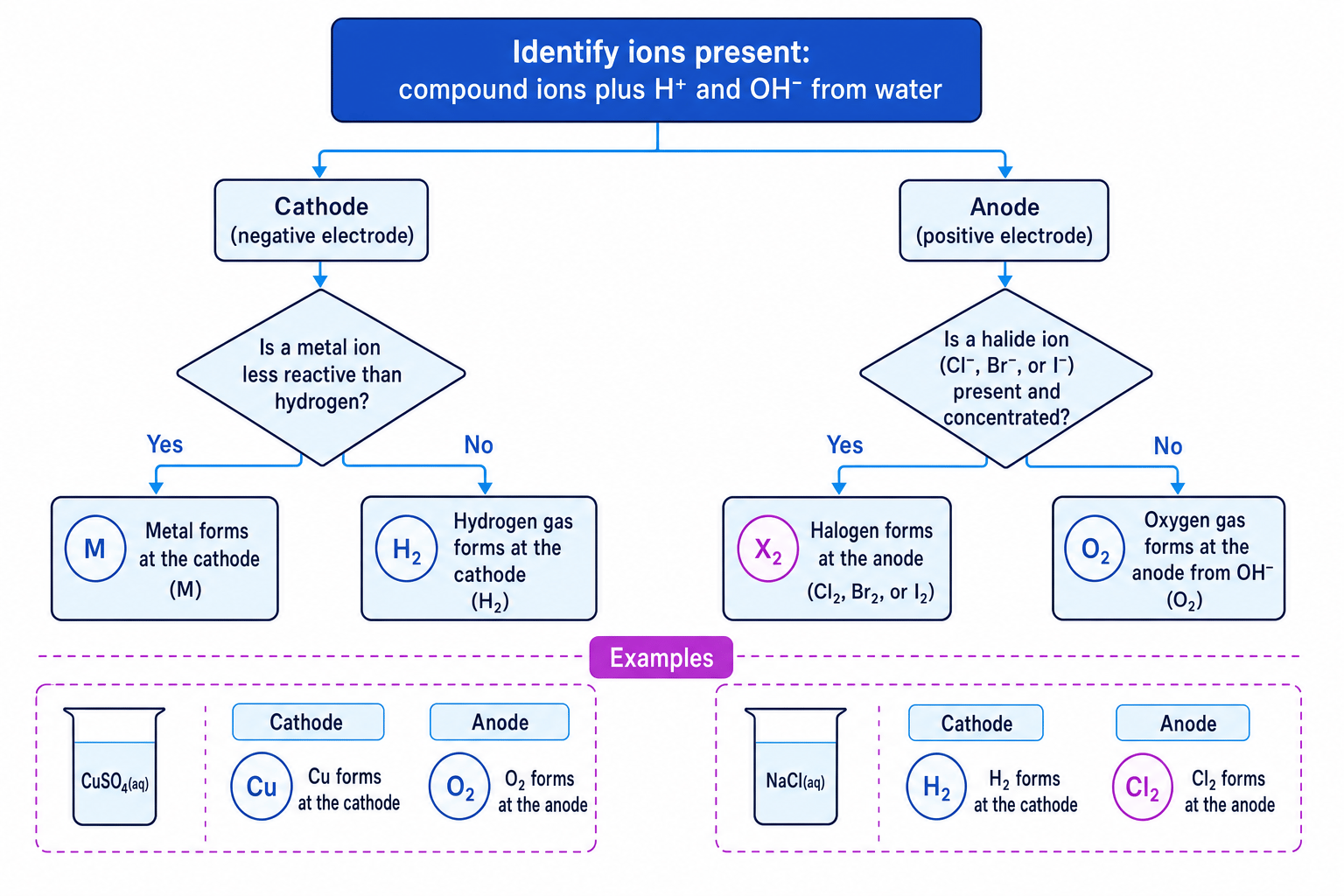
At the cathode
The cathode is negative, so positive ions go there.
If the metal ion is less reactive than hydrogen, the metal forms.
Example:
Cu2+(aq)+2e−→Cu(s)Cu^{2+}\text{(aq)} + 2e^- \rightarrow Cu\text{(s)}Cu2+(aq)+2e−→Cu(s)
If the metal ion is more reactive than hydrogen, hydrogen gas forms instead:
2H+(aq)+2e−→H2(g)2H^+\text{(aq)} + 2e^- \rightarrow H_2\text{(g)}2H+(aq)+2e−→H2(g)
At the anode
The anode is positive, so negative ions go there.
If a halide ion is present, such as Cl−Cl^-Cl−, Br−Br^-Br− or I−I^-I−, the halogen is usually formed.
Example for chloride:
2Cl−(aq)→Cl2(g)+2e−2Cl^-\text{(aq)} \rightarrow Cl_2\text{(g)} + 2e^-2Cl−(aq)→Cl2(g)+2e−
If there is no halide ion, oxygen forms from hydroxide ions:
4OH−(aq)→O2(g)+2H2O(l)+4e−4OH^-\text{(aq)} \rightarrow O_2\text{(g)} + 2H_2O\text{(l)} + 4e^-4OH−(aq)→O2(g)+2H2O(l)+4e−
Forgetting water ions
In aqueous electrolysis, do not only list the ions from the dissolved salt. Remember that water also provides H+H^+H+ and OH−OH^-OH− ions.
Important aqueous examples
Sodium chloride solution
Aqueous sodium chloride contains Na+Na^+Na+, Cl−Cl^-Cl−, H+H^+H+ and OH−OH^-OH− ions.
At the cathode, sodium is more reactive than hydrogen, so hydrogen gas forms:
2H+(aq)+2e−→H2(g)2H^+\text{(aq)} + 2e^- \rightarrow H_2\text{(g)}2H+(aq)+2e−→H2(g)
At the anode, chloride ions form chlorine gas:
2Cl−(aq)→Cl2(g)+2e−2Cl^-\text{(aq)} \rightarrow Cl_2\text{(g)} + 2e^-2Cl−(aq)→Cl2(g)+2e−
The remaining solution becomes alkaline because Na+Na^+Na+ and OH−OH^-OH− remain, forming sodium hydroxide solution.
Dilute sulfuric acid
Dilute sulfuric acid contains H+H^+H+, SO42−SO_4^{2-}SO42− and water ions.
At the cathode:
2H+(aq)+2e−→H2(g)2H^+\text{(aq)} + 2e^- \rightarrow H_2\text{(g)}2H+(aq)+2e−→H2(g)
At the anode, sulfate ions are not discharged, so oxygen forms from hydroxide ions:
4OH−(aq)→O2(g)+2H2O(l)+4e−4OH^-\text{(aq)} \rightarrow O_2\text{(g)} + 2H_2O\text{(l)} + 4e^-4OH−(aq)→O2(g)+2H2O(l)+4e−
Overall, water is decomposed:
2H2O(l)→2H2(g)+O2(g)2H_2O\text{(l)} \rightarrow 2H_2\text{(g)} + O_2\text{(g)}2H2O(l)→2H2(g)+O2(g)
You may see about twice as much hydrogen as oxygen.
Copper(II) sulfate solution
Copper(II) sulfate solution contains Cu2+Cu^{2+}Cu2+, SO42−SO_4^{2-}SO42− and water ions.
At the cathode, copper is less reactive than hydrogen, so copper metal forms:
Cu2+(aq)+2e−→Cu(s)Cu^{2+}\text{(aq)} + 2e^- \rightarrow Cu\text{(s)}Cu2+(aq)+2e−→Cu(s)
At the anode, sulfate ions are not discharged, so oxygen forms:
4OH−(aq)→O2(g)+2H2O(l)+4e−4OH^-\text{(aq)} \rightarrow O_2\text{(g)} + 2H_2O\text{(l)} + 4e^-4OH−(aq)→O2(g)+2H2O(l)+4e−
With inert electrodes, the blue colour becomes paler because Cu2+Cu^{2+}Cu2+ ions are removed from the solution.
Predicting products for copper(II) sulfate solution
- Identify the ions present: Cu2+Cu^{2+}Cu2+ and SO42−SO_4^{2-}SO42− from copper(II) sulfate, plus H+H^+H+ and OH−OH^-OH− from water.
- At the cathode, compare copper with hydrogen. Copper is less reactive than hydrogen, so Cu2+Cu^{2+}Cu2+ is reduced to copper metal.
- At the anode, check for halide ions. There are no chloride, bromide or iodide ions, so OH−OH^-OH− ions are oxidised to oxygen gas.
- Predict observations: a pink-brown copper coating forms at the cathode, bubbles of oxygen form at the anode, and the blue solution becomes paler.
Practical: investigating electrolysis of aqueous solutions
This named practical uses inert electrodes to investigate products from different aqueous electrolytes.
Apparatus
You may use:
- beaker or small electrolysis cell
- low-voltage DC power supply
- connecting wires and crocodile clips
- two inert graphite electrodes
- aqueous solutions, such as sodium chloride, copper(II) sulfate and dilute sulfuric acid
- test tubes to collect gases
- lit splint, glowing splint and damp blue litmus paper
Method
- Add a measured volume, such as 50 cm³, of the electrolyte to a beaker.
- Place two graphite electrodes into the solution, making sure they do not touch.
- Connect the electrodes to a low-voltage DC power supply and label the cathode and anode.
- Switch on the current for a fixed time.
- Observe any gas bubbles, colour changes or metal deposits.
- Test gases where possible: hydrogen gives a squeaky pop with a lit splint, oxygen relights a glowing splint, and chlorine bleaches damp blue litmus paper.
- Repeat with fresh solution and clean electrodes for each electrolyte.
Variables
- Independent variable: the electrolyte used.
- Dependent variable: the products or observations at each electrode.
- Control variables: voltage, time, volume and concentration of solution, electrode material, electrode spacing and electrode surface area.
Expected results
- Sodium chloride solution: hydrogen at the cathode, chlorine at the anode, alkaline solution left behind.
- Dilute sulfuric acid: hydrogen at the cathode, oxygen at the anode.
- Copper(II) sulfate solution: copper at the cathode, oxygen at the anode, blue solution becomes paler.
Short-circuiting the cell
If the electrodes touch, the current bypasses the electrolyte, so electrolysis will not happen properly.
In the exam
- Always identify the ions present first, including H+H^+H+ and OH−OH^-OH− for aqueous solutions.
- Label the cathode as negative and the anode as positive before predicting products.
- For half-equations, check electron position: electrons on the left means reduction; electrons on the right means oxidation.
Check yourself
- Why does molten sodium chloride conduct electricity but solid sodium chloride does not?
- What products would you expect from electrolysis of dilute sulfuric acid using inert electrodes?
- How can you tell from a half-equation whether oxidation or reduction has happened?
