What you'll learn
- How to recognise the ester functional group, −C(=O)−O−-\mathrm{C(=O)-O}-−C(=O)−O−.
- How ethanol and ethanoic acid form ethyl ethanoate using an acid catalyst.
- How to write and work backwards from structural and displayed formulae of esters.
- Why esters are useful, and how to prepare a small sample safely in the lab.
Esters are a small Paper 2 only part of Edexcel IGCSE Chemistry, but the main pattern is very learnable once you see where each part of the molecule comes from.
Prerequisites: alcohols, carboxylic acids and functional groups
In organic chemistry, a functional group is the part of a molecule mainly responsible for its chemical reactions.
Alcohols contain the hydroxyl group, −OH-\mathrm{OH}−OH. For example, ethanol is CH3CH2OHCH_3CH_2OHCH3CH2OH.
Carboxylic acids contain the carboxyl group, −COOH-\mathrm{COOH}−COOH. For example, ethanoic acid is CH3COOHCH_3COOHCH3COOH.
Functional group
A functional group is an atom or group of atoms in an organic molecule that gives the molecule its typical reactions.
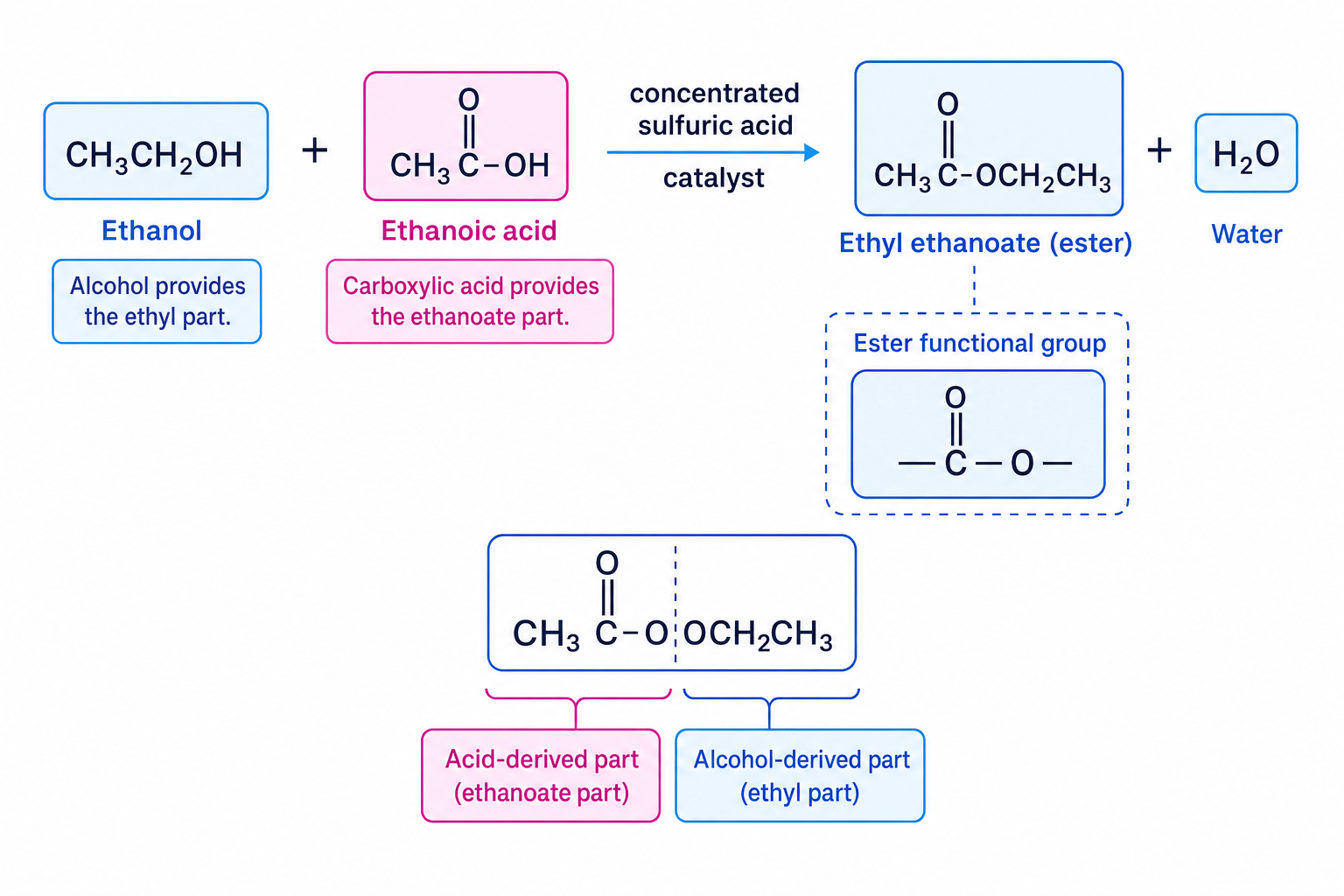
The key idea for esters is that an alcohol and a carboxylic acid can join together, producing an ester and water.
The ester functional group
Esters contain the functional group:
−C(=O)−O−-\mathrm{C(=O)-O}-−C(=O)−O−This is often written more compactly as −COO−-\mathrm{COO}-−COO−.
The C=OC=OC=O part is called a carbonyl group. In an ester, the carbonyl carbon is bonded to another oxygen atom, which then connects to a carbon chain.
Ester
An ester is an organic compound containing the −C(=O)−O−-\mathrm{C(=O)-O}-−C(=O)−O− functional group. Esters are commonly made by reacting a carboxylic acid with an alcohol.
The ester pattern
In an ester, the carboxylic acid provides the “alkanoate” part, and the alcohol provides the “alkyl” part of the name.
Making ethyl ethanoate
The ester you need to know by name is ethyl ethanoate.
It is made when ethanol reacts with ethanoic acid in the presence of an acid catalyst, usually concentrated sulfuric acid.
Catalyst
A catalyst increases the rate of a reaction but is not used up overall. In this reaction, concentrated sulfuric acid provides acidic conditions and speeds up ester formation.
The word equation is:
ethanoic acid + ethanol → ethyl ethanoate + water
The balanced symbol equation, with state symbols, is:
CH3COOH(l)+CH3CH2OH(l)→CH3COOCH2CH3(l)+H2O(l)CH_3COOH(l) + CH_3CH_2OH(l) \to CH_3COOCH_2CH_3(l) + H_2O(l)CH3COOH(l)+CH3CH2OH(l)→CH3COOCH2CH3(l)+H2O(l)This reaction is called esterification.
Formulae of ethyl ethanoate
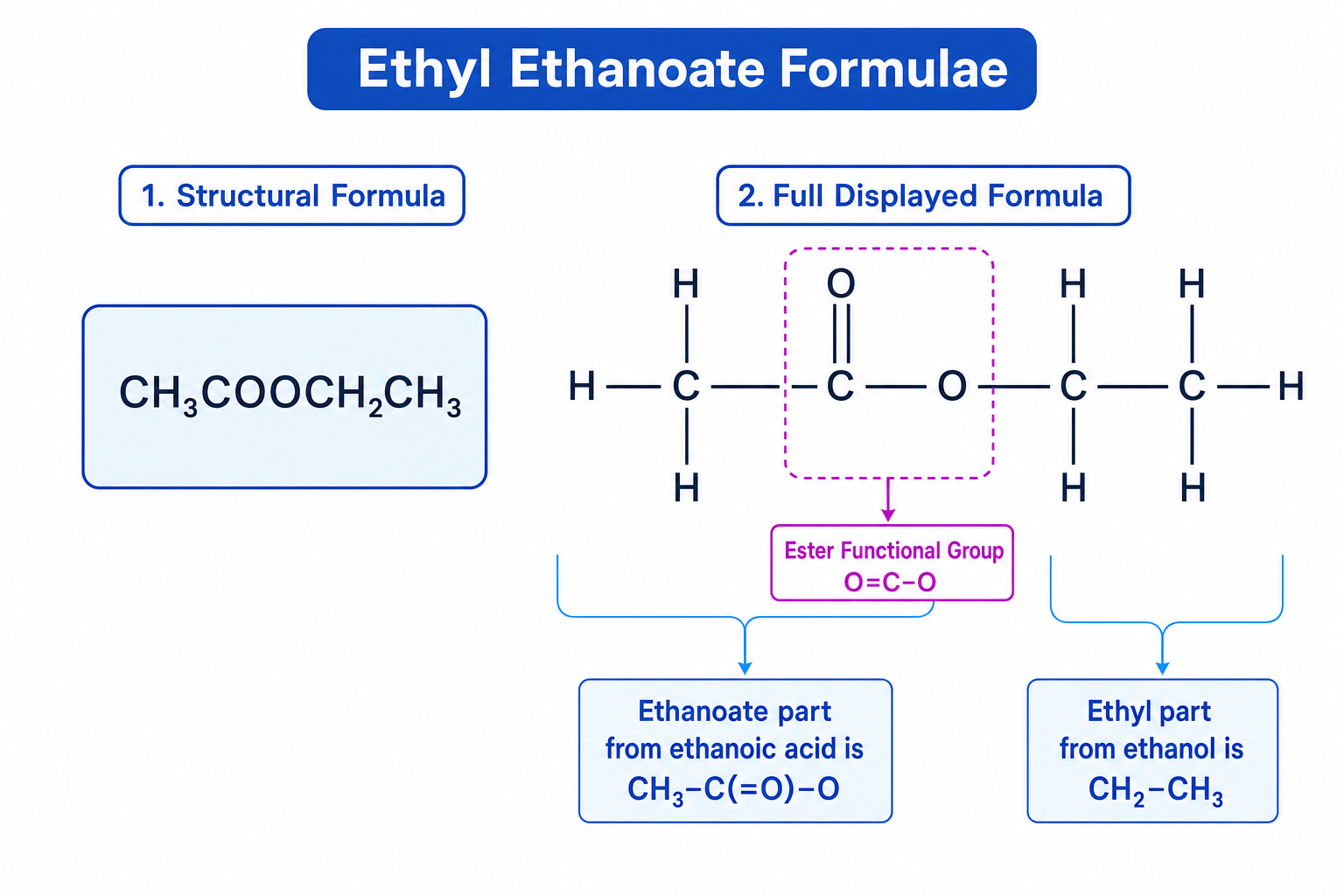
A structural formula shows how atoms are connected, using groups such as CH3CH_3CH3 and CH2CH_2CH2.
A displayed formula shows every atom and every bond, including all the C–H bonds.
For ethyl ethanoate:
- Structural formula: CH3COOCH2CH3CH_3COOCH_2CH_3CH3COOCH2CH3
- Condensed displayed form: CH3−C(=O)−O−CH2−CH3CH_3-C(=O)-O-CH_2-CH_3CH3−C(=O)−O−CH2−CH3
The diagram shows both ways of representing the same ester.
Leaving out the linking oxygen
Ethyl ethanoate is CH3COOCH2CH3CH_3COOCH_2CH_3CH3COOCH2CH3, not CH3COCH2CH3CH_3COCH_2CH_3CH3COCH2CH3. If you leave out the single-bonded oxygen, you no longer have the ester functional group.
Naming esters from the reactants
The name of an ester has two words:
- The first word comes from the alcohol.
- The second word comes from the carboxylic acid, changing “-oic acid” to “-oate”.
For example:
- methanol gives methyl
- ethanol gives ethyl
- propanol gives propyl
And:
- methanoic acid gives methanoate
- ethanoic acid gives ethanoate
- propanoic acid gives propanoate
So:
ethanol + ethanoic acid → ethyl ethanoate
Alkyl group
An alkyl group is a hydrocarbon fragment from an alkane with one hydrogen removed, such as methyl, CH3−CH_3-CH3−, or ethyl, CH3CH2−CH_3CH_2-CH3CH2−.
Naming an ester from its reactants
-
Identify the alcohol: ethanol gives the ethyl part of the ester name.
-
Identify the carboxylic acid: propanoic acid gives the propanoate part of the ester name.
-
Combine the name in the correct order: alcohol part first, acid part second, so the ester is ethyl propanoate.
-
Write the structural formula by keeping the acid part as CH3CH2COO−CH_3CH_2COO-CH3CH2COO− and attaching the ethyl part, CH2CH3CH_2CH_3CH2CH3, to the oxygen: CH3CH2COOCH2CH3CH_3CH_2COOCH_2CH_3CH3CH2COOCH2CH3.
Name order versus formula order
The name usually starts with the alcohol part, but the structural formula is often written starting with the acid-derived part. Ethyl ethanoate is named alcohol-then-acid, but written as CH3COOCH2CH3CH_3COOCH_2CH_3CH3COOCH2CH3.
Working backwards from an ester
You may also be given an ester and asked which alcohol and carboxylic acid made it.
To reverse the process, split the ester at the single bond after the ester oxygen:
acid part−C(=O)−O ∣ alcohol part\mathrm{acid\ part{-}C(=O)-O\ |\ alcohol\ part}acid part−C(=O)−O ∣ alcohol partThe part containing C=OC=OC=O came from the carboxylic acid. The carbon chain attached after the single-bonded oxygen came from the alcohol.
Finding the reactants from an ester formula
-
Start with the ester CH3COOCH3CH_3COOCH_3CH3COOCH3 and locate the ester group: CH3C(=O)OCH3CH_3C(=O)OCH_3CH3C(=O)OCH3.
-
Split after the single-bonded oxygen: CH3COO−CH_3COO-CH3COO− is the acid-derived part, and CH3−CH_3-CH3− is the alcohol-derived part.
-
Turn the acid-derived part back into a carboxylic acid by adding H to the final O: CH3COOHCH_3COOHCH3COOH, which is ethanoic acid.
-
Turn the alcohol-derived part back into an alcohol by adding OHOHOH: CH3OHCH_3OHCH3OH, which is methanol.
-
Therefore, CH3COOCH3CH_3COOCH_3CH3COOCH3 is methyl ethanoate, made from methanol and ethanoic acid.
Splitting the ester in the wrong place
When finding the original acid and alcohol, split the single bond between the ester oxygen and the alcohol-derived carbon. Do not break the C=OC=OC=O double bond.
Properties and uses of esters
Esters are often volatile and have distinctive smells.
Volatile
A volatile substance evaporates easily, so its particles can enter the air at room temperature or with gentle warming.
Many small esters have sweet, fruity smells. Because they evaporate easily, their vapour reaches your nose quickly, even when only a small amount is present.
Esters are used in:
- food flavourings, such as fruit-flavoured sweets and drinks
- perfumes, because they often have pleasant smells and evaporate into the air
In the lab, you should never sniff chemicals directly. You should waft the smell gently towards your nose.
Practical: preparing ethyl ethanoate
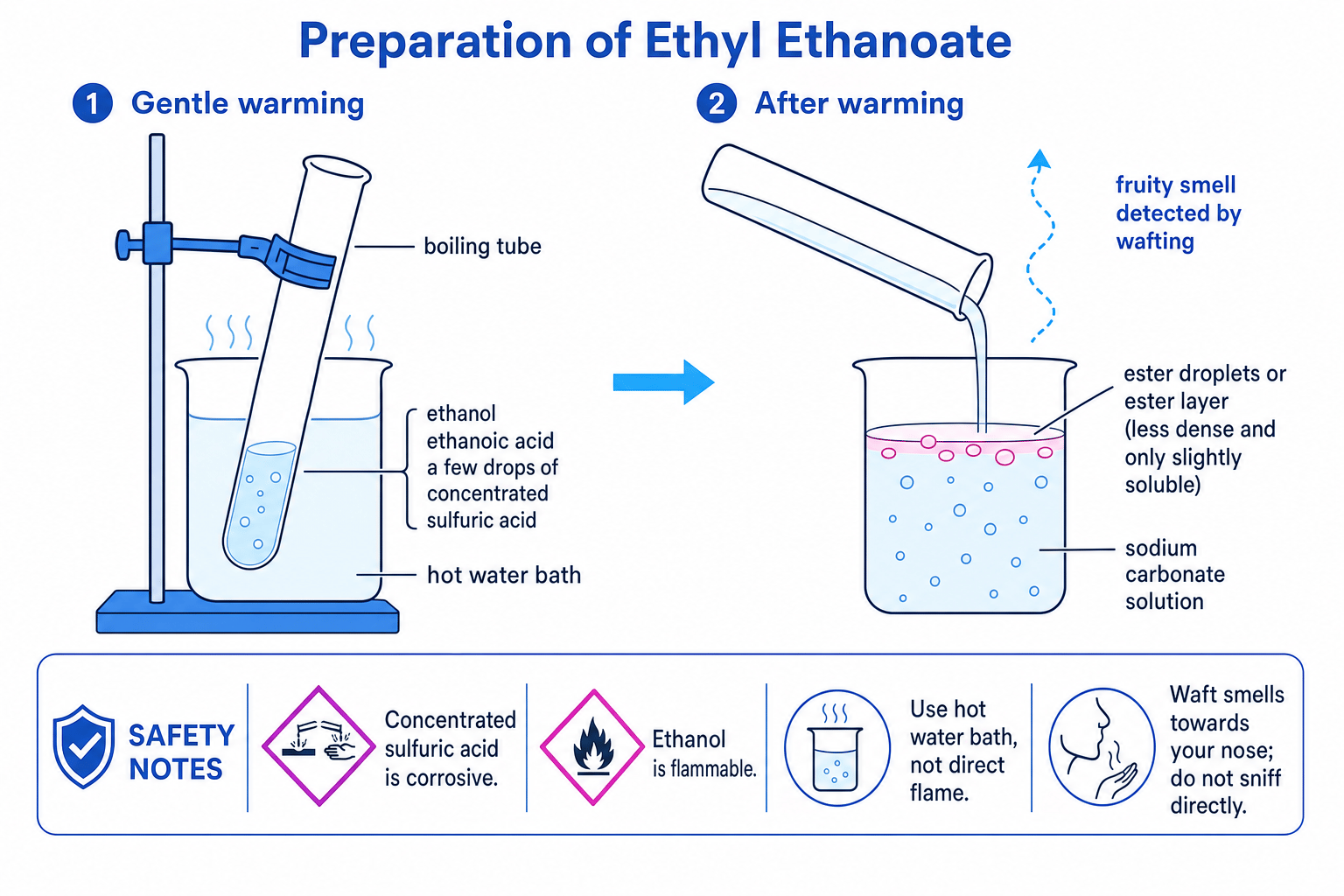
To prepare a small sample of ethyl ethanoate, you react ethanol with ethanoic acid using a few drops of concentrated sulfuric acid.
Typical apparatus includes:
- boiling tube
- beaker of hot water as a water bath
- clamp or test-tube holder
- dropping pipettes
- sodium carbonate solution or water for separating the ester after heating
Method
-
Add small measured volumes of ethanol and ethanoic acid to a boiling tube.
-
Carefully add a few drops of concentrated sulfuric acid.
-
Warm the boiling tube in a hot water bath for a few minutes. Do not heat the mixture directly with a flame.
-
Pour the warm reaction mixture into sodium carbonate solution or water.
-
Look for oily ester droplets or a thin layer floating near the surface, then carefully waft the smell towards your nose.
The sodium carbonate solution helps neutralise leftover acid. With ethanoic acid, this produces carbon dioxide gas, so you may see fizzing:
2CH3COOH(aq)+Na2CO3(aq)→2CH3COONa(aq)+H2O(l)+CO2(g)2CH_3COOH(aq) + Na_2CO_3(aq) \to 2CH_3COONa(aq) + H_2O(l) + CO_2(g)2CH3COOH(aq)+Na2CO3(aq)→2CH3COONa(aq)+H2O(l)+CO2(g)Variables and expected results
The main reactants chosen determine which ester forms. If you are comparing preparations, keep the volumes of alcohol and acid, number of catalyst drops, water bath temperature and heating time the same.
Expected observations for ethyl ethanoate include:
- sweet or fruity smell
- oily droplets or a layer because the ester is only slightly soluble in water
- fizzing if sodium carbonate neutralises excess acid
Safety in the ester practical
Ethanol is flammable, so use a hot water bath rather than direct heating. Concentrated sulfuric acid is corrosive, so wear eye protection and handle it carefully. Always waft smells; do not sniff directly.
Overheating the mixture
If you heat too strongly, volatile reactants or ester can evaporate away, and ethanol vapour can catch fire. Gentle warming is enough.
In the exam
-
Look for the ester functional group −C(=O)−O−-\mathrm{C(=O)-O}-−C(=O)−O−, not just any oxygen-containing group.
-
For naming, use alcohol first, acid second: ethanol + ethanoic acid makes ethyl ethanoate.
-
For the practical, mention the acid catalyst, hot water bath, sodium carbonate or water separation step, fruity smell, and wafting for safety.
Check yourself
- What ester forms from methanol and propanoic acid?
- Which alcohol and carboxylic acid could form CH3CH2COOCH3CH_3CH_2COOCH_3CH3CH2COOCH3?
- Why is a hot water bath used instead of direct heating when preparing an ester?