What you'll learn
- How small molecules called monomers join to make addition polymers.
- How to draw and interpret repeat units for common plastics such as poly(ethene) and PTFE.
- Why many addition polymers cause disposal problems.
- How condensation polymerisation makes polyesters and water (Paper 2 only).
The starting idea: small molecules making giant chains
A synthetic polymer is a large molecule made by humans, usually from many smaller molecules joined together in a long chain. Many everyday plastics are synthetic polymers.
Monomer, polymer and polymerisation
A monomer is a small molecule that can join to other similar molecules. A polymer is a very large molecule made from many monomers joined together. Polymerisation is the reaction that joins monomers to make a polymer.
The word poly- means “many”. So poly(ethene) means “many ethene molecules joined together”.
Addition polymerisation
What happens to the double bond?
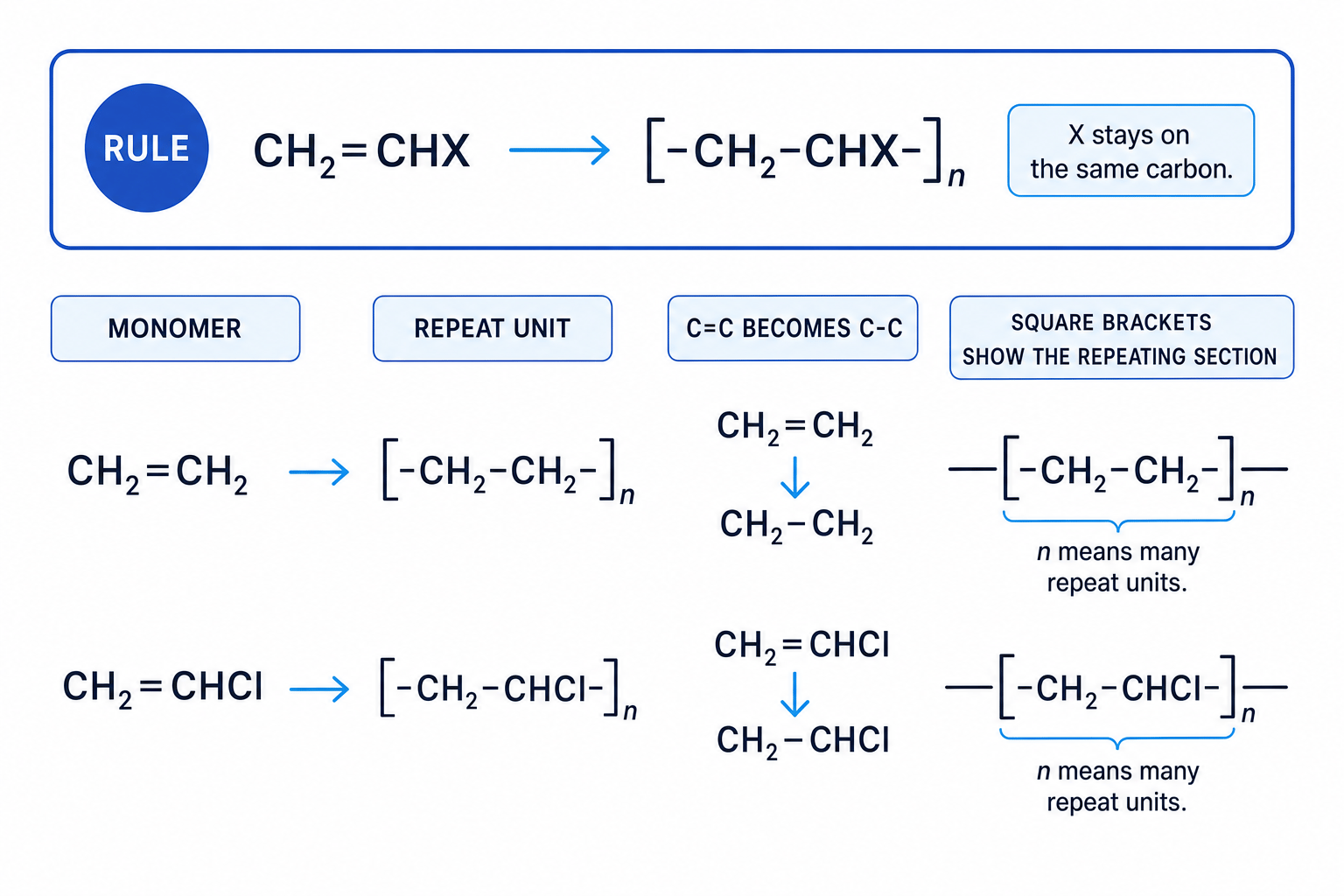
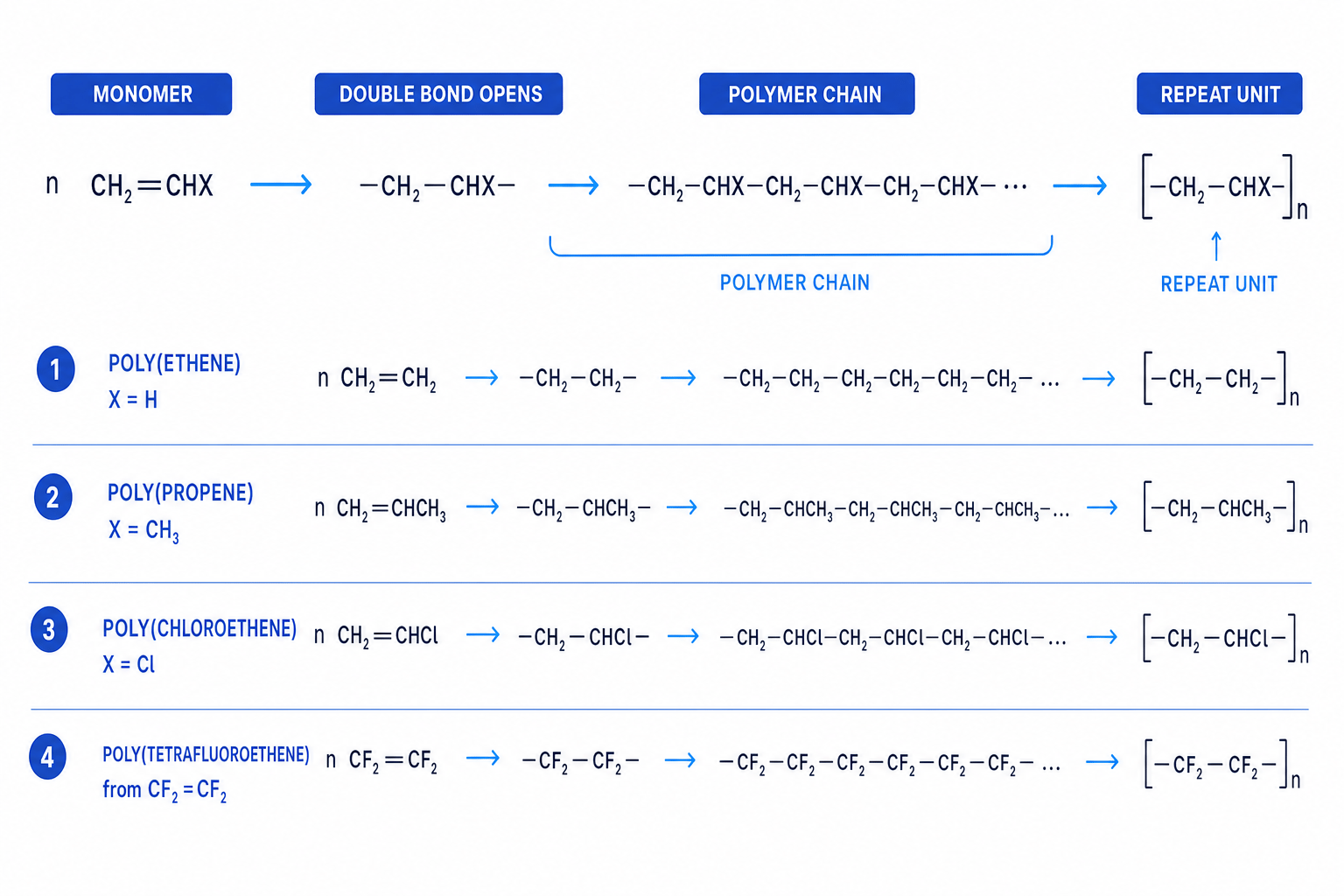
In addition polymerisation, many monomers join together without forming any other product. The monomers usually contain a carbon–carbon double bond, C=CC=CC=C.
During the reaction, the double bond opens up. Each carbon atom can then form new single covalent bonds to neighbouring monomers, making a long chain.
Addition polymer
An addition polymer is formed when many small unsaturated monomers join together, with no small molecule released.
For ethene:
n CH2=CH2→[-CH2-CH2-]nn\,\text{CH}_2\text{=CH}_2 \rightarrow \left[\text{-CH}_2\text{-CH}_2\text{-}\right]_nnCH2=CH2→[-CH2-CH2-]nThe nnn means “a very large number of repeat units”.
Addition polymerisation in one sentence
The C=CC=CC=C double bond in each monomer becomes part of a long chain of C−CC-CC−C single bonds in the polymer.
Repeat units
A repeat unit is the smallest section of a polymer chain that repeats again and again.
In displayed or structural formulae, the repeat unit is shown inside square brackets with an nnn outside:
[-CH2-CH2-]n\left[\text{-CH}_2\text{-CH}_2\text{-}\right]_n[-CH2-CH2-]nThe bonds sticking out through the brackets show that the chain continues in both directions.
How to draw an addition polymer repeat unit
Use this method for monomers with one C=CC=CC=C bond:
- Find the two carbon atoms in the C=CC=CC=C double bond.
- Change the C=CC=CC=C double bond into a C−CC-CC−C single bond.
- Keep all other atoms or groups attached to the same carbon atoms.
- Put the new two-carbon unit in square brackets.
- Add an nnn outside the brackets.
Drawing the repeat unit from propene
Propene has the structural formula CH2=CHCH3CH_2=CHCH_3CH2=CHCH3.
- Identify the two carbon atoms in the double bond: they are the CH2CH_2CH2 carbon and the CHCHCH carbon.
- Change the double bond into a single bond, so the backbone becomes -CH2-CH-\text{-CH}_2\text{-CH-}-CH2-CH-.
- Keep the CH3CH_3CH3 group attached to the second carbon, giving the repeat unit [-CH2-CH(CH3)-]n\left[\text{-CH}_2\text{-CH(CH}_3\text{)-}\right]_n[-CH2-CH(CH3)-]n.
Do not keep the double bond
In an addition polymer repeat unit, the C=CC=CC=C double bond is gone. The polymer backbone contains C−CC-CC−C single bonds.
The named addition polymers you need
You should know these common monomer–polymer pairs.
Poly(ethene)
Ethene monomer:
CH2=CH2\text{CH}_2\text{=CH}_2CH2=CH2Poly(ethene) repeat unit:
[-CH2-CH2-]n\left[\text{-CH}_2\text{-CH}_2\text{-}\right]_n[-CH2-CH2-]nPoly(propene)
Propene monomer:
CH2=CHCH3\text{CH}_2\text{=CHCH}_3CH2=CHCH3Poly(propene) repeat unit:
[-CH2-CH(CH3)-]n\left[\text{-CH}_2\text{-CH(CH}_3\text{)-}\right]_n[-CH2-CH(CH3)-]nPoly(chloroethene)
Chloroethene monomer:
CH2=CHCl\text{CH}_2\text{=CHCl}CH2=CHClPoly(chloroethene) repeat unit:
[-CH2-CHCl-]n\left[\text{-CH}_2\text{-CHCl-}\right]_n[-CH2-CHCl-]nPoly(chloroethene) is also called PVC.
Poly(tetrafluoroethene)
Tetrafluoroethene monomer:
CF2=CF2\text{CF}_2\text{=CF}_2CF2=CF2Poly(tetrafluoroethene), often called PTFE, has the repeat unit:
[-CF2-CF2-]n\left[\text{-CF}_2\text{-CF}_2\text{-}\right]_n[-CF2-CF2-]nDrawing brackets correctly
The square brackets should cut through the bonds at both ends of the repeat unit. This shows the repeat unit connects to more repeat units on both sides.
Working backwards: finding the monomer
You also need to deduce the monomer from a repeat unit.
To reverse addition polymerisation:
- Remove the brackets and the nnn.
- Take one repeat unit.
- Put a C=CC=CC=C double bond between the two backbone carbon atoms.
- Keep the side groups attached to the same carbon atoms.
Deducing a monomer from a repeat unit
A polymer has the repeat unit [-CH2-CHCl-]n\left[\text{-CH}_2\text{-CHCl-}\right]_n[-CH2-CHCl-]n.
- Focus on one repeat unit: -CH2-CHCl-\text{-CH}_2\text{-CHCl-}-CH2-CHCl-.
- The two carbon atoms in the backbone came from the original double bond.
- Replace the single bond between them with a double bond to get the monomer CH2=CHCl\text{CH}_2\text{=CHCl}CH2=CHCl.
Do not move the side group
If the repeat unit contains ClClCl, CH3CH_3CH3 or another side group, keep it attached to the same carbon when you redraw the monomer.
Disposal problems with addition polymers
Many addition polymers are very useful because they are strong, waterproof and chemically unreactive. The problem is that these same properties make them difficult to dispose of.
Inert
A substance is inert if it is very unreactive under normal conditions.
Addition polymers are often inert because their chains contain strong covalent bonds. This means many microorganisms cannot break them down easily.
Biodegradable
A material is biodegradable if microorganisms can break it down into simpler substances over time.
Most addition polymers are not biodegradable, so they can remain in landfill or the environment for a very long time.
Burning addition polymers can reduce the volume of waste, but it can produce toxic gases. For example, burning poly(chloroethene) can release hydrogen chloride gas, HClHClHCl, which is harmful and acidic. Incomplete combustion of plastics can also produce carbon monoxide, COCOCO, which is poisonous.
Why plastic waste is difficult
Addition polymers are difficult to dispose of because they are usually inert, do not biodegrade, and may release toxic gases when burned.
Condensation polymerisation
You also need to know about condensation polymerisation of polyesters (Paper 2 only).
In condensation polymerisation, monomers join together and a small molecule is released each time a link forms. For the polyesters in this specification, the small molecule released is water, H2OH_2OH2O.
Condensation polymerisation
Condensation polymerisation is polymerisation in which monomers join together and small molecules, such as water, are eliminated.
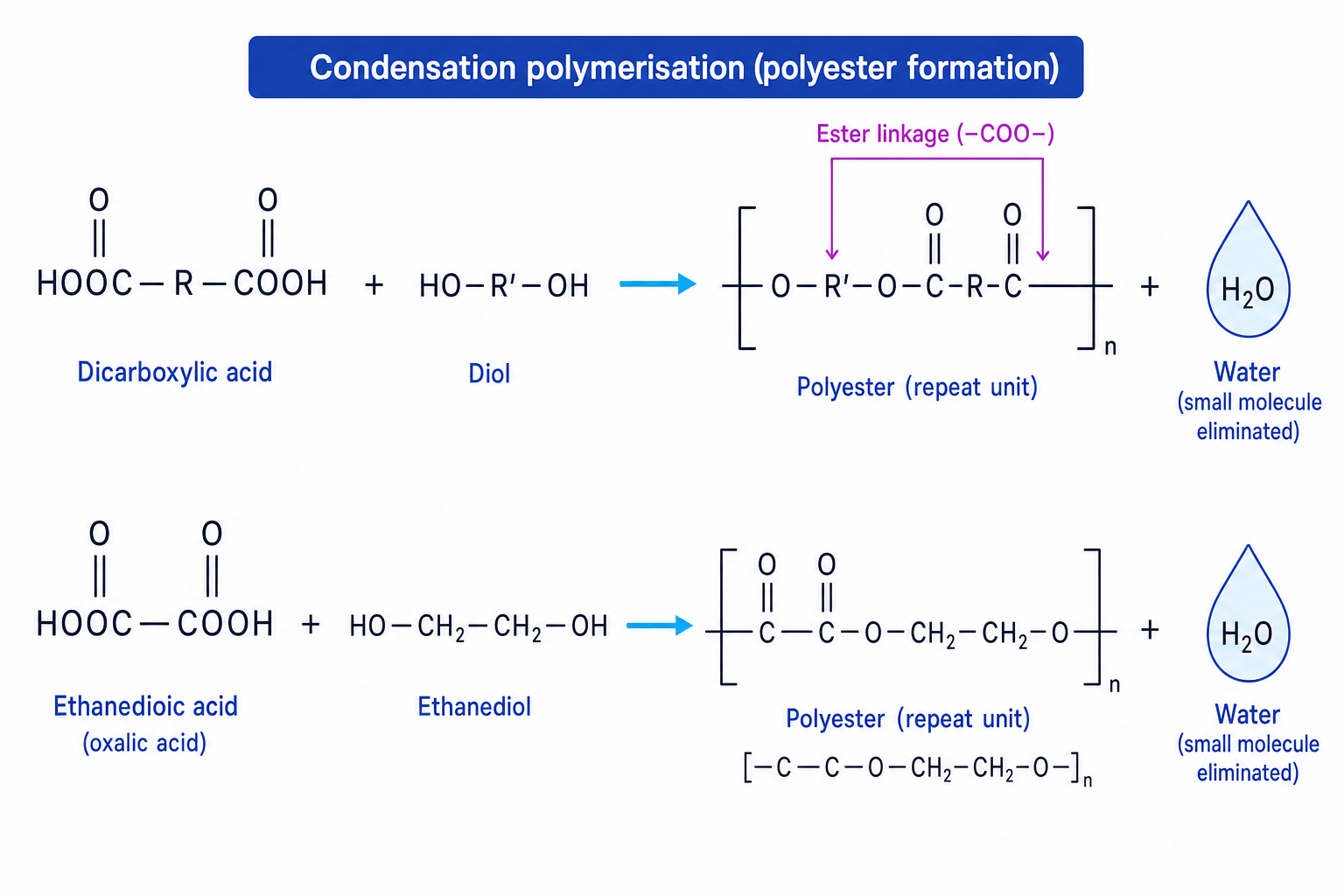
Making polyesters from a dicarboxylic acid and a diol
A dicarboxylic acid is a molecule with two carboxylic acid groups, −COOH-COOH−COOH.
A diol is an alcohol with two hydroxyl groups, −OH-OH−OH.
When a dicarboxylic acid reacts with a diol:
- the monomers join to form a polyester
- an ester linkage, −COO−-COO-−COO−, forms
- water is produced
Polyester
A polyester is a condensation polymer containing many ester linkages, −COO−-COO-−COO−, in its chain.
Polyester formation
A dicarboxylic acid plus a diol forms a polyester plus water.
Drawing a polyester repeat unit
The main skill is to remove the correct atoms and join the monomers in the correct order.
A carboxylic acid group, −COOH-COOH−COOH, reacts with an alcohol group, −OH-OH−OH:
- the acid loses OHOHOH
- the alcohol loses HHH
- these form water, H2OH_2OH2O
- the remaining parts join to make an ester linkage, −COO−-COO-−COO−
Writing the polyester from ethanedioic acid and ethanediol
Ethanedioic acid is HOOC-COOH\text{HOOC-COOH}HOOC-COOH. Ethanediol is HO-CH2CH2-OH\text{HO-CH}_2\text{CH}_2\text{-OH}HO-CH2CH2-OH.
- Identify the two functional groups on each monomer: ethanedioic acid has two −COOH-COOH−COOH groups, and ethanediol has two −OH-OH−OH groups.
- Remove OHOHOH from each carboxylic acid group and remove HHH from each alcohol group; these removed atoms form water.
- Join the acid carbonyl carbons to the oxygen atoms from the diol, forming ester linkages.
- Put the repeating section in brackets:
Addition versus condensation
Addition polymerisation uses a C=CC=CC=C double bond and produces no small molecule. Condensation polymerisation uses two functional groups on each monomer and produces a small molecule such as water.
Biopolyesters
Some polyesters are called biopolyesters. These are biodegradable, meaning microorganisms can break them down under suitable conditions.
This is useful because biodegradable polymers can reduce long-term plastic waste. However, they usually need the correct conditions, such as warmth, moisture and suitable microorganisms, to break down quickly.
Not all polyesters behave the same
Some polyesters are biodegradable, but you should not assume every polyester or every plastic will biodegrade rapidly.
In the exam
- For addition polymers, always convert the monomer’s C=CC=CC=C into a C−CC-CC−C repeat unit and keep all side groups.
- For monomer-from-repeat questions, reverse the process: remove brackets and put the C=CC=CC=C back between the two backbone carbons.
- For polyesters, look for a dicarboxylic acid and a diol, show ester linkages, and include water as a product.
- In disposal questions, link properties to problems: inert means difficult to biodegrade; burning can produce toxic gases.
Check yourself
- What is the repeat unit of poly(propene), and where is the CH3CH_3CH3 group placed?
- How would you find the monomer from [-CF2-CF2-]n\left[\text{-CF}_2\text{-CF}_2\text{-}\right]_n[-CF2-CF2-]n?
- Why does condensation polymerisation of a polyester produce water?