What you'll learn
- How to recognise the carboxylic acid functional group, −COOH-COOH−COOH.
- How to draw and name the first four unbranched carboxylic acids.
- How aqueous carboxylic acids react with metals and metal carbonates.
- Why vinegar is linked to ethanoic acid.
These Edexcel 4CH1 carboxylic acid points, 4.34C to 4.37C, are Paper 2 only, but they build on acid reactions you may already know.
The formula language you need
Carboxylic acids are organic compounds, meaning they contain carbon. In this topic, you need to move between different ways of showing molecules.
A molecular formula gives the number of each type of atom, such as C2H4O2C_2H_4O_2C2H4O2.
A structural formula shows how atoms are grouped, such as CH3COOHCH_3COOHCH3COOH.
A displayed formula shows every atom and every covalent bond. In exams, displayed formulae are useful because they make the functional group very clear.
Finding a molecular formula from a structural formula
For the structural formula CH3CH2COOHCH_3CH_2COOHCH3CH2COOH:
- Split the formula into useful groups: CH3CH_3CH3, CH2CH_2CH2 and COOHCOOHCOOH.
- Count each atom type: carbon atoms are 1+1+1=31 + 1 + 1 = 31+1+1=3, hydrogen atoms are 3+2+1=63 + 2 + 1 = 63+2+1=6, and oxygen atoms are 2.
- Write the molecular formula with each atom count: C3H6O2C_3H_6O_2C3H6O2.
The carboxylic acid functional group
A functional group is the atom or group of atoms that gives an organic molecule its typical chemical reactions.
Functional group
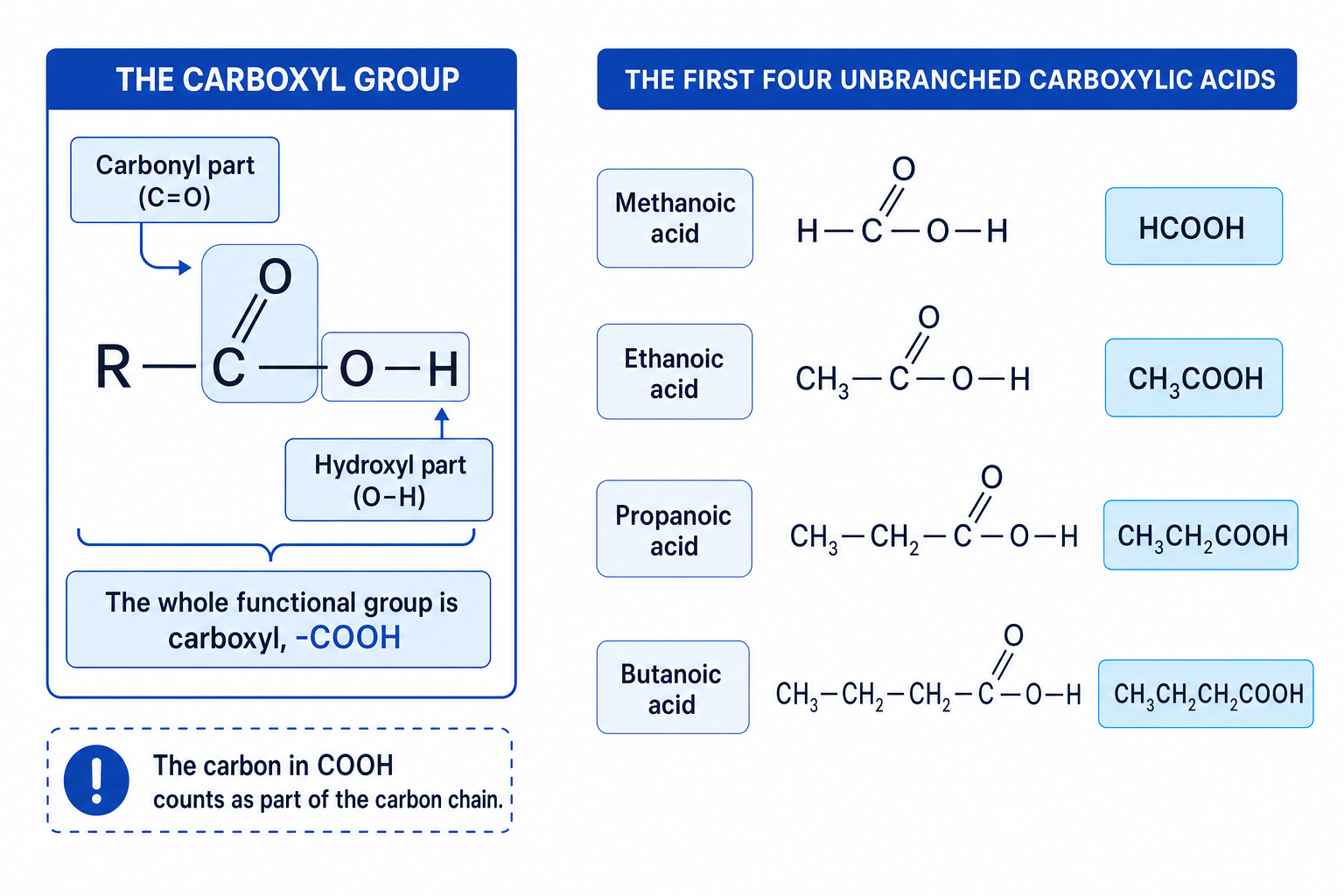
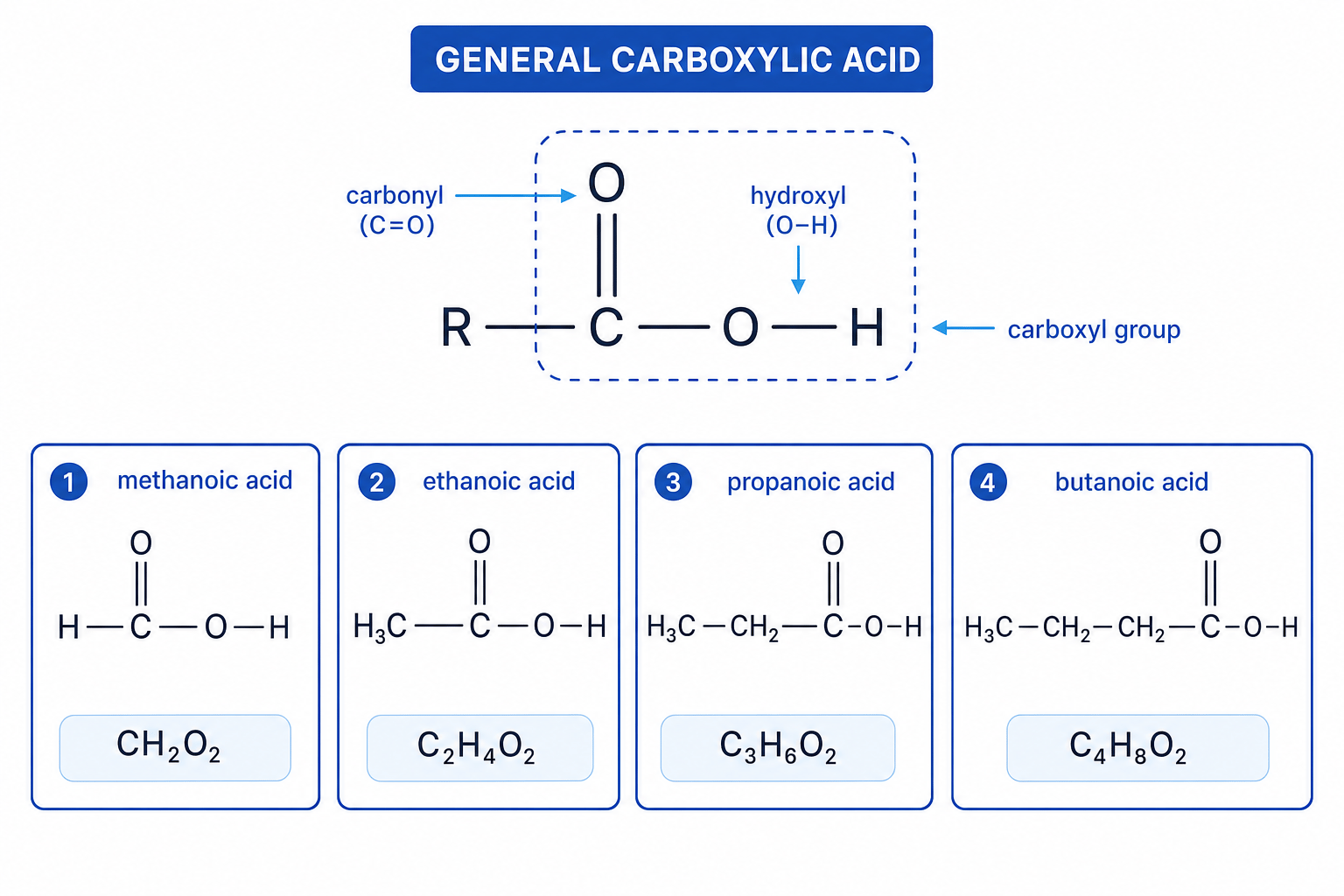
The functional group of a carboxylic acid is the carboxyl group, written as −COOH-COOH−COOH or more fully as −C(=O)−OH-C(=O)-OH−C(=O)−OH.
The carboxyl group contains two parts on the same carbon atom: a carbonyl group, C=OC=OC=O, and a hydroxyl group, O−HO-HO−H. The letter R in a general formula means “the rest of the molecule”, usually a carbon chain.
The diagram below shows the carboxyl group and the first four unbranched carboxylic acids you need to know.
The key pattern
A carboxylic acid must contain the whole −COOH-COOH−COOH group. An −OH-OH−OH group by itself is not enough.
Confusing alcohols and carboxylic acids
Alcohols contain an −OH-OH−OH group, but carboxylic acids contain −COOH-COOH−COOH. Look for the carbon double-bonded to oxygen and single-bonded to OHOHOH.
Recognising the carboxylic acid
Which compound is a carboxylic acid: CH3CH2OHCH_3CH_2OHCH3CH2OH or CH3COOHCH_3COOHCH3COOH?
- Check CH3CH2OHCH_3CH_2OHCH3CH2OH: it has an OHOHOH group, but no C=OC=OC=O next to it, so it is not a carboxylic acid.
- Check CH3COOHCH_3COOHCH3COOH: it contains a carbon attached to =O=O=O and to OHOHOH, so it has the full −COOH-COOH−COOH group.
- Therefore, CH3COOHCH_3COOHCH3COOH is the carboxylic acid.
Naming the first four unbranched carboxylic acids
An unbranched chain has carbon atoms in one continuous chain, with no side branches.
For simple carboxylic acids, count the total number of carbon atoms, including the carbon in the −COOH-COOH−COOH group. Then use the related alkane name and change the ending to -oic acid.
- 1 carbon: methanoic acid, structural formula HCOOHHCOOHHCOOH, molecular formula CH2O2CH_2O_2CH2O2
- 2 carbons: ethanoic acid, structural formula CH3COOHCH_3COOHCH3COOH, molecular formula C2H4O2C_2H_4O_2C2H4O2
- 3 carbons: propanoic acid, structural formula CH3CH2COOHCH_3CH_2COOHCH3CH2COOH, molecular formula C3H6O2C_3H_6O_2C3H6O2
- 4 carbons: butanoic acid, structural formula CH3CH2CH2COOHCH_3CH_2CH_2COOHCH3CH2CH2COOH, molecular formula C4H8O2C_4H_8O_2C4H8O2
To draw a displayed formula, expand each CH3CH_3CH3 and CH2CH_2CH2 group so that every C-H bond is shown.
Count the acid carbon
The carbon in −COOH-COOH−COOH is part of the main carbon chain. For example, CH3CH2COOHCH_3CH_2COOHCH3CH2COOH has three carbon atoms, so it is propanoic acid.
Naming an unbranched carboxylic acid
Name CH3CH2CH2COOHCH_3CH_2CH_2COOHCH3CH2CH2COOH.
- Identify the −COOH-COOH−COOH group at the end of the molecule, so the compound is a carboxylic acid.
- Count all the carbon atoms, including the carbon in COOHCOOHCOOH: there are four carbon atoms.
- Four carbon atoms gives the prefix from butane, so the name is butanoic acid.
Drawing propanoic acid
Draw the structural formula for propanoic acid.
- The name “propanoic” tells you there must be three carbon atoms in the chain.
- Make one end carbon the carboxyl carbon, so it must be written as COOHCOOHCOOH.
- Add the remaining two carbons before it and complete their bonds with hydrogen atoms: CH3CH2COOHCH_3CH_2COOHCH3CH2COOH.
Reactions of aqueous carboxylic acids
An aqueous solution is a solution where the substance is dissolved in water. In equations, aqueous is shown using the state symbol (aq).
Carboxylic acids are acids, so they react with some metals and with metal carbonates. They are usually weak acids, so reactions may be slower than with hydrochloric acid of the same concentration, but the product patterns are the same.
Reaction with metals
Aqueous carboxylic acids react with reactive metals such as magnesium or zinc to form a salt and hydrogen gas.
acid+metal→salt+hydrogen\text{acid} + \text{metal} \rightarrow \text{salt} + \text{hydrogen}acid+metal→salt+hydrogenFor ethanoic acid, the salt is called an ethanoate. You would observe bubbles of hydrogen gas, and the metal would gradually disappear. Hydrogen gives a squeaky pop with a lit splint.
Balancing ethanoic acid with magnesium
Write the balanced equation for ethanoic acid reacting with magnesium.
- Magnesium forms a 2+ ion, so the salt needs two ethanoate groups: Mg(CH3COO)2Mg(CH_3COO)_2Mg(CH3COO)2.
- Two ethanoic acid molecules are needed to provide those two CH3COOCH_3COOCH3COO groups.
- The balanced equation is:
Reaction with metal carbonates
Aqueous carboxylic acids react with metal carbonates to form a salt, water and carbon dioxide.
acid+metal carbonate→salt+water+carbon dioxide\text{acid} + \text{metal carbonate} \rightarrow \text{salt} + \text{water} + \text{carbon dioxide}acid+metal carbonate→salt+water+carbon dioxideYou would observe fizzing because carbon dioxide gas is produced. Carbon dioxide turns limewater milky.
Carbonate reactions do not make hydrogen
Acid + metal makes hydrogen gas. Acid + metal carbonate makes carbon dioxide gas and water.
Writing a carbonate reaction
Write the balanced equation for ethanoic acid reacting with calcium carbonate.
- Calcium forms a 2+ ion, so the salt needs two ethanoate groups: Ca(CH3COO)2Ca(CH_3COO)_2Ca(CH3COO)2.
- The carbonate part produces water and carbon dioxide when it reacts with acid.
- The balanced equation is:
Vinegar and ethanoic acid
Vinegar is an aqueous solution containing ethanoic acid, CH3COOHCH_3COOHCH3COOH. This is why vinegar has acidic properties, such as reacting with carbonates to produce carbon dioxide.
Vinegar
For IGCSE, remember: vinegar contains ethanoic acid dissolved in water.
In the exam
- When identifying a carboxylic acid, look for the whole −COOH-COOH−COOH group, not just OHOHOH.
- When naming, count the carbon in the COOHCOOHCOOH group as part of the chain.
- For reactions, remember: acid + metal gives salt + hydrogen; acid + carbonate gives salt + water + carbon dioxide.
- Include state symbols in balanced symbol equations when the question asks for them.
- If vinegar is mentioned, link it to aqueous ethanoic acid, not ethanol.
Check yourself
- What two bonding features make up the carboxyl group?
- What are the name and structural formula of the three-carbon carboxylic acid?
- What gas is produced when ethanoic acid reacts with calcium carbonate?