

What you'll learn
- How to represent a metallic lattice using a 2-D diagram.
- What metallic bonding means in terms of electrostatic attraction.
- Why metals conduct electricity and are malleable.
- How to write clear structure-and-bonding explanations for Edexcel IGCSE questions. This sub-topic is Paper 2 only in 4CH1.
Starting point: what is special about metals?
Metals are elements found mostly on the left and in the centre of the Periodic Table. Metal atoms usually have a small number of electrons in their outer shell.
In a piece of metal, the outer electrons are not held tightly to just one atom. Instead, they become shared throughout the whole structure. This gives metals their distinctive bonding and properties.
Delocalised electrons
Delocalised electrons are electrons that are not attached to one particular atom. In a metal, they can move through the whole structure.
The atoms that have lost control of these outer electrons are left as positive metal ions.
Positive ion
A positive ion is a particle with an overall positive charge because it has lost one or more electrons. Positive ions are also called cations.
The metallic lattice
A lattice is a regular repeating arrangement of particles. In a metal, the particles are positive metal ions arranged in layers, with delocalised electrons between and around them.
The diagram below shows the 2-D metallic lattice, then links it to conductivity and malleability.
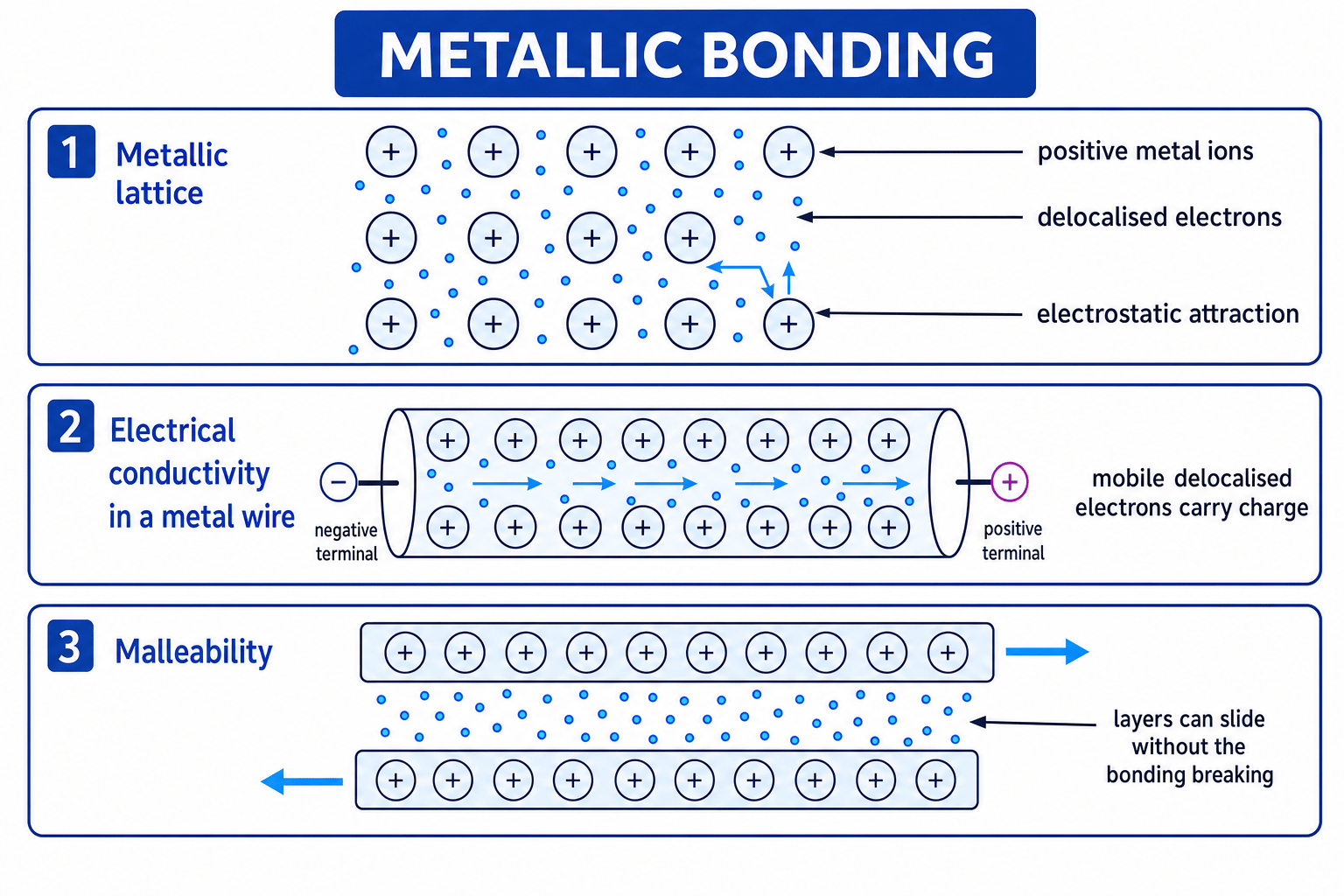
Metallic lattice
A metallic lattice is a giant regular structure of positive metal ions surrounded by delocalised electrons.
The word giant is important: a metal is not made from small separate molecules. The metallic lattice continues throughout the whole piece of metal.
How to draw a 2-D metallic lattice
For Edexcel IGCSE, a good 2-D diagram of a metallic lattice should show:
- circles with plus signs, arranged in regular rows or layers;
- the circles labelled positive metal ions;
- small dots or crosses between the ions, labelled delocalised electrons;
- the electrons spread throughout the structure, not paired between two atoms;
- the structure continuing in all directions, not just one little cluster.
Drawing a 2-D metallic lattice for magnesium
-
Magnesium is in Group 2, so each magnesium atom has two outer-shell electrons that can become delocalised. The positive ions can be labelled Mg2+Mg^{2+}Mg2+.
-
Draw several Mg2+Mg^{2+}Mg2+ ions in a regular repeating pattern, such as rows of circles. This shows the lattice is ordered and giant.
-
Add many small dots between and around the ions to represent delocalised electrons. Label them clearly as delocalised electrons, not “shared pairs”.
-
Add a label or arrow showing electrostatic attraction between the positive metal ions and the delocalised electrons.
Drawing molecules of metal
Do not draw a metal as separate little molecules. Metals have a giant metallic lattice, not simple molecular structures.
What is metallic bonding?
The positive metal ions and the delocalised electrons have opposite charges, so they attract each other.
Electrostatic attraction
Electrostatic attraction is the force of attraction between particles with opposite electrical charges.
Metallic bonding
Metallic bonding is the strong electrostatic attraction between positive metal ions and delocalised electrons in a giant metallic lattice.
This attraction acts throughout the whole structure. Each positive ion is attracted to the “sea” of delocalised electrons around it.
The big picture
A metal is a giant lattice of positive metal ions held together by a sea of delocalised electrons.
Why is metallic bonding strong?
Metallic bonding is strong because there are many positive ions and many delocalised electrons attracting each other throughout the whole lattice. A lot of energy is needed to overcome these attractions.
This is why most metals have high melting points and boiling points.
Do not say all metals have high melting points
Most metals have high melting points, but there are exceptions. Mercury is a metal that is liquid at room temperature.
Electrical conductivity in metals
A material conducts electricity if it allows electric charge to flow through it.
For a substance to conduct electricity, it must contain charged particles that can move. In metals, the charged particles that move are the delocalised electrons.
The positive metal ions are not free to travel through the solid metal. They vibrate in fixed positions in the lattice. The electrons, however, can move through the structure.
Explaining why solid copper conducts electricity
-
Solid copper has a giant metallic lattice containing positive metal ions and delocalised electrons.
-
An electric current needs mobile charged particles. In solid copper, the mobile charged particles are the delocalised electrons.
-
When a potential difference is applied, the delocalised electrons move through the lattice and carry charge, so copper conducts electricity.
Conductivity explanation shortcut
For any conductivity question, ask: what charged particles are present, and are they free to move? In metals, the answer is usually delocalised electrons.
Metals can conduct electricity as solids and when molten because the delocalised electrons are mobile in both states.
Saying the ions carry the current
In a solid metal, the positive metal ions do not move through the structure to carry charge. The current is carried by mobile delocalised electrons.
Malleability
Malleability means a material can be hammered, pressed or rolled into shape without breaking. Many metals are malleable, which is why aluminium can be rolled into foil and gold can be beaten into very thin sheets.
Malleable
A malleable material can be hammered or pressed into a new shape without shattering.
Metals are malleable because the layers of positive metal ions can slide over each other. When the layers move, the delocalised electrons are still spread throughout the structure, so the electrostatic attraction is maintained.
The metallic bonding is not just a fixed bond between one ion and one electron. It acts throughout the lattice, so the structure can change shape without the bonding completely breaking.
Explaining why aluminium can be rolled into foil
-
Aluminium has positive metal ions arranged in layers, surrounded by delocalised electrons.
-
When a force is applied by rollers, the layers of positive ions slide over each other.
-
The delocalised electrons remain between the ions and continue to attract them, so the metallic bonding is maintained.
-
Because the structure does not shatter, aluminium can be rolled into thin foil.
Malleable is not the same as brittle
A brittle material breaks or shatters when force is applied. Metals are usually not brittle because the layers can slide while the delocalised electrons continue holding the structure together.
This is different from many ionic compounds, where sliding layers can bring ions with the same charge next to each other, causing repulsion and cracking. You do not need that comparison for every answer, but it can help you understand why metallic bonding gives different properties.
Other typical physical properties of metals
Because of their metallic bonding, metals usually have several recognisable physical properties.
High melting and boiling points
Most metals have high melting and boiling points because strong electrostatic attractions in the metallic lattice require a lot of energy to overcome.
A melting answer should link the property to the bonding:
- strong metallic bonding;
- many electrostatic attractions;
- lots of energy needed to overcome them.
Good thermal conductivity
Metals are also good conductors of heat. Energy can be transferred through the lattice by moving delocalised electrons and by vibrations of the positive metal ions.
Shiny appearance
Metals are often shiny because their delocalised electrons interact with light and reflect much of it. You are more likely to be asked about conductivity and malleability, but shine is another common metallic property.
How to build a full exam explanation
In bonding questions, avoid listing properties without explaining them. The best answers link:
- structure — giant metallic lattice;
- bonding — electrostatic attraction between positive ions and delocalised electrons;
- property — conductivity, malleability or high melting point.
Linking metallic bonding to a property
Explain why sodium conducts electricity when solid.
-
Sodium is a metal, so it has a giant metallic lattice of positive sodium ions and delocalised electrons.
-
Electrical conduction requires mobile charged particles. The positive ions are fixed in the lattice, but the delocalised electrons can move.
-
The delocalised electrons carry charge through the solid metal, so solid sodium conducts electricity.
In the exam
-
For a metallic lattice diagram, draw regular positive ions with delocalised electrons spread between them.
-
For conductivity, always mention mobile delocalised electrons carrying charge.
-
For malleability, explain that layers of ions slide while the delocalised electrons still hold the lattice together.
-
Avoid vague phrases like “metals conduct because they have free particles” — name the particles and say why they can move.
Check yourself
-
What two types of particle are present in a metallic lattice?
-
Why can a solid metal conduct electricity?
-
Why can layers in a metal slide without the metal shattering?

