

What you'll learn
- Write word equations and balanced symbol equations with state symbols.
- Use ArA_rAr, MrM_rMr and moles to calculate masses and yields.
- Find empirical and molecular formulae from experimental data.
- Use concentration and gas volume calculations, including the Paper 2-only parts.
Equations: describing chemical reactions
A word equation uses the names of substances, for example:
magnesium + oxygen → magnesium oxide
A symbol equation uses chemical formulae. A balanced chemical equation has the same number of each type of atom on both sides, because atoms are rearranged in a reaction, not created or destroyed.
State symbols
State symbols show the physical state of each substance: (s) solid, (l) liquid, (g) gas and (aq) aqueous, meaning dissolved in water.
For example, burning magnesium is:
2Mg(s)+O2(g)→2MgO(s)2Mg(s) + O_2(g) \to 2MgO(s)2Mg(s)+O2(g)→2MgO(s)
For unfamiliar reactions, use the information given to identify the reactants and products, write their formulae correctly, then balance the atoms.
Balancing a symbol equation
Balance aluminium reacting with oxygen to form aluminium oxide, Al2O3Al_2O_3Al2O3.
- Start with the correct formulae: Al+O2→Al2O3Al + O_2 \to Al_2O_3Al+O2→Al2O3. Oxygen atoms are 2 on the left and 3 on the right, so use the lowest common multiple, 6: put 3 in front of O2O_2O2 and 2 in front of Al2O3Al_2O_3Al2O3.
- Now count aluminium atoms on the right: 2Al2O32Al_2O_32Al2O3 contains 4 aluminium atoms, so put 4 in front of AlAlAl.
- Add state symbols: 4Al(s)+3O2(g)→2Al2O3(s)4Al(s) + 3O_2(g) \to 2Al_2O_3(s)4Al(s)+3O2(g)→2Al2O3(s).
Changing formulae while balancing
Do not change small numbers inside formulae, such as the 2 in H2OH_2OH2O. Only change the big numbers in front, called coefficients.
Relative masses: ArA_rAr and MrM_rMr
Relative atomic mass and relative formula mass
The relative atomic mass, ArA_rAr, is the relative mass of an atom compared with carbon-12. The relative formula mass, MrM_rMr, is the total of the ArA_rAr values for all atoms in a formula; for molecular substances it may also be called relative molecular mass.
For example, H2OH_2OH2O contains 2 hydrogen atoms and 1 oxygen atom, so its MrM_rMr is 2(1)+16=182(1) + 16 = 182(1)+16=18.
Calculating relative formula mass and amount
Calculate the MrM_rMr of Ca(NO3)2Ca(NO_3)_2Ca(NO3)2 and the amount in 16.4 g of it. Use ArA_rAr: Ca = 40, N = 14, O = 16.
- Interpret the formula carefully: Ca(NO3)2Ca(NO_3)_2Ca(NO3)2 contains 1 Ca atom, 2 N atoms and 6 O atoms.
- Add the relative atomic masses: Mr=40+2(14)+6(16)=164M_r = 40 + 2(14) + 6(16) = 164Mr=40+2(14)+6(16)=164.
- Use n=mMrn = \frac{m}{M_r}n=Mrm, so n=16.4164=0.100 moln = \frac{16.4}{164} = 0.100\ \text{mol}n=16416.4=0.100 mol.
The mole and the big calculation map
The mole
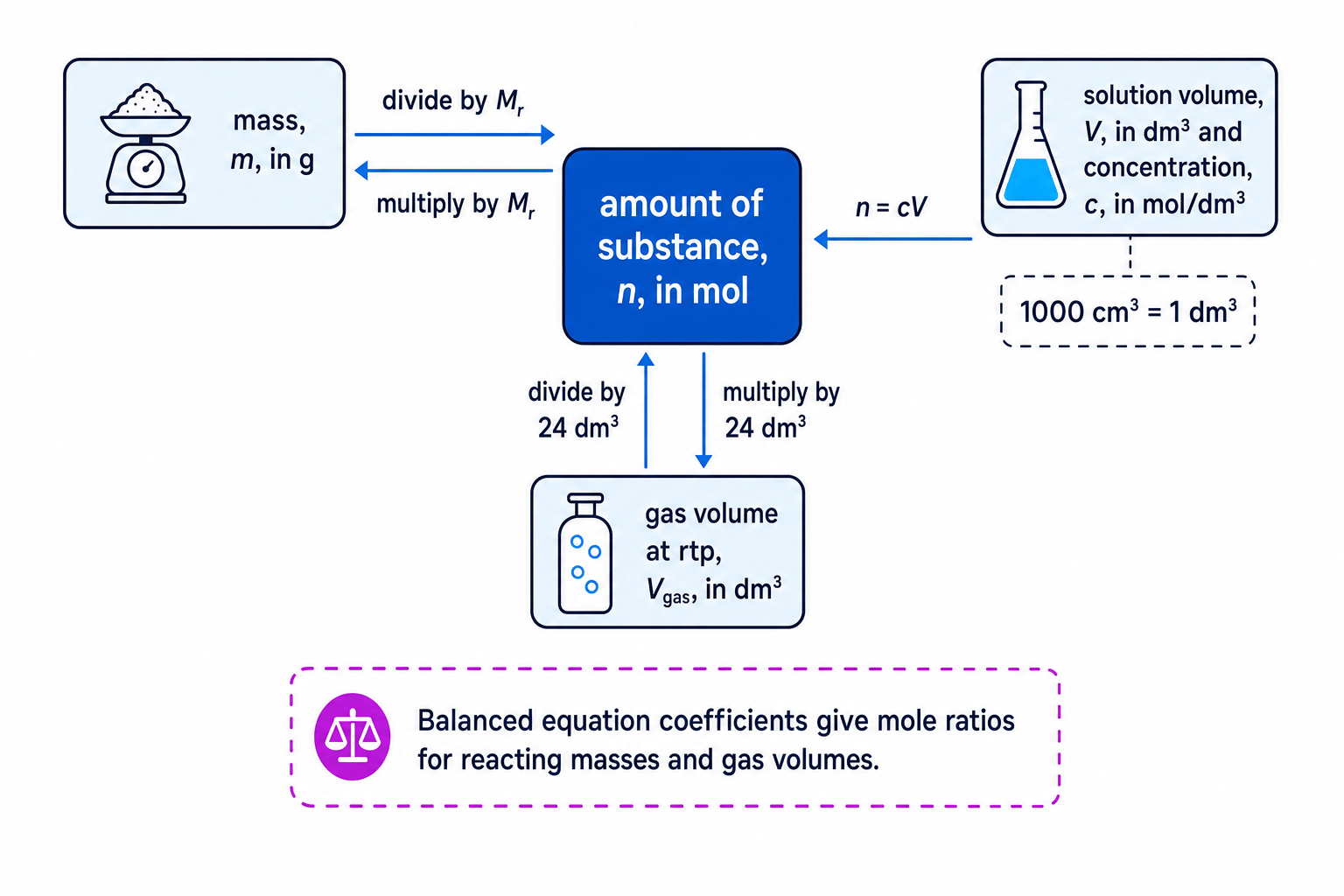
The mole, symbol mol, is the unit for amount of substance. One mole of a substance has a mass equal to its MrM_rMr in grams.
The most important mass relationship is:
n=mMrn = \frac{m}{M_r}n=Mrmwhere nnn is amount in mol and mmm is mass in g.
Most quantitative chemistry is about choosing the right route to moles, using the balanced equation ratio, then converting to the unit asked for.
Use moles as the bridge
Masses, solution concentrations and gas volumes all become easier once you convert them into moles.
Reacting masses and percentage yield
A balanced equation gives a mole ratio, not a mass ratio. For example:
2Mg(s)+O2(g)→2MgO(s)2Mg(s) + O_2(g) \to 2MgO(s)2Mg(s)+O2(g)→2MgO(s)
This means 2 mol of magnesium react to form 2 mol of magnesium oxide, so the mole ratio Mg:MgOMg:MgOMg:MgO is 1:1.
Percentage yield
The theoretical yield is the maximum product predicted by the equation. The actual yield is what is really obtained. Percentage yield compares them: percentage yield=actual yieldtheoretical yield×100%\text{percentage yield} = \frac{\text{actual yield}}{\text{theoretical yield}} \times 100\%percentage yield=theoretical yieldactual yield×100%.
Calculating reacting mass and percentage yield
4.80 g of magnesium is burnt in excess oxygen. The actual mass of magnesium oxide collected is 7.50 g. Calculate the theoretical mass and percentage yield.
- Convert magnesium mass into moles: n(Mg)=4.8024.0=0.200 moln(Mg) = \frac{4.80}{24.0} = 0.200\ \text{mol}n(Mg)=24.04.80=0.200 mol.
- Use the equation ratio. Since Mg:MgOMg:MgOMg:MgO is 1:1, moles of MgO=0.200 molMgO = 0.200\ \text{mol}MgO=0.200 mol.
- Convert moles of MgOMgOMgO into mass: Mr(MgO)=24+16=40M_r(MgO) = 24 + 16 = 40Mr(MgO)=24+16=40, so m=0.200×40=8.00 gm = 0.200 \times 40 = 8.00\ \text{g}m=0.200×40=8.00 g.
- Calculate percentage yield: 7.508.00×100%=93.8%\frac{7.50}{8.00} \times 100\% = 93.8\%8.007.50×100%=93.8%.
Yields are often below 100% because some reactant may not react, some product may be lost during handling, or side reactions may occur.
Empirical and molecular formulae
Empirical and molecular formulae
The empirical formula is the simplest whole-number ratio of atoms or ions in a compound. The molecular formula gives the actual number of each type of atom in one molecule.
To find an empirical formula from data:
- Find the mass of each element.
- Convert each mass into moles.
- Divide all mole values by the smallest.
- Multiply if needed to get whole numbers.
Finding empirical and molecular formulae
A compound contains 40.0% carbon, 6.7% hydrogen and 53.3% oxygen. Its MrM_rMr is 180. Find its empirical and molecular formulae.
- Assume 100 g, so the masses are 40.0 g C, 6.7 g H and 53.3 g O. Convert to moles: C is 40.012=3.33\frac{40.0}{12} = 3.331240.0=3.33, H is 6.71=6.7\frac{6.7}{1} = 6.716.7=6.7, and O is 53.316=3.33\frac{53.3}{16} = 3.331653.3=3.33.
- Divide by the smallest value, 3.33: the ratio is C:H:O = 1:2:1, so the empirical formula is CH2OCH_2OCH2O.
- Find the multiplier: empirical formula mass is 12+2(1)+16=3012 + 2(1) + 16 = 3012+2(1)+16=30, and 18030=6\frac{180}{30} = 630180=6, so the molecular formula is C6H12O6C_6H_{12}O_6C6H12O6.
Awkward ratios
If you get a ratio such as 1:1.5, multiply all parts by 2. If you get 1:1.33, multiply all parts by 3.
Finding formulae experimentally
Simple formulae can be found by measuring masses before and after a reaction, then converting mass changes into mole ratios.
For metal oxides, you can either burn a metal in oxygen or reduce a metal oxide. For water, you can form water from hydrogen and oxygen, then compare the masses of hydrogen and oxygen present. For salts containing water of crystallisation, heat the hydrated salt; the mass lost is water.
Water of crystallisation
Water of crystallisation is water chemically included in the crystal structure of a hydrated salt, for example in CuSO4⋅5H2OCuSO_4 \cdot 5H_2OCuSO4⋅5H2O.
Finding water of crystallisation
A 2.50 g sample of hydrated copper(II) sulfate is heated to constant mass. The anhydrous copper(II) sulfate left has mass 1.60 g. Find the formula CuSO4⋅xH2OCuSO_4 \cdot xH_2OCuSO4⋅xH2O. Use Mr(CuSO4)=160M_r(CuSO_4)=160Mr(CuSO4)=160 and Mr(H2O)=18M_r(H_2O)=18Mr(H2O)=18.
- Find the mass of water lost: 2.50−1.60=0.90 g2.50 - 1.60 = 0.90\ \text{g}2.50−1.60=0.90 g.
- Convert to moles: n(CuSO4)=1.60160=0.0100 moln(CuSO_4)=\frac{1.60}{160}=0.0100\ \text{mol}n(CuSO4)=1601.60=0.0100 mol and n(H2O)=0.9018=0.0500 moln(H_2O)=\frac{0.90}{18}=0.0500\ \text{mol}n(H2O)=180.90=0.0500 mol.
- Divide by the smaller amount: CuSO4:H2O=0.0100:0.0500=1:5CuSO_4:H_2O = 0.0100:0.0500 = 1:5CuSO4:H2O=0.0100:0.0500=1:5, so the formula is CuSO4⋅5H2OCuSO_4 \cdot 5H_2OCuSO4⋅5H2O.
Heating hydrated salts
Heat gently and to constant mass. If the salt decomposes, the mass lost is not just water, so the calculated formula will be wrong.
Named practical: formula of a metal oxide
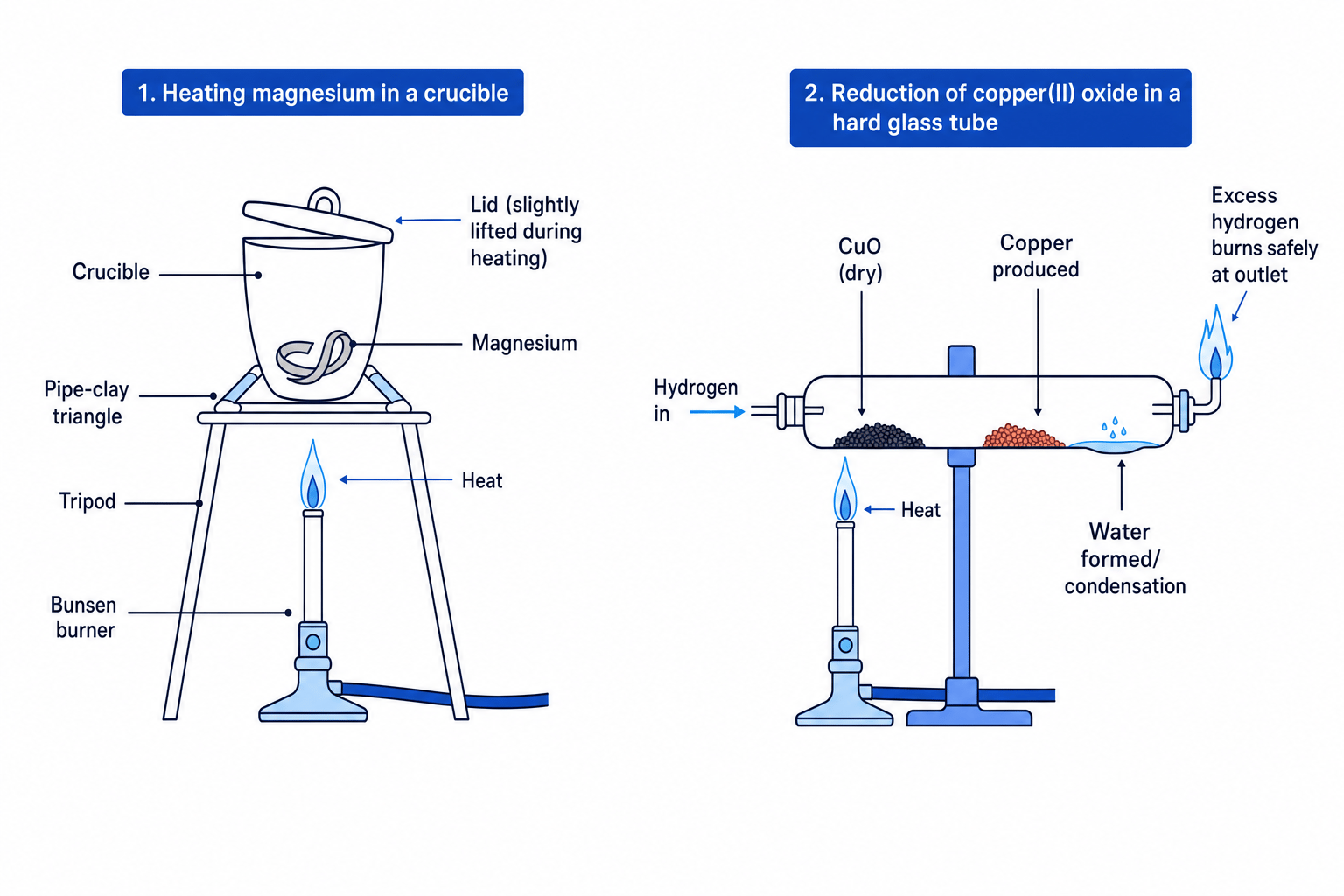
The two common practical routes are combustion of magnesium and reduction of copper(II) oxide.
Magnesium oxide by combustion
The reaction is:
2Mg(s)+O2(g)→2MgO(s)2Mg(s) + O_2(g) \to 2MgO(s)2Mg(s)+O2(g)→2MgO(s)
Method:
- Weigh a clean, dry crucible and lid.
- Add cleaned magnesium ribbon and reweigh.
- Heat strongly with the lid slightly lifted at intervals to let oxygen in but reduce loss of white magnesium oxide smoke.
- Cool, weigh, then reheat and reweigh until the mass is constant.
The magnesium changes into a white solid, magnesium oxide, and the mass increases because oxygen has been added. Calculate mass of magnesium from the starting data, mass of oxygen from the mass gain, then convert both to moles and find the simplest ratio.
Copper(II) oxide by reduction
The reaction with hydrogen is:
CuO(s)+H2(g)→Cu(s)+H2O(l)CuO(s) + H_2(g) \to Cu(s) + H_2O(l)CuO(s)+H2(g)→Cu(s)+H2O(l)
Dry hydrogen is passed over heated copper(II) oxide. Black copper(II) oxide turns to pink-brown copper and water forms. The mass decreases because oxygen is removed from the oxide.
Key practical points:
- Use excess oxygen for magnesium or excess hydrogen for copper(II) oxide.
- Heat to constant mass to improve reliability.
- Cool before weighing, because hot apparatus gives unreliable balance readings.
- Main errors include loss of powder, incomplete reaction, wet apparatus, or re-oxidising hot copper in air.
- Hydrogen is flammable, so air must be flushed out before lighting the excess hydrogen safely.
Solution concentration calculations
Some calculations involving solution concentration are Paper 2 only. Concentration in mol/dm³ means the amount of solute in 1 dm³ of solution.
n=cVn = cVn=cVHere nnn is amount in mol, ccc is concentration in mol/dm³ and VVV is volume in dm³.
Using cm³ directly
Before using n=cVn = cVn=cV, convert cm³ to dm³ by dividing by 1000.
Using concentration to find mass
Calculate the mass of sodium hydroxide, NaOHNaOHNaOH, needed to make 250 cm³ of 0.200 mol/dm³ solution.
- Convert the volume: 250 cm³ = 0.250 dm³.
- Calculate amount: n=cV=0.200×0.250=0.0500 moln = cV = 0.200 \times 0.250 = 0.0500\ \text{mol}n=cV=0.200×0.250=0.0500 mol.
- Convert moles to mass: Mr(NaOH)=23+16+1=40M_r(NaOH)=23+16+1=40Mr(NaOH)=23+16+1=40, so m=0.0500×40=2.00 gm = 0.0500 \times 40 = 2.00\ \text{g}m=0.0500×40=2.00 g.
Gas volume calculations at rtp
Gas volume calculations are also Paper 2 only. At room temperature and pressure, rtp, 1 mol of any gas has volume 24 dm³, which is 24 000 cm³.
n=Vgas24n = \frac{V_{\text{gas}}}{24}n=24VgasUse this when the gas volume is in dm³. If the volume is in cm³, divide by 24 000 instead.
Calculating gas volume at rtp
Calculate the volume of carbon dioxide formed at rtp when 5.00 g of calcium carbonate reacts with excess hydrochloric acid.
CaCO3(s)+2HCl(aq)→CaCl2(aq)+CO2(g)+H2O(l)CaCO_3(s) + 2HCl(aq) \to CaCl_2(aq) + CO_2(g) + H_2O(l)CaCO3(s)+2HCl(aq)→CaCl2(aq)+CO2(g)+H2O(l)
- Convert calcium carbonate mass into moles: Mr(CaCO3)=40+12+3(16)=100M_r(CaCO_3)=40+12+3(16)=100Mr(CaCO3)=40+12+3(16)=100, so n=5.00100=0.0500 moln=\frac{5.00}{100}=0.0500\ \text{mol}n=1005.00=0.0500 mol.
- Use the equation ratio. CaCO3:CO2CaCO_3:CO_2CaCO3:CO2 is 1:1, so moles of CO2=0.0500 molCO_2 = 0.0500\ \text{mol}CO2=0.0500 mol.
- Convert moles of gas to volume: V=0.0500×24=1.20 dm3V = 0.0500 \times 24 = 1.20\ \text{dm}^3V=0.0500×24=1.20 dm3, which is 1200 cm³.
In the exam
- Balance the symbol equation first, then use the coefficients as mole ratios.
- Convert the given quantity into moles: mass uses n=mMrn=\frac{m}{M_r}n=Mrm, solution uses n=cVn=cVn=cV, and gas at rtp uses 24 dm³ per mol.
- Keep units with every calculation, especially converting cm³ to dm³ before concentration work.
- For empirical formulae, divide all mole values by the smallest and only round to sensible whole-number ratios.
Check yourself
- Why must you change coefficients, not formula subscripts, when balancing equations?
- A hydrated salt loses mass when heated: how would you use the mass loss to find water of crystallisation?
- In which calculations must you convert cm³ into dm³ before substituting into the formula?
