

What you'll learn
- How ions form when atoms lose or gain electrons.
- How to predict common ion charges from the Periodic Table.
- How to write formulae and draw dot-and-cross diagrams for ionic compounds.
- Why ionic compounds have high melting points and conduct electricity only when molten or dissolved.
1. Atoms, electrons and charges
An atom contains positive protons, neutral neutrons, and negative electrons. In a neutral atom, the number of protons equals the number of electrons, so the charges cancel.
Electrons are arranged in shells around the nucleus. The electrons in the outer shell are especially important because they are involved in bonding.
Ion
An ion is a charged particle formed when an atom, or a group of atoms, loses or gains electrons.
Atoms form ions because a full outer shell of electrons is more stable. In ionic bonding, electrons are transferred from one atom to another.
Positive and negative ions
If an atom loses electrons, it becomes a positive ion. Positive ions are called cations.
For example:
Na→Na++e−Na \rightarrow Na^+ + e^-Na→Na++e−If an atom gains electrons, it becomes a negative ion. Negative ions are called anions.
For example:
Cl+e−→Cl−Cl + e^- \rightarrow Cl^-Cl+e−→Cl−Electron loss and gain
Metals usually lose electrons to form positive ions. Non-metals usually gain electrons to form negative ions.
Predicting ions from electron arrangements
A sodium atom has electron arrangement 2,8,1. An oxygen atom has electron arrangement 2,6. Predict the ions they form.
-
Sodium has one electron in its outer shell, so it can reach a full outer shell by losing one electron.
-
Losing one negative electron leaves sodium with one more proton than electrons, so the ion is Na+Na^+Na+.
-
Oxygen has six electrons in its outer shell, so it needs two more electrons to reach a full outer shell of eight.
-
Gaining two negative electrons gives oxygen a charge of 2−, so the ion is O2−O^{2-}O2−.
Do not change the number of protons
Atoms become ions by losing or gaining electrons only. The nucleus does not change in ionic bonding, so the number of protons stays the same.
2. Charges you need to know
For Edexcel IGCSE, you must know the charges of several common ions.
Group ions
For main-group elements, the group number helps you predict the charge.
- Group 1 metals form 1+ ions, such as Li+Li^+Li+, Na+Na^+Na+ and K+K^+K+.
- Group 2 metals form 2+ ions, such as Mg2+Mg^{2+}Mg2+ and Ca2+Ca^{2+}Ca2+.
- Group 3 metals form 3+ ions, such as Al3+Al^{3+}Al3+.
- Group 5 non-metals form 3− ions, such as N3−N^{3-}N3−.
- Group 6 non-metals form 2− ions, such as O2−O^{2-}O2− and S2−S^{2-}S2−.
- Group 7 non-metals form 1− ions, such as F−F^-F−, Cl−Cl^-Cl−, Br−Br^-Br− and I−I^-I−.
Other ions to memorise
Some ions cannot be predicted just from the group number, so you need to learn them.
Single-element ions:
- Silver ion: Ag+Ag^+Ag+
- Copper(II) ion: Cu2+Cu^{2+}Cu2+
- Iron(II) ion: Fe2+Fe^{2+}Fe2+
- Iron(III) ion: Fe3+Fe^{3+}Fe3+
- Lead(II) ion: Pb2+Pb^{2+}Pb2+
- Zinc ion: Zn2+Zn^{2+}Zn2+
- Hydrogen ion: H+H^+H+
Compound ions:
- Hydroxide ion: OH−OH^-OH−
- Ammonium ion: NH4+NH_4^+NH4+
- Carbonate ion: CO32−CO_3^{2-}CO32−
- Nitrate ion: NO3−NO_3^-NO3−
- Sulfate ion: SO42−SO_4^{2-}SO42−
Roman numerals in ion names
In names such as iron(III) and copper(II), the Roman numeral tells you the ion charge. Iron(III) is Fe3+Fe^{3+}Fe3+ and copper(II) is Cu2+Cu^{2+}Cu2+.
3. Writing formulae for ionic compounds
An ionic compound is made from positive and negative ions. Overall, the compound must be neutral, meaning the total positive charge equals the total negative charge.
For example, sodium chloride contains Na+Na^+Na+ and Cl−Cl^-Cl−. One 1+ charge balances one 1− charge, so the formula is NaClNaClNaCl.
The balanced equation for sodium reacting with chlorine is:
2Na(s)+Cl2(g)→2NaCl(s)2Na(s) + Cl_2(g) \rightarrow 2NaCl(s)2Na(s)+Cl2(g)→2NaCl(s)The charge-balancing method
To write an ionic formula:
- Write the positive ion and negative ion.
- Choose the smallest ratio of ions that balances the charges.
- Write the formula without charges.
- Use brackets if you need more than one compound ion.
Writing the formula for aluminium sulfate
Write the formula of aluminium sulfate.
-
Identify the ions: aluminium forms Al3+Al^{3+}Al3+ and sulfate is SO42−SO_4^{2-}SO42−.
-
Find the smallest total charge that both ions can make. The lowest common multiple of 3 and 2 is 6.
-
Two aluminium ions give a total charge of 6+, because 2×3+=6+2 \times 3+ = 6+2×3+=6+. Three sulfate ions give a total charge of 6−, because 3×2−=6−3 \times 2- = 6-3×2−=6−.
-
Write the formula using brackets around sulfate because there is more than one sulfate ion: Al2(SO4)3Al_2(SO_4)_3Al2(SO4)3.
More useful examples:
- Mg2+Mg^{2+}Mg2+ and Cl−Cl^-Cl− form MgCl2MgCl_2MgCl2.
- Al3+Al^{3+}Al3+ and O2−O^{2-}O2− form Al2O3Al_2O_3Al2O3.
- NH4+NH_4^+NH4+ and NO3−NO_3^-NO3− form NH4NO3NH_4NO_3NH4NO3.
- Cu2+Cu^{2+}Cu2+ and OH−OH^-OH− form Cu(OH)2Cu(OH)_2Cu(OH)2.
- Zn2+Zn^{2+}Zn2+ and CO32−CO_3^{2-}CO32− form ZnCO3ZnCO_3ZnCO3.
Forgetting brackets around compound ions
Use brackets when there is more than one of a compound ion. For example, calcium nitrate is Ca(NO3)2Ca(NO_3)_2Ca(NO3)2, not CaNO32CaNO_32CaNO32.
4. Dot-and-cross diagrams for ionic compounds
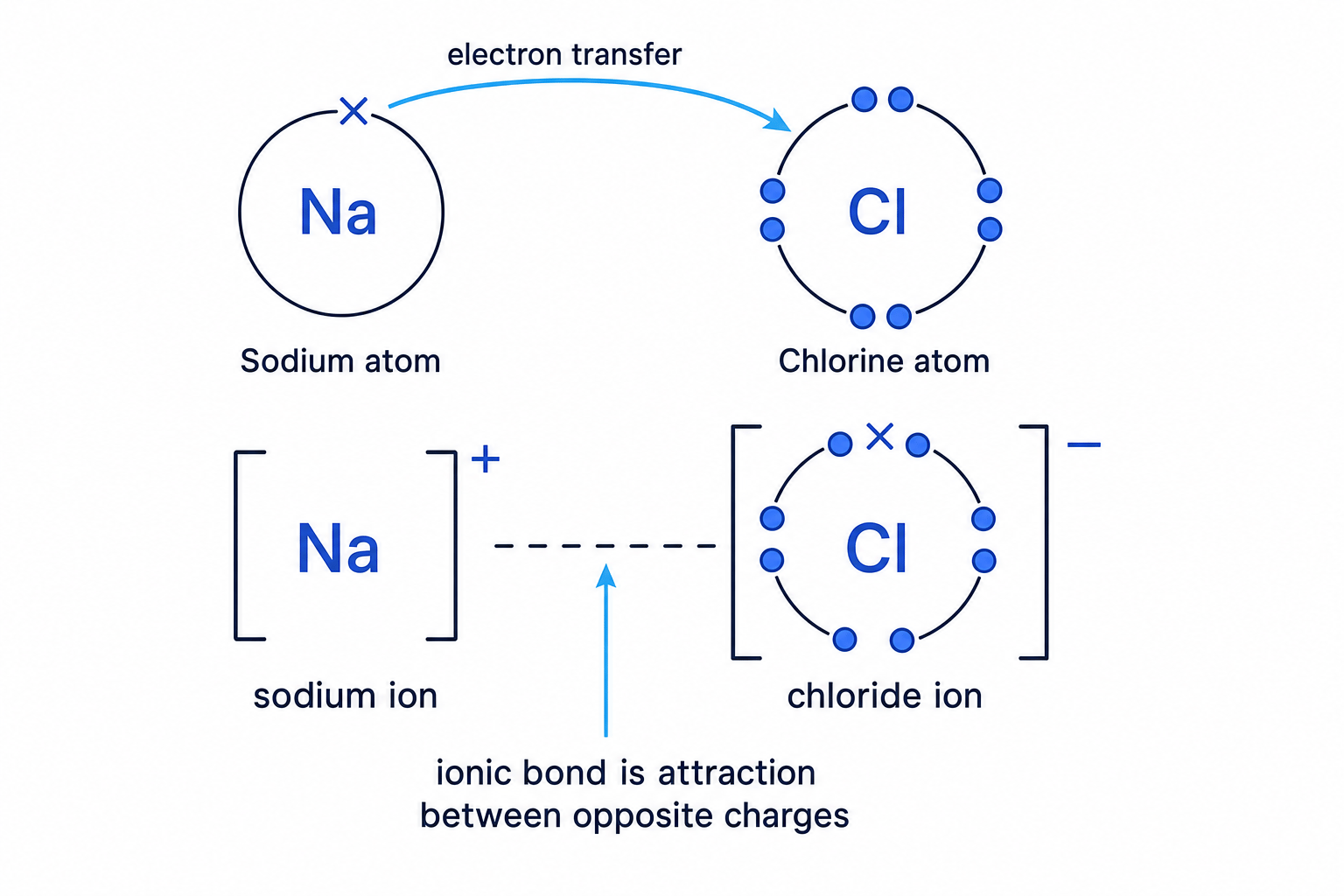
A dot-and-cross diagram shows outer-shell electrons. Dots are used for electrons from one atom, and crosses are used for electrons from the other atom.
For ionic bonding, the diagram must show electron transfer, not sharing.
How to draw them
Only outer electrons need to be shown.
For combinations of elements from Groups 1, 2, 3 and 5, 6, 7:
- Group 1 atoms lose one electron.
- Group 2 atoms lose two electrons.
- Group 3 atoms lose three electrons.
- Group 5 atoms gain three electrons.
- Group 6 atoms gain two electrons.
- Group 7 atoms gain one electron.
After transfer, draw the ions in square brackets with their charges.
Drawing magnesium oxide
Magnesium oxide forms from magnesium and oxygen. Explain what the dot-and-cross diagram should show.
-
Magnesium is in Group 2, so each magnesium atom loses two outer-shell electrons and forms Mg2+Mg^{2+}Mg2+.
-
Oxygen is in Group 6, so each oxygen atom gains two electrons and forms O2−O^{2-}O2−.
-
The two electrons lost by magnesium are exactly the two electrons gained by oxygen, so the ion ratio is one magnesium ion to one oxide ion.
-
The final diagram should show [Mg]2+[Mg]^{2+}[Mg]2+ and [O]2−[O]^{2-}[O]2−. The oxide ion should have eight outer electrons: six from oxygen and two transferred from magnesium.
Drawing shared electrons
In an ionic dot-and-cross diagram, the transferred electrons belong to the negative ion’s outer shell. Do not draw a shared pair between the two atoms — that would be covalent bonding.
5. What ionic bonding actually is
Ionic bond
An ionic bond is the strong electrostatic attraction between oppositely charged ions.
Electrostatic attraction means attraction between opposite electric charges. In sodium chloride, Na+Na^+Na+ ions and Cl−Cl^-Cl− ions attract each other because their charges are opposite.
A very important point: ionic bonding is not just a bond between one sodium ion and one chloride ion. In a solid ionic compound, each ion is attracted to many oppositely charged ions around it.
Ionic bonding is attraction, not electron transfer
Electron transfer forms the ions. The ionic bond is the electrostatic attraction between the positive and negative ions after they have formed.
6. Giant ionic lattices
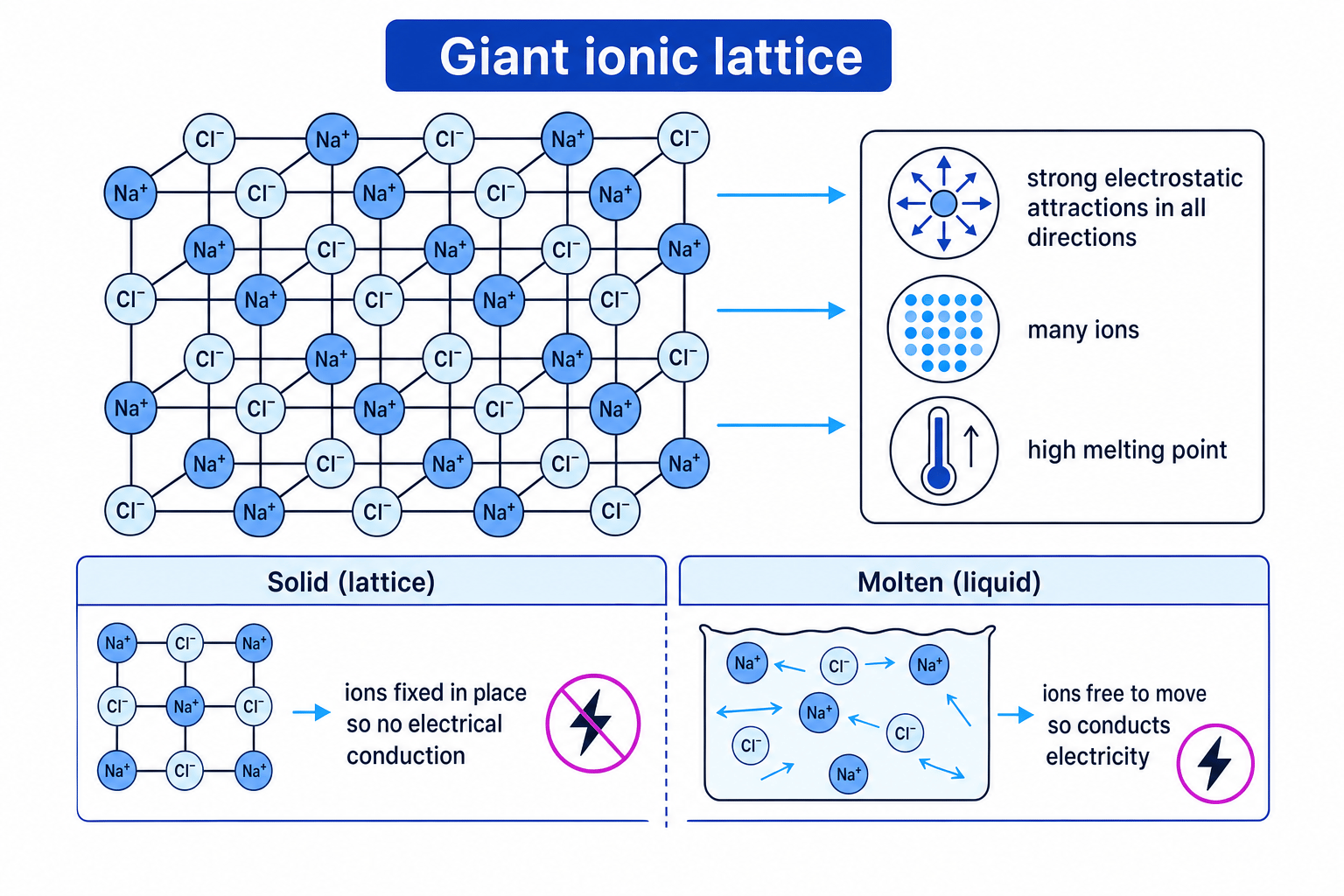
A lattice is a regular repeating arrangement of particles. A giant ionic lattice is a huge repeating structure made of many positive and negative ions.
Ionic compounds such as sodium chloride, magnesium oxide and aluminium oxide form giant ionic lattices.
Why ionic compounds have high melting and boiling points
Ionic compounds usually have high melting points and high boiling points because:
- they contain a giant lattice of many ions
- there are strong electrostatic attractions between oppositely charged ions
- these attractions act in all directions through the lattice
- a lot of energy is needed to overcome the attractions
Melting does not turn the ions into atoms. It just gives the ions enough energy to move away from their fixed positions in the lattice.
Explaining the high melting point of sodium chloride
Explain why sodium chloride has a high melting point.
-
Sodium chloride has a giant ionic lattice containing many Na+Na^+Na+ and Cl−Cl^-Cl− ions.
-
There are strong electrostatic attractions between the oppositely charged ions in all directions.
-
A large amount of energy is needed to overcome these attractions, so a high temperature is needed to melt sodium chloride.
Saying intermolecular forces in ionic compounds
Ionic compounds do not have simple molecules, so do not say “strong intermolecular forces” for sodium chloride. Say “strong electrostatic attractions between oppositely charged ions”.
7. Electrical conductivity
To conduct electricity, a substance must contain charged particles that are free to move.
Ionic compounds contain charged particles — ions — but whether they conduct depends on whether those ions can move.
Solid ionic compounds
In a solid ionic compound, the ions are held in fixed positions in the giant lattice. They can vibrate, but they cannot move through the structure. So solid ionic compounds do not conduct electricity.
Molten ionic compounds
Molten means melted. When an ionic compound is molten, the lattice has broken apart enough for the ions to move. The ions are free to carry charge, so the molten ionic compound conducts electricity.
Aqueous ionic compounds
Aqueous means dissolved in water. When many ionic compounds dissolve, their ions separate and can move through the solution.
For example:
NaCl(s)→Na+(aq)+Cl−(aq)NaCl(s) \rightarrow Na^+(aq) + Cl^-(aq)NaCl(s)→Na+(aq)+Cl−(aq)So sodium chloride solution conducts electricity because it contains mobile Na+Na^+Na+ and Cl−Cl^-Cl− ions.
Predicting conductivity of sodium chloride
Predict whether sodium chloride conducts electricity when solid, molten and dissolved in water.
-
Solid sodium chloride contains ions, but they are fixed in the lattice, so there are no mobile charge carriers. It does not conduct.
-
Molten sodium chloride contains Na+Na^+Na+ and Cl−Cl^-Cl− ions that can move through the liquid, so it conducts.
-
Sodium chloride solution contains Na+(aq)Na^+(aq)Na+(aq) and Cl−(aq)Cl^-(aq)Cl−(aq) ions that can move through the water, so it conducts.
The key word is mobile
Ions can only carry charge if they are mobile. Solid ionic compound: ions not mobile. Molten or aqueous ionic compound: ions mobile.
In the exam
-
When explaining ion formation, always state whether electrons are lost or gained, and give the charge of the ion formed.
-
For ionic formulae, balance the total positive and negative charges; the final formula must have no overall charge.
-
For properties, link structure to bonding: giant ionic lattice, strong electrostatic attractions, lots of energy needed, or mobile ions for conductivity.
Check yourself
- What ion is formed when an aluminium atom loses three electrons?
- Why is the formula of magnesium chloride MgCl2MgCl_2MgCl2 rather than MgClMgClMgCl?
- Why does molten potassium bromide conduct electricity, but solid potassium bromide does not?
