What you'll learn
- How elements are arranged by atomic number into groups and periods.
- How to deduce electronic configurations for the first 20 elements.
- How conductivity and oxide behaviour help classify elements as metals or non-metals.
- Why elements in the same group behave similarly, and why Group 0 is unreactive.
The Periodic Table is an ordered map
An atom is the smallest particle of an element that still has that element’s chemical identity. An element is a substance made from only one type of atom.
The Periodic Table is not just a list: it is a map. If you know where an element is, you can predict a lot about its atoms and its chemical behaviour.
Atomic number
The atomic number is the number of protons in the nucleus of an atom. The nucleus is the tiny central part of the atom. In a neutral atom, the atomic number is also equal to the number of electrons.
Elements are arranged in order of increasing atomic number. This means hydrogen, atomic number 1, comes before helium, atomic number 2, then lithium, atomic number 3, and so on.
The word periodic means that patterns repeat. As atomic number increases, similar chemical properties appear again and again in a regular pattern.
Groups and periods
Groups and periods
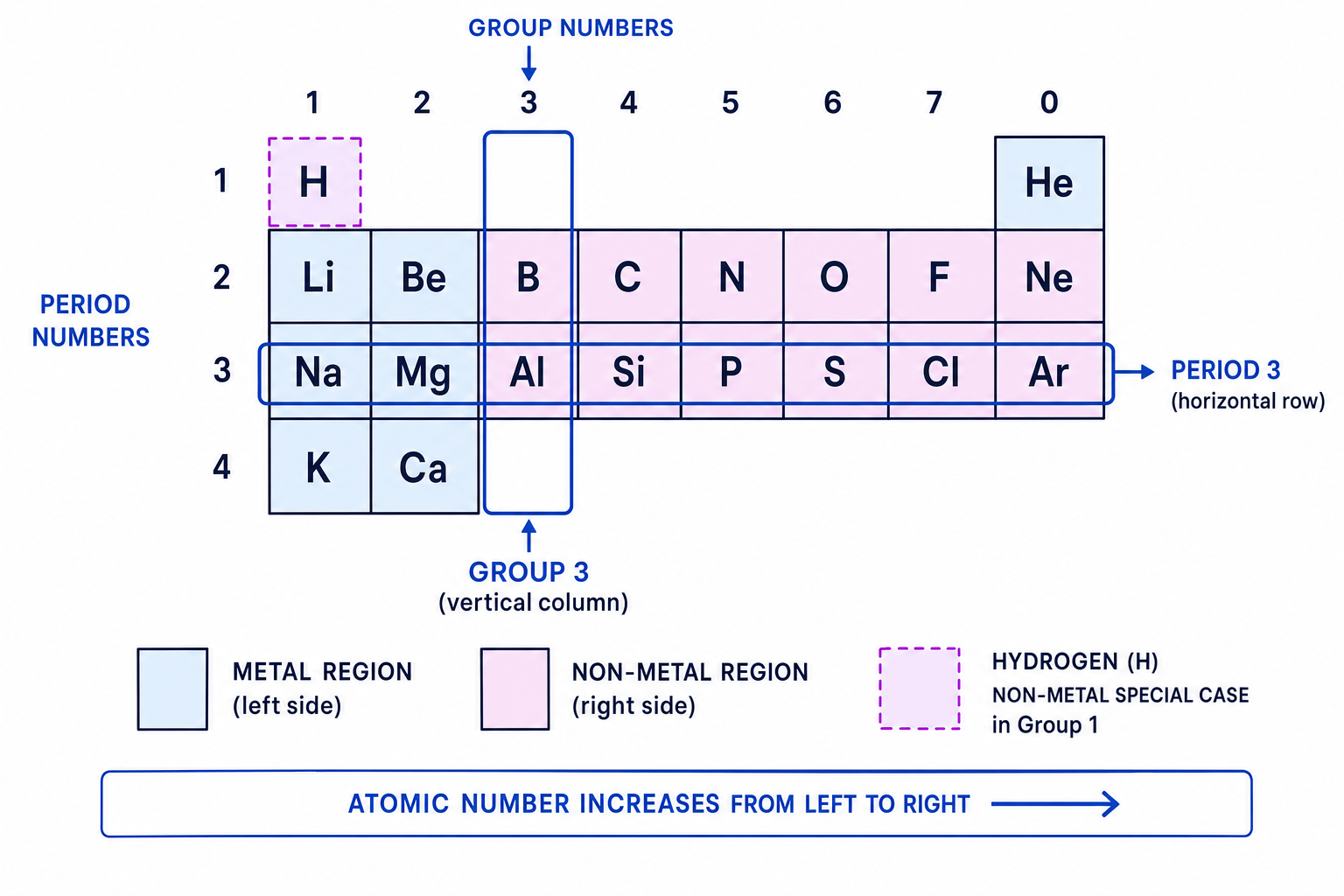
A group is a vertical column in the Periodic Table. A period is a horizontal row.
Elements in the same group often behave in similar ways. Elements in the same period have the same number of occupied electron shells, which we will build up in the next section.
Use this simplified first-20-elements map to see the main layout: group numbers are at the top, period numbers are at the side, and atomic number increases across the table.
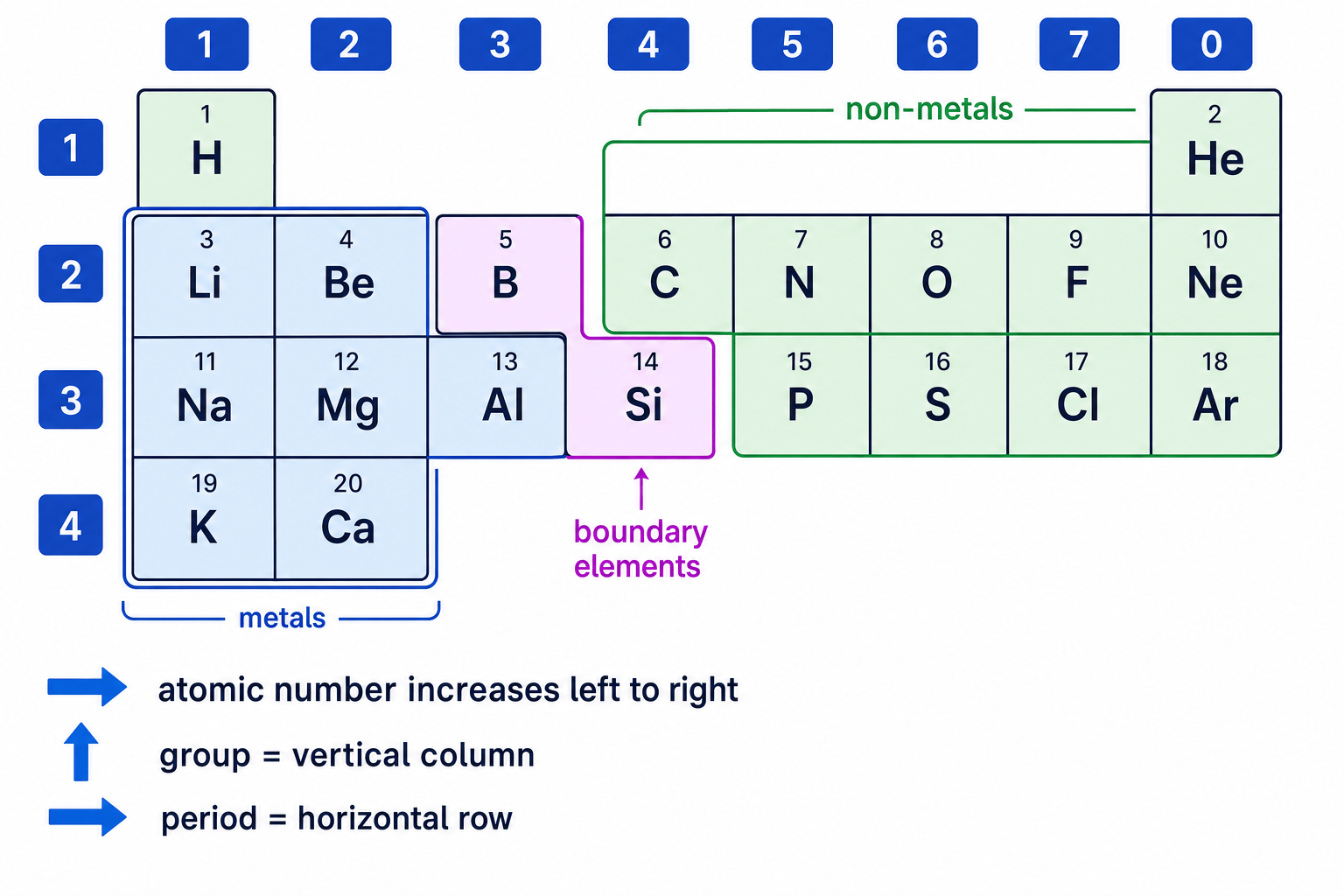
Most metals are on the left and in the centre of the Periodic Table. Most non-metals are on the right. Hydrogen is a special case: it is placed in Group 1 because it has one electron, but it is a non-metal.
How the table is arranged
The modern Periodic Table is arranged by increasing atomic number. Vertical columns are groups; horizontal rows are periods.
Reading position in the table
An element has atomic number 17. Identify its position and type.
- Atomic number 17 identifies the element as chlorine, because each element has a unique atomic number.
- Chlorine is in Period 3, so its atoms have three occupied electron shells.
- Chlorine is in Group 7 and on the right-hand non-metal region, so it is a non-metal with seven outer-shell electrons.
Hydrogen is not a Group 1 metal
Hydrogen sits above Group 1, but it is not an alkali metal. In this topic, classify hydrogen as a non-metal.
Electronic configuration
Electrons are arranged around the nucleus in shells. The first shell is closest to the nucleus, then the second shell, then the third, and so on.
Electronic configuration
An electronic configuration is the arrangement of electrons in shells around an atom, written as numbers such as 2, 8, 1. The outer shell is the highest occupied shell, furthest from the nucleus.
For the first 20 elements, use this shell-filling pattern:
- First shell holds up to 2 electrons.
- Second shell holds up to 8 electrons.
- Third shell holds up to 8 electrons for the first 20 elements.
- Potassium and calcium start a fourth shell.
A main group element is an element in Groups 1 to 7 or Group 0, rather than one of the transition metals in the central block.
For main group elements:
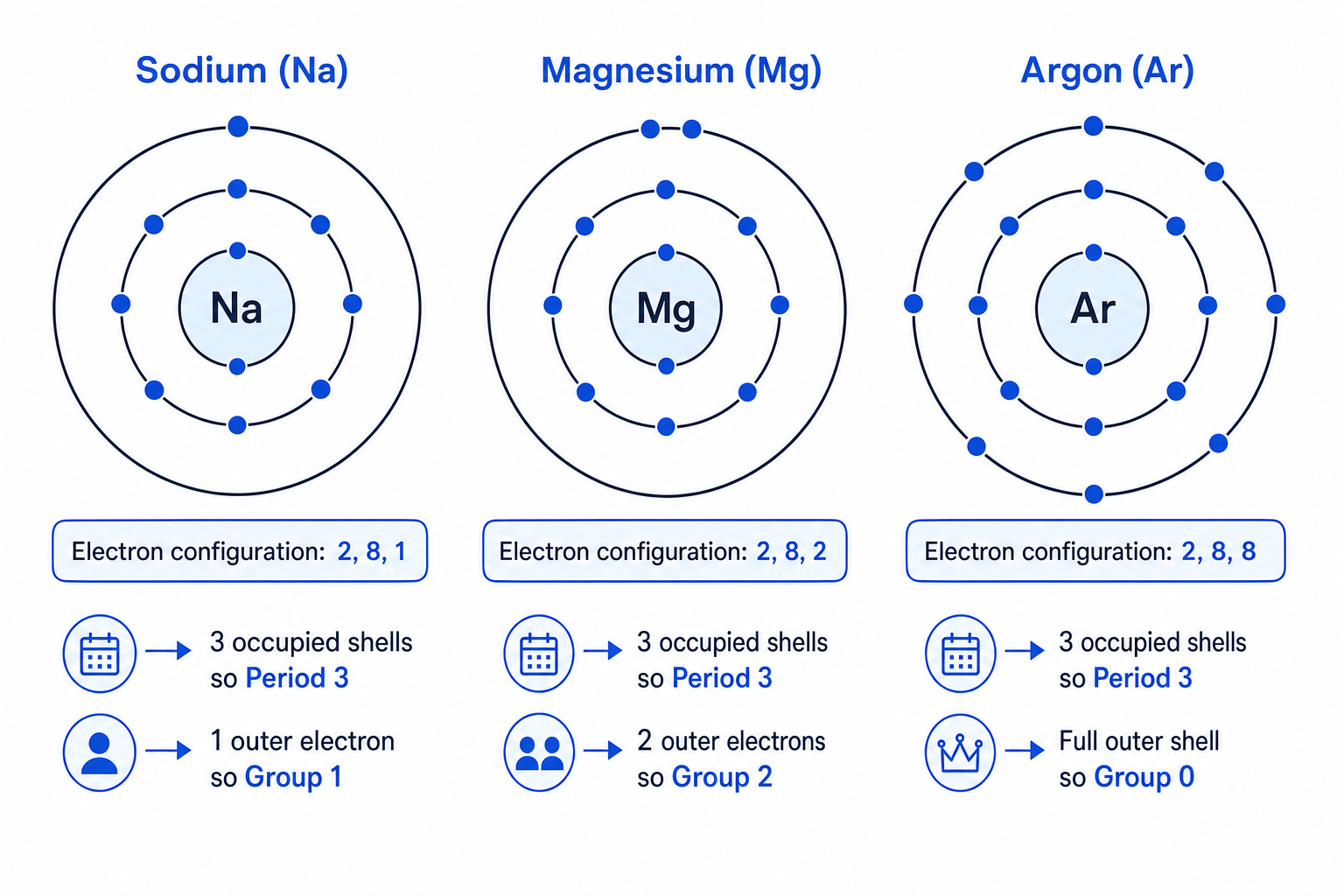
- Period number = number of occupied electron shells.
- Group number, for Groups 1 to 7 = number of outer-shell electrons.
- Group 0 = full outer shell.
The diagram below shows how electronic configuration links to position for sodium, magnesium and argon.
Configurations to recognise for the first 20 elements
You do not need to memorise these as a random list. Try to see the pattern:
- Period 1: H is 1; He is 2.
- Period 2: Li to Ne go from 2, 1 up to 2, 8.
- Period 3: Na to Ar go from 2, 8, 1 up to 2, 8, 8.
- Period 4 begins: K is 2, 8, 8, 1; Ca is 2, 8, 8, 2.
Position and electronic configuration
For the first 20 elements, the period tells you the number of occupied shells, and the group tells you the number of outer-shell electrons for Groups 1 to 7.
Deducing sulfur’s electronic configuration
Sulfur is in Period 3 and Group 6. Deduce its electronic configuration.
- Period 3 means sulfur atoms have three occupied electron shells.
- Group 6 means sulfur atoms have six electrons in the outer shell.
- Fill the inner shells first: the first shell has 2 electrons and the second shell has 8 electrons, so sulfur is 2, 8, 6.
Potassium is not 2, 8, 9
For the first 20 elements, potassium is 2, 8, 8, 1 and calcium is 2, 8, 8, 2. Do not keep adding electrons to the third shell after argon at this level.
Metals and non-metals
You can classify many elements as metals or non-metals from their position in the Periodic Table.
- Metals are generally found on the left and in the centre.
- Non-metals are generally found on the right.
- Group 0 elements are non-metals.
- Boundary elements such as boron and silicon are near the dividing line and can show mixed properties; for this specification, focus on the broad metal/non-metal pattern.
Electrical conductivity
Electrical conductivity
Electrical conductivity is the ability of a substance to allow electric charge to flow through it.
Metals conduct electricity because they contain delocalised electrons, which are electrons that can move through the structure and carry charge.
Most non-metals do not conduct electricity because their electrons are not free to move.
Oxides and acid-base character
An oxide is a compound containing oxygen and one other element.
The acid-base character of an oxide means whether it behaves as an acid or a base. A base is a substance that neutralises an acid. An alkali is a soluble base.
Metal oxides are usually basic oxides. They react with acids to form a salt and water. For example:
MgO(s)+2HCl(aq)→MgCl2(aq)+H2O(l)MgO(s) + 2HCl(aq) \rightarrow MgCl_2(aq) + H_2O(l)MgO(s)+2HCl(aq)→MgCl2(aq)+H2O(l)
Non-metal oxides are usually acidic oxides. They react with alkalis. For example, carbon dioxide reacts with sodium hydroxide solution:
CO2(g)+2NaOH(aq)→Na2CO3(aq)+H2O(l)CO_2(g) + 2NaOH(aq) \rightarrow Na_2CO_3(aq) + H_2O(l)CO2(g)+2NaOH(aq)→Na2CO3(aq)+H2O(l)
Classifying using properties
A solid that conducts electricity and forms a basic oxide is likely to be a metal. A poor conductor that forms an acidic oxide is likely to be a non-metal.
Classifying an element from tests
An unknown solid element conducts electricity. Its oxide reacts with dilute hydrochloric acid to form a salt and water. Classify the element.
- The solid conducts electricity, which is typical of metals because mobile electrons can carry charge.
- Its oxide reacts with acid to form salt and water, so the oxide is basic.
- Conductivity plus a basic oxide both point to the element being a metal.
Using only one clue
Graphite, a form of carbon, conducts electricity even though carbon is a non-metal. If a question gives several clues, use all of them rather than relying only on conductivity.
Why elements in the same group have similar properties
Chemical reactions usually involve the outer-shell electrons of atoms. If two elements have the same number of outer-shell electrons, they tend to react in similar ways.
For example:
- Group 1 elements have one outer-shell electron.
- Group 2 elements have two outer-shell electrons.
- Group 7 elements have seven outer-shell electrons.
- Group 0 elements have full outer shells.
This is why elements in the same group have similar chemical properties.
Predicting similar chemical behaviour
An element has electronic configuration 2, 8, 7. Explain why it behaves similarly to chlorine.
- The configuration 2, 8, 7 shows seven electrons in the outer shell.
- Seven outer-shell electrons places the element in Group 7, the same group as chlorine.
- Because both atoms have the same number of outer-shell electrons, they tend to react similarly, such as forming 1- ions in compounds with metals.
Why Group 0 does not readily react
Noble gases
The noble gases are the Group 0 elements, including helium, neon and argon. They are very unreactive non-metals.
Group 0 elements have full outer electron shells:
- Helium has 2 electrons, filling its first shell.
- Neon has 2, 8.
- Argon has 2, 8, 8.
A full outer shell is stable. Because noble gas atoms already have stable electronic configurations, they have little tendency to gain, lose or share electrons.
Full outer shells are stable
Group 0 elements do not readily react because their atoms already have full outer electron shells.
Explaining why argon is unreactive
Explain why argon does not readily react.
- Argon has atomic number 18, so a neutral argon atom has 18 electrons.
- These electrons are arranged 2, 8, 8, giving argon a full outer shell.
- Since its outer shell is already full, argon has little tendency to gain, lose or share electrons, so it is very unreactive.
Group 0 does not mean zero electrons
Group 0 elements do not have zero outer-shell electrons. They have full outer shells, which is why they are stable and unreactive.
In the exam
- Start with atomic number: it tells you the number of protons, and for a neutral atom, the number of electrons.
- For the first 20 elements, fill shells as 2, then 8, then 8, then start the fourth shell for potassium and calcium.
- When explaining similar properties, always link the answer to the same number of outer-shell electrons.
- For metal/non-metal classification, combine position, conductivity and oxide behaviour if the question gives more than one clue.
Check yourself
- What is the electronic configuration of calcium, and how does it show calcium is in Group 2?
- Why do chlorine and fluorine have similar chemical properties?
- How could you use an oxide’s reaction with acid or alkali to help classify an element?