What you'll learn
- How to recognise alcohols from their –OH functional group.
- How to draw and name methanol, ethanol, propan-1-ol and butan-1-ol.
- Three ways ethanol can be oxidised, including combustion and acidified dichromate(VI).
- Two ways ethanol is manufactured, and why fermentation needs no air and about 30 °C.
These Edexcel 4CH1 alcohol points have a C suffix, so they are assessed on Paper 2 only — but learn them just as carefully as the rest of organic chemistry.
Alcohols and the –OH functional group
Organic chemistry is the chemistry of carbon compounds. In organic chemistry, a small group of atoms can control how a whole molecule reacts.
Functional group
A functional group is an atom or group of atoms in an organic molecule that gives the molecule its characteristic reactions. Alcohols contain the –OH functional group, called the hydroxyl group.
In an alcohol, the –OH group is covalently bonded to a carbon chain. For example, ethanol can be written as CH3CH2OHCH_3CH_2OHCH3CH2OH: the CH3CH2CH_3CH_2CH3CH2 part is the carbon chain, and the OHOHOH part is the alcohol functional group.
–OH is not the same as OH⁻
The –OH group in an alcohol is neutral and covalently bonded inside the molecule. It is not the hydroxide ion, OH−OH^-OH−, found in alkalis.
Drawing and naming the first alcohols
A structural formula shows how atoms are grouped in a molecule without drawing every bond. A displayed formula shows every atom and every bond.
When drawing displayed formulae, use the usual bonding rules:
- carbon forms 4 bonds
- oxygen forms 2 bonds
- hydrogen forms 1 bond
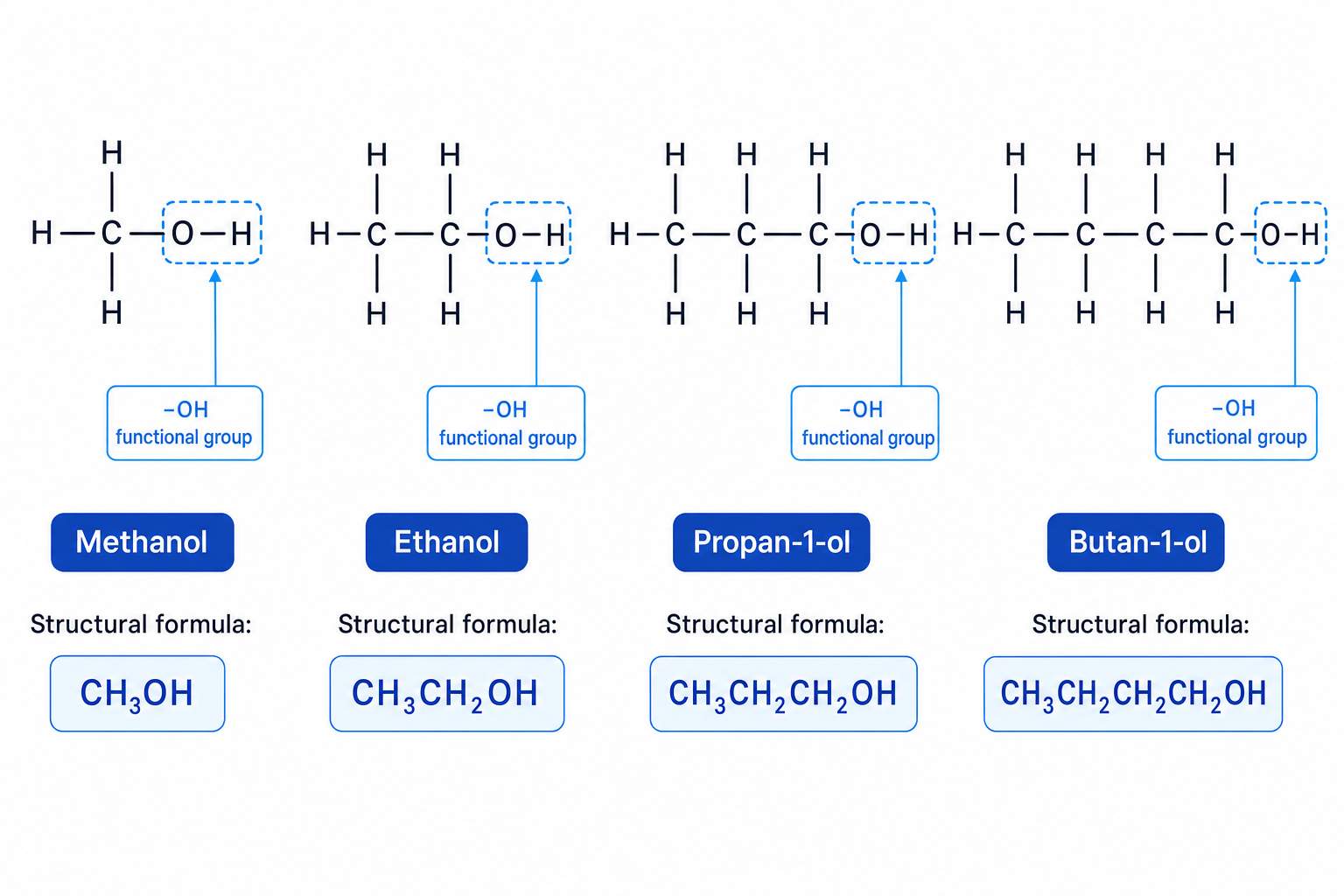
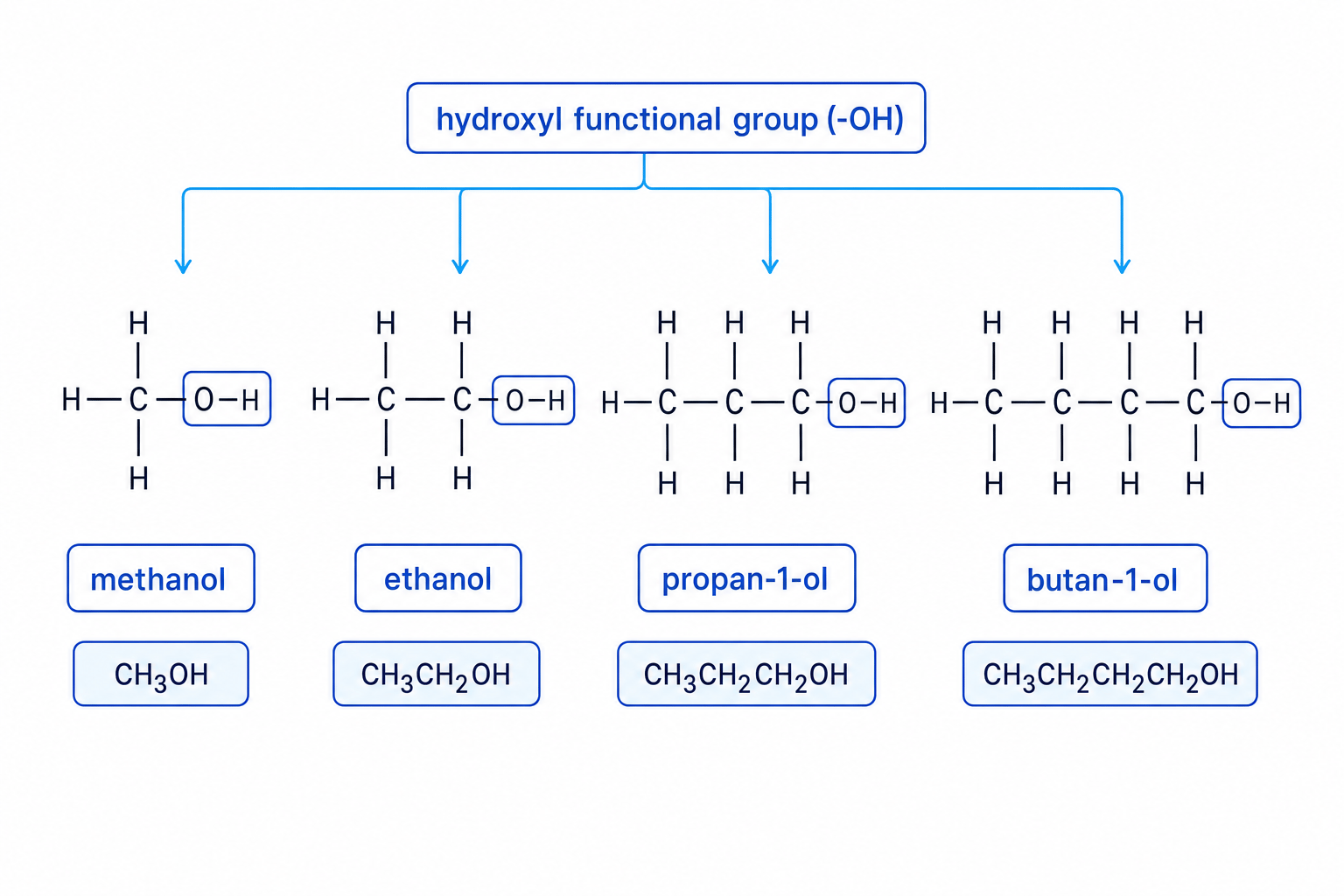
The diagram shows the displayed and structural formulae for the first four straight-chain alcohols in this specification.
Names and structural formulae
The first four alcohols you need are:
- methanol: CH3OHCH_3OHCH3OH
- ethanol: CH3CH2OHCH_3CH_2OHCH3CH2OH, also written as C2H5OHC_2H_5OHC2H5OH
- propan-1-ol: CH3CH2CH2OHCH_3CH_2CH_2OHCH3CH2CH2OH
- butan-1-ol: CH3CH2CH2CH2OHCH_3CH_2CH_2CH_2OHCH3CH2CH2CH2OH
The prefixes tell you the number of carbon atoms:
- meth- means 1 carbon
- eth- means 2 carbons
- prop- means 3 carbons
- but- means 4 carbons
The ending -ol tells you the compound is an alcohol.
For this specification, propanol means propan-1-ol, and butanol means butan-1-ol. The “1” means the –OH group is on carbon 1, at the end of the chain.
Naming alcohols
Count the carbon atoms to choose the prefix, then add -ol because the molecule contains the –OH functional group.
Naming and drawing butan-1-ol
-
Count the carbon atoms in CH3CH2CH2CH2OHCH_3CH_2CH_2CH_2OHCH3CH2CH2CH2OH. There are 4 carbon atoms, so the prefix is but-.
-
Identify the functional group. The molecule contains –OH, so it is an alcohol and the name ends in -ol.
-
Check the position of the –OH group. It is attached to the end carbon, so it is on carbon 1. The name is butan-1-ol. In a displayed formula, draw a chain of 4 carbon atoms, add the –OH to the end carbon, then add enough hydrogen atoms so each carbon has 4 bonds.
Moving the –OH group
For this topic, keep the –OH group on carbon 1 for propan-1-ol and butan-1-ol. Do not draw propan-2-ol or other butanol isomers unless a question specifically introduces them.
Oxidation of ethanol
Oxidation
In this topic, oxidation means a reaction in which ethanol gains oxygen, reacts with oxygen, or is converted into a more oxygen-rich product.
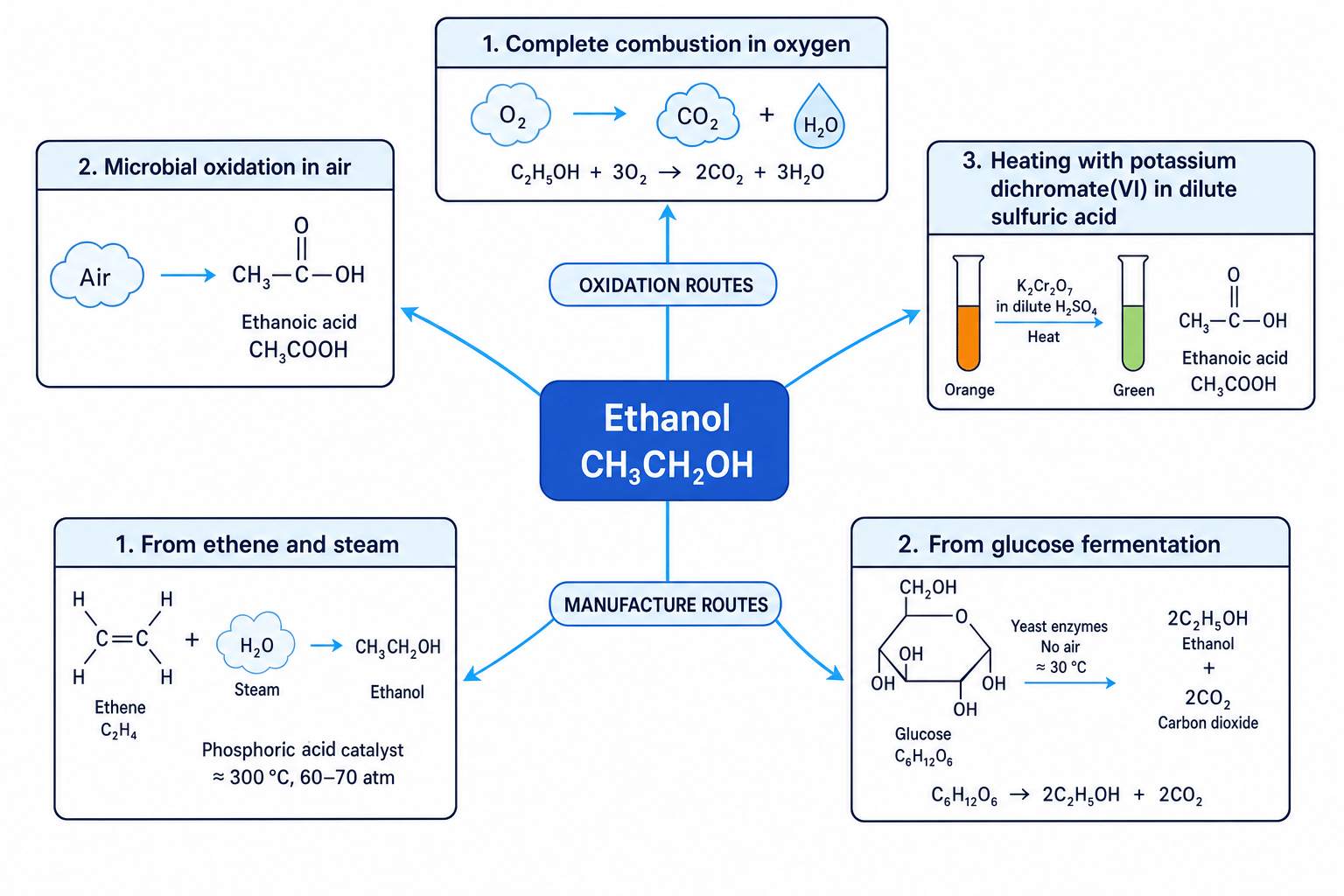
Ethanol can be oxidised in three important ways. The diagram gives the overview; the details are explained underneath.
1. Complete combustion
Complete combustion means burning in plenty of oxygen. Ethanol burns in air or oxygen to form carbon dioxide and water.
C2H5OH(l)+3O2(g)→2CO2(g)+3H2O(g)C_2H_5OH\text{(l)} + 3O_2\text{(g)} \rightarrow 2CO_2\text{(g)} + 3H_2O\text{(g)}C2H5OH(l)+3O2(g)→2CO2(g)+3H2O(g)This is oxidation because ethanol reacts with oxygen. It is also why ethanol can be used as a fuel.
Balancing ethanol combustion
- Start with the unbalanced equation: ethanol plus oxygen forms carbon dioxide and water.
- Balance carbon and hydrogen first. Ethanol contains 2 carbon atoms and 6 hydrogen atoms, so make 2 carbon dioxide molecules and 3 water molecules.
- Count oxygen atoms on the right: 2CO22CO_22CO2 contains 4 oxygen atoms and 3H2O3H_2O3H2O contains 3 oxygen atoms, giving 7 oxygen atoms in total. Ethanol already supplies 1 oxygen atom, so oxygen gas must supply 6 more oxygen atoms, which is 3O23O_23O2.
2. Microbial oxidation in air
If ethanol is exposed to air, microorganisms can oxidise it to ethanoic acid. This is why wine or beer left open to air can eventually turn sour.
CH3CH2OH(aq)+O2(g)→CH3COOH(aq)+H2O(l)CH_3CH_2OH\text{(aq)} + O_2\text{(g)} \rightarrow CH_3COOH\text{(aq)} + H_2O\text{(l)}CH3CH2OH(aq)+O2(g)→CH3COOH(aq)+H2O(l)Ethanoic acid, CH3COOHCH_3COOHCH3COOH, is the acid found in vinegar.
3. Heating with acidified potassium dichromate(VI)
Ethanol can also be oxidised by heating it with potassium dichromate(VI) in dilute sulfuric acid. This reagent is often called acidified potassium dichromate(VI).
The key observation is:
- orange potassium dichromate(VI) turns green
- ethanol is oxidised to ethanoic acid
A simplified organic equation is:
CH3CH2OH(aq)+2[O]→CH3COOH(aq)+H2O(l)CH_3CH_2OH\text{(aq)} + 2[O] \rightarrow CH_3COOH\text{(aq)} + H_2O\text{(l)}CH3CH2OH(aq)+2[O]→CH3COOH(aq)+H2O(l)What [O] means
In this simplified equation, [O] means oxygen supplied by the oxidising agent. It is not oxygen gas, and it is not a separate substance you would collect.
Manufacturing ethanol
Ethanol can be manufactured in two main ways: from ethene and steam, or by fermentation of glucose.
Route 1: Reacting ethene with steam
Ethene is an alkene with formula C2H4C_2H_4C2H4. Steam is gaseous water. Ethene reacts with steam to make ethanol.
C2H4(g)+H2O(g)→C2H5OH(g)C_2H_4\text{(g)} + H_2O\text{(g)} \rightarrow C_2H_5OH\text{(g)}C2H4(g)+H2O(g)→C2H5OH(g)The conditions are:
- phosphoric acid catalyst, H3PO4H_3PO_4H3PO4
- about 300 °C
- about 60–70 atm pressure
Catalyst
A catalyst speeds up a chemical reaction without being used up overall.
This industrial method is fast and continuous, but it needs high temperature and pressure, and ethene usually comes from crude oil.
Route 2: Fermentation of glucose
Fermentation is the breakdown of glucose by enzymes in yeast to produce ethanol and carbon dioxide. Yeast is a microorganism, and enzymes are biological catalysts.
C6H12O6(aq)→2C2H5OH(aq)+2CO2(g)C_6H_{12}O_6\text{(aq)} \rightarrow 2C_2H_5OH\text{(aq)} + 2CO_2\text{(g)}C6H12O6(aq)→2C2H5OH(aq)+2CO2(g)Fermentation needs:
- glucose solution
- yeast
- absence of air
- optimum temperature of about 30 °C
The absence of air is important because oxygen would allow aerobic respiration, producing carbon dioxide and water instead of ethanol. Air can also allow microbial oxidation of ethanol into ethanoic acid.
The temperature matters because enzymes work best at an optimum temperature. Below about 30 °C, fermentation is slow. If the temperature is too high, enzymes denature and the yeast may die, so ethanol production falls.
Fermentation conditions
Fermentation works best with no air and about 30 °C because yeast enzymes must produce ethanol quickly without being denatured or diverted into aerobic respiration.
Explaining a low ethanol yield
-
If the mixture is too cold, yeast enzymes have less kinetic energy, so successful enzyme-controlled reactions happen less often. Fermentation is slow.
-
If the mixture is much hotter than 30 °C, the enzymes may denature, meaning their active sites change shape. Glucose is no longer broken down effectively.
-
If air enters the vessel, oxygen can lead to aerobic respiration or oxidation of ethanol. Less ethanol is produced, and some ethanol may be converted to ethanoic acid.
In the exam
- When asked for the functional group of alcohols, write –OH, not just “oxygen”.
- Learn the exact ethanol manufacture conditions: phosphoric acid catalyst, about 300 °C, 60–70 atm for ethene and steam; yeast, no air, about 30 °C for fermentation.
- For ethanol oxidation, link each method to its product: combustion gives carbon dioxide and water; microbial oxidation and acidified dichromate(VI) give ethanoic acid.
Check yourself
- Can you draw the displayed formula of propan-1-ol and label the –OH group?
- What colour change happens when ethanol is heated with acidified potassium dichromate(VI)?
- Why does fermentation need to happen without air and at about 30 °C?