

What you'll learn
- How litmus, phenolphthalein, methyl orange and universal indicator show whether a solution is acidic or alkaline.
- How the pH scale from 0–14 classifies solutions.
- What acids and alkalis produce when dissolved in water.
- How an acid-alkali titration is carried out accurately.
Aqueous solutions: the starting point
Many acid and alkali reactions happen in water. When a substance is dissolved in water, the solution is called aqueous. In equations, aqueous is shown using the state symbol (aq).
Aqueous solution
An aqueous solution is a mixture where a substance is dissolved in water.
This matters because acids and alkalis are defined by the ions they produce in aqueous solution.
Indicators: dyes that change colour
An indicator is a dye that changes colour depending on whether a solution is acidic or alkaline.
Indicator
An indicator is a substance that shows whether a solution is acidic or alkaline by changing colour.
For Edexcel IGCSE, you need these three key indicators:
| Indicator | In acidic solution | In alkaline solution |
|---|---|---|
| Litmus | Red | Blue |
| Phenolphthalein | Colourless | Pink |
| Methyl orange | Red | Yellow |
Litmus may be used as paper or solution. Blue litmus turns red in acid; red litmus turns blue in alkali.
Using indicator colours
A colourless solution turns blue litmus red. Phenolphthalein stays colourless, and methyl orange turns red. Decide whether the solution is acidic or alkaline.
- Blue litmus turning red is evidence for an acidic solution.
- Phenolphthalein being colourless fits an acidic solution, because it is only pink in alkaline solution.
- Methyl orange turning red also fits an acidic solution, so the solution is acidic.
Indicator colours are not exact pH values
Litmus, phenolphthalein and methyl orange mainly tell you whether a solution is acidic or alkaline. They do not give an exact pH value.
The pH scale
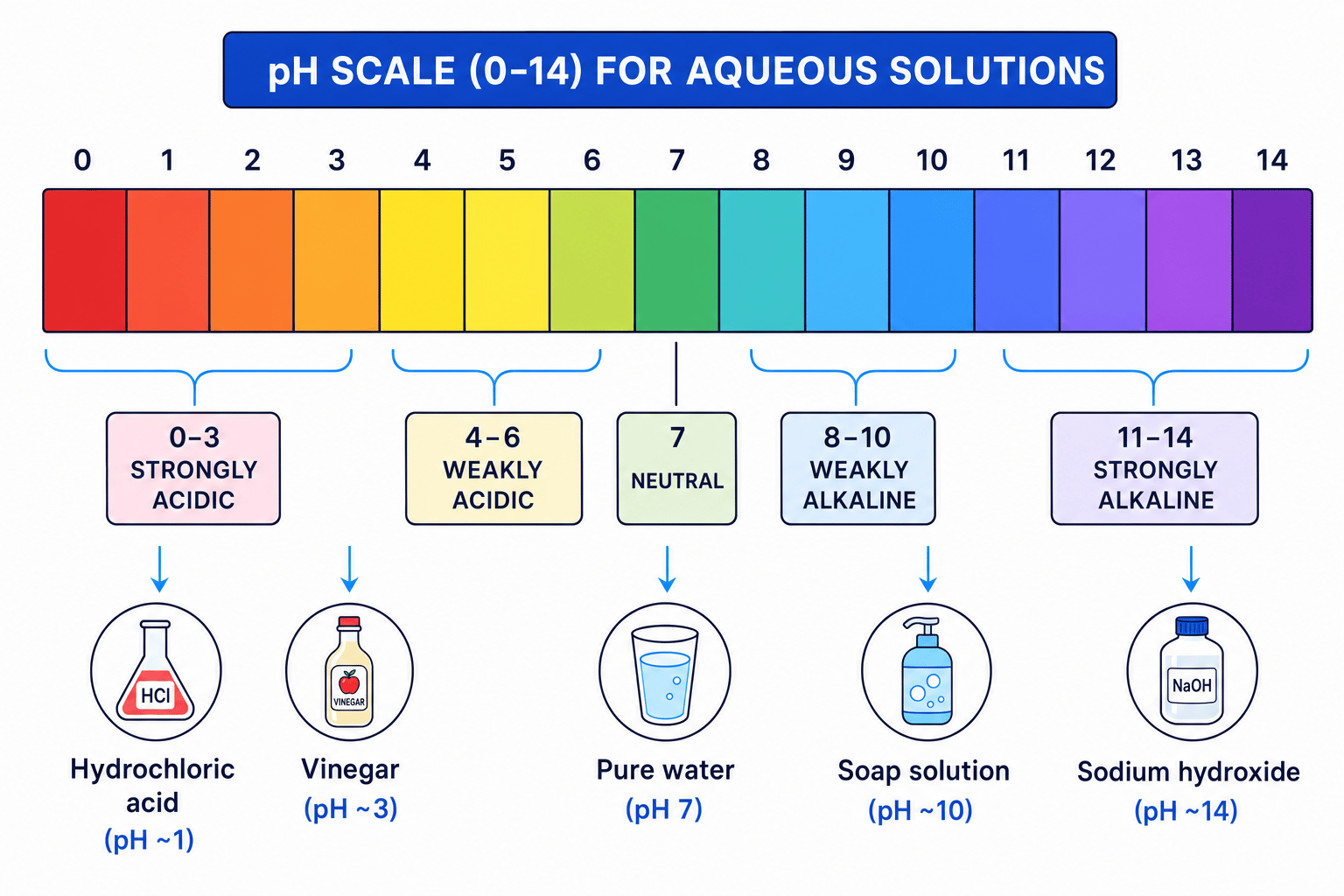
The pH scale measures how acidic or alkaline an aqueous solution is. At IGCSE, use the scale from 0 to 14.
- pH 0–3: strongly acidic
- pH 4–6: weakly acidic
- pH 7: neutral
- pH 8–10: weakly alkaline
- pH 11–14: strongly alkaline
The lower the pH, the more acidic the solution. The higher the pH, the more alkaline the solution.
Classifying a pH value
A solution has pH 12. Classify it.
- Compare pH 12 with the Edexcel pH ranges.
- pH 12 lies in the range 11–14.
- Therefore, the solution is strongly alkaline.
Neutral means pH 7
A neutral solution is pH 7. It is not acidic and not alkaline. Pure water is the standard example.
Universal indicator
Universal indicator is a mixture of indicators. It shows an approximate pH by producing a range of colours.
Typical universal indicator colours are:
- Red: strongly acidic
- Orange/yellow: weakly acidic
- Green: neutral
- Blue: weakly alkaline
- Purple: strongly alkaline
To use universal indicator, add a few drops to the solution, or dip universal indicator paper into it. Then compare the colour with a pH colour chart.
Universal indicator gives an estimate
Universal indicator gives an approximate pH, not a perfectly exact value. You must compare the colour to the chart provided.
Estimating pH from universal indicator
A solution turns universal indicator blue. What can you say about it?
- Blue on a universal indicator chart usually matches a pH around 8–10.
- The pH range 8–10 is classified as weakly alkaline.
- So the solution is alkaline, but not strongly alkaline.
Acids and alkalis in water
Now for the particle-level idea.
Acids and alkalis are not just “things with certain colours”. They produce particular ions when dissolved in water.
Acid
An acid is a substance that produces hydrogen ions, H+H^+H+, in aqueous solution.
Alkali
An alkali is a soluble base that produces hydroxide ions, OH−OH^-OH−, in aqueous solution.
For example:
HCl(aq)→H+(aq)+Cl−(aq)HCl\text{(aq)} \rightarrow H^+\text{(aq)} + Cl^-\text{(aq)}HCl(aq)→H+(aq)+Cl−(aq) NaOH(aq)→Na+(aq)+OH−(aq)NaOH\text{(aq)} \rightarrow Na^+\text{(aq)} + OH^-\text{(aq)}NaOH(aq)→Na+(aq)+OH−(aq)So hydrochloric acid provides H+H^+H+ ions, while sodium hydroxide provides OH−OH^-OH− ions.
The important ions
Acids are sources of H+H^+H+ ions in water. Alkalis are sources of OH−OH^-OH− ions in water.
Neutralisation
Neutralisation is the reaction between an acid and an alkali. The alkali cancels out the acidic properties of the acid.
Neutralisation
Neutralisation is a reaction in which an acid reacts with an alkali or base to form water and a salt.
The general word equation is:
acid + alkali → salt + water
The key ionic equation is:
H+(aq)+OH−(aq)→H2O(l)H^+\text{(aq)} + OH^-\text{(aq)} \rightarrow H_2O\text{(l)}H+(aq)+OH−(aq)→H2O(l)This shows the main idea: hydrogen ions from the acid react with hydroxide ions from the alkali to make water.
For example:
HCl(aq)+NaOH(aq)→NaCl(aq)+H2O(l)HCl\text{(aq)} + NaOH\text{(aq)} \rightarrow NaCl\text{(aq)} + H_2O\text{(l)}HCl(aq)+NaOH(aq)→NaCl(aq)+H2O(l)Here, hydrochloric acid reacts with sodium hydroxide to form sodium chloride and water.
Writing a neutralisation equation
Write a balanced equation for sulfuric acid reacting with sodium hydroxide.
- Identify the reactants and products: sulfuric acid reacts with sodium hydroxide to form sodium sulfate and water.
- Write the formulae: H2SO4H_2SO_4H2SO4, NaOHNaOHNaOH, Na2SO4Na_2SO_4Na2SO4 and H2OH_2OH2O.
- Balance the sodium ions and hydroxide ions by placing a 2 before NaOHNaOHNaOH and H2OH_2OH2O:
Acid-alkali titration
A titration is an accurate method used to find the volume of one solution needed to exactly react with a measured volume of another solution. The full acid-alkali titration method is Paper 2 only in Edexcel 4CH1, but it is a very useful practical skill.
Titration
A titration is a practical technique where one solution is added to another until the reaction is just complete.
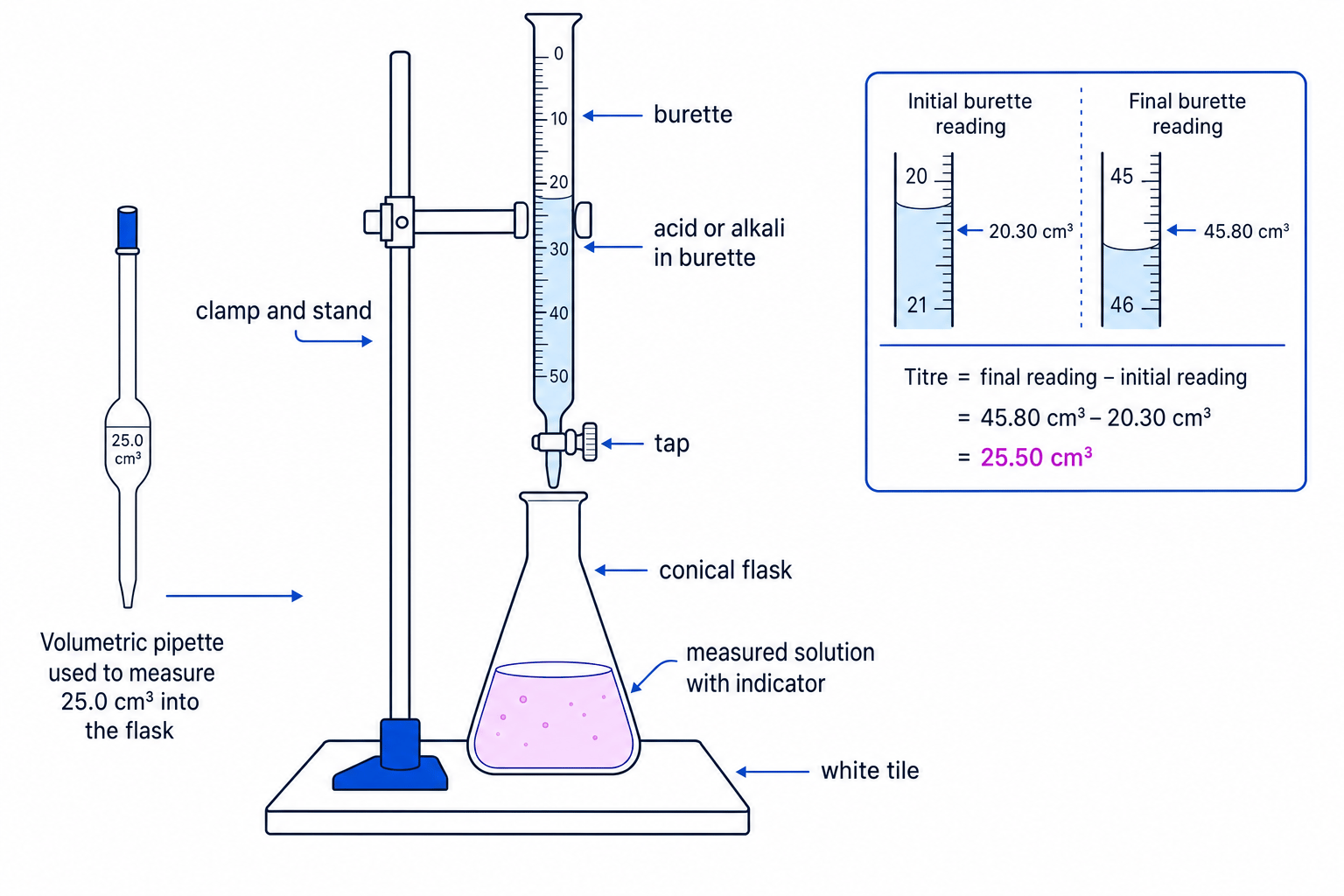
A titration usually uses:
- A burette to deliver a variable, measured volume of solution.
- A volumetric pipette to measure a fixed volume, often 25.0 cm³.
- A conical flask to hold the measured solution and allow swirling.
- An indicator to show the endpoint.
- A white tile to make the colour change easier to see.
Method
- Use a volumetric pipette and pipette filler to measure a fixed volume of one solution into a conical flask.
- Add a few drops of a suitable indicator.
- Fill the burette with the other solution and record the initial burette reading at eye level.
- Add the solution from the burette into the flask while swirling.
- Near the endpoint, add the solution drop by drop.
- Stop when the indicator just changes colour permanently.
- Record the final burette reading.
- Calculate the titre, which is the volume delivered from the burette.
- Repeat until you get concordant titres, which are close together.
Titre
The titre is the volume of solution delivered from the burette during a titration.
Expected colour changes
The colour change depends on the indicator and which solution is in the flask.
- If acid is in the flask and phenolphthalein is used, the solution starts colourless and becomes pale pink when a slight excess of alkali is added.
- If alkali is in the flask and phenolphthalein is used, the solution starts pink and becomes colourless when acid is added.
- With methyl orange, acid is red and alkali is yellow; the endpoint is often seen as orange.
Do not use universal indicator for titration
Universal indicator gives many gradual colour changes, so it is difficult to spot one sharp endpoint. Use phenolphthalein or methyl orange instead.
Calculating a titre and mean
A student records an initial burette reading of 1.20 cm³ and a final reading of 24.70 cm³. Their accurate titres are 23.45 cm³, 23.50 cm³, 23.55 cm³ and 24.10 cm³. Calculate the mean concordant titre.
- Calculate the titre from the burette readings:
- Choose concordant titres. 23.45 cm³, 23.50 cm³ and 23.55 cm³ are close together; 24.10 cm³ is not close, so exclude it.
- Calculate the mean of the concordant titres:
Rinsing the wrong glassware
Rinse the burette with the solution that will go in it, and rinse the pipette with the solution it will measure. The conical flask can be rinsed with distilled water, because extra water does not change the amount of acid or alkali in the flask.
In the exam
- For indicator questions, give both the indicator and the correct colour change.
- For pH questions, use the exact ranges: 0–3 strongly acidic, 4–6 weakly acidic, 7 neutral, 8–10 weakly alkaline, 11–14 strongly alkaline.
- For neutralisation, mention H+H^+H+ ions reacting with OH−OH^-OH− ions to form water.
- For titration methods, include the pipette, burette, indicator, dropwise addition near the endpoint, repeat titres and mean concordant titre.
Check yourself
- What colour is phenolphthalein in an alkaline solution?
- Which ions are produced by acids and alkalis in aqueous solution?
- Why is universal indicator not normally used in an acid-alkali titration?

