

What you'll learn
- How to use solubility rules to predict whether an ionic compound dissolves in water.
- What acids and bases mean in terms of proton transfer.
- How acids react with metals, bases and carbonates to make salts.
- How to prepare pure, dry soluble and insoluble salts, including the named practicals.
Salts, solutions and solubility
A salt is an ionic compound formed when the hydrogen in an acid is replaced by a metal ion or an ammonium ion. For example, hydrochloric acid forms chlorides, sulfuric acid forms sulfates, and nitric acid forms nitrates.
A solution labelled aqueous, written (aq), has the substance dissolved in water.
Soluble and insoluble
A substance is soluble if it dissolves in water. A substance is insoluble if it does not dissolve, or only dissolves by a tiny amount, in water.
Solubility rules you need
For common ionic compounds in water:
- Common sodium, potassium and ammonium compounds are soluble.
- All nitrates are soluble.
- Common chlorides are soluble, except silver chloride and lead(II) chloride.
- Common sulfates are soluble, except barium sulfate, calcium sulfate and lead(II) sulfate.
- Common carbonates are insoluble, except sodium, potassium and ammonium carbonates.
- Common hydroxides are insoluble, except sodium hydroxide, potassium hydroxide and calcium hydroxide. Calcium hydroxide is only slightly soluble.
Forgetting the exceptions
Do not write “all chlorides are soluble” or “all sulfates are soluble”. The exceptions are often the whole point of a salt-preparation question.
Predicting solubility
Decide whether these compounds are soluble in water: magnesium sulfate, lead(II) chloride, potassium carbonate and copper(II) hydroxide.
- Magnesium sulfate is a sulfate. Common sulfates are soluble except barium, calcium and lead(II) sulfates, so magnesium sulfate is soluble.
- Lead(II) chloride is a chloride. Common chlorides are soluble except silver and lead(II) chlorides, so lead(II) chloride is insoluble.
- Potassium carbonate is a carbonate. Common carbonates are insoluble except sodium, potassium and ammonium carbonates, so potassium carbonate is soluble.
- Copper(II) hydroxide is a hydroxide. Common hydroxides are insoluble except sodium, potassium and slightly soluble calcium hydroxide, so copper(II) hydroxide is insoluble.
Acids and bases: proton transfer
Acids and bases
An acid is a proton donor. A base is a proton acceptor. In acid-base chemistry, a proton means a hydrogen ion, H+H^+H+.
When an acid reacts, it donates H+H^+H+. When a base reacts, it accepts H+H^+H+. For example, ammonia acts as a base because it accepts a proton to form an ammonium ion:
NH3(aq)+H+(aq)→NH4+(aq)\text{NH}_{3}(aq)+\text{H}^{+}(aq)\to\text{NH}_{4}^{+}(aq)NH3(aq)+H+(aq)→NH4+(aq)Metal oxides, metal hydroxides and ammonia can all act as bases. An alkali is a base that is soluble in water, such as sodium hydroxide solution or potassium hydroxide solution.
Neutralisation
Neutralisation is a proton-transfer reaction in which an acid reacts with a base to form a salt, often with water as another product.
Reactions of acids to form salts
Naming the salt
The acid decides the second part of the salt name:
- Hydrochloric acid makes chlorides.
- Sulfuric acid makes sulfates.
- Nitric acid makes nitrates.
The metal, or ammonium ion, decides the first part of the salt name. For example, copper(II) oxide plus sulfuric acid makes copper(II) sulfate.
Acid + metal
Acid + metal makes salt + hydrogen gas.
Mg(s)+2HCl(aq)→MgCl2(aq)+H2(g)\text{Mg}(s)+2\text{HCl}(aq)\to\text{MgCl}_{2}(aq)+\text{H}_{2}(g)Mg(s)+2HCl(aq)→MgCl2(aq)+H2(g)Nitric acid and metals
For this specification point, you do not need to describe reactions between nitric acid and metals. Nitric acid reactions with metals are more complicated than simply making hydrogen.
Acid + base
Acid + metal oxide or metal hydroxide makes salt + water.
CuO(s)+H2SO4(aq)→CuSO4(aq)+H2O(l)\text{CuO}(s)+\text{H}_{2}\text{SO}_{4}(aq)\to\text{CuSO}_{4}(aq)+\text{H}_{2}\text{O}(l)CuO(s)+H2SO4(aq)→CuSO4(aq)+H2O(l)Acid + alkali also makes salt + water:
HCl(aq)+NaOH(aq)→NaCl(aq)+H2O(l)\text{HCl}(aq)+\text{NaOH}(aq)\to\text{NaCl}(aq)+\text{H}_{2}\text{O}(l)HCl(aq)+NaOH(aq)→NaCl(aq)+H2O(l)Ammonia can react with acids to form ammonium salts:
NH3(aq)+HNO3(aq)→NH4NO3(aq)\text{NH}_{3}(aq)+\text{HNO}_{3}(aq)\to\text{NH}_{4}\text{NO}_{3}(aq)NH3(aq)+HNO3(aq)→NH4NO3(aq)Acid + metal carbonate
Acid + metal carbonate makes salt + water + carbon dioxide. You see fizzing because carbon dioxide gas is produced.
CaCO3(s)+2HNO3(aq)→Ca(NO3)2(aq)+H2O(l)+CO2(g)\text{CaCO}_{3}(s)+2\text{HNO}_{3}(aq)\to\text{Ca(NO}_{3}\text{)}_{2}(aq)+\text{H}_{2}\text{O}(l)+\text{CO}_{2}(g)CaCO3(s)+2HNO3(aq)→Ca(NO3)2(aq)+H2O(l)+CO2(g)Writing a carbonate reaction
Write the equation for zinc carbonate reacting with hydrochloric acid.
- The acid is hydrochloric acid, so the salt will be a chloride. Zinc forms Zn2+Zn^{2+}Zn2+, so the salt is zinc chloride, ZnCl2ZnCl_2ZnCl2.
- A carbonate reacting with an acid always forms salt, water and carbon dioxide, so the products are zinc chloride, water and carbon dioxide.
- Balance the chloride ions and hydrogen atoms by placing 2 in front of hydrochloric acid.
- Add state symbols: zinc carbonate is an insoluble solid, hydrochloric acid and zinc chloride are aqueous, water is liquid, and carbon dioxide is a gas.
Choosing the correct salt preparation method
The method depends mainly on whether the salt you want is soluble or insoluble, and whether the starting base is soluble.
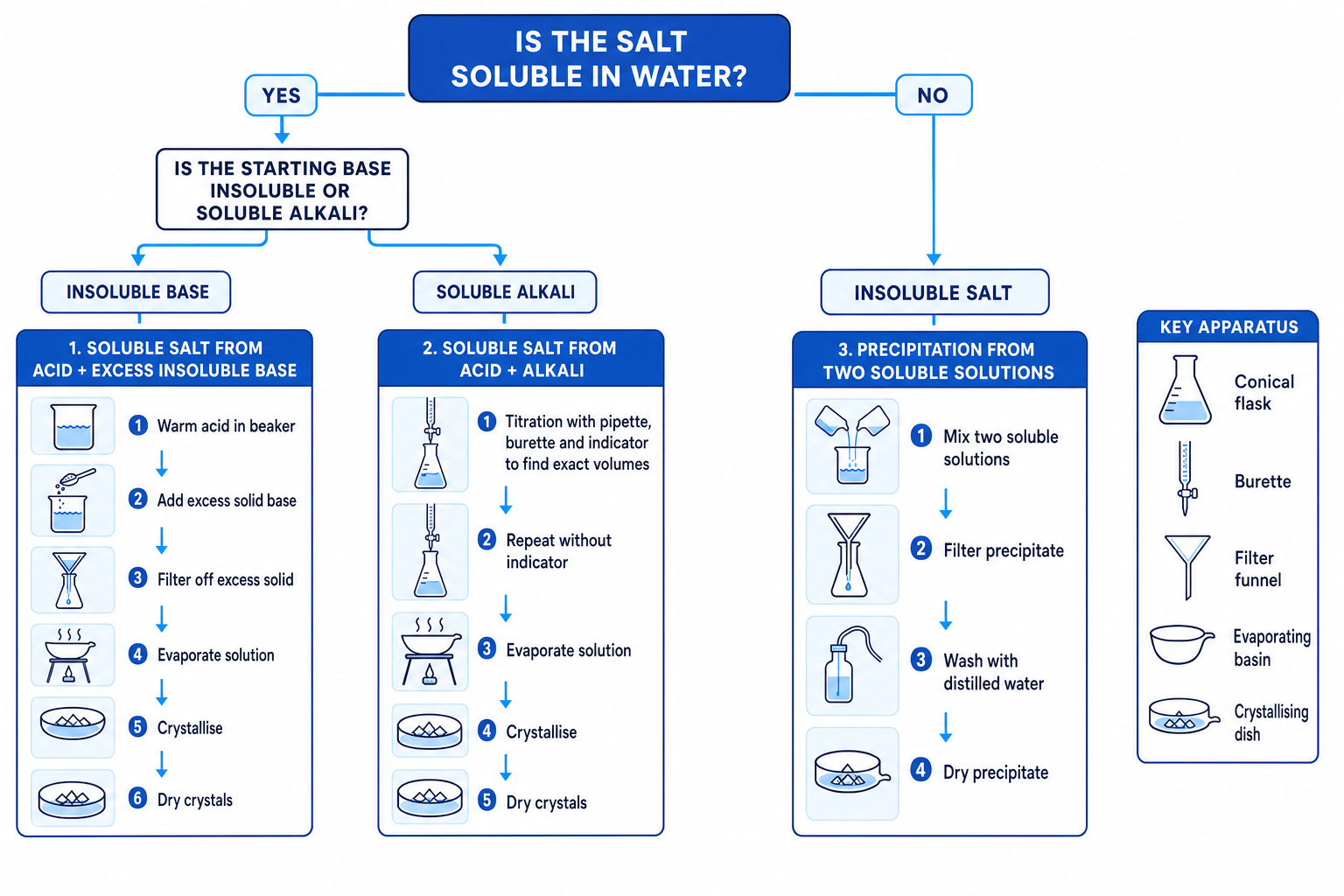
Choosing the preparation route
Choose suitable methods for preparing copper(II) sulfate and lead(II) sulfate.
- Copper(II) sulfate is a sulfate. It is not barium, calcium or lead(II) sulfate, so it is soluble.
- Copper(II) oxide is insoluble, so copper(II) sulfate can be made by reacting warm sulfuric acid with excess copper(II) oxide, then filtering and crystallising.
- Lead(II) sulfate is a sulfate exception, so it is insoluble.
- An insoluble salt is made by precipitation: mix two soluble solutions containing the required ions, such as lead(II) nitrate and sodium sulfate.
Preparing a soluble salt from an insoluble reactant
This method is used when the salt is soluble but the base, carbonate or metal oxide is insoluble. The insoluble reactant can be added in excess, meaning more than is needed, so all the acid reacts.
General method:
- Warm the acid gently in a beaker.
- Add the insoluble solid in small portions, stirring.
- Keep adding until some solid remains. This shows the acid has been used up.
- Filter to remove the excess solid.
- Heat the filtrate gently in an evaporating basin until it is nearly saturated.
- Leave it to cool so crystals form.
- Filter off the crystals and dry them between filter papers or in a warm place.
Boiling to dryness
Do not heat the solution until all the water has gone. This can give impure crystals or decompose hydrated crystals. Heat to the point of crystallisation, then cool.
Practical: hydrated copper(II) sulfate crystals from copper(II) oxide
A hydrated crystal contains water molecules built into its crystal structure. Hydrated copper(II) sulfate is CuSO4⋅5H2OCuSO_4\cdot5H_2OCuSO4⋅5H2O and forms blue crystals.
Apparatus: dilute sulfuric acid, copper(II) oxide powder, beaker, heat source, glass rod, filter funnel and paper, evaporating basin, crystallising dish.
Method and observations:
- Warm dilute sulfuric acid gently.
- Add black copper(II) oxide in small portions and stir. The solution turns blue as copper(II) sulfate forms.
- Add excess copper(II) oxide until some black solid remains.
- Filter to remove the unreacted copper(II) oxide.
- Gently evaporate the blue filtrate until crystals are just about to form.
- Leave to cool, then filter and dry the blue crystals.
Key variables and errors: use excess copper(II) oxide to remove all acid; do not overheat; rinse the beaker and filter paper with a little distilled water to reduce loss; avoid transferring filter-paper fibres into the crystals.
Preparing a soluble salt from an acid and an alkali
This is a Paper 2 only point. If both reactants are solutions, you cannot add one in excess and filter it off. Instead, use a titration to find the exact volumes that neutralise each other.
Method:
- Use a pipette to place a measured volume of alkali in a conical flask.
- Add a few drops of indicator.
- Add acid from a burette until the indicator just changes colour.
- Repeat to get reliable, concordant titres.
- Repeat the experiment using the same volumes but without indicator, so the salt is not contaminated.
- Evaporate, crystallise and dry the salt.
Why repeat without indicator?
Indicator is an impurity. Use it to find the correct volumes, then make the final salt solution again without indicator before crystallising.
Preparing an insoluble salt by precipitation
This is also a Paper 2 only point. A precipitate is an insoluble solid that forms when two solutions are mixed.
To make an insoluble salt, choose two soluble reactants that contain the ions you need. Mix them, filter off the precipitate, wash it with distilled water, then dry it.
Practical: pure, dry lead(II) sulfate
Lead(II) sulfate is insoluble, so it is made by precipitation. Suitable soluble reactants are lead(II) nitrate solution and sodium sulfate solution.
Pb(NO3)2(aq)+Na2SO4(aq)→PbSO4(s)+2NaNO3(aq)\text{Pb(NO}_{3}\text{)}_{2}(aq)+\text{Na}_{2}\text{SO}_{4}(aq)\to\text{PbSO}_{4}(s)+2\text{NaNO}_{3}(aq)Pb(NO3)2(aq)+Na2SO4(aq)→PbSO4(s)+2NaNO3(aq)Method and observations:
- Mix lead(II) nitrate solution with sodium sulfate solution in a beaker.
- A white precipitate of lead(II) sulfate forms.
- Filter the mixture to collect the precipitate.
- Wash the precipitate with distilled water to remove soluble impurities such as sodium nitrate.
- Dry the solid on filter paper or in a warm drying oven.
Key variables and errors: use clean apparatus; mix thoroughly; wash the precipitate well; do not use too much water when washing or some solid may be lost; handle lead compounds carefully because they are toxic.
In the exam
- Use the solubility rules first: they tell you whether to crystallise a soluble salt or filter off an insoluble precipitate.
- For acid + insoluble base, mention excess solid, filtering, crystallising and drying.
- For acid + alkali, mention titration, then repeat without indicator before crystallising.
- For precipitation, name two soluble reactants and state that the precipitate is filtered, washed and dried.
- Include balanced equations with state symbols when a practical asks what reaction is taking place.
Check yourself
- Why can excess copper(II) oxide be filtered off, but excess sodium hydroxide cannot?
- Which solubility rule explains why lead(II) sulfate forms as a precipitate?
- What products form when a metal carbonate reacts with dilute hydrochloric acid?
