

What you'll learn
- Why most metals are extracted from ores in the Earth’s crust, while very unreactive metals can be found uncombined.
- How the reactivity series decides whether carbon reduction or electrolysis is used.
- How the properties of aluminium, copper, iron, steel and alloys explain their uses.
For Edexcel 4CH1, these C-suffix points are Paper 2 only, but they link very closely to reactivity, electrolysis and bonding.
Metals in the Earth’s crust
A metal is extracted when it is obtained from a natural material and separated from unwanted rock. Most metals are not found as shiny pieces of metal in the ground. Instead, they are chemically combined with other elements in compounds such as oxides, sulfides or carbonates.
Ore
An ore is a rock that contains enough of a metal or metal compound for extraction to be economically worthwhile.
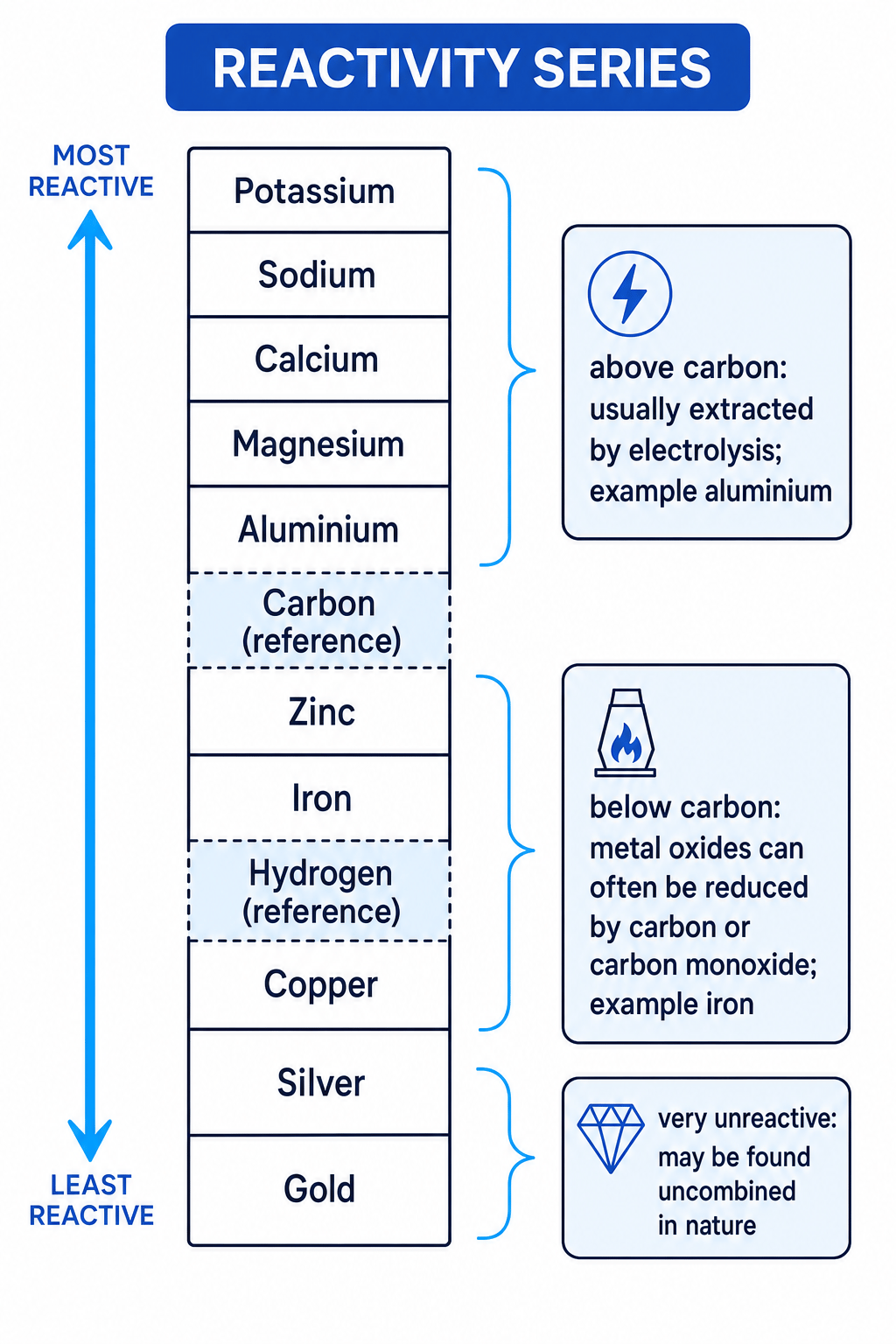
Very unreactive metals, such as gold and silver, do not readily form compounds. They can sometimes be found as the uncombined element, meaning the metal atoms are not chemically bonded to another element.
Reactivity affects how metals occur
The more reactive a metal is, the more likely it is to be found as a compound in an ore. Very unreactive metals may be found naturally as the metal itself.
The reactivity series and extraction
Reactivity series
The reactivity series is a list of elements arranged in order of how easily they react. For metal extraction, the key comparison is whether the metal is above or below carbon.
Carbon is important because it can remove oxygen from the oxides of many metals below it in the reactivity series. Metals above carbon form more stable compounds, so they usually need electrolysis instead.
Choosing the extraction method
Metals above carbon are usually extracted by electrolysis. Metals below carbon can often be extracted from their oxides by heating with carbon or carbon monoxide.
Carbon extraction: iron as the example
Reduction
In metal extraction, reduction often means the removal of oxygen from a metal oxide to produce the metal.
Iron is less reactive than carbon, so iron can be extracted from iron oxide using carbon monoxide. The carbon monoxide removes oxygen from iron(III) oxide:
Fe2O3(s)+3CO(g)→2Fe(l)+3CO2(g)\mathrm{Fe_2O_3(s) + 3CO(g) \to 2Fe(l) + 3CO_2(g)}Fe2O3(s)+3CO(g)→2Fe(l)+3CO2(g)The iron oxide is reduced to iron. The carbon monoxide is oxidised because it gains oxygen to form carbon dioxide.
You do not need detailed blast furnace knowledge for this spec point, but you should understand why the process works: iron is below carbon in the reactivity series.
Carbon does not work for every metal
Do not write that all metal oxides can be heated with carbon. Carbon cannot extract metals such as aluminium, magnesium, calcium, sodium or potassium because these metals are above carbon in the reactivity series.
Electrolysis: aluminium as the example
Electrolysis
Electrolysis is the decomposition of an ionic compound using electricity. The compound must be molten or dissolved so that its ions can move.
Aluminium is above carbon in the reactivity series, so carbon cannot reduce aluminium oxide. Instead, aluminium is extracted by electrolysis of aluminium oxide dissolved in molten cryolite. Cryolite lowers the operating temperature, which reduces energy costs.
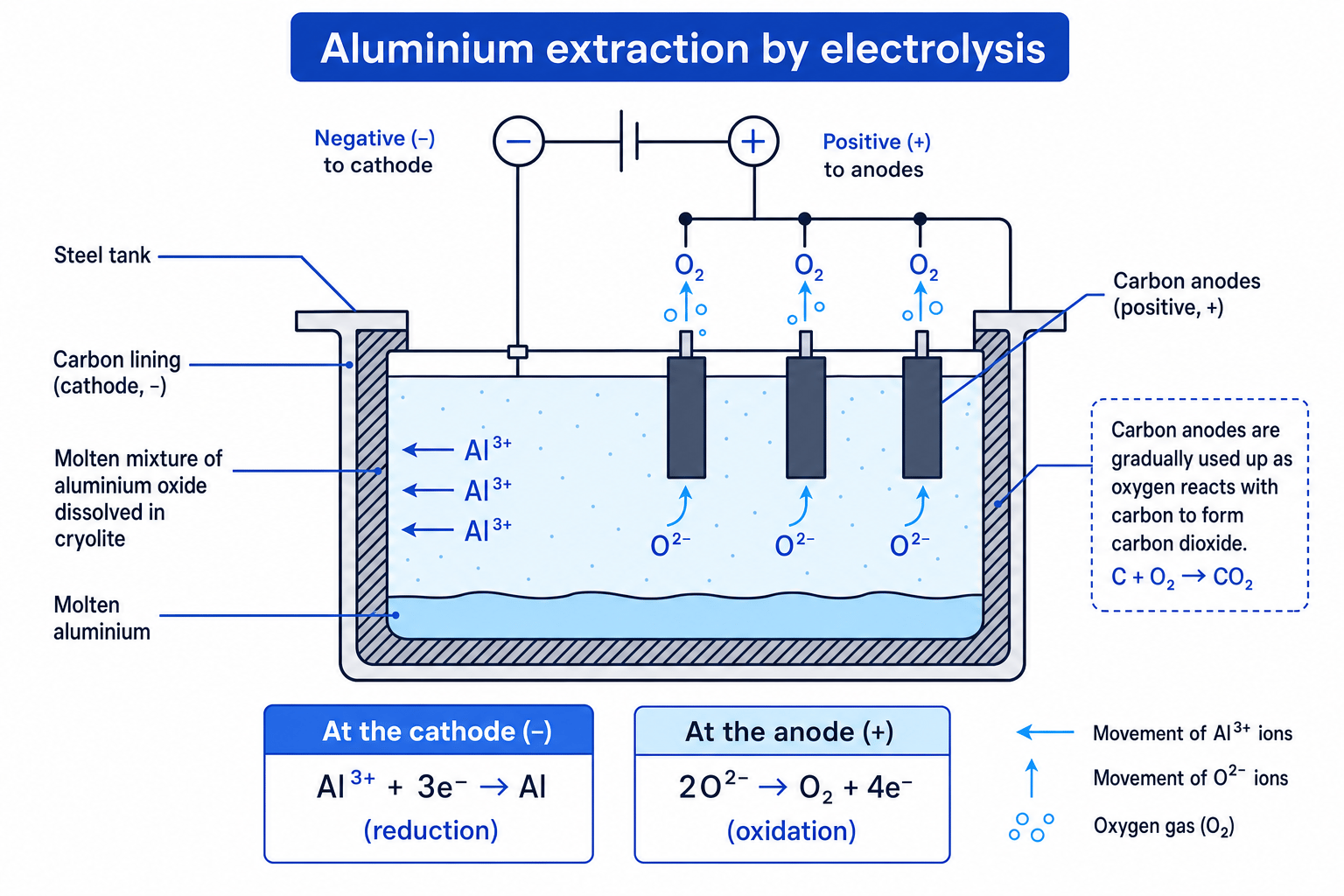
At the negative cathode, aluminium ions gain electrons and form aluminium:
Al3++3e−→Al\mathrm{Al^{3+} + 3e^- \to Al}Al3++3e−→AlAt the positive anode, oxide ions lose electrons and form oxygen:
2O2−→O2+4e−\mathrm{2O^{2-} \to O_2 + 4e^-}2O2−→O2+4e−The overall decomposition can be written as:
2Al2O3(l)→4Al(l)+3O2(g)\mathrm{2Al_2O_3(l) \to 4Al(l) + 3O_2(g)}2Al2O3(l)→4Al(l)+3O2(g)In the industrial cell, the oxygen reacts with the carbon anodes, producing carbon dioxide:
C(s)+O2(g)→CO2(g)\mathrm{C(s) + O_2(g) \to CO_2(g)}C(s)+O2(g)→CO2(g)This means the carbon anodes gradually wear away and need replacing.
Choosing an extraction method
A metal oxide contains metal X. Metal X is below carbon in the reactivity series. Should it be extracted by carbon reduction or electrolysis?
- Compare metal X with carbon: X is below carbon, so carbon is reactive enough to remove oxygen from its oxide.
- Apply the extraction rule: a metal oxide below carbon can often be reduced by heating with carbon or carbon monoxide.
- Choose the more suitable method: carbon reduction is likely to be preferred because electrolysis uses much more electricity and is usually more expensive.
- Add a balanced judgement: carbon reduction is chemically suitable, but it may produce carbon dioxide, so environmental impact should still be considered.
Commenting on an extraction process
In exams, you may be given information about an unfamiliar extraction process. You are not expected to know the detailed industrial process already. Instead, use the information given and apply general chemistry.
Good points to comment on include:
- reactivity: is the metal above or below carbon?
- energy use: does the process need very high temperatures or lots of electricity?
- cost: are the raw materials or electricity expensive?
- environmental impact: are greenhouse gases, toxic gases or waste products made?
- purity: does the process produce a pure enough metal for its use?
- ore concentration: a low-grade ore may be more expensive to process.
Comparing two extraction processes
A company can extract metal Q from its oxide in two ways. Q is below carbon. Method A heats the oxide with carbon and produces carbon dioxide. Method B uses electrolysis and produces very pure metal, but needs a large amount of electricity.
- Use the reactivity information: because Q is below carbon, Method A is chemically possible.
- Compare energy demand: Method B is likely to be more energy-intensive because electrolysis requires a continuous electrical supply.
- Compare environmental effects: Method A directly produces carbon dioxide; Method B may have lower direct emissions, but only if the electricity comes from low-carbon sources.
- Make a reasoned comment: Method A may be cheaper for bulk production, while Method B may be chosen if very high purity is needed or renewable electricity is available.
Uses of metals and alloys
A metal’s use depends on its properties: features such as density, strength, hardness, electrical conductivity, thermal conductivity, malleability and resistance to corrosion.
Link the property to the use
In exam answers, do not just name a property. Say how it helps: for example, “aluminium is used for aircraft because it has low density, so the aircraft is lighter and needs less fuel.”
Aluminium
Aluminium has low density, good corrosion resistance due to a protective oxide layer, and good electrical conductivity. It is also malleable, meaning it can be shaped without breaking.
Common uses include:
- aircraft bodies and bicycle frames, because low density helps reduce mass
- drinks cans, because it is light, malleable and corrosion-resistant
- overhead power cables, because it conducts electricity and is much less dense than copper
Copper
Copper is an excellent electrical conductor and thermal conductor. It is ductile, meaning it can be drawn into wires, and it is fairly resistant to corrosion.
Common uses include:
- electrical wiring, because it conducts electricity very well
- water pipes, because it is malleable and resists corrosion
- heat exchangers and cooking bases, because it conducts heat well
Iron and steel
Iron is strong and cheap, but it rusts easily. In everyday structures, iron is usually used as steel, which is an alloy based mainly on iron.
The steel types you need are:
- low-carbon steel, also called mild steel: tough, malleable and easy to shape; used for car bodies, nails, beams and machinery
- high-carbon steel: harder than mild steel but more brittle; used for cutting tools, blades and springs
- stainless steel: contains chromium, and often nickel; resists corrosion, so it is used for cutlery, sinks, surgical instruments and chemical equipment
Choosing a metal for overhead power cables
Why is aluminium often used for overhead power cables instead of copper?
- Identify the job: the cable must conduct electricity and hang between pylons without being too heavy.
- Compare useful properties: copper conducts electricity better, but aluminium has much lower density and still conducts electricity well.
- Link property to use: lower density means aluminium cables have less weight, so they sag less and need less support.
- Conclude: aluminium is a good choice because it balances conductivity, low mass and cost.
Alloys
Alloy
An alloy is a mixture of a metal with one or more other elements, usually other metals or carbon.
An alloy is a mixture, not a compound with one fixed formula. Steel, for example, is an alloy of iron with carbon, and stainless steel also contains chromium.
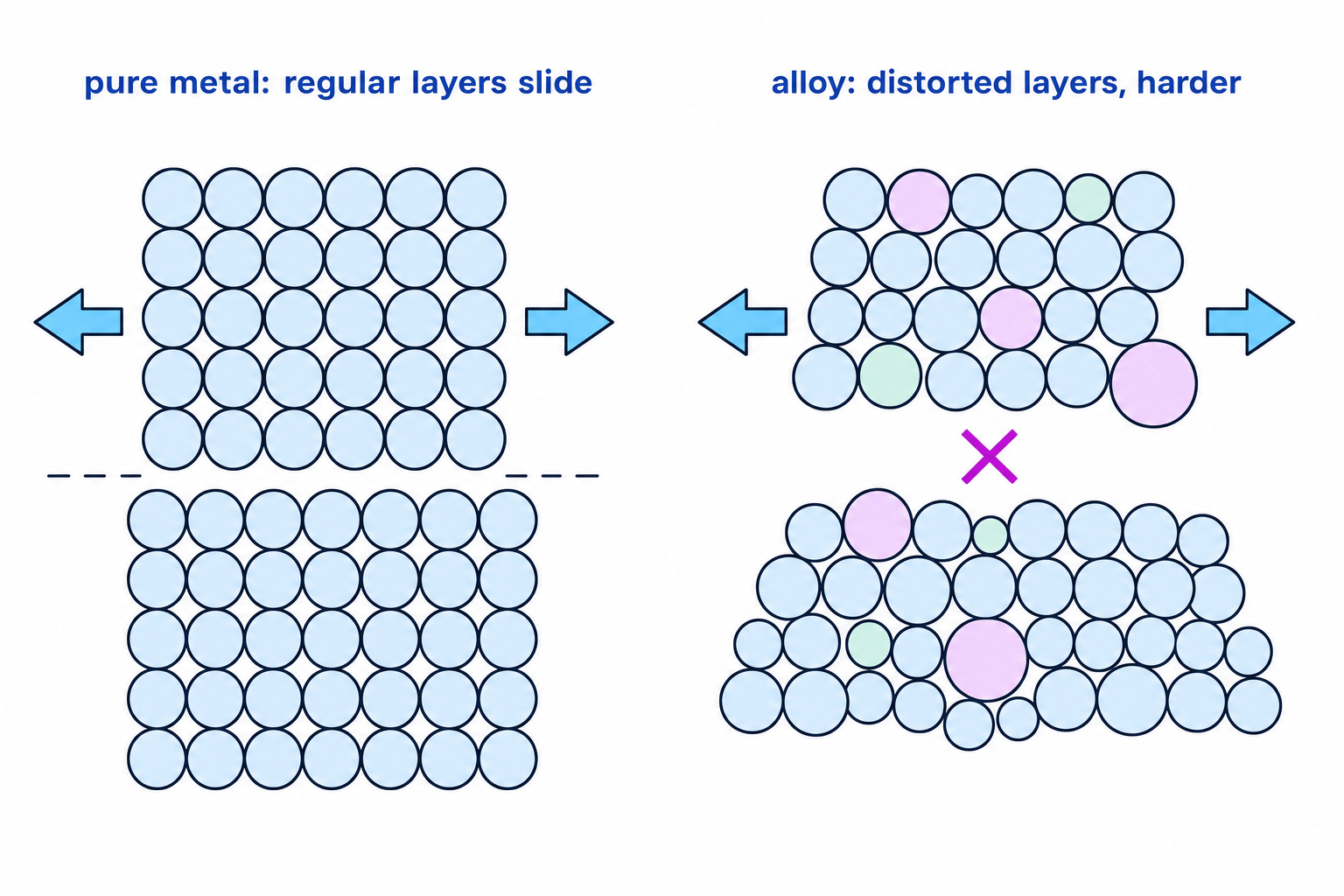
Pure metals have atoms arranged in regular layers. These layers can slide over each other, so many pure metals are quite malleable. In an alloy, atoms of different sizes disrupt the regular layers. This makes it harder for the layers to slide, so the alloy is harder.
Why alloys are harder
Alloys are harder than pure metals because different-sized atoms distort the regular arrangement and stop layers sliding over each other easily.
Explaining why high-carbon steel is harder than pure iron
- Identify the material: high-carbon steel is an alloy of iron and carbon.
- Compare the particles: carbon atoms are different in size from iron atoms, so they disturb the regular layers of iron atoms.
- Apply the sliding model: when a force is applied, the distorted layers cannot slide past each other as easily.
- Conclude: high-carbon steel is harder than pure iron, although it may also be more brittle.
Alloys are not automatically lighter
Alloying usually changes properties such as hardness, strength and corrosion resistance. Do not assume every alloy has lower density than the pure metal.
In the exam
- Use the reactivity series first: above carbon means electrolysis; below carbon means carbon or carbon monoxide reduction may work for oxides; very unreactive metals may be found uncombined.
- When commenting on a process, discuss both chemistry and practicality: reactivity, energy use, cost, purity and environmental impact.
- For uses, always write a clear property-to-use link, and name the steel type if the question asks for one.
Check yourself
- Why is aluminium extracted by electrolysis rather than by heating aluminium oxide with carbon?
- Give one use of copper and link it to a property that makes copper suitable.
- Explain, using particles and layers, why high-carbon steel is harder than pure iron.

