What you'll learn
- How to describe the main groups of eukaryotic organisms: plants, animals, fungi and protoctists.
- How bacteria differ from eukaryotic cells.
- Why viruses are not living organisms.
- How to use cell features and feeding methods to classify unfamiliar examples.
The big idea: classifying organisms
Biologists classify living things by looking for shared features. For this topic, the most useful features are:
- whether the cells have a nucleus — a structure that contains genetic material called DNA
- whether the organism is multicellular — made of many cells — or single-celled
- whether the cells have a cell wall
- whether the cells contain chloroplasts, which are structures needed for photosynthesis
- how the organism obtains food
- what storage carbohydrate it uses, such as starch, sucrose or glycogen
Eukaryotic and prokaryotic cells
- A eukaryotic cell has a nucleus containing DNA. Plants, animals, fungi and protoctists are eukaryotic organisms.
- A prokaryotic cell does not have a nucleus. Bacteria are prokaryotic organisms; their DNA is found as a circular chromosome in the cytoplasm.
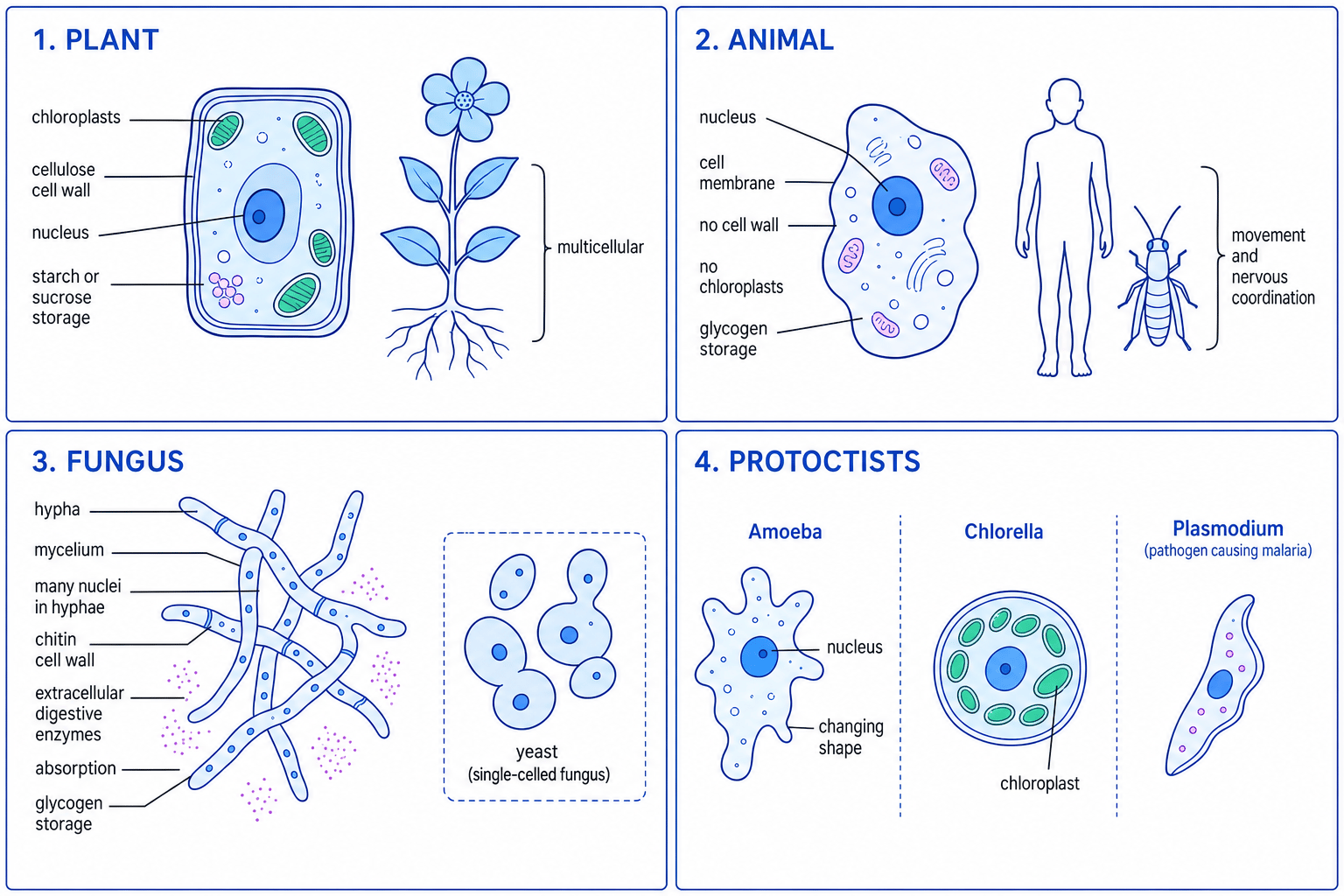
The four eukaryotic groups in this topic are plants, animals, fungi and protoctists. The diagram summarises their most important features.
Eukaryotic organisms
Plants
Plants are multicellular organisms. Their cells contain chloroplasts, so they can carry out photosynthesis — using light energy to make glucose from carbon dioxide and water.
Plant cells have cell walls made of cellulose. Cellulose is a strong material that supports the cell. Plants store carbohydrates as starch or sucrose.
Examples include flowering plants, such as a cereal like maize, and herbaceous legumes such as peas or beans. A herbaceous plant has soft, non-woody stems, and a legume is a plant in the pea/bean family.
Animals
Animals are also multicellular, but their cells do not contain chloroplasts, so animals cannot photosynthesise. Animal cells have no cell walls.
Animals usually have nervous co-ordination, meaning they can detect stimuli and coordinate responses using nerve cells. Most animals can move from one place to another. They often store carbohydrate as glycogen.
Examples include mammals, such as humans, and insects, such as houseflies and mosquitoes.
Fungi
Fungi are eukaryotic organisms, but they are not plants. They do not contain chloroplasts and cannot photosynthesise.
The body of a typical fungus is organised into a mycelium. A mycelium is a network of thread-like structures called hyphae. Each hypha may contain many nuclei. Fungal cells have cell walls made of chitin, not cellulose.
Saprotrophic nutrition
Saprotrophic nutrition is feeding by secreting digestive enzymes outside the body onto food material, then absorbing the smaller soluble products back into the fungus.
This is called extracellular digestion because the digestion happens outside the fungal cells. Fungi may store carbohydrate as glycogen.
Examples include Mucor, which has the typical fungal hyphal structure, and yeast, which is a single-celled fungus.
Fungi are not plants
Do not classify fungi as plants just because some fungi have cell walls. Fungal cell walls are made of chitin, fungi do not photosynthesise, and they feed by saprotrophic nutrition.
Protoctists
Protoctists are mostly microscopic single-celled eukaryotic organisms. They are a mixed group, so different protoctists can look quite different.
Some protoctists, such as Amoeba, live in pond water and have features more like an animal cell. Others, such as Chlorella, have chloroplasts and are more plant-like.
A disease-causing, or pathogenic, protoctist is Plasmodium, which causes malaria.
The eukaryote shortcut
Plants photosynthesise and have cellulose cell walls; animals have no cell walls or chloroplasts; fungi have chitin cell walls and feed saprotrophically; protoctists are mostly microscopic single-celled eukaryotes.
Classifying a eukaryotic organism
An unknown organism is made of hyphae, has cell walls made of chitin, does not contain chloroplasts, and digests food outside its cells.
- Compare photosynthesis features: it has no chloroplasts, so it is not a plant and it cannot photosynthesise.
- Compare cell wall material: chitin cell walls are a fungal feature, while plant cell walls are made of cellulose.
- Compare feeding method: extracellular digestion followed by absorption is saprotrophic nutrition, which is typical of fungi.
- Use the body organisation: hyphae forming a mycelium suggest a fungus like Mucor, rather than single-celled yeast.
Prokaryotic organisms: bacteria
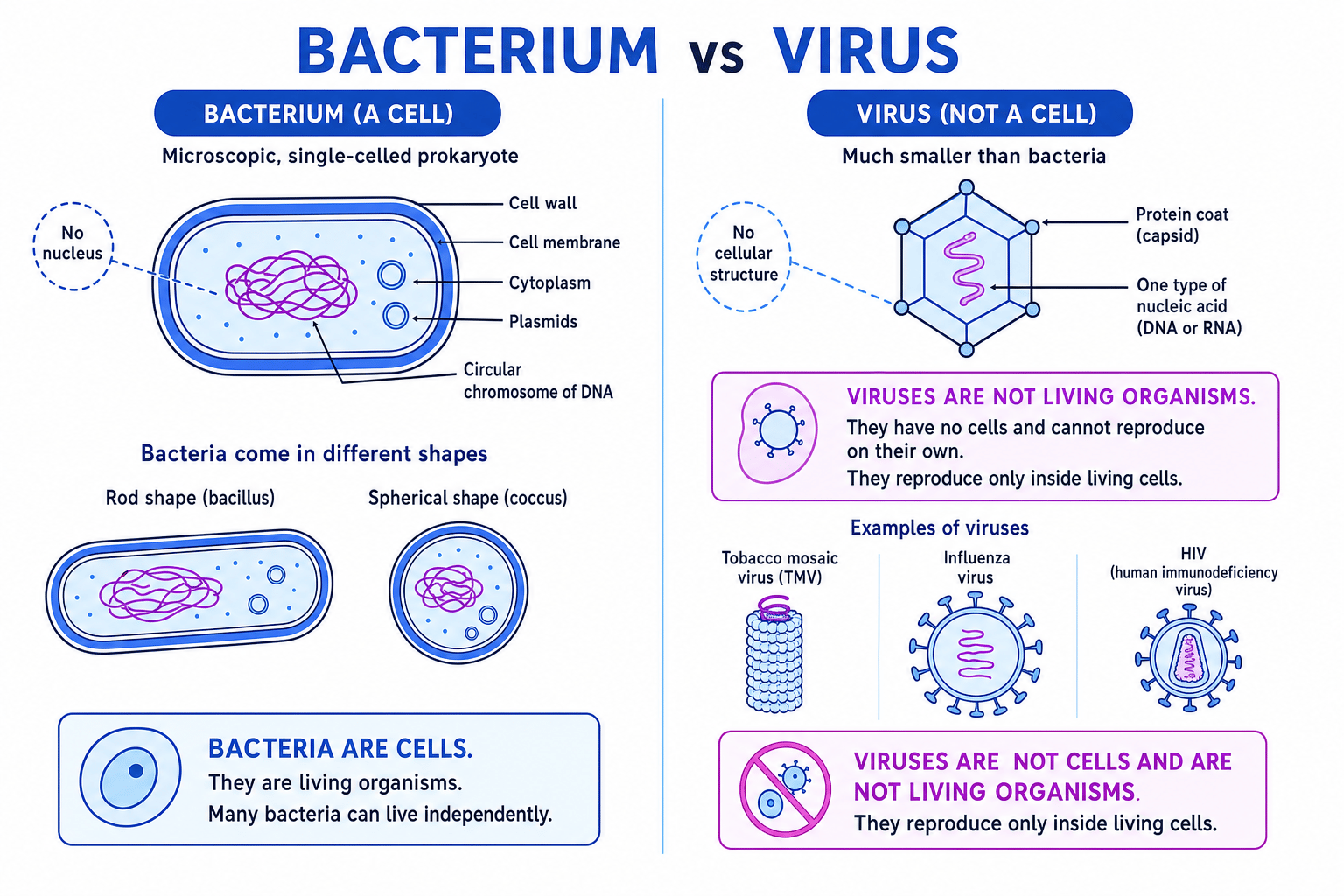
Bacteria are microscopic single-celled prokaryotic organisms. They are cells, but they are much simpler than eukaryotic cells.
A bacterium has:
- a cell wall for support
- a cell membrane, which controls movement of substances into and out of the cell
- cytoplasm, the jelly-like material where many cell reactions happen
- plasmids, which are small circular pieces of DNA
- a circular chromosome of DNA
- no nucleus
Some bacteria can photosynthesise, but most feed off other living or dead organisms.
Examples include Lactobacillus bulgaricus, a rod-shaped bacterium used to produce yoghurt from milk, and Pneumococcus, a spherical bacterium that acts as the pathogen causing pneumonia.
The diagram compares a bacterium with a virus, which is important because exam questions often ask you to separate “bacteria” from “viruses”.
No nucleus does not mean no DNA
Bacteria do not have a nucleus, but they still contain DNA. Their main DNA is a circular chromosome, and they may also contain plasmids.
Pathogens and viruses
Pathogen
A pathogen is a disease-causing microorganism or virus. Pathogens may include fungi, bacteria, protoctists or viruses.
Not all bacteria, fungi or protoctists are pathogens. For example, Lactobacillus bulgaricus is useful in yoghurt production, while Pneumococcus is pathogenic because it causes pneumonia.
Viruses
Viruses are not living organisms. They are small particles, smaller than bacteria, and they have no cellular structure.
A virus has:
- a protein coat
- one type of nucleic acid, either DNA or RNA, which carries genetic information
- no cytoplasm, nucleus, cell membrane or cell wall
Viruses are parasitic. This means they reproduce using a host living cell and benefit at the host’s expense. They can reproduce only inside living cells, and they infect every type of living organism.
Examples include:
- tobacco mosaic virus, which causes discolouring of tobacco plant leaves by preventing the formation of chloroplasts
- influenza virus, which causes flu
- HIV, which causes AIDS
Viruses are not cells
A virus is not a bacterium and not a cell. It is a particle with a protein coat and DNA or RNA, and it can only reproduce inside living cells.
Distinguishing a bacterium from a virus
An infectious particle is described as smaller than bacteria, with a protein coat and RNA. It has no cytoplasm and reproduces only inside human cells.
- Check whether it is cellular: no cytoplasm and no cell structures means it is not a bacterial cell.
- Check its genetic material arrangement: RNA inside a protein coat is a virus feature, not the circular chromosome and plasmids of bacteria.
- Check reproduction: needing living human cells to reproduce shows it is an intracellular parasite, which matches a virus.
- Conclude the type of pathogen: it is a viral pathogen, not a bacterial pathogen.
A quick classification order
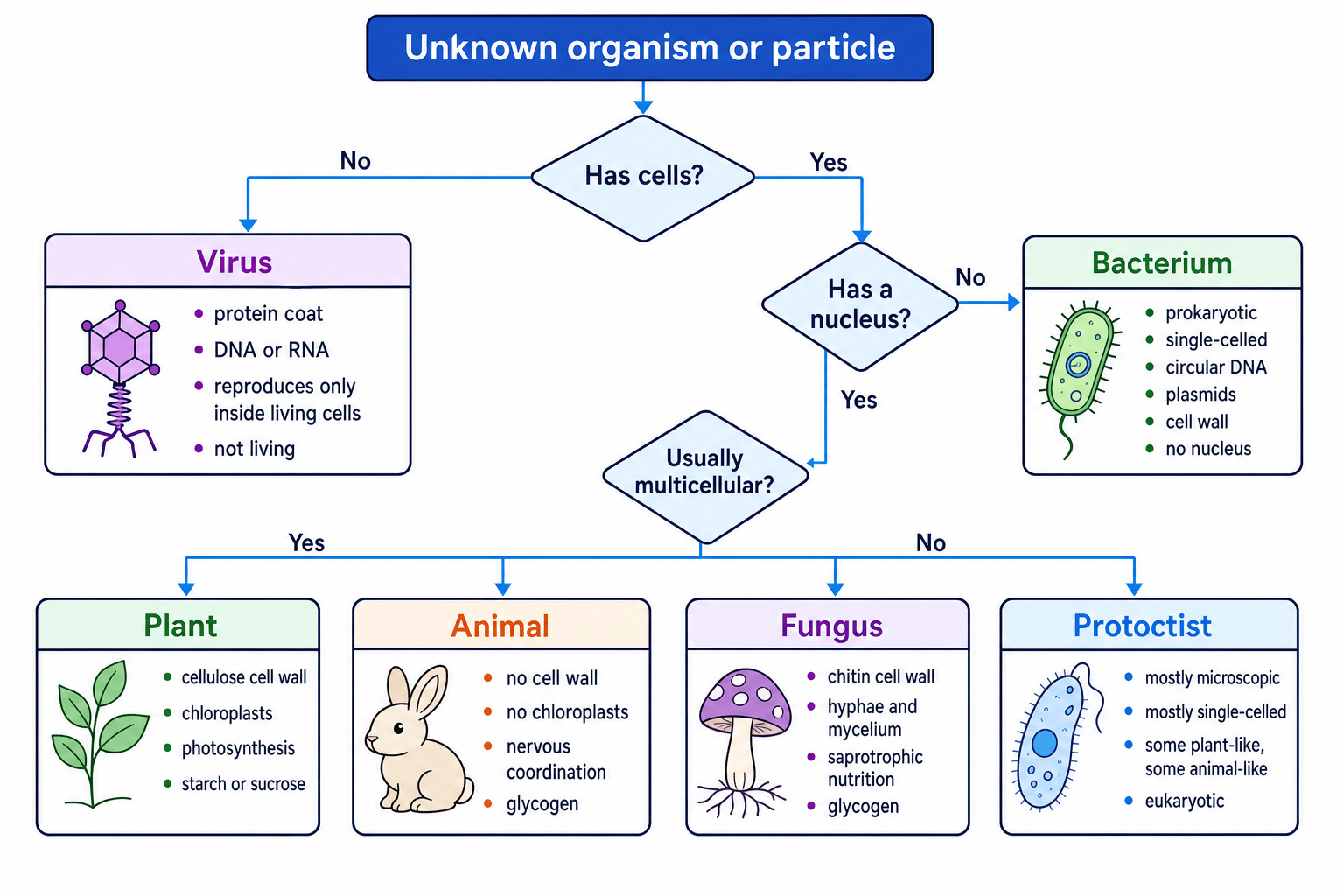
When classifying an organism, ask: Does it have cells? If yes, ask whether it has a nucleus. Then use features such as chloroplasts, cell wall material and feeding method.
In the exam
- Use precise group names: plant, animal, fungus, protoctist, bacterium or virus.
- Give features, not just examples. For instance, write “has chitin cell walls and feeds by saprotrophic nutrition” rather than only “it is like Mucor”.
- Do not call viruses living organisms or cells. State that they have a protein coat and DNA or RNA, and reproduce only inside living cells.
Check yourself
- What two features of plant cells allow you to distinguish plants from animals?
- Why is a fungus not classified as a plant?
- How can you tell from a description that a pathogen is a virus rather than a bacterium?