What you'll learn
- The eight characteristics shared by living organisms in Edexcel IGCSE Biology 1.1.
- What each characteristic means, using precise biology vocabulary.
- How to avoid common confusions such as respiration vs breathing and excretion vs egestion.
- How to use the characteristics as a checklist when deciding whether something is living.
Before the list: organisms and life processes
Biology begins with a simple question: what do all living things have in common? A tree, a bacterium, a mushroom and a human look very different, but they all carry out the same broad life processes.
Organism
An organism is an individual living thing. Organisms are made of one or more cells, which are the basic units of life.
A life process is an activity that living organisms carry out to stay alive, grow, or produce more organisms. Edexcel wants you to know eight shared characteristics.
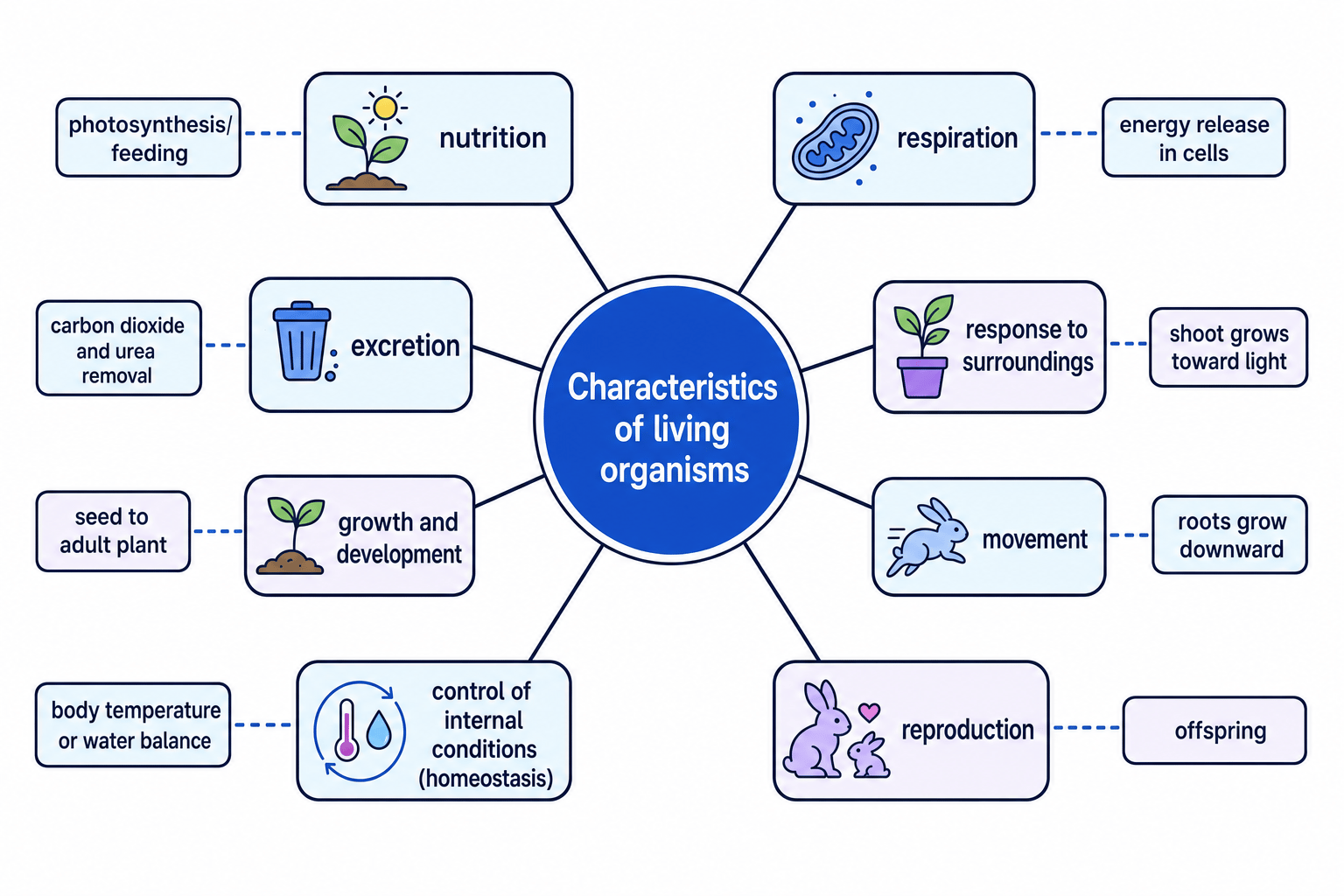
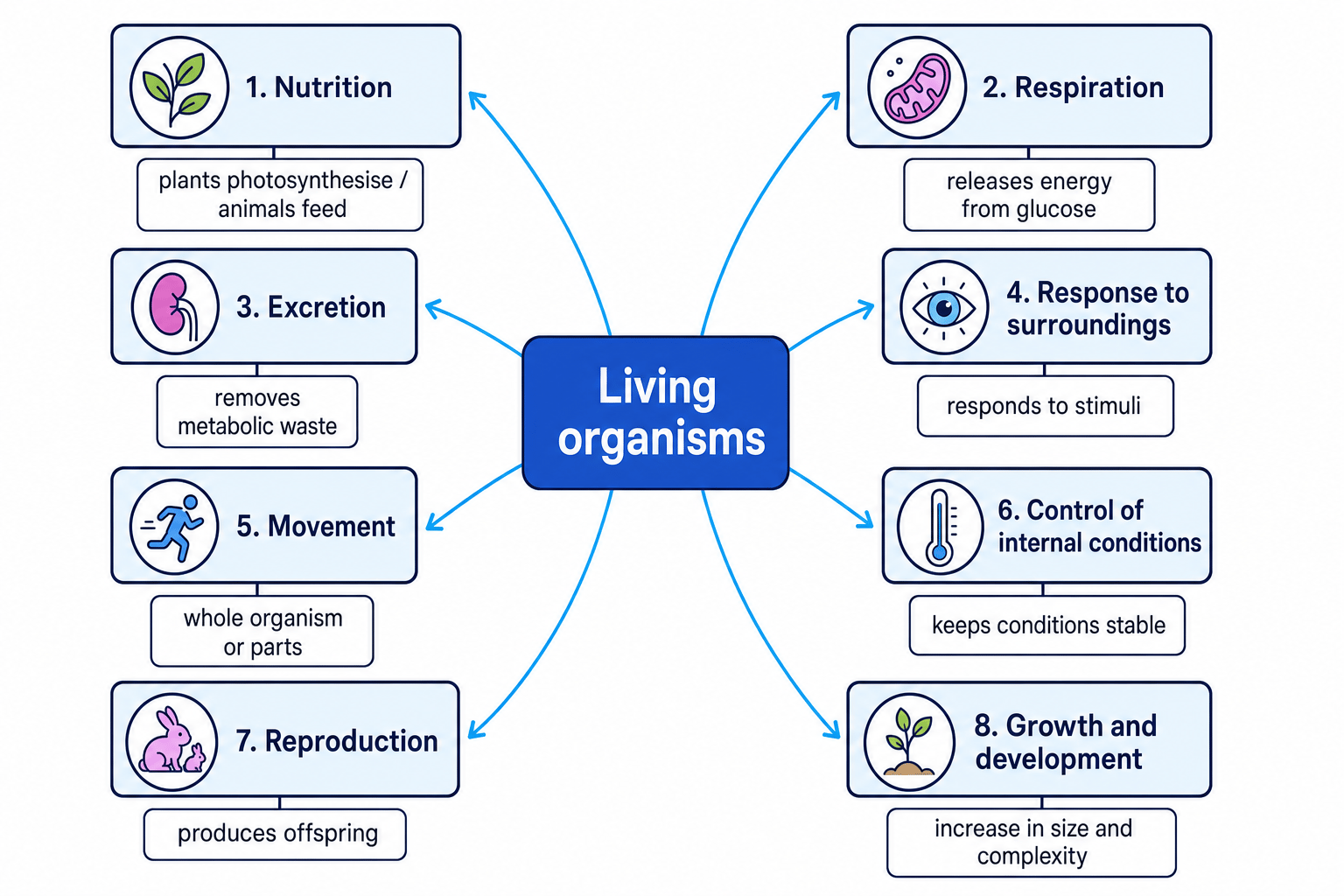
The diagram below summarises the full checklist. The order is not important, but the wording is useful for exams.
The whole set matters
A living organism should show the full set of life processes: nutrition, respiration, excretion, response, movement, control of internal conditions, reproduction, and growth/development.
The eight characteristics
1. Nutrition: obtaining useful materials
Nutrition means obtaining the materials needed for energy, growth, repair and keeping cells working.
Different organisms do this in different ways:
- Green plants make glucose by photosynthesis, using light energy.
- Animals take in food, digest it, and absorb useful molecules.
- Fungi absorb nutrients from their surroundings after digesting food outside their bodies.
Do not think of nutrition as only “eating”. A plant does not eat, but it still has nutrition because it makes and uses food molecules.
2. Respiration: releasing energy
Respiration is the set of chemical reactions in cells that release energy from glucose.
That released energy is needed for life processes such as movement, growth, active transport, cell division and maintaining body temperature in some animals. All living organisms respire, including plants. Plants respire in the light and in the dark.
Respiration is not breathing
Breathing is moving air in and out of lungs. Respiration happens inside cells and releases energy from glucose. Breathing helps supply oxygen for respiration in many animals, but they are not the same process.
3. Excretion: removing metabolic waste
Metabolism means all the chemical reactions taking place in cells. These reactions produce waste substances. Excretion is the removal of metabolic waste from the body.
Examples include:
- Carbon dioxide from respiration.
- Urea made when excess amino acids are broken down in animals.
- Excess water and ions when their levels need controlling.
Waste substances must be removed because they can become toxic or disturb the conditions inside cells.
Excretion is not egestion
Excretion removes waste made by chemical reactions in cells. Egestion is getting rid of undigested food from the digestive system as faeces. Faeces are not metabolic waste.
4. Responding to surroundings
A stimulus is a change in the surroundings. A response is what an organism does because of that stimulus.
Examples of stimuli include light, temperature, chemicals, sound and touch. Animals may respond quickly, such as moving away from danger. Plants also respond, but often more slowly. For example, a shoot may grow towards light.
This characteristic is sometimes called sensitivity, but Edexcel’s wording is “respond to their surroundings”.
5. Movement
Movement means a change in position of the whole organism or part of the organism.
Animals often move their whole bodies from place to place. Plants are rooted in one place, but they still show movement. For example:
- Shoots can bend towards light.
- Roots can grow downwards into the soil.
- Leaves or flowers may change position during the day.
So, “movement” does not always mean walking, running or swimming.
6. Controlling internal conditions
Living organisms must keep conditions inside their bodies within suitable limits. This is called homeostasis.
Homeostasis
Homeostasis is the maintenance of a relatively constant internal environment.
Examples of internal conditions that may need controlling include:
- Body temperature.
- Water content.
- Blood glucose concentration in animals.
- Ion concentration.
This matters because the chemical reactions in cells only work properly within certain conditions. If an organism cannot control its internal environment, its cells may stop functioning correctly.
7. Reproduction
Reproduction is the production of new organisms of the same species.
There are two main types:
- Sexual reproduction involves two parents and sex cells called gametes, such as sperm and egg cells.
- Asexual reproduction involves one parent and produces offspring that are genetically identical to the parent, unless mutations occur.
Reproduction is important because it allows a species to continue over time.
Individual organisms do not always reproduce
A young, old or infertile individual can still be alive even if it cannot reproduce at that moment. In exams, reproduction is a characteristic of living organisms as a group, not proof that every individual must be reproducing all the time.
8. Growth and development
Growth is a permanent increase in size and mass. In biology, growth often involves cells dividing and increasing in size.
Development means the changes an organism goes through as it becomes more mature or more complex. For example:
- A seed develops into a seedling and then into an adult plant.
- A baby develops into an adult human.
- A caterpillar develops into a butterfly.
Growth and development are linked, but they are not identical. Growth is about becoming bigger; development is about changing form, structure or abilities.
Using the characteristics as a checklist
In exam questions, you may be given something unfamiliar and asked whether it is living. The key is to avoid relying on just one characteristic. Some non-living things can appear to show one or two life-like features.
For example, a flame can move, grow and use oxygen, but that does not make it a living organism.
Deciding whether a flame is alive
-
Compare the flame with the characteristics it seems to show: it can spread, increase in size, use fuel and oxygen, and release carbon dioxide, so it may appear to show movement, growth, nutrition and waste production.
-
Check the deeper life processes: a flame is not made of cells, does not carry out cellular respiration, does not control internal conditions, and does not reproduce to make offspring of the same species.
-
Decide using the full checklist: because it does not show the full set of life processes, a flame is classified as non-living, even though it has some life-like features.
Living, dead and non-living
These words are sometimes mixed up, so keep them separate:
- Living means currently carrying out life processes.
- Dead means it was once alive but no longer carries out life processes.
- Non-living means it has never been alive.
For example, a living tree carries out life processes. A fallen dead leaf was once part of a living organism, but is no longer alive. A rock is non-living because it has never been an organism.
A useful memory check
The classic mnemonic MRS GREN helps with movement, respiration, sensitivity, growth, reproduction, excretion and nutrition — but Edexcel also expects control of internal conditions, so do not leave that one out.
In the exam
-
If asked to state the characteristics of living organisms, give the life process names clearly: nutrition, respiration, excretion, response, movement, internal control, reproduction, and growth/development.
-
If asked whether something is living, compare it with several characteristics rather than relying on one feature such as movement.
-
Use precise pairs of words: respiration is not breathing, and excretion is not egestion.
Check yourself
- Can you name all eight characteristics of living organisms from the Edexcel specification?
- Why can a plant be described as moving even though it stays rooted in one place?
- A robot can move and respond to light or sound. Which characteristics of living organisms does it still lack?