What you'll learn
- The correct order of biological organisation: organelles → cells → tissues → organs → systems.
- What each level means, using animal and plant examples.
- How to decide whether something is a tissue, organ or system in exam questions.
- Common mistakes to avoid when describing organisation in organisms.
The big picture: organisms are organised
Living things are not just random collections of parts. In multicellular organisms, smaller structures build up into larger structures, and each level has a particular function, meaning a job or role.
Level of organisation
A level of organisation is a step in the hierarchy of biological structure, from small parts inside cells to whole systems in an organism.
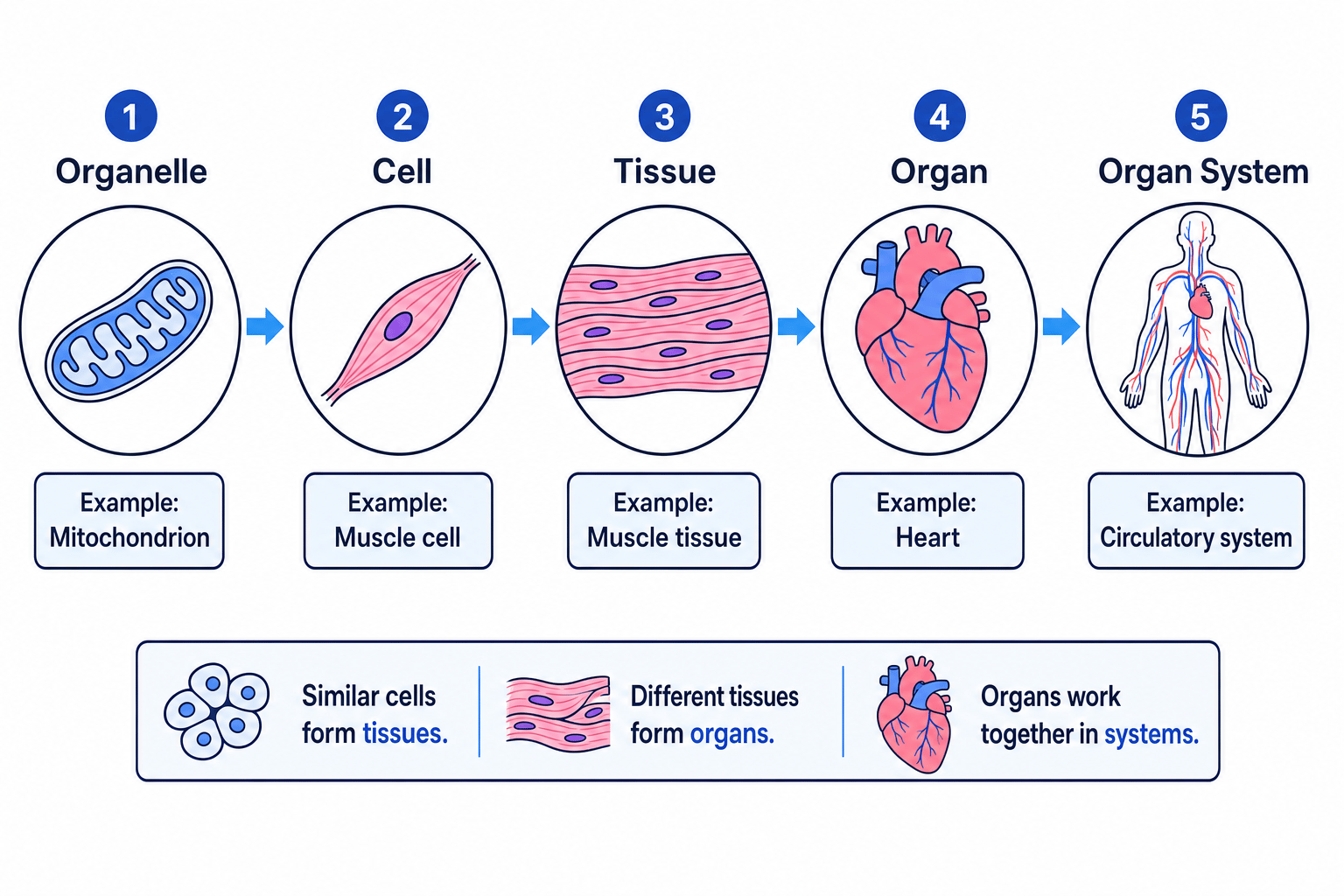
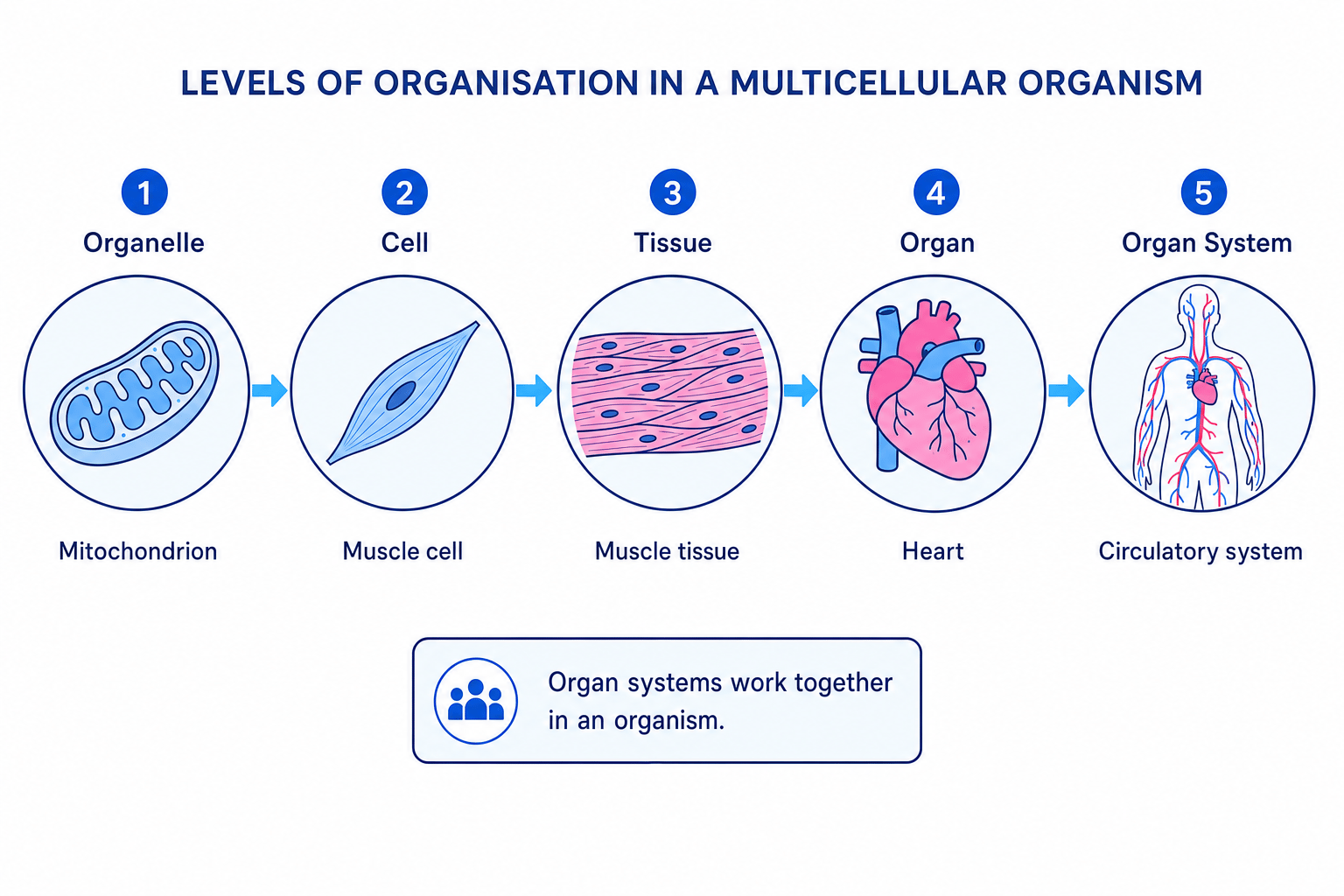
The hierarchy can be shown as a simple chain, from the smallest structures inside cells up to a whole organ system:
The hierarchy
In Edexcel IGCSE Biology, you need to describe the levels as: organelles are found inside cells; similar cells form tissues; different tissues form organs; organs work together in systems.
1. Organelles: small structures inside cells
An organelle is a small structure inside a cell that has a specific function. You can think of organelles as specialised parts of a cell, but they are not usually living organisms on their own.
Organelle
An organelle is a specialised structure inside a cell that carries out a particular function.
Examples include:
- Nucleus — controls many activities of the cell and contains genetic material.
- Mitochondria — where aerobic respiration happens, releasing energy for the cell.
- Ribosomes — where proteins are made.
- Chloroplasts — found in plant cells and algal cells; absorb light for photosynthesis.
Not every cell contains every organelle. For example, animal cells do not contain chloroplasts, but many plant cells do.
Organelle versus cell
A mitochondrion is an organelle, not a cell. It is found inside a cell and cannot carry out all the life processes of a whole cell by itself.
2. Cells: the basic units of life
A cell is the smallest unit of life. This means a cell is the smallest structure that can carry out the basic life processes, such as respiration, growth and response to stimuli.
Cell
A cell is the basic structural and functional unit of a living organism.
Some organisms are made of only one cell. These are called single-celled or unicellular organisms. Other organisms, such as humans, oak trees and insects, are multicellular, meaning they are made of many cells.
In multicellular organisms, cells often become specialised. A specialised cell has features that help it do a particular job.
Examples include:
- Muscle cells — can contract to cause movement.
- Nerve cells — carry electrical impulses around the body.
- Palisade cells in leaves — contain many chloroplasts for photosynthesis.
- Root hair cells — have a large surface area to absorb water and mineral ions.
Specialised cell
A specialised cell is a cell adapted to carry out a specific function.
Single-celled organisms
A single-celled organism, such as Amoeba, is one cell that carries out all life processes. It does not have tissues, organs or organ systems.
3. Tissues: similar cells working together
A tissue is made from many similar cells working together to carry out a particular function.
Tissue
A tissue is a group of similar cells working together to perform a specific function.
Examples include:
- Muscle tissue — made of muscle cells that contract to cause movement.
- Epithelial tissue — covers or lines surfaces, such as the lining of the small intestine.
- Palisade mesophyll tissue — found in leaves and adapted for photosynthesis.
- Xylem tissue — transports water and mineral ions through a plant.
- Phloem tissue — transports dissolved food substances through a plant.
The key idea is that the cells in a tissue are similar and cooperate to do the same overall job.
Tissue is not just lots of cells
A tissue is not any random group of cells. It is a group of similar cells working together for a shared function.
4. Organs: different tissues working together
An organ is a structure made from different tissues working together to carry out a particular function.
Organ
An organ is a group of different tissues working together to perform a specific function.
Animal examples include:
- Heart — contains muscle tissue, nervous tissue, blood vessels and connective tissue; its function is to pump blood.
- Stomach — contains muscle tissue, glandular tissue and epithelial tissue; it helps digest food.
- Lungs — contain tissues adapted for gas exchange, support and transport.
Plant examples include:
- Leaf — contains palisade mesophyll tissue, spongy mesophyll tissue, xylem, phloem and epidermal tissue.
- Root — contains tissues for absorption, transport and support.
- Stem — contains tissues for support and transport.
Deciding whether a leaf is a tissue or an organ
A student says a leaf is a tissue because it contains lots of leaf cells. Is that correct?
- Compare the leaf with the definition of a tissue: a tissue is made of similar cells doing one shared job, such as palisade mesophyll cells carrying out photosynthesis.
- A leaf contains several different tissues, including palisade mesophyll, spongy mesophyll, xylem, phloem and epidermal tissue.
- Because these different tissues work together for functions such as photosynthesis, gas exchange and transport, a leaf is an organ, not a single tissue.
5. Systems: organs working together
A system, often called an organ system, is made of organs working together to carry out a major function in the organism.
System
A system is a group of organs working together to perform a major function in an organism.
Examples include:
- Digestive system — includes the mouth, oesophagus, stomach, small intestine, large intestine, liver and pancreas. It breaks down food and absorbs useful substances.
- Circulatory system — includes the heart, blood vessels and blood. It transports substances such as oxygen and glucose around the body.
- Respiratory system — includes the trachea, bronchi, lungs and air sacs. It is involved in gas exchange.
- Nervous system — includes the brain, spinal cord and nerves. It coordinates responses.
In plants, organs such as roots, stems and leaves work together to keep the plant alive. For example, roots absorb water, stems transport substances, and leaves carry out photosynthesis.
Function gets broader
As you move up the hierarchy, the function usually becomes broader: an organelle has a small cell-level job, while a system carries out a major life process for the organism.
Putting the levels together
A clear description of the levels of organisation should link each level to the next one.
You could write:
- Organelles are specialised structures inside cells.
- Cells are the basic units of life.
- Groups of similar cells form tissues.
- Different tissues work together to form organs.
- Organs work together to form systems.
Classifying biological structures by level
Classify these structures: mitochondrion, muscle cell, muscle tissue, heart, circulatory system.
- A mitochondrion is found inside a cell and carries out aerobic respiration, so it is an organelle.
- A muscle cell is one whole living cell adapted to contract, so it is a cell.
- Muscle tissue is made of many similar muscle cells working together to contract, so it is a tissue.
- The heart contains different tissues, including muscle tissue, nervous tissue and blood vessels, working together to pump blood, so it is an organ.
- The circulatory system includes the heart, blood vessels and blood working together to transport substances, so it is a system.
Spotting the level in exam questions
Exam questions may give you the name of a structure, or they may describe what it is made of. Use the description to decide the level.
Ask yourself:
- Is it inside a cell? It is probably an organelle.
- Is it one living unit? It is probably a cell.
- Is it many similar cells working together? It is a tissue.
- Is it different tissues working together? It is an organ.
- Is it several organs working together? It is a system.
Build your answer as a chain
A strong description uses linking language: organelles are inside cells; similar cells form tissues; different tissues form organs; organs work together in systems.
Organ versus system
The heart is an organ, not a system. The circulatory system includes the heart plus blood vessels and blood working together.
In the exam
- Give the levels in the correct order: organelle → cell → tissue → organ → system.
- Include both structure and function in definitions, for example: “a tissue is a group of similar cells working together to perform a function”.
- For classification questions, use the “made of” clue: similar cells means tissue; different tissues means organ; several organs means system.
Check yourself
- What is the difference between a tissue and an organ?
- Why is the heart an organ, but the circulatory system a system?
- Put these in order from smallest to largest: stomach, mitochondrion, muscle tissue, muscle cell, digestive system.