

What you'll learn
- The differences between sexual and asexual reproduction.
- How flowering plants use pollination, fertilisation, seeds and runners.
- How to investigate the conditions needed for seed germination.
- How human reproductive organs, hormones, the placenta and amniotic fluid support reproduction.
The big idea: making new organisms
Reproduction is the process by which living organisms produce new individuals of the same species. The new individuals are called offspring.
There are two main types: sexual reproduction and asexual reproduction.
Sexual and asexual reproduction
- Sexual reproduction involves the fusion of a male gamete and a female gamete. A gamete is a sex cell, such as a sperm cell or an egg cell. Sexual reproduction usually produces offspring with genetic variation, meaning they are not genetically identical to their parents.
- Asexual reproduction involves one parent and no fusion of gametes. It produces genetically identical offspring called clones.
A key comparison:
| Feature | Sexual reproduction | Asexual reproduction |
|---|---|---|
| Number of parents | Usually two | One |
| Gametes involved? | Yes | No |
| Fertilisation? | Yes | No |
| Offspring | Genetically varied | Genetically identical clones |
| Speed | Usually slower | Usually faster |
Fertilisation, zygotes and embryos
Fertilisation is the fusion of the male and female gametes. In animals, this is usually a sperm cell fusing with an egg cell. In flowering plants, the male gamete is carried inside a pollen grain and the female gamete is inside an ovule.
Fertilisation
Fertilisation produces a zygote. The zygote is the first cell of the new organism. It then undergoes repeated cell division and develops into an embryo, which is an early stage of development.
Sexual reproduction creates variation
Because the zygote receives genetic information from two gametes, sexually produced offspring are usually genetically different from each other and from their parents.
Reproduction in flowering plants
Flower parts and pollination
Pollination is the transfer of pollen from an anther to a stigma. The anther is the male part that produces pollen. The stigma is the female surface that receives pollen.
Other important flower parts include:
- filament — holds up the anther
- style — connects the stigma to the ovary
- ovary — contains ovules
- ovule — contains the female gamete
- petals — may attract insects
- nectary — produces nectar, a sugary liquid that attracts insects
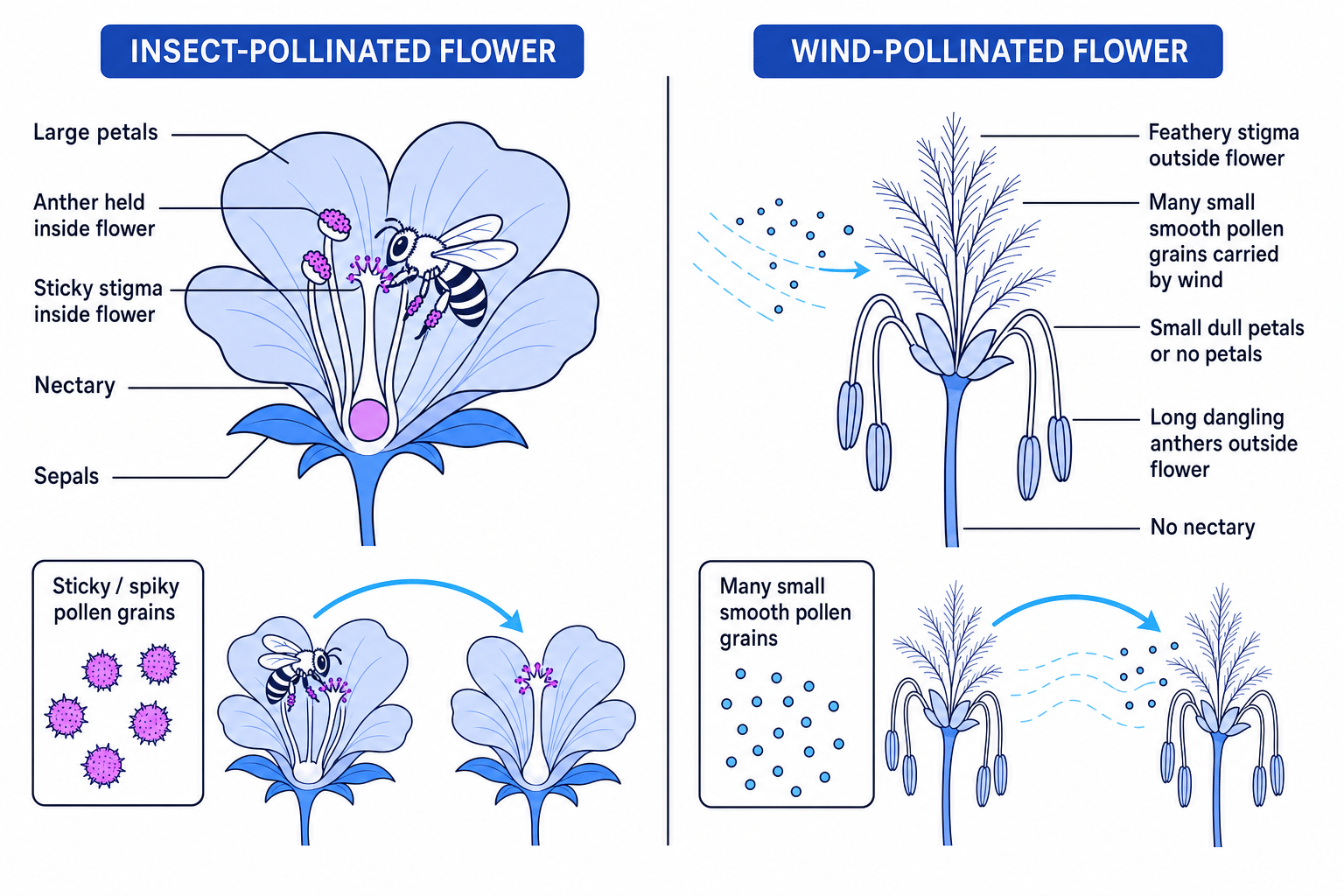
Flower structure depends on whether the plant is mainly pollinated by insects or by wind.
Insect-pollinated flowers
Insect-pollinated flowers are adapted to attract insects and make pollen stick to them:
- large, brightly coloured petals attract insects
- nectar and scent encourage insects to visit
- sticky or spiky pollen sticks to the insect’s body
- anthers and stigmas are held inside the flower so the insect brushes against them
- sticky stigma catches pollen from the insect
Wind-pollinated flowers
Wind-pollinated flowers do not need to attract animals. They are adapted to release and catch airborne pollen:
- small, dull petals or no petals because attraction is not needed
- no nectary because nectar is not needed
- long dangling anthers hang outside the flower to release pollen into the wind
- feathery stigmas hang outside the flower to catch pollen
- pollen is small, light and smooth
- large amounts of pollen are produced because much of it is wasted
Pollination is not fertilisation
Pollination is pollen moving from anther to stigma. Fertilisation happens later, when the male and female gametes fuse.
Identifying a wind-pollinated flower
A flower has small dull petals, dangling anthers, feathery stigmas and no scent. Explain how you know it is wind-pollinated.
- The dangling anthers are positioned outside the flower, so pollen can be released easily into moving air.
- The feathery stigmas provide a large surface area to trap pollen carried by wind.
- The lack of scent, nectar and large petals shows the flower is not adapted to attract insects, so it is wind-pollinated.
From pollen tube to seed and fruit
After pollination, the pollen grain can grow a pollen tube. This tube grows down through the style towards the ovary.
The sequence is:
- A pollen grain lands on a suitable stigma.
- A pollen tube grows from the pollen grain down the style.
- The male gamete travels through the pollen tube.
- The male gamete reaches an ovule in the ovary.
- The male and female gametes fuse during fertilisation, forming a zygote.
- The zygote divides and develops into an embryo.
- The ovule becomes a seed.
- The ovary becomes a fruit.
The seed contains the embryo and a food store. The fruit helps protect the seeds and may help with seed dispersal.
Germination and the named practical
Germination is when a seed starts to grow into a seedling.
Seeds usually need:
- water — to activate enzymes and allow chemical reactions
- oxygen — for aerobic respiration
- a suitable temperature — so enzymes work effectively
They do not usually need light at the very start, because the seedling has not yet developed leaves for photosynthesis.
Practical: investigating conditions needed for seed germination
A common method uses cress seeds or radish seeds.
- Place the same number of seeds on cotton wool or filter paper in several containers.
- Set up different conditions:
- moist seeds at room temperature with air
- dry seeds at room temperature with air
- moist seeds in a fridge
- seeds with oxygen excluded, for example using boiled cooled water with an oil layer
- Keep other variables the same where possible, such as seed type, number of seeds, time left, light level and volume of water.
- After a set time, count how many seeds have germinated.
The independent variable is the condition being tested, such as water, oxygen or temperature. The dependent variable is usually the number or percentage of seeds germinated. Control variables include seed species, number of seeds, time and temperature, except when temperature is the variable being tested.
Calculating percentage germination
In one dish, 18 out of 20 seeds germinate. Calculate the percentage germination.
- Use the formula: percentage germination=number germinatedtotal number of seeds×100\text{percentage germination} = \frac{\text{number germinated}}{\text{total number of seeds}} \times 100percentage germination=total number of seedsnumber germinated×100
- Substitute the values: 1820×100=90%\frac{18}{20} \times 100 = 90\%2018×100=90%
- So the percentage germination is 90%, meaning most seeds had the conditions needed to begin growing.
Changing too many variables
If one dish is dry and cold, but another is wet and warm, you cannot tell whether water or temperature caused the difference. Change one condition at a time.
How germinating seeds use food reserves
Before a seedling has leaves, it cannot photosynthesise enough to make its own glucose. Instead, it uses stored food reserves in the seed.
Enzymes, which are biological catalysts, break down stored food such as starch into soluble sugars. These sugars are used in respiration to release energy for growth. The seedling uses this energy for cell division, root growth and shoot growth.
Seeds grow before they photosynthesise
A germinating seed relies on stored food reserves for respiration until its leaves develop and it can carry out photosynthesis.
Asexual reproduction in plants
Plants can reproduce asexually by natural and artificial methods.
Natural method: runners
A runner is a horizontal stem that grows out from the parent plant. New plantlets form along the runner. These plantlets develop roots and shoots, then grow into separate plants.
Strawberry plants are a classic example. The new plants are clones of the parent because no gametes fuse.
Artificial method: cuttings
A cutting is a piece of plant, often a stem with leaves, removed from a parent plant and encouraged to grow roots.
Gardeners may place the cutting in moist soil or water. Sometimes rooting powder is used to encourage root growth. The new plant is genetically identical to the parent, so cuttings are useful for producing many plants with desirable features.
Human reproduction
Reproductive systems and adaptations
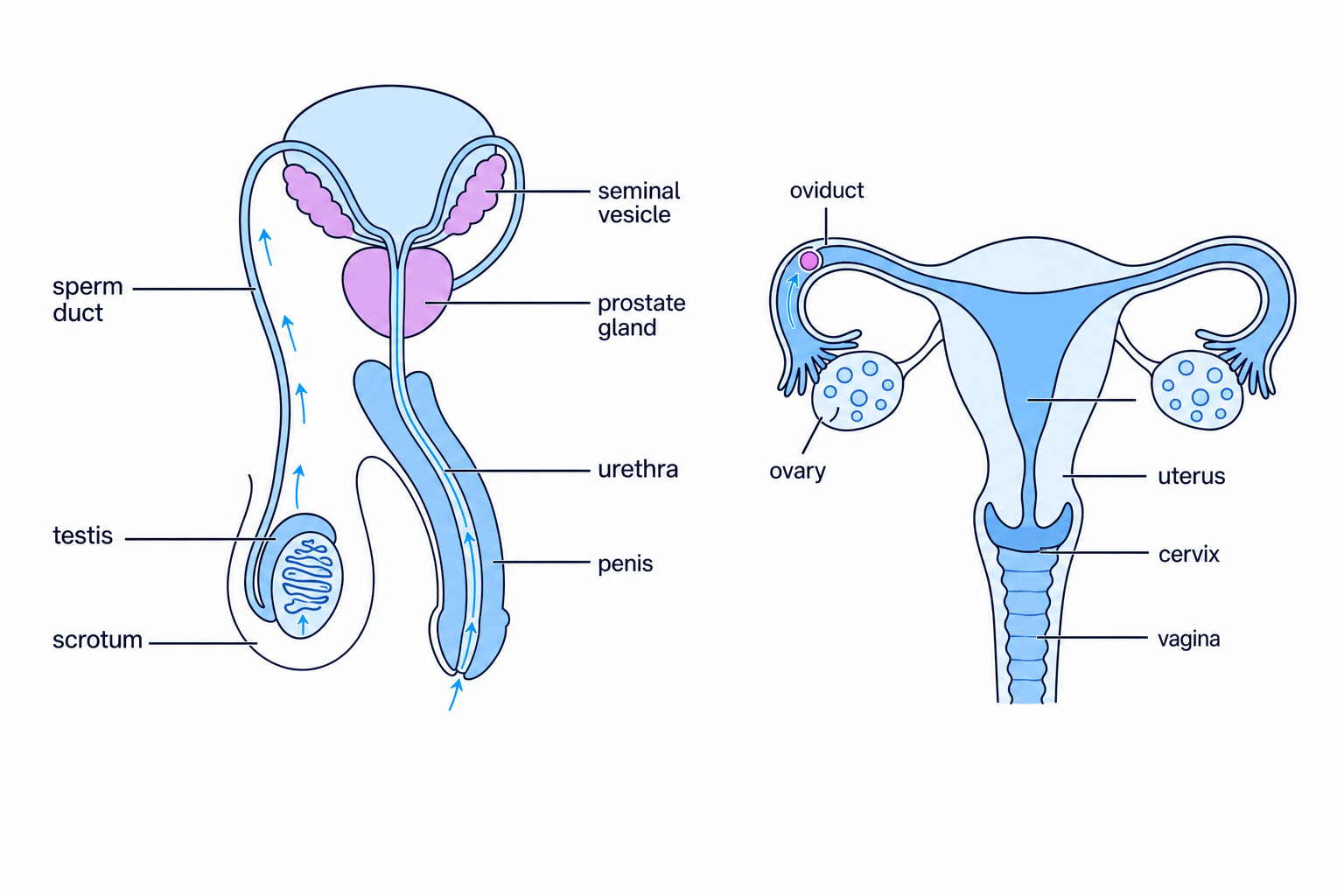
Humans reproduce sexually. The male reproductive system produces and delivers sperm. The female reproductive system produces eggs and supports embryo development.
Male reproductive structures:
- testes produce sperm and testosterone
- scrotum holds the testes outside the body, keeping them slightly cooler for sperm production
- sperm ducts carry sperm from the testes
- glands produce seminal fluid, which mixes with sperm to form semen
- urethra carries semen through the penis
- penis transfers semen into the vagina during sexual intercourse
Female reproductive structures:
- ovaries produce eggs and the hormones oestrogen and progesterone
- oviducts carry eggs from the ovaries towards the uterus; fertilisation usually occurs here
- uterus has a muscular wall and a lining where an embryo can implant and develop
- cervix is the opening between the uterus and vagina
- vagina receives semen and acts as the birth canal
The menstrual cycle and hormones
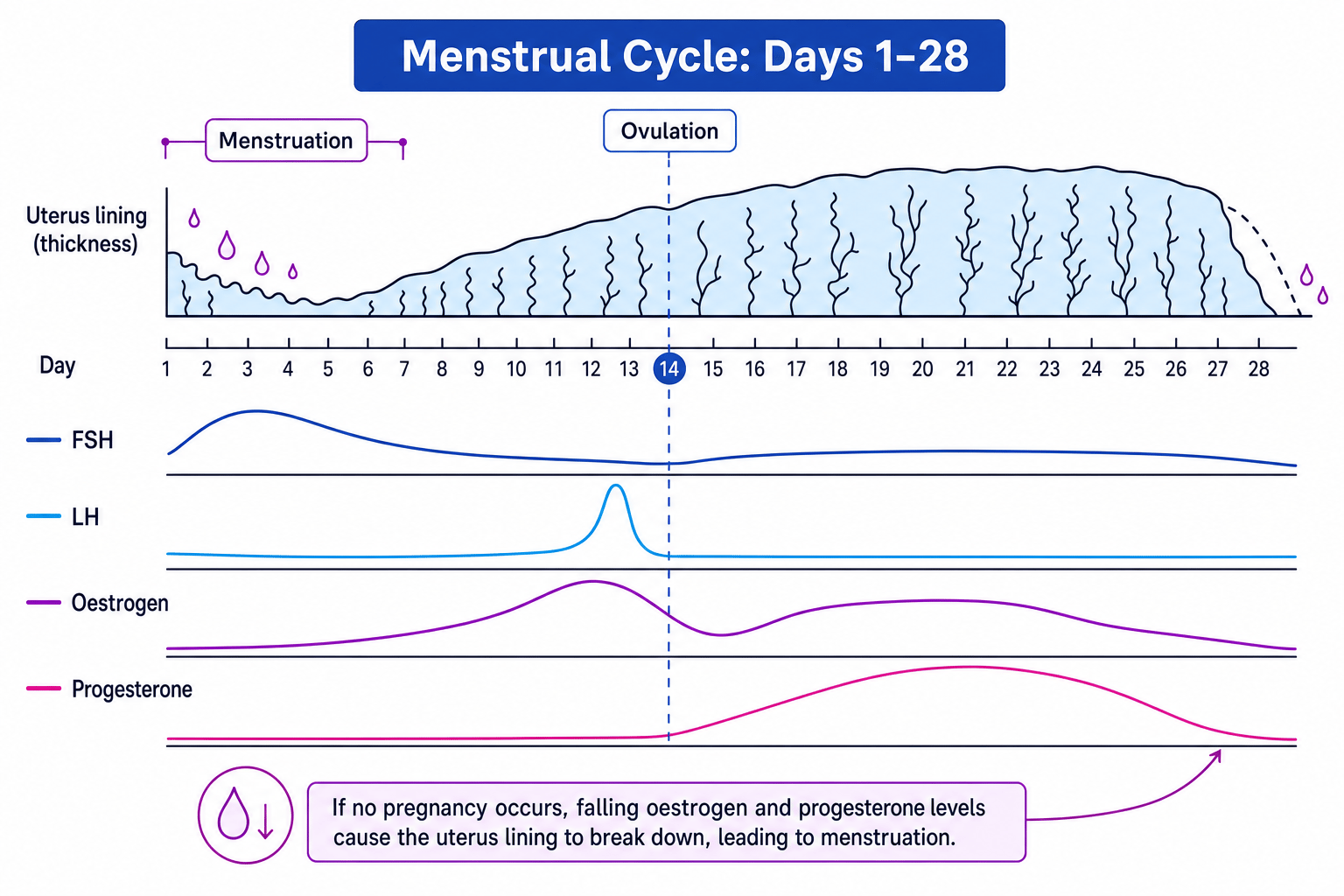
The menstrual cycle prepares the uterus for pregnancy. It is often described as about 28 days, though real cycles can vary.
Hormones are chemical messengers carried in the blood. The main hormones in this topic are oestrogen, progesterone, FSH and LH. FSH and LH are marked as Paper 2 only in the specification, but they help the whole cycle make sense.
Key roles:
- FSH stimulates an egg to mature in an ovary and stimulates oestrogen production.
- Oestrogen helps repair and thicken the uterus lining after menstruation.
- LH triggers ovulation, which is the release of an egg from an ovary.
- Progesterone maintains the thick uterus lining after ovulation.
- If no pregnancy occurs, oestrogen and progesterone levels fall, causing the uterus lining to break down. This is menstruation.
Interpreting hormone changes
A graph shows progesterone rising after day 14 and falling just before day 28. What does this suggest?
- A rise in progesterone after day 14 suggests ovulation has already happened, because progesterone is important after ovulation.
- Progesterone maintains the uterus lining, so a high level means the lining is being kept thick.
- A fall in progesterone near day 28 means the lining is no longer maintained, so menstruation is likely to begin if there is no pregnancy.
Placenta, nutrition and protection
After fertilisation, the embryo develops in the uterus. It receives substances from the mother through the placenta, a temporary organ attached to the uterus lining. The embryo is connected to the placenta by the umbilical cord.
The placenta allows useful substances such as glucose, amino acids, oxygen, water and mineral ions to pass from the mother’s blood to the embryo. Waste substances such as carbon dioxide and urea pass from the embryo to the mother.
Blood does not normally mix
The mother’s blood and the embryo’s blood do not normally mix directly. Substances exchange across the placenta.
The embryo is surrounded by amniotic fluid inside the amniotic sac. This fluid cushions the embryo, helping protect it from knocks and sudden movements. It also helps provide a stable environment.
Puberty and secondary sexual characteristics
Puberty is the stage when the body becomes physically able to reproduce. Secondary sexual characteristics are features that develop at puberty but are not the reproductive organs themselves.
Oestrogen is involved in female secondary sexual characteristics, such as breast development, widening of the hips and the start of the menstrual cycle.
Testosterone is involved in male secondary sexual characteristics, such as growth of facial and body hair, deepening of the voice, increased muscle development and sperm production beginning.
In the exam
- Keep pollination and fertilisation separate: pollen transfer first, gamete fusion later.
- When describing flower adaptations, always link the structure to its function, such as “feathery stigma catches wind-blown pollen”.
- For the germination practical, name the independent variable, dependent variable and control variables.
- In menstrual cycle questions, link each hormone to a clear effect: FSH matures egg, LH causes ovulation, oestrogen thickens lining, progesterone maintains lining.
- For the placenta, say substances exchange across it; do not say the mother’s and embryo’s blood mix.
Check yourself
- What are two differences between sexual and asexual reproduction?
- Why does a germinating seed need oxygen before it can photosynthesise?
- How do oestrogen and progesterone affect the uterus lining during the menstrual cycle?
