

What you'll learn
- How organisms detect changes and produce co-ordinated responses.
- How plants respond to light and gravity using growth responses.
- How the human nervous system produces rapid responses, including reflexes.
- How hormones, the eye and the skin help control body conditions.
Why organisms need to respond
Living organisms are constantly affected by changes in their surroundings. A stimulus is a change in the environment, and a response is the action taken because of that change.
Examples of stimuli include light, temperature, sound, touch, gravity, water availability and blood glucose concentration. Responding helps organisms survive by finding food, avoiding harm, reproducing and keeping internal conditions suitable for cells.
Stimulus, receptor and effector
A stimulus is a change that can be detected. A receptor is a cell or organ that detects the stimulus. An effector is a muscle or gland that produces the response.
A co-ordinated response usually follows this pattern:
stimulus → receptor → co-ordination → effector → response
Identifying stimulus, receptor and effector
A person touches a hot pan and pulls their hand away.
- The stimulus is the high temperature of the pan, because this is the change being detected.
- The receptors are temperature or pain receptors in the skin, because they detect the heat.
- The effectors are muscles in the arm, because they contract to move the hand away.
Homeostasis
Homeostasis
Homeostasis is the maintenance of a constant internal environment.
Your cells work best when internal conditions stay within a narrow range. For example, enzymes are affected by temperature, and cells can be damaged if they gain or lose too much water.
Two important examples of homeostasis in humans are:
- body temperature
- body water content
Why homeostasis matters
Homeostasis does not mean conditions never change. It means changes are detected and responses bring conditions back towards normal.
Plant responses
Plants do not have nerves or muscles, but they still respond to stimuli. Their responses are often slower than animal responses because they usually involve growth.
Tropism
A tropism is a growth response of a plant to a directional stimulus.
Phototropism and geotropism
Phototropism is growth in response to light.
- Stems are positively phototropic: they grow towards light.
- This helps leaves receive more light for photosynthesis.
Geotropism is growth in response to gravity. It is also called gravitropism.
- Roots are positively geotropic: they grow downwards, towards gravity.
- Stems are negatively geotropic: they grow upwards, away from gravity.
Auxin is a plant growth substance that affects cell elongation. In the phototropic response of stems, auxin moves to the shaded side of the shoot. Cells on the shaded side elongate more, so the stem bends towards the light.
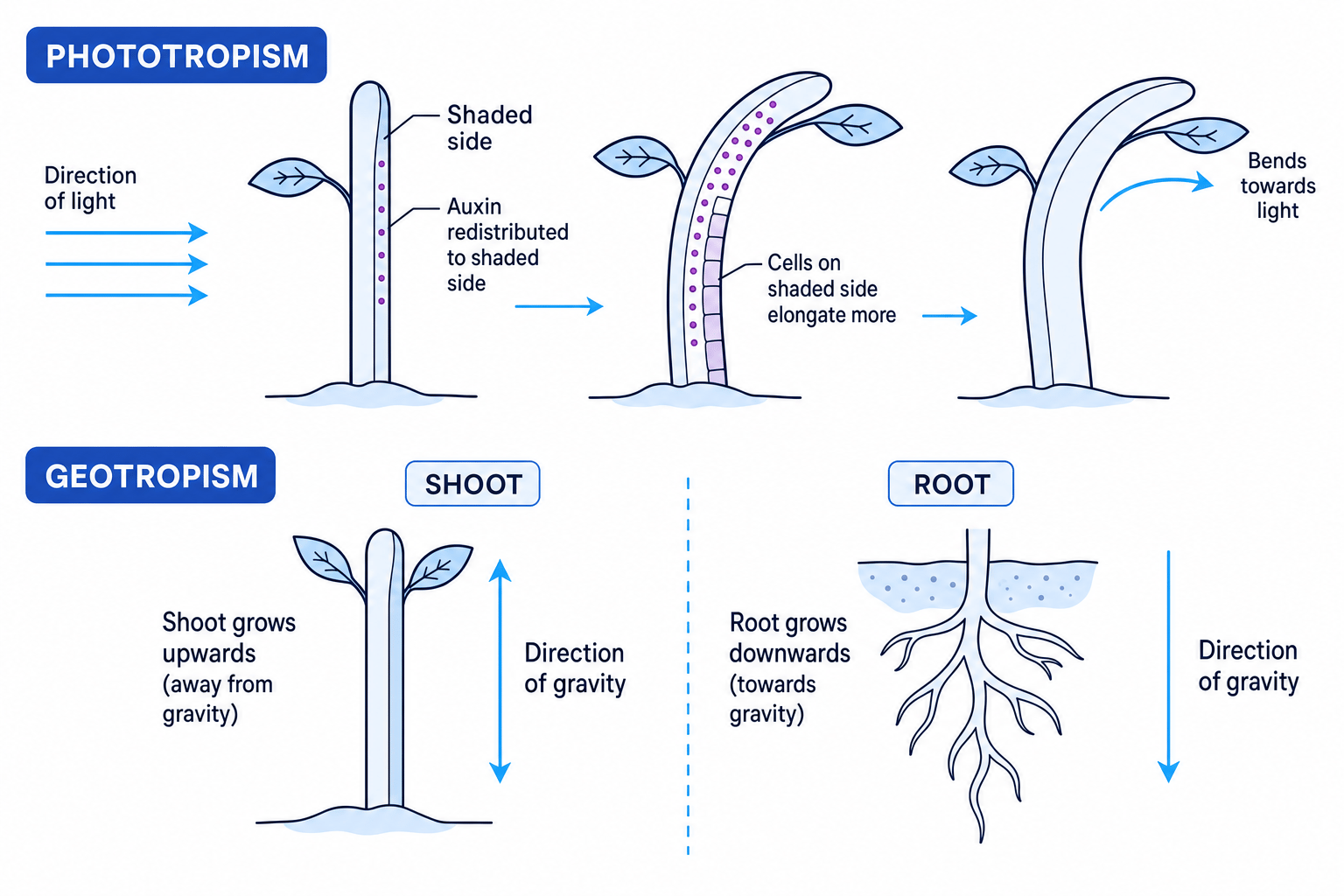
Predicting bending in a shoot
A shoot is lit from the left side only. Predict the direction of growth.
- The stimulus is light from the left, so one side of the shoot is lit and the opposite side is shaded.
- Auxin collects on the shaded side of the shoot, which is the right side.
- Cells on the right side elongate more than cells on the left, so the shoot bends towards the left, towards the light.
Phototropism direction
Do not say “auxin moves to the light side”. In stems, auxin collects on the shaded side, causing that side to grow faster.
Human co-ordination: nerves and hormones
Humans use two main communication systems:
- the nervous system, which uses electrical impulses along neurones
- the hormonal system, which uses chemical messengers called hormones carried in the blood
A neurone is a nerve cell. A nerve is a bundle of neurones. An impulse is an electrical signal that travels along a neurone.
| Feature | Nervous communication | Hormonal communication |
|---|---|---|
| Signal | Electrical impulses | Hormones in blood |
| Speed | Very fast | Slower |
| Duration | Usually short-lived | Often longer-lasting |
| Target | Specific muscles or glands | Target organs with the correct receptors |
| Example | Pulling away from heat | Insulin controlling blood glucose |
Speed versus duration
For comparison questions, nervous responses are usually faster and shorter-lasting; hormonal responses are usually slower and longer-lasting.
The central nervous system
The central nervous system, or CNS, consists of the brain and spinal cord. Sense organs, such as the eyes, ears, nose, tongue and skin, contain receptors and are linked to the CNS by nerves.
When receptors are stimulated, electrical impulses travel along nerves into the CNS. The CNS processes the information, then impulses travel out to effectors. This produces rapid responses.
Synapses and neurotransmitters
Synapse
A synapse is a small gap between two neurones.
Electrical impulses cannot jump directly across the synapse. When an impulse reaches the end of one neurone, chemicals called neurotransmitters are released. They diffuse across the synapse and trigger a new electrical impulse in the next neurone.
Reflex actions
A reflex action is a fast, automatic response to a stimulus. Reflexes help protect the body from damage.
The path taken by impulses in a reflex is called a reflex arc. In the example of withdrawing a finger from a hot object, impulses travel from a receptor in the skin, along a sensory neurone, through a relay neurone in the spinal cord, then along a motor neurone to a muscle effector.
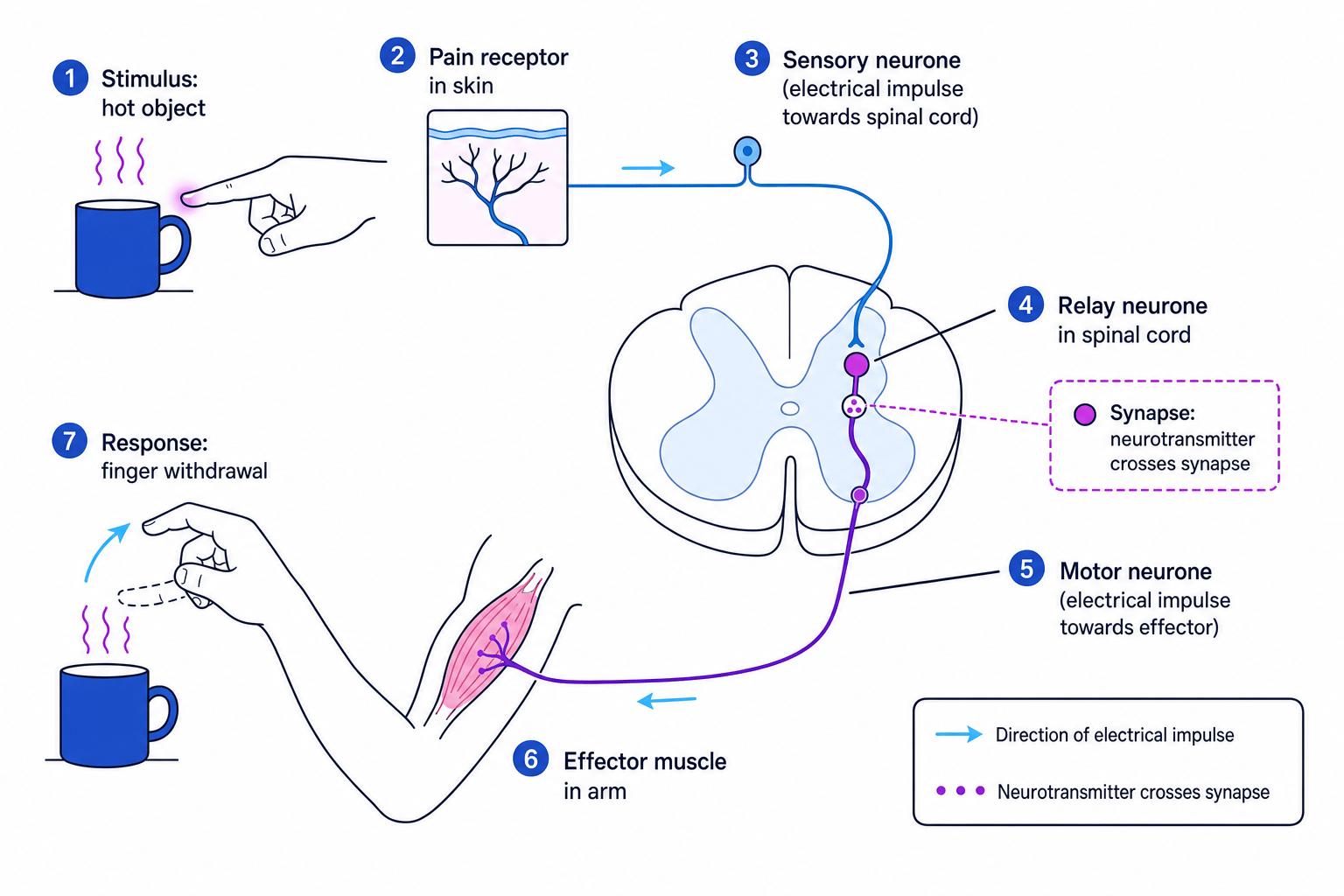
Tracing a withdrawal reflex
A finger touches a very hot object and is pulled away before you consciously think about it.
- Heat stimulates pain receptors in the skin, so electrical impulses start in a sensory neurone.
- The sensory neurone carries impulses to the spinal cord, where neurotransmitters pass the signal across synapses to a relay neurone and then a motor neurone.
- The motor neurone carries impulses to an arm muscle, causing it to contract and pull the finger away.
Reflexes and the brain
The brain may become aware of the pain, but the first withdrawal response is co-ordinated through the spinal cord, making it faster.
The eye as a receptor
The eye is a sense organ that detects light. Light enters the eye and is focused onto the retina, a light-sensitive layer containing receptor cells. The receptors produce electrical impulses that travel along the optic nerve to the brain.
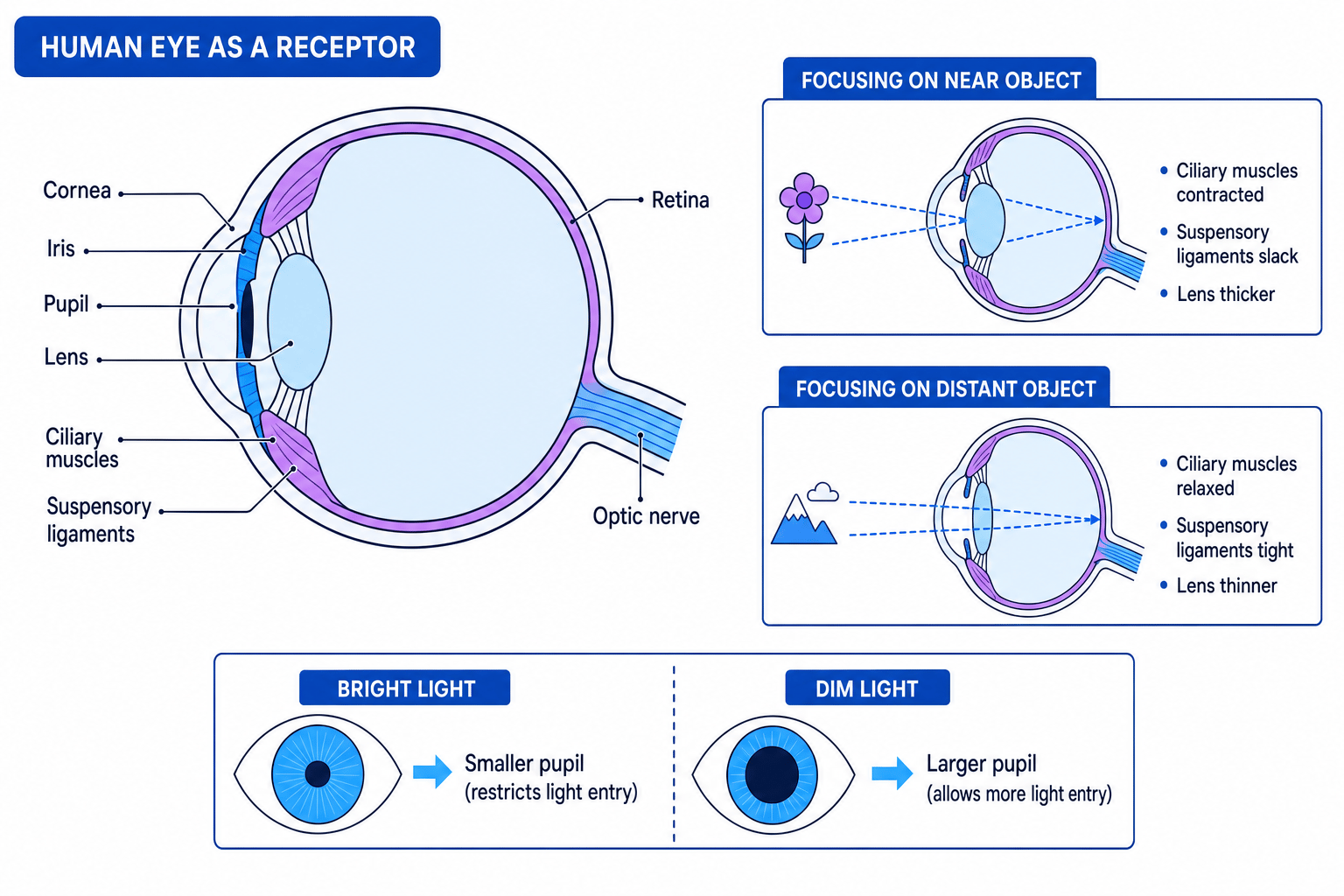
Main structures to know:
- cornea: transparent front part that refracts, or bends, light
- iris: coloured ring of muscle that controls pupil size
- pupil: hole that lets light enter the eye
- lens: changes shape to focus light onto the retina
- ciliary muscles: alter tension in the suspensory ligaments
- suspensory ligaments: hold the lens and help change its shape
- retina: contains light receptors
- optic nerve: carries impulses to the brain
Focusing on near and distant objects
For a near object:
- ciliary muscles contract
- suspensory ligaments slacken
- lens becomes thicker and more rounded
- light is refracted more strongly
For a distant object:
- ciliary muscles relax
- suspensory ligaments become tight
- lens becomes thinner
- light is refracted less strongly
Lens shape
Near objects need a thicker lens. Distant objects need a thinner lens.
Responding to light intensity
In bright light, the pupil becomes smaller, reducing the amount of light entering the eye and protecting the retina. In dim light, the pupil becomes larger, allowing more light to enter.
Skin and temperature regulation
The skin helps control body temperature. This is part of homeostasis.
If you are too hot:
- sweat glands produce sweat
- sweat evaporates from the skin surface, transferring energy away from the body
- blood vessels near the skin surface widen, called vasodilation
- more blood flows near the skin, so more heat is lost
If you are too cold:
- less sweat is produced
- blood vessels near the skin surface narrow, called vasoconstriction
- less blood flows near the skin, so less heat is lost
Predicting skin responses in heat
A person exercises on a warm day and their body temperature rises.
- The rise in body temperature must be corrected to maintain homeostasis.
- Sweat production increases, and evaporation removes thermal energy from the skin.
- Vasodilation increases blood flow near the surface, increasing heat loss to the surroundings.
Blood vessels do not move
In vasodilation and vasoconstriction, blood vessels widen or narrow. They do not move closer to or further away from the skin surface.
Hormones
Hormone
A hormone is a chemical messenger produced by a gland and carried in the blood to a target organ.
Hormones act more slowly than nerve impulses, but their effects can last longer. A target organ only responds to a hormone if its cells have the correct receptors.
ADH, FSH and LH are Paper 2 only in the specification, but they are included here so your notes are complete.
| Hormone | Source | Roles and effects |
|---|---|---|
| Adrenaline | Adrenal glands | Prepares the body for “fight or flight”; increases heart rate and breathing rate and helps raise blood glucose. |
| Insulin | Pancreas | Lowers blood glucose by causing cells, especially liver and muscle cells, to take up glucose and store it as glycogen. |
| Testosterone | Testes | Stimulates sperm production and male secondary sexual characteristics, such as facial hair and a deeper voice. |
| Progesterone | Ovaries, and placenta during pregnancy | Maintains the uterus lining and supports pregnancy. |
| Oestrogen | Ovaries | Stimulates female secondary sexual characteristics and helps rebuild the uterus lining during the menstrual cycle. |
| ADH | Pituitary gland | Increases water reabsorption by the kidneys, producing a smaller volume of more concentrated urine. |
| FSH | Pituitary gland | In females, stimulates egg maturation and oestrogen production; in males, supports sperm production. |
| LH | Pituitary gland | In females, triggers ovulation and stimulates progesterone production; in males, stimulates testosterone production. |
Hormones and homeostasis
Hormones help maintain stable internal conditions, such as blood glucose concentration and body water content.
In the exam
- For any response question, identify the stimulus, receptor, effector and response before writing your explanation.
- In reflex arc questions, keep the order clear: receptor → sensory neurone → relay neurone → motor neurone → effector.
- For plant tropisms, state the stimulus direction first, then explain unequal growth.
- For comparison questions, use paired points such as “nervous is faster; hormonal is slower”.
Check yourself
- Why does a shoot bend towards light when auxin collects on the shaded side?
- What is the role of neurotransmitters at a synapse?
- How do sweating and vasodilation help reduce body temperature?
