

What you'll learn
- How DNA, genes, chromosomes and the genome store inherited information.
- How alleles affect phenotype, and how to use monohybrid genetic diagrams.
- How mitosis, meiosis and fertilisation affect chromosome number and variation.
- How mutations, natural selection and antibiotic resistance link to inheritance.
The big idea: inheritance
Inheritance means the passing of genetic information from parents to their offspring — their young. This information affects many characteristics, such as blood group, flower colour, enzyme production and some inherited disorders.
DNA, genes, chromosomes and the genome
In plant and animal cells, the nucleus is the part of the cell that contains chromosomes. Chromosomes are long molecules of DNA, coiled up so they fit inside the nucleus.
Genome, gene and chromosome
- DNA is the genetic material found in chromosomes.
- The genome is the entire DNA of an organism.
- A gene is a section of a molecule of DNA that codes for a specific protein.
- A protein is a molecule made from amino acids; proteins can be structural, or can control cell processes such as enzymes.
Where genes are found
Genes are located on chromosomes in the nucleus. The genome is all the DNA in the organism, while one gene is one useful section of that DNA.
DNA structure and protein synthesis
For Paper 2, you also need the detail of DNA structure and how proteins are made.
A DNA molecule has two strands coiled to form a double helix. The strands are linked by paired bases. A base is one of the “letters” in the genetic code:
- adenine, A, pairs with thymine, T
- cytosine, C, pairs with guanine, G
RNA is similar to DNA, but an RNA molecule is single stranded and contains uracil, U, instead of thymine, T.
During protein synthesis, the cell uses the code in a gene to build a protein. Transcription is the copying of a gene into mRNA, which is messenger RNA. Translation is the building of a protein at a ribosome, using the mRNA code. A codon is a group of three bases on mRNA. A tRNA molecule carries an amino acid and has an anticodon, a group of three bases that pairs with a codon.
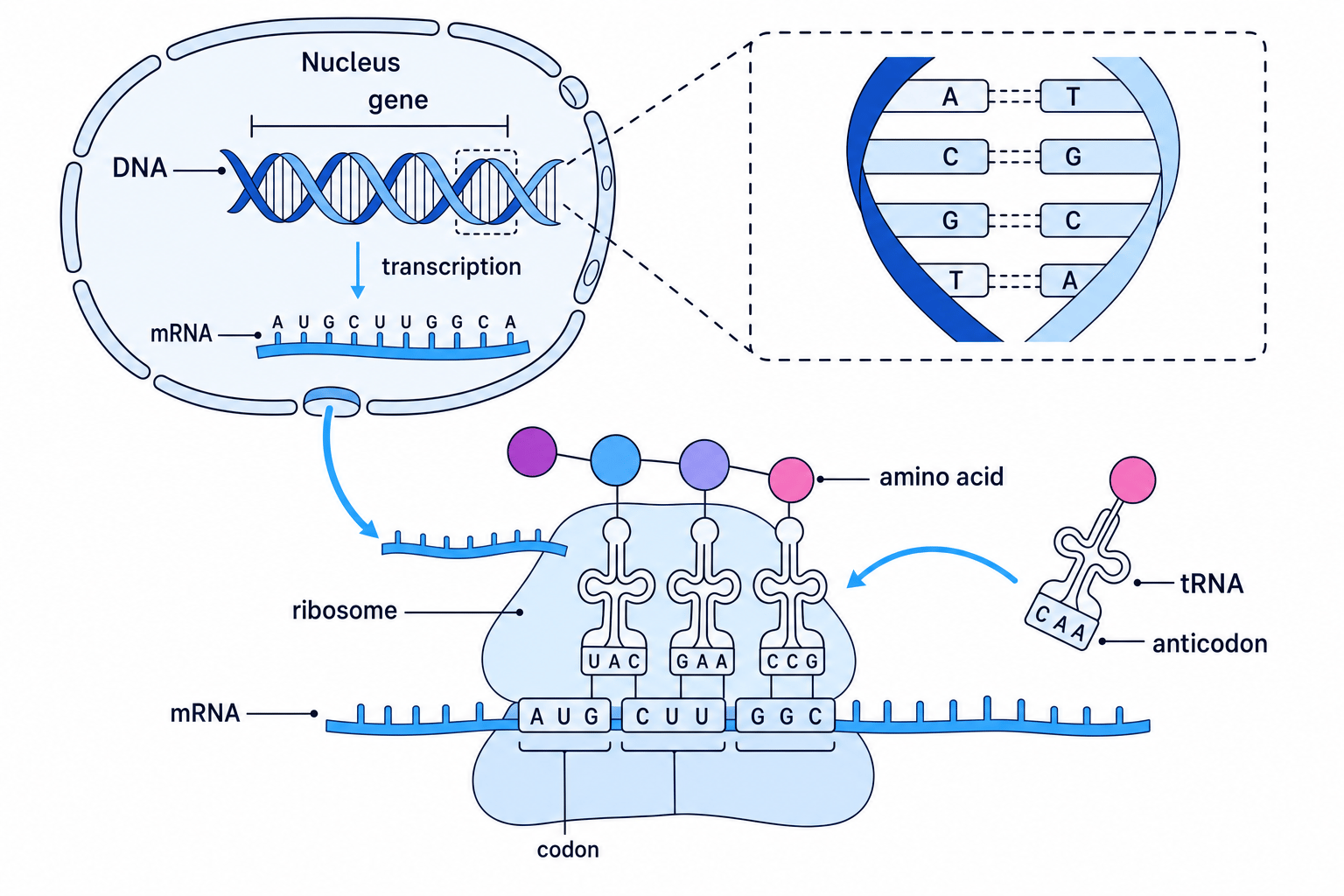
Tracing a short code through protein synthesis
Suppose the DNA template sequence is TACGGA.
- Apply DNA-to-RNA base pairing: T pairs with A, A pairs with U, C pairs with G, and G pairs with C, so the mRNA sequence becomes AUGCCU.
- Split the mRNA into codons: AUG and CCU. Each codon helps determine one amino acid in the protein.
- Match tRNA anticodons to the mRNA codons: AUG pairs with UAC, and CCU pairs with GGA, so the correct tRNA molecules bring amino acids in the order coded by the mRNA.
Alleles, genotype and phenotype
A gene can exist in alternative forms called alleles. Different alleles can give rise to differences in inherited characteristics.
Key inheritance vocabulary
- A dominant allele is expressed in the phenotype if at least one copy is present.
- A recessive allele is expressed only when no dominant allele is present.
- Homozygous means having two identical alleles for a gene, such as BB or bb.
- Heterozygous means having two different alleles for a gene, such as Bb.
- The genotype is the alleles an organism has.
- The phenotype is the observable characteristic, produced by the genotype and sometimes the environment too.
Codominance means both alleles are expressed in the phenotype of a heterozygous organism. This is Paper 2 only. For example, if a red coat allele and a white coat allele are codominant, a heterozygous animal may show both red and white hairs.
Most phenotypic features are not controlled by a single gene. Polygenic inheritance means a characteristic is controlled by many genes. Human height and skin colour are examples, and both can also be affected by the environment.
Dominant does not mean common
A dominant allele is not necessarily the most common allele in a population. “Dominant” only describes what happens in a heterozygous genotype.
Monohybrid inheritance
Monohybrid inheritance is the inheritance of one characteristic controlled by one gene. A genetic diagram shows how alleles can be passed from parents to offspring. A gamete is a sex cell, such as a sperm cell or egg cell. Fertilisation is the fusion of two gametes.
The diagram below shows a monohybrid Punnett square and the same genetic-diagram logic applied to human sex determination.
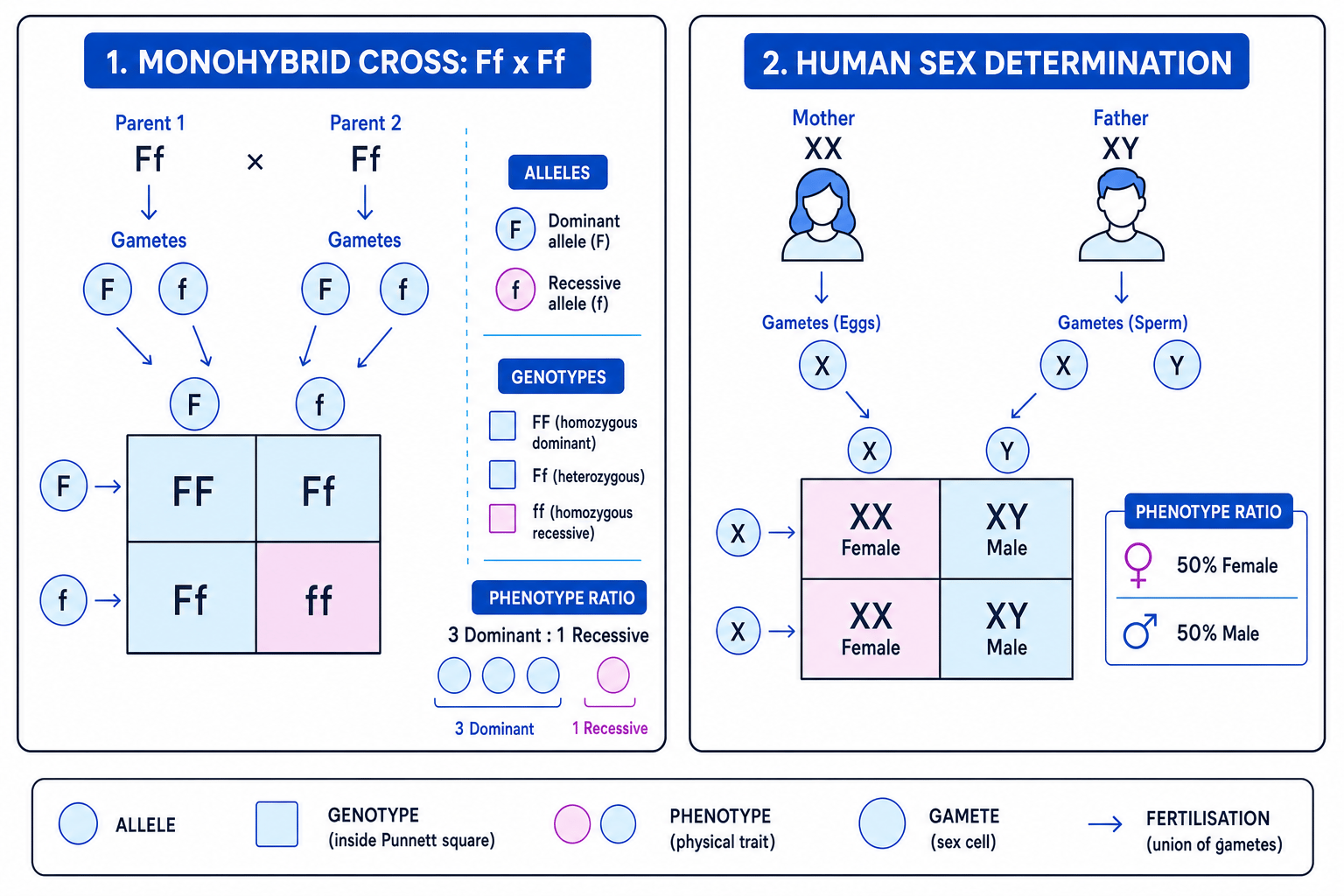
Predicting offspring from two heterozygous parents
In a plant, purple flowers are caused by a dominant allele P, and white flowers are caused by a recessive allele p. Two heterozygous purple plants are crossed.
- Convert the parent phenotypes into genotypes: heterozygous means each parent is Pp.
- Work out possible gametes: each Pp parent can pass on either P or p.
- Combine the gametes to get the possible offspring genotypes: PP, Pp, Pp and pp.
- Convert genotypes to phenotypes: PP and Pp are purple, while pp is white.
- Calculate the probability of white flowers:
So the expected phenotype ratio is 3 purple : 1 white.
Probability is not a promise
A 25% chance does not guarantee exactly one affected offspring in every four. It means each fertilisation has that chance independently.
Family pedigrees
A family pedigree is a diagram that shows how a characteristic is inherited through a family. In many pedigrees, squares represent males, circles represent females, and shaded symbols represent people showing the phenotype.
A carrier is a heterozygous person who has one recessive allele for a condition but does not show the condition.
Interpreting a recessive pedigree
Two unaffected parents have an affected child for a condition controlled by one gene.
- If the condition is recessive, the affected child must have genotype aa, because a recessive phenotype appears only when there is no dominant allele.
- The child must have received one a allele from each parent, so both parents must carry the recessive allele.
- Because the parents are unaffected, each parent must also have a dominant A allele, so both parents are carriers with genotype Aa.
- A cross between Aa and Aa gives AA, Aa, Aa and aa, so the probability of an affected child is one out of four.
Sex determination in humans
In humans, biological sex is controlled by one pair of chromosomes:
- XX usually produces a female
- XY usually produces a male
The egg cell always contains an X chromosome. A sperm cell contains either an X chromosome or a Y chromosome.
Predicting sex at fertilisation
- The mother is XX, so all her egg cells carry an X chromosome.
- The father is XY, so his sperm cells can carry either X or Y.
- If an X sperm fertilises the egg, the offspring is XX; if a Y sperm fertilises the egg, the offspring is XY. This gives a 50% chance of XX and a 50% chance of XY.
Mitosis, meiosis and chromosome number
A diploid cell has two sets of chromosomes, arranged in pairs. A haploid cell has one set of chromosomes. In humans, the diploid number is 46 and the haploid number is 23.
Mitosis is cell division that produces two cells with identical sets of chromosomes. It is used for growth, repair, cloning and asexual reproduction. Cloning means producing genetically identical copies. Asexual reproduction uses one parent and does not involve fusion of gametes.
Meiosis is cell division that produces four genetically different haploid gametes, each with half the number of chromosomes. Random fertilisation means any one sperm can fuse with any one egg, producing genetic variation in offspring.
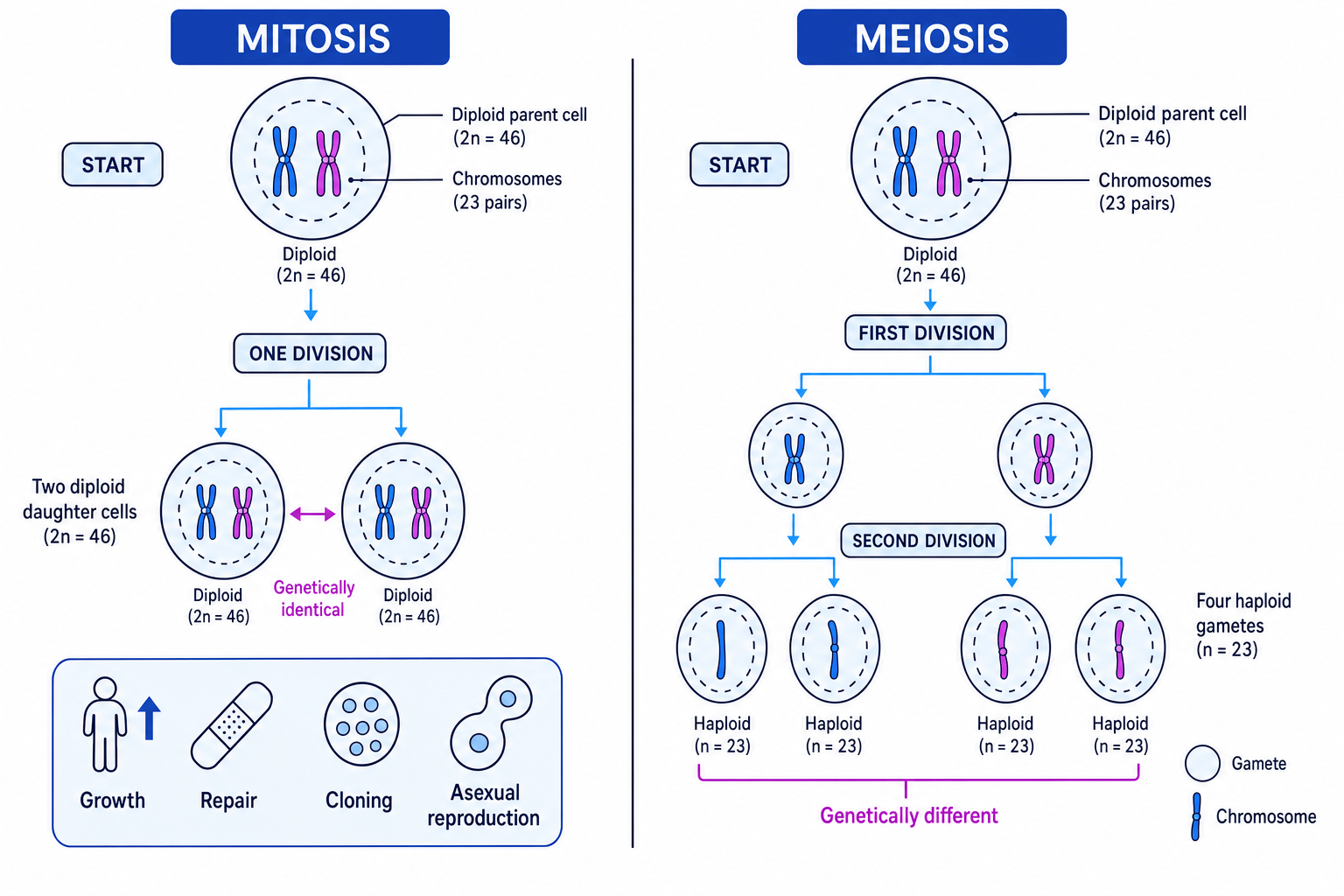
Following chromosome number
- A human body cell has 46 chromosomes. Meiosis halves this number, so a sperm cell or egg cell has 23 chromosomes.
- At fertilisation, the two gamete nuclei fuse:
- The new cell has the diploid number again, but its allele combination is unique because the gametes were genetically different and met at random.
Variation and mutations
A species is a group of organisms that can reproduce to produce fertile offspring. Variation means differences between individuals in a species.
Variation can be:
- genetic, caused by different alleles
- environmental, caused by surroundings or lifestyle
- a combination of genetic and environmental factors, such as height or body mass
A mutation is a rare, random change in genetic material. A mutation can be inherited if it occurs in a cell that forms gametes.
For Paper 2, you need to link DNA changes to phenotype. A change in DNA can alter the mRNA codons, which can alter the sequence of amino acids in a protein. This may change the protein’s shape or function, which may affect the phenotype. However, most genetic mutations have no effect on phenotype, some have a small effect, and only rarely do they have a significant effect.
The incidence of mutations can be increased by mutagens, which are agents that increase mutation rate. Examples include ionising radiation such as gamma rays, x-rays and ultraviolet rays, and chemical mutagens such as chemicals in tobacco smoke.
Mutations are random
Mutations do not happen because an organism “needs” them. They occur randomly; the environment may then select organisms with useful mutations.
Evolution by natural selection
Evolution is the change in inherited characteristics of a population over many generations. Darwin’s theory of natural selection explains how this can happen.
- Individuals in a population show variation.
- Some variation is genetic, so it can be inherited.
- Individuals with advantageous characteristics are more likely to survive and reproduce.
- They pass on the alleles for those characteristics.
- Over many generations, those alleles become more common in the population.
Antibiotic resistance
Antibiotic resistance is the ability of bacteria to survive exposure to an antibiotic that would normally kill them or stop them reproducing. This can make infections difficult to control.
Explaining antibiotic resistance
- A random mutation may produce a bacterium with resistance to an antibiotic.
- When the antibiotic is used, susceptible bacteria are killed, but resistant bacteria survive.
- The resistant bacteria reproduce asexually and pass on the genetic material for resistance.
- Over generations, the proportion of resistant bacteria increases, so the infection becomes harder to treat.
Selection acts on populations
Individual bacteria do not become resistant because they “try” to survive. Resistant bacteria already present are selected for, then reproduce and become more common.
In the exam
- For genetic diagrams, always show parent genotypes, gametes, offspring genotypes and phenotype probabilities.
- For pedigree questions, use the evidence: unaffected parents with an affected child often suggests a recessive allele.
- For natural selection questions, include variation, survival advantage, reproduction, inheritance of alleles and change over generations.
Check yourself
- What is the difference between a gene, an allele and a genome?
- How does meiosis help produce genetic variation?
- Why can antibiotic resistance increase in a bacterial population after antibiotic treatment?
