

What you'll learn
- How sulfur dioxide and carbon monoxide harm living organisms.
- Why greenhouse gases can cause an enhanced greenhouse effect and global warming.
- How sewage and fertiliser runoff damage aquatic ecosystems.
- How deforestation affects soil, water movement, the carbon cycle and atmospheric gases.
The big idea: humans can change ecosystems
An ecosystem is a community of organisms interacting with each other and with their physical environment. Human activities can change ecosystems by adding harmful substances, removing habitats, or altering natural cycles such as the carbon cycle and water cycle.
Pollution
Pollution is the addition of a substance to the environment in amounts that cause harm to living organisms. A harmful substance that causes pollution is called a pollutant.
Air pollution
Sulfur dioxide
Sulfur dioxide is a gas released when fossil fuels containing sulfur, such as some coal and oil, are burned.
In the atmosphere, sulfur dioxide dissolves in water droplets and can form acid rain. Acid rain has a lower pH than normal rain.
Biological consequences include:
- damage to leaves, reducing photosynthesis
- acidification of lakes and rivers, which can kill fish and aquatic invertebrates
- damage to roots, making it harder for plants to absorb mineral ions
- irritation of the lungs and breathing difficulties in animals, including humans
Carbon monoxide
Carbon monoxide is a poisonous gas produced by incomplete combustion, when fuels burn without enough oxygen. Examples include faulty gas boilers and car engines in poorly ventilated spaces.
Carbon monoxide is dangerous because it binds strongly to haemoglobin, the red blood cell protein that normally carries oxygen. This forms carboxyhaemoglobin, so less oxygen is transported around the body.
Explaining carbon monoxide poisoning
- Carbon monoxide is breathed into the lungs and diffuses into the blood.
- It binds to haemoglobin in red blood cells, taking the place where oxygen would normally bind.
- Less oxygen is carried to body tissues, so cells cannot carry out enough aerobic respiration.
- If vital organs such as the brain and heart receive too little oxygen, the person may become unconscious or die.
Sulfur dioxide vs carbon monoxide
Do not mix up their effects: sulfur dioxide is mainly linked to acid rain and respiratory irritation, while carbon monoxide reduces oxygen transport by binding to haemoglobin.
Greenhouse gases and global warming
Greenhouse gas
A greenhouse gas is a gas in the atmosphere that absorbs long-wave infrared radiation emitted from Earth’s surface.
The greenhouse gases named in this specification are:
- water vapour
- carbon dioxide
- nitrous oxide
- methane
- CFCs
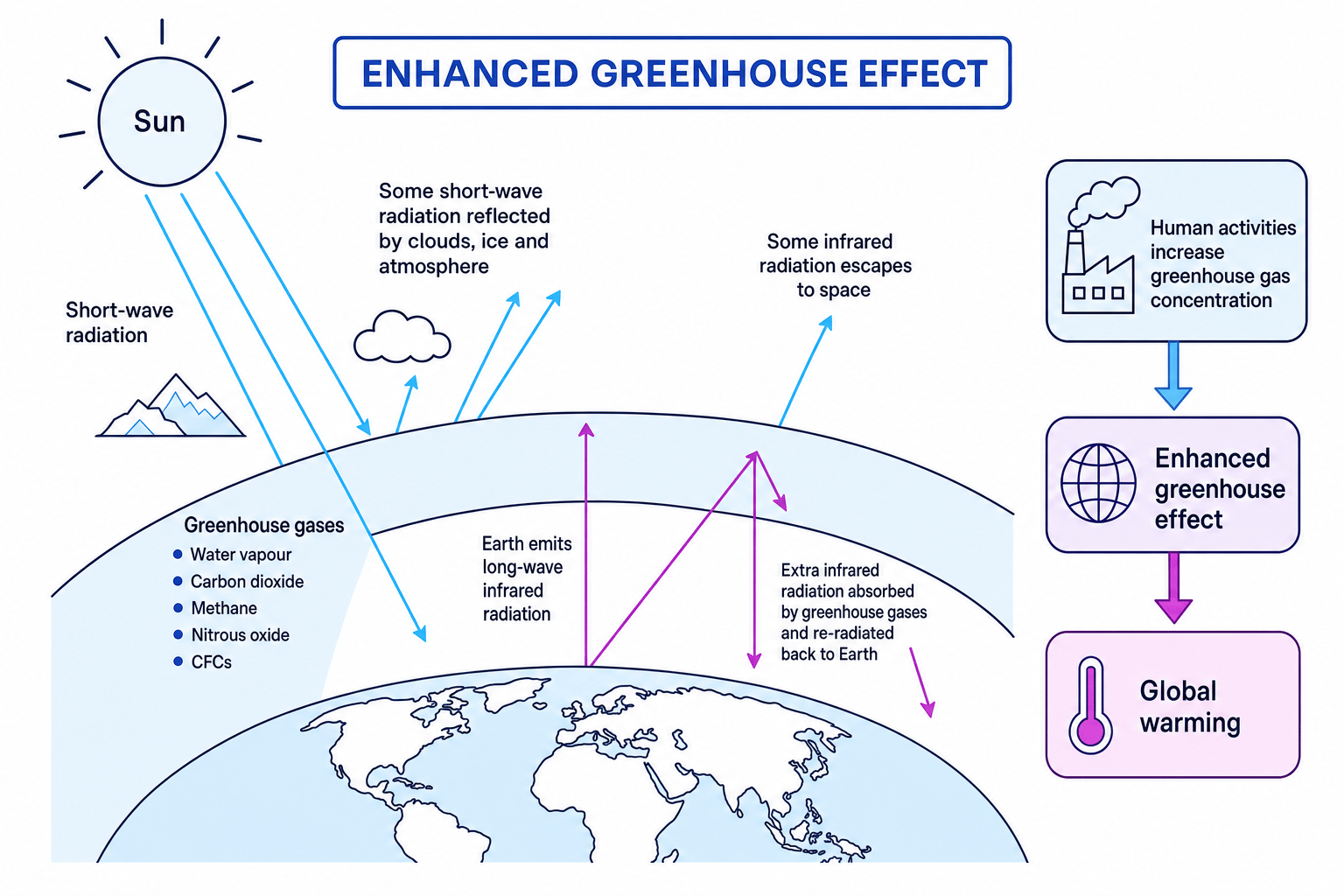
The greenhouse effect is natural and important: it helps keep Earth warm enough for life. The problem is the enhanced greenhouse effect, where human activities increase greenhouse gas concentrations, causing more infrared radiation to be trapped.
This diagram shows the energy transfers involved in the enhanced greenhouse effect.
How human activities increase greenhouse gases
Humans add greenhouse gases in several ways:
- burning fossil fuels in power stations, transport and industry releases carbon dioxide
- deforestation reduces photosynthesis and often releases carbon dioxide by burning or decomposition
- cattle farming, rice fields and landfill sites release methane
- fertilised soils can release nitrous oxide due to microbial activity
- CFCs were used in some older aerosols, refrigerators and foams, and can remain in the atmosphere for a long time
Global warming
Global warming is an increase in the mean temperature of Earth’s atmosphere and oceans.
Possible biological consequences include:
- melting ice and rising sea levels, flooding coastal habitats
- changes in rainfall patterns, causing droughts or floods
- changes in species distribution as organisms move to suitable temperatures
- extinction of species that cannot adapt or migrate
- reduced crop yields in some regions
- increased spread of some pests and disease vectors
Tracing the enhanced greenhouse effect
- A human activity, such as burning fossil fuels, increases the concentration of carbon dioxide in the atmosphere.
- Earth’s surface emits long-wave infrared radiation after being warmed by sunlight.
- Extra greenhouse gas molecules absorb more of this infrared radiation and re-radiate some of it back towards Earth.
- Less energy escapes into space, so the average global temperature may increase.
- Warmer temperatures can alter habitats, rainfall and food availability, affecting survival and reproduction of organisms.
Greenhouse effect vs ozone depletion
CFCs are involved in ozone depletion, but in this topic you must also know that CFCs are greenhouse gases. Do not write only about the ozone layer if the question asks about global warming.
Water pollution by sewage
Sewage is wastewater containing faeces, urine and other organic waste. Untreated sewage can contain pathogens, which are microorganisms that cause disease.
Sewage also provides food for decomposing microorganisms. These microorganisms reproduce rapidly and respire aerobically, using up dissolved oxygen in the water.
The biological oxygen demand, or BOD, is the amount of oxygen needed by microorganisms to break down organic matter. Sewage increases BOD, which can reduce oxygen available for fish and other aquatic animals.
Sewage reduces oxygen
The main chain is: sewage adds organic matter → decomposer bacteria increase → aerobic respiration increases → dissolved oxygen falls → aquatic animals may die.
Eutrophication from fertiliser
Eutrophication
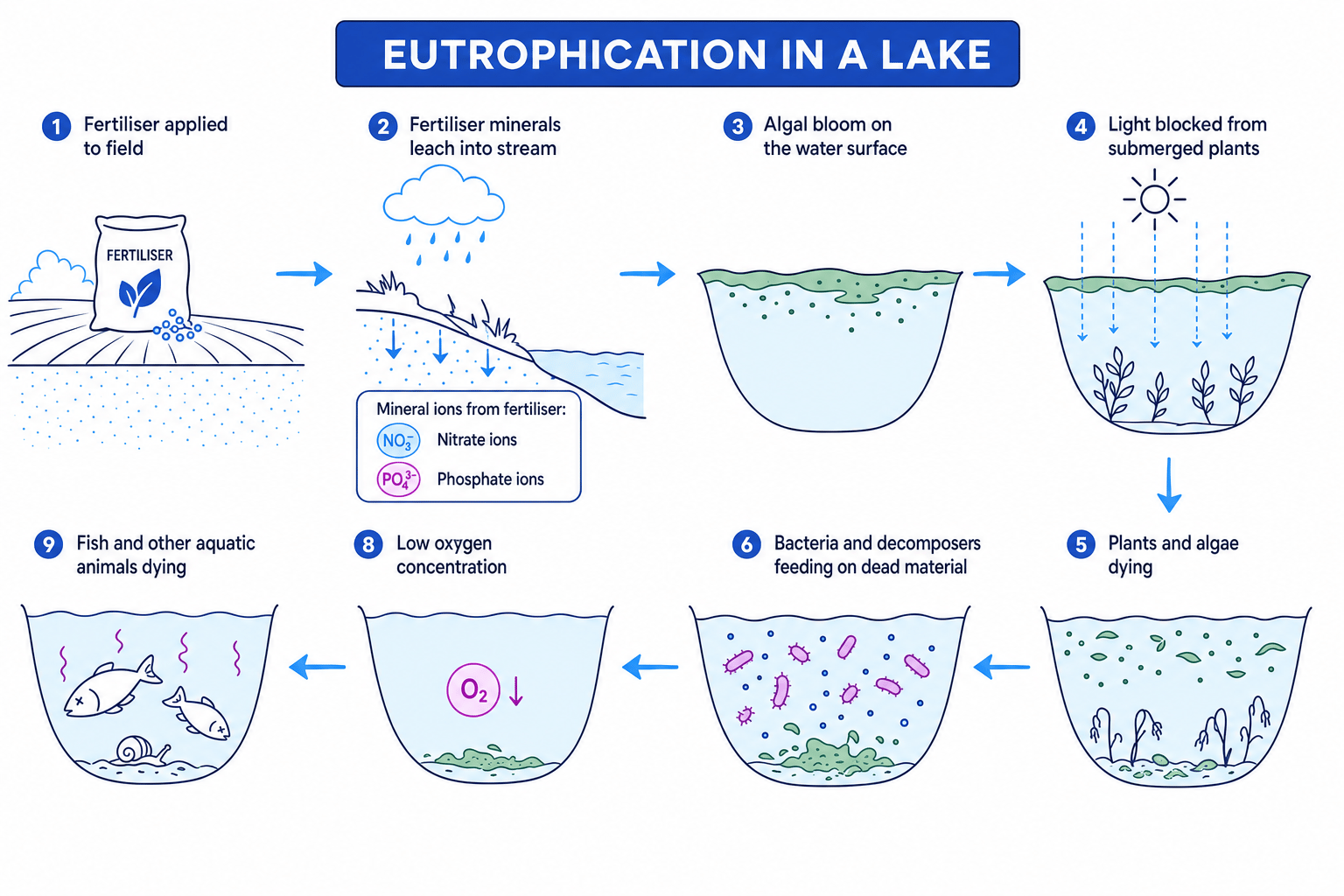
Eutrophication is the enrichment of water with mineral ions, especially nitrate ions and phosphate ions, causing excessive growth of algae and aquatic plants.
Farmers add fertilisers to soil to provide mineral ions for crop growth. Some of these ions can be leached, meaning dissolved in rainwater and washed out of the soil into streams, rivers and lakes.
This can lead to a sequence of events:
- Nitrate and phosphate ions enter a body of water.
- Algae grow rapidly, forming an algal bloom.
- The algal bloom blocks light from reaching submerged plants.
- Submerged plants die because they cannot photosynthesise enough.
- Dead plants and algae are broken down by decomposers.
- Decomposers respire aerobically, using dissolved oxygen.
- Oxygen concentration falls.
- Fish and other aquatic animals die.
Distinguishing sewage pollution from eutrophication
- If the pollution source is untreated waste rich in organic matter, the main issue is sewage: decomposers feed directly on the waste.
- If the pollution source is fertiliser minerals such as nitrate and phosphate ions, the main issue is eutrophication: algae grow rapidly first.
- In both cases, decomposers eventually respire aerobically and use dissolved oxygen.
- The shared final consequence is low oxygen concentration, which can kill fish and other aerobic aquatic organisms.
Why oxygen falls in eutrophication
Do not just write “algae use up all the oxygen”. The key oxygen loss happens when decomposers break down dead plants and algae and respire aerobically.
Deforestation
This part is Paper 2 only, but it links strongly to carbon cycles and ecosystems.
Deforestation
Deforestation is the large-scale removal of trees from forests, often for farming, timber, roads or settlements.
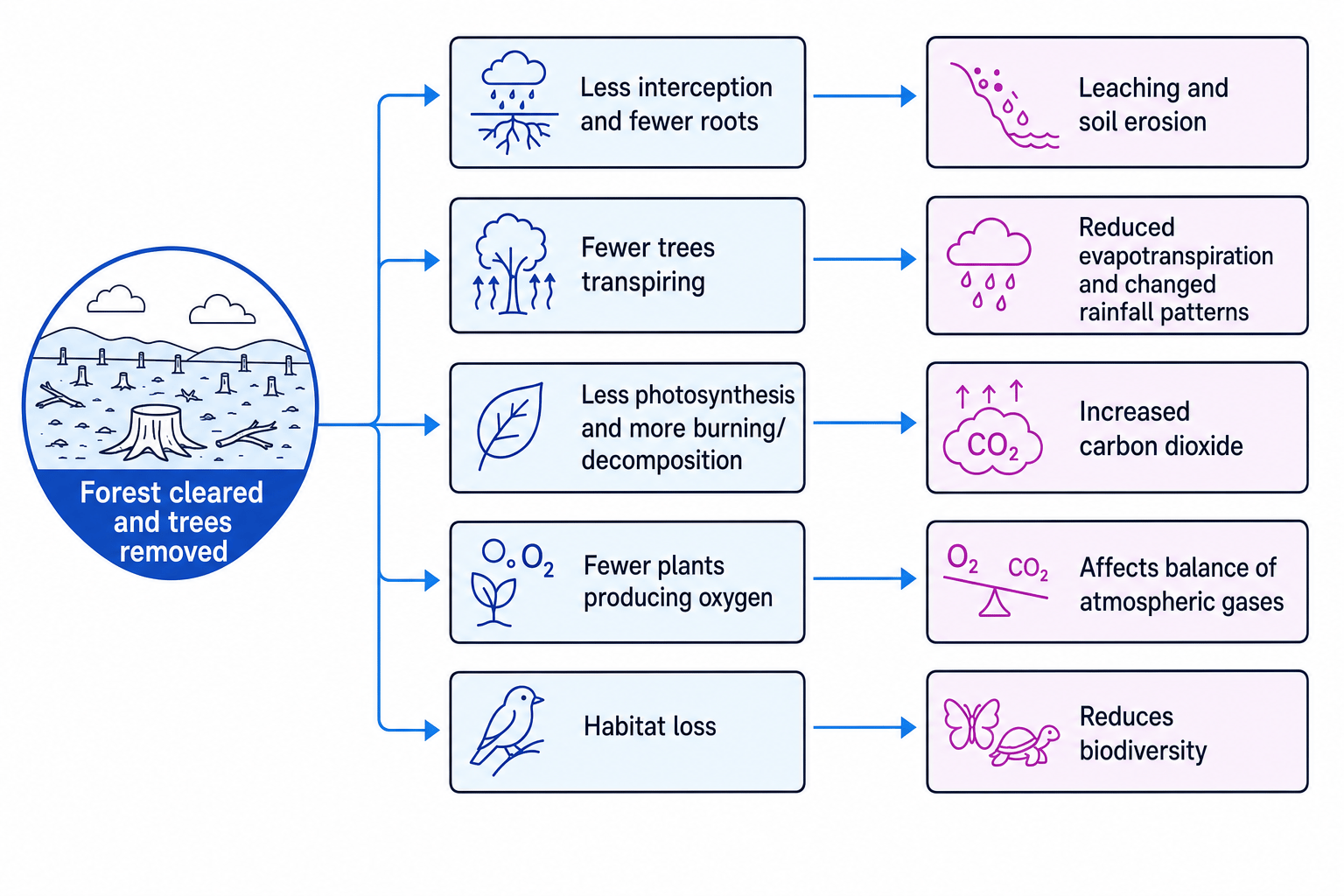
Deforestation has several linked effects.
Leaching and soil erosion
Tree canopies intercept rainfall, and roots help hold soil together. When trees are removed:
- more rain hits the soil directly
- soluble mineral ions are washed out by leaching
- topsoil is removed by water or wind, causing soil erosion
- soil becomes less fertile, making plant regrowth harder
Disturbance of evapotranspiration
Evapotranspiration is the movement of water vapour into the atmosphere by evaporation from surfaces and transpiration from plants.
Forests release large amounts of water vapour. Removing trees reduces transpiration, which can reduce cloud formation and rainfall in some regions. This can make the local climate drier.
Effects on the carbon cycle and atmospheric gases
Trees remove carbon dioxide from the air during photosynthesis and store carbon in biomass. When forests are cleared:
- less carbon dioxide is removed by photosynthesis
- burning trees releases carbon dioxide
- decomposition of dead wood releases carbon dioxide
- less oxygen is produced by photosynthesis
This affects the balance of atmospheric gases, especially by increasing carbon dioxide concentration and reducing oxygen production.
Linking deforestation to atmospheric carbon dioxide
- Removing trees decreases the total leaf area available for photosynthesis.
- With less photosynthesis, less carbon dioxide is removed from the atmosphere.
- If the trees are burned or left to decay, carbon stored in their biomass is released as carbon dioxide.
- Higher carbon dioxide concentration can strengthen the enhanced greenhouse effect.
Use cause-and-effect chains
For longer answers, write in linked stages using words like “therefore”, “so” and “because”. For example: “Trees are removed, so less photosynthesis occurs, therefore less carbon dioxide is removed from the air.”
In the exam
- For pollution questions, identify the pollutant first, then give the biological consequence.
- For greenhouse effect questions, mention infrared radiation and explain that more is absorbed and re-radiated by greenhouse gases.
- For eutrophication, keep the sequence in order: fertiliser minerals → algal bloom → plants die → decomposers respire → oxygen falls → fish die.
- For deforestation, link each effect to a process: roots for soil, transpiration for rainfall, photosynthesis for carbon dioxide and oxygen.
Check yourself
- How does carbon monoxide reduce the amount of oxygen delivered to body cells?
- Why can fertiliser runoff eventually cause fish to die?
- Give two ways deforestation can increase atmospheric carbon dioxide concentration.
