

What you'll learn
- Why ecosystems recycle materials instead of “using them up”.
- The stages of the carbon cycle: photosynthesis, respiration, decomposition and combustion.
- The stages of the nitrogen cycle (Paper 2 only): nitrogen fixing, decomposition, nitrification and denitrification.
- How to describe cycle answers clearly using arrows, substances and processes.
Why ecosystems need cycles
An ecosystem is all the living organisms in an area, together with the non-living conditions around them, such as soil, water, air and temperature.
Living things need elements such as carbon and nitrogen to make biological molecules. Carbon is found in carbohydrates, fats and proteins. Nitrogen is needed to make amino acids and proteins.
Unlike energy, which flows through ecosystems and is eventually lost as heat, atoms are recycled. The same carbon and nitrogen atoms can move through air, soil, plants, animals and microorganisms again and again.
Nutrient cycle
A nutrient cycle is the movement and recycling of elements, such as carbon or nitrogen, between living organisms and the non-living environment.
Materials cycle, energy flows
Ecosystems need a continuous supply of materials. Decomposers are especially important because they return useful substances from dead organisms and waste back into the environment.
Predicting effects of fewer decomposers
- If decomposers decrease, dead organisms and waste break down more slowly, so carbon and nitrogen stay trapped in dead organic material.
- Fewer mineral ions, including nitrogen-containing ions, are returned to the soil, so plants absorb fewer nutrients through their roots.
- Plant growth falls because plants make fewer proteins, so there is less biomass available for animals higher in the food chain.
The carbon cycle
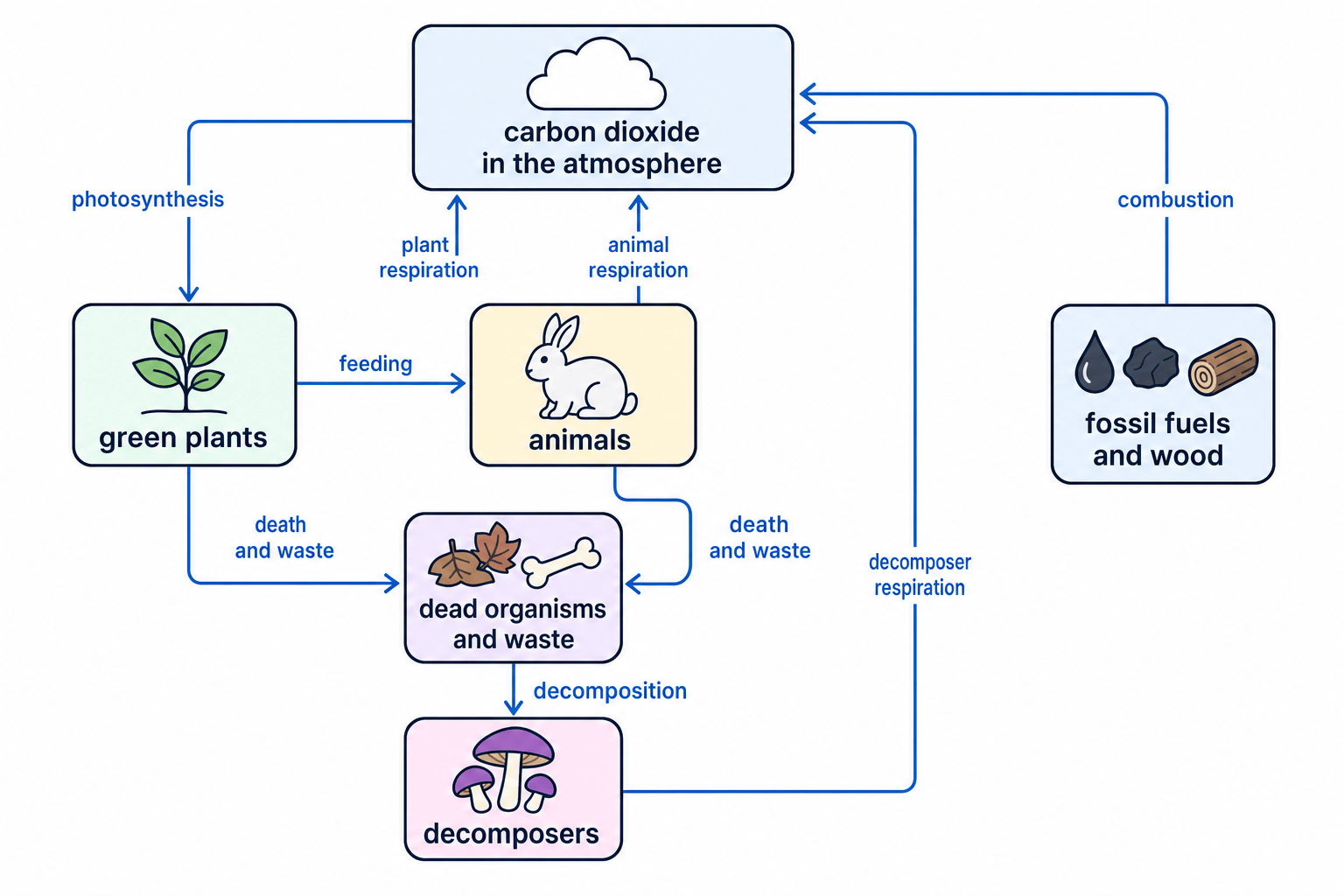
The carbon cycle describes how carbon moves between the atmosphere, living organisms, dead material and fuels.
Carbon dioxide in the atmosphere is an important store of carbon. Plants remove carbon dioxide from the air during photosynthesis, and carbon is returned to the air by respiration, decomposition and combustion.
Photosynthesis removes carbon dioxide
Photosynthesis is the process by which green plants use light energy to convert carbon dioxide and water into glucose and oxygen.
The carbon from carbon dioxide becomes part of glucose. Plants can then use glucose to make other carbon-containing molecules, such as starch, cellulose, fats and proteins. This builds plant biomass, which is the mass of living plant material.
So, in the carbon cycle, photosynthesis moves carbon:
from carbon dioxide in the atmosphere → into carbon compounds in plants
Feeding moves carbon through food chains
When animals eat plants, carbon compounds are transferred from plant biomass into animal biomass.
For example, a cow eating grass takes in carbon-containing molecules. Some are used in respiration, while others become part of the cow’s body tissues.
Respiration returns carbon dioxide
Respiration is the chemical process in cells that releases energy from glucose. In aerobic respiration, glucose reacts with oxygen, producing carbon dioxide and water.
Plants, animals and decomposers all respire. This means carbon dioxide is returned to the atmosphere by:
- plant respiration
- animal respiration
- respiration by decomposers such as bacteria and fungi
Plants respire too
Do not say that only animals respire. Plants photosynthesise in the light, but they respire all the time because their cells need energy.
Decomposition returns carbon from dead material
Decomposition is the breakdown of dead organisms and waste materials, such as faeces and fallen leaves.
Decomposers include bacteria and fungi. They break down dead organic matter using saprotrophic nutrition, where they release enzymes onto dead material, digest it outside their bodies, then absorb the soluble products.
As decomposers feed and respire, carbon from dead material is released back into the atmosphere as carbon dioxide.
Saprotrophic nutrition
Saprotrophic nutrition is feeding by digesting dead or waste organic material outside the organism, then absorbing the soluble products.
Combustion releases carbon dioxide
Combustion means burning. When wood or fossil fuels burn, carbon in the fuel reacts with oxygen and forms carbon dioxide.
Wood contains carbon because trees took in carbon dioxide by photosynthesis. Fossil fuels, such as coal, oil and gas, contain carbon from ancient dead organisms that were buried and changed over millions of years.
Combustion therefore moves carbon:
from fuels → into carbon dioxide in the atmosphere
Carbon is not only carbon dioxide
Carbon dioxide is one form of carbon, but carbon is also found in glucose, starch, fats, proteins, dead organisms, wood and fossil fuels.
Tracing carbon from an animal to the atmosphere
- A rabbit gets carbon compounds by feeding on plants, so some carbon from plant biomass becomes part of the rabbit’s body.
- Some of the rabbit’s glucose is broken down during respiration, releasing carbon dioxide into the atmosphere.
- If the rabbit dies, decomposers break down its body and respire, releasing more carbon dioxide into the atmosphere.
The nitrogen cycle
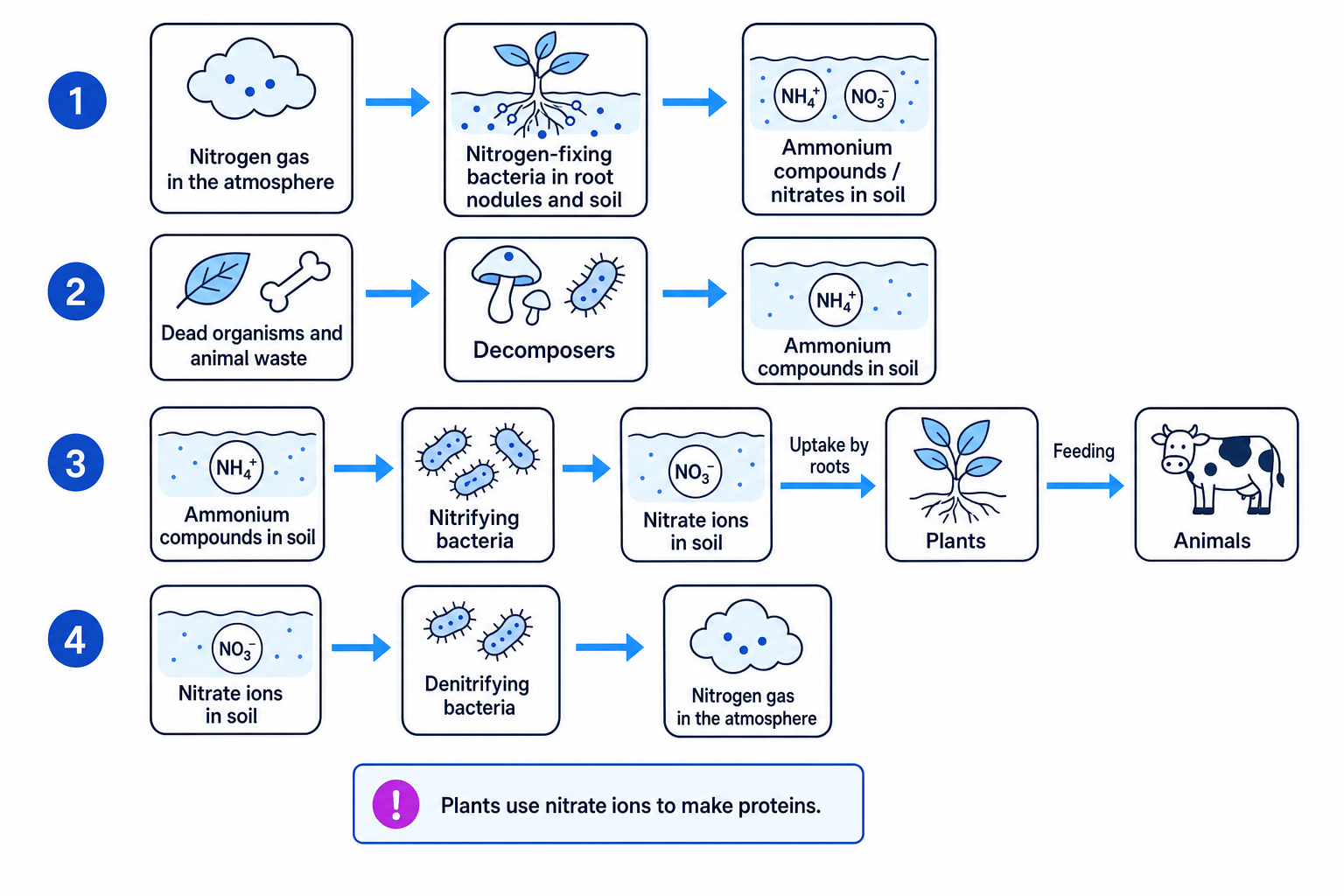
The nitrogen cycle describes how nitrogen moves between the atmosphere, soil and living organisms.
This part of the specification is marked 4.11B, so it is assessed on Paper 2 only, but you should still learn it properly.
Nitrogen gas makes up most of the air, but most plants cannot use nitrogen gas directly. Plants mainly absorb nitrogen as nitrate ions from the soil. They use nitrate ions to make amino acids, which are then used to make proteins.
Nitrogen fixing bacteria
Nitrogen fixing bacteria convert nitrogen gas from the atmosphere into nitrogen-containing compounds in the soil, such as ammonium compounds or nitrates.
Some nitrogen fixing bacteria live freely in the soil. Others live in root nodules of leguminous plants, such as peas, beans and clover.
Nitrogen fixation
Nitrogen fixation is the conversion of nitrogen gas from the atmosphere into nitrogen-containing compounds that plants can eventually use.
No bacterial names needed
For Edexcel IGCSE Biology, you need to know the roles of the bacteria in the nitrogen cycle, but not the specific species names.
Plants absorb nitrates and make proteins
Plants absorb nitrate ions from the soil through their roots. They use these nitrate ions to make amino acids and then proteins.
Animals cannot absorb nitrate ions from soil. They get nitrogen by feeding on plants or on other animals. The proteins in food are digested into amino acids, which are then used to build animal proteins.
Decomposers release ammonium compounds
When plants and animals die, or when animals produce waste, their proteins still contain nitrogen.
Decomposers, such as bacteria and fungi, break down dead organisms and waste. This releases ammonium compounds into the soil.
This stage is important because it recycles nitrogen from dead biological material back into soil compounds.
Nitrifying bacteria make nitrates
Nitrifying bacteria convert ammonium compounds in the soil into nitrites and then nitrates. You do not usually need to name nitrites in detail; the key point is that nitrifying bacteria increase the amount of nitrate ions in the soil.
Nitrate ions are useful because plants can absorb them through their roots.
Denitrifying bacteria return nitrogen gas
Denitrifying bacteria convert nitrate ions in the soil back into nitrogen gas, which returns to the atmosphere.
This reduces the amount of nitrate available to plants, so it can reduce soil fertility. Denitrifying bacteria are more active in conditions with little oxygen, such as waterlogged soil.
Nitrifying vs denitrifying
Nitrifying bacteria make nitrates in the soil. Denitrifying bacteria remove nitrates from the soil and return nitrogen gas to the atmosphere.
The nitrogen cycle in one sentence
Bacteria make atmospheric nitrogen usable, plants turn nitrates into proteins, animals get nitrogen by feeding, decomposers recycle nitrogen from waste and dead organisms, and denitrifying bacteria return nitrogen gas to the air.
Predicting effects of reduced nitrifying bacteria
- Nitrifying bacteria normally convert ammonium compounds into nitrate ions, so fewer nitrifying bacteria means fewer nitrates are produced.
- Plants absorb fewer nitrate ions through their roots, so they make fewer amino acids and proteins.
- Plant growth decreases, reducing plant biomass and potentially reducing food available for animals.
Comparing the two cycles
| Feature | Carbon cycle | Nitrogen cycle |
|---|---|---|
| Main atmospheric form | Carbon dioxide | Nitrogen gas |
| How plants take it in | Carbon dioxide through leaves during photosynthesis | Nitrate ions through roots |
| Role of decomposers | Break down dead material and respire, releasing carbon dioxide | Break down proteins and waste, releasing ammonium compounds |
| Process returning gas to atmosphere | Respiration, decomposition and combustion | Denitrification |
| Key microorganisms | Decomposers | Nitrogen fixing, decomposing, nitrifying and denitrifying bacteria |
Writing cycle answers clearly
Use the pattern: substance → process → organism or place. For example: “Nitrifying bacteria convert ammonium compounds in the soil into nitrate ions, which plants absorb through their roots.”
In the exam
- For the carbon cycle, use precise verbs: photosynthesis removes carbon dioxide; respiration, decomposition and combustion release carbon dioxide.
- For the nitrogen cycle, state the bacterial role and direction: nitrogen fixing makes useful soil compounds, nitrifying makes nitrates, and denitrifying returns nitrogen gas.
- If the question says “explain”, link the cycle to consequences such as plant protein production, plant growth, soil fertility or atmospheric carbon dioxide.
Check yourself
- Which process removes carbon dioxide from the atmosphere in the carbon cycle?
- Why can most plants not use nitrogen gas directly, and what form of nitrogen do they absorb?
- What would happen to soil nitrate concentration if denitrifying bacteria became very active?
