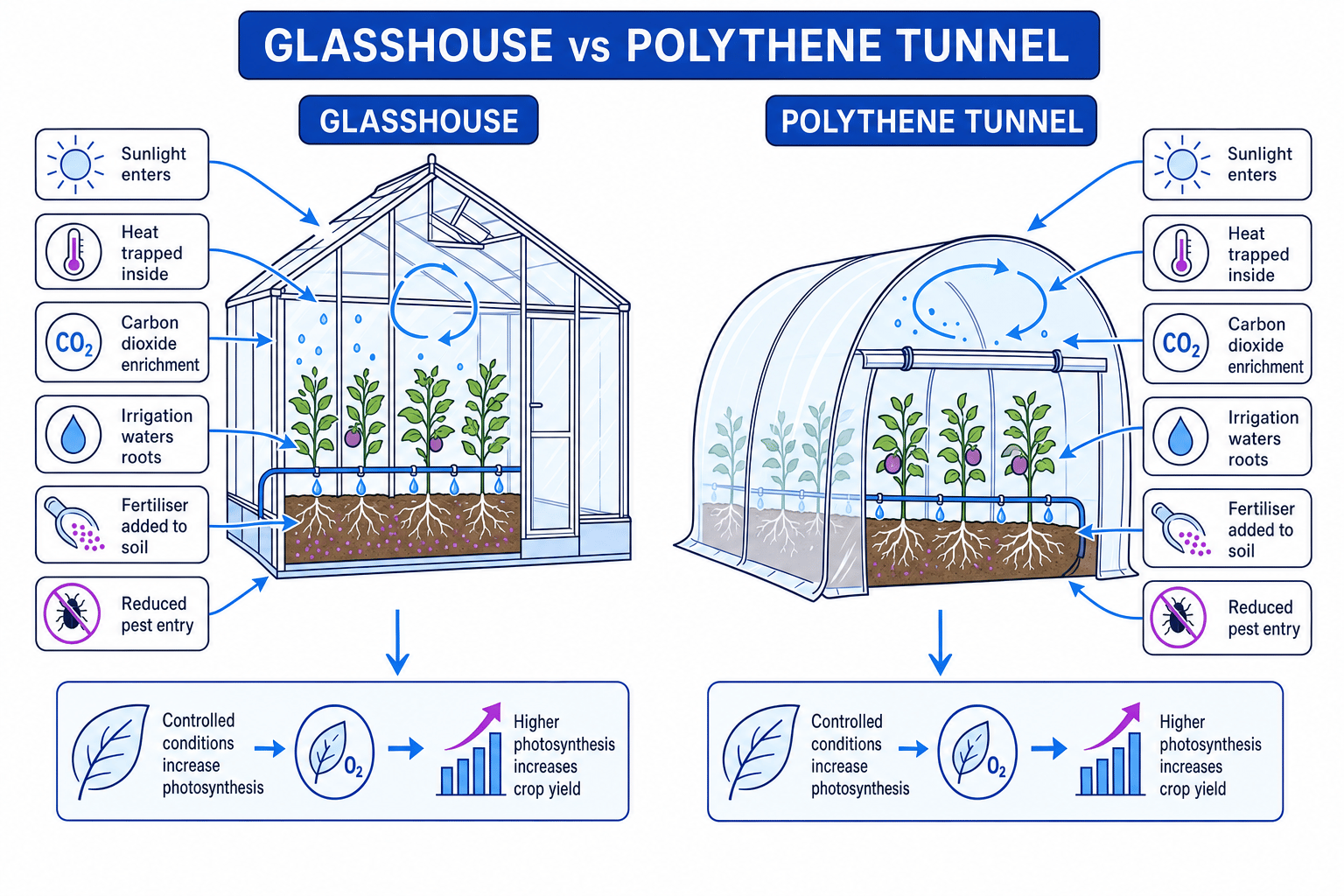
What you'll learn
- How glasshouses and polythene tunnels increase crop yield.
- Why fertilisers and pest control can improve food production.
- How yeast and bacteria are used to make foods such as bread and yoghurt.
- How industrial fermenters and fish farms are managed to produce food safely and efficiently.
The big idea: increasing yield
Food production is about using biological knowledge to produce more food of good quality, while reducing waste, disease and unwanted competition.
Yield
Yield is the amount of useful product obtained, such as the mass of crop harvested from a field, or the number of fish produced in a farm.
For crop plants, yield depends strongly on photosynthesis, because photosynthesis makes glucose that can be used for growth. If plants grow faster and lose less material to pests or disease, the final yield is usually higher.
Crop plants: glasshouses and polythene tunnels
A glasshouse is a structure with transparent glass walls and roof used to grow crops in controlled conditions. A polythene tunnel is a similar covered structure made from transparent plastic sheeting.
Both are used for crops such as tomatoes, cucumbers, peppers and strawberries.
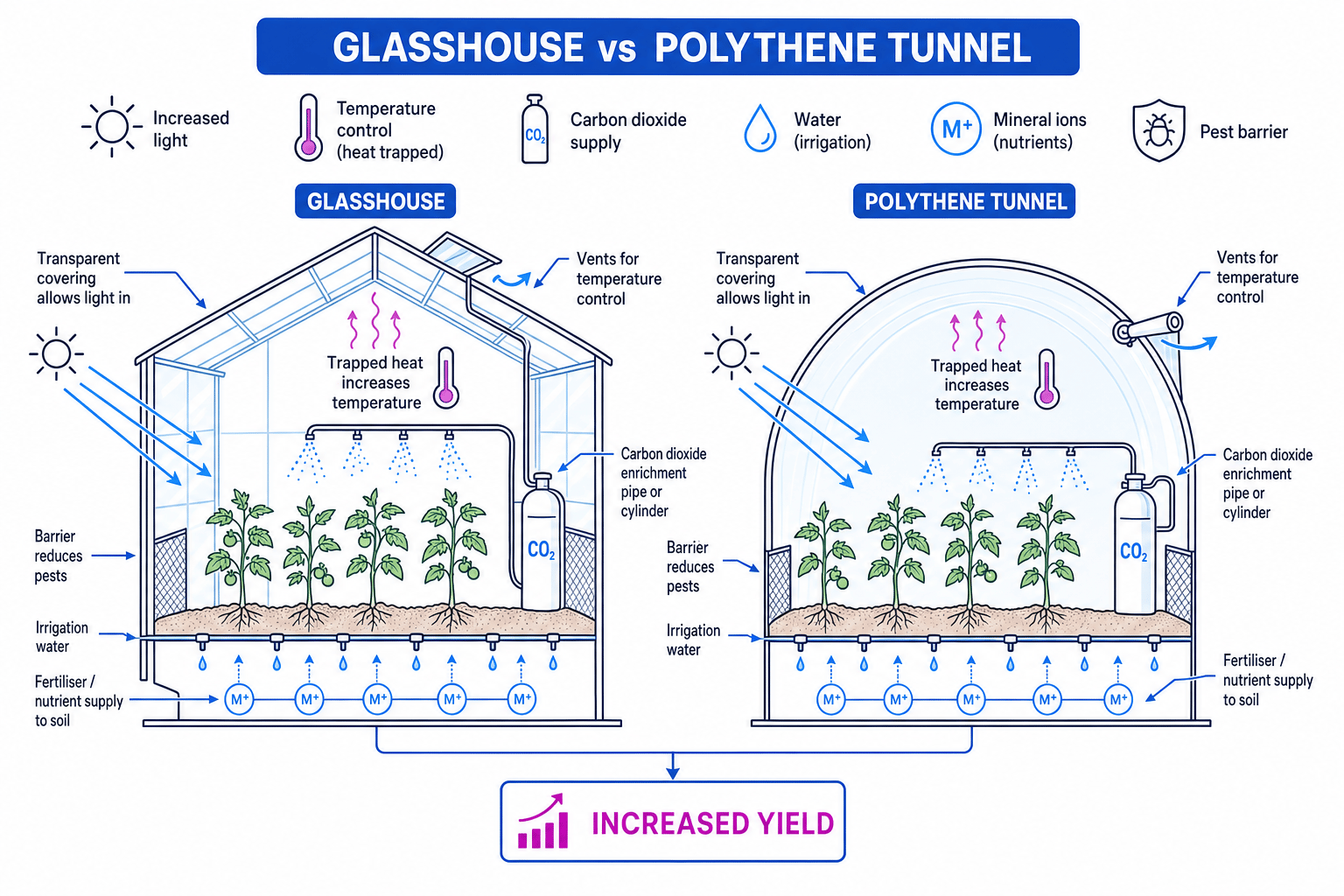
How they increase yield
Glasshouses and polythene tunnels increase yield by helping farmers control conditions around the plants.
They can:
- allow plenty of light through for photosynthesis
- trap heat, increasing the temperature
- protect plants from wind, frost and heavy rain
- reduce entry of pests
- allow controlled watering by irrigation
- allow fertilisers to be added more precisely
- allow carbon dioxide to be added to increase photosynthesis
Controlled conditions
Glasshouses and polythene tunnels increase crop yield because they let farmers control the main factors affecting plant growth: light, temperature, carbon dioxide, water, mineral ions and pest damage.
Carbon dioxide and temperature in glasshouses
Plants use carbon dioxide during photosynthesis. If carbon dioxide concentration is low, photosynthesis may be slower, so less glucose is made and growth is reduced.
Increasing carbon dioxide in a glasshouse can increase crop yield, but only up to a point. Once another factor, such as light or temperature, becomes limiting, adding more carbon dioxide will not increase yield further.
Limiting factor
A limiting factor is the factor in shortest supply that prevents a process, such as photosynthesis, from happening faster.
Temperature also affects yield because photosynthesis is controlled by enzymes. As temperature rises, enzyme-controlled reactions usually happen faster, increasing photosynthesis and growth. However, if the temperature becomes too high, enzymes may stop working properly, plants may lose too much water, and yield can fall.
Identifying the limiting factor
A tomato grower increases carbon dioxide in a glasshouse, but the crop yield does not increase. The glasshouse is cold and light levels are good.
- Since carbon dioxide was increased but yield did not rise, carbon dioxide is unlikely to be the current limiting factor.
- Light levels are good, so light is also unlikely to be limiting.
- The glasshouse is cold, so temperature is the most likely limiting factor because enzyme-controlled photosynthesis will be slow.
- Heating the glasshouse carefully could increase yield, as long as the temperature does not become too high.
More is not always better
Do not write that increasing temperature always increases yield. Above the optimum temperature, enzymes may be affected and plants can lose water faster, reducing growth.
Fertilisers and crop yield
Plants need mineral ions from the soil. These are dissolved substances absorbed by roots and used to make important cell materials.
Fertiliser
A fertiliser is a substance added to soil to replace mineral ions and improve plant growth.
Important mineral ions include:
- nitrate ions, needed to make amino acids and proteins for growth
- magnesium ions, needed to make chlorophyll for photosynthesis
- phosphate ions, needed for cell membranes, DNA and growth
- potassium ions, needed for healthy enzyme activity and general plant function
Fertilisers increase yield because they replace mineral ions removed when crops are harvested. With enough mineral ions, plants can make more proteins, chlorophyll and new cells, so they grow faster and produce a larger crop.
Link fertiliser to growth
In exam answers, do not just say “fertiliser makes plants grow”. Explain that fertilisers provide mineral ions, which plants use to make substances needed for growth.
Pest control in crops
A pest is an organism that damages crops or reduces their yield. Pests may eat leaves, roots, fruits or seeds. They may also spread disease or compete with crops for resources.
Farmers use pest control because pests can:
- reduce photosynthesis by damaging leaves
- reduce the mass or quality of the harvested crop
- spread plant diseases
- make food unsuitable for sale
- reduce profit for the farmer
Pesticides
A pesticide is a chemical used to kill pests. For example, an insecticide kills insects.
Advantages of pesticides:
- act quickly
- can be sprayed over large areas
- often very effective at reducing pest numbers
- can be cheaper and easier than other methods in the short term
Disadvantages of pesticides:
- may kill useful organisms, such as pollinators or natural predators
- may leave chemical residues on food or in the environment
- pests may evolve resistance, so the pesticide becomes less effective
- may need repeated applications
Biological control
Biological control uses another organism to control a pest. This may be a predator, parasite or pathogen of the pest.
For example, ladybirds can be used to reduce aphid numbers because ladybirds eat aphids.
Advantages of biological control:
- more specific to the pest
- no chemical residues on food
- may give long-term control if the control organism survives
Disadvantages of biological control:
- slower than pesticides
- may not remove all pests
- the introduced organism may affect other species
- it can be harder to control once released
Choosing a pest control method
A farmer growing salad leaves in a glasshouse finds aphids on the crop. The leaves will be sold fresh and eaten raw.
- A pesticide could reduce aphid numbers quickly, but there is a risk of chemical residues on leaves that are eaten raw.
- Biological control, such as introducing ladybirds, is slower but avoids pesticide residues.
- Because the crop is in a glasshouse, the introduced predators are easier to keep near the pest population.
- Biological control may be a suitable choice, especially if the infestation is not severe and the farmer wants to reduce chemical use.
Microorganisms in food production
A microorganism is a very small living organism, such as a bacterium or yeast. Some microorganisms are useful in food production because they respire, grow and produce substances that change the food.
Yeast and bread
Yeast is a single-celled fungus. In bread-making, yeast respires anaerobically when oxygen is limited.
Anaerobic respiration
Anaerobic respiration is the release of energy from glucose without using oxygen.
In yeast, anaerobic respiration produces ethanol and carbon dioxide. In bread dough, the carbon dioxide forms bubbles, making the dough rise. During baking, the ethanol evaporates and the yeast cells are killed by the heat.
Yeast in bread
Yeast makes bread rise because it produces carbon dioxide during anaerobic respiration.
Practical: investigating anaerobic respiration by yeast
You need to know how to investigate the role of anaerobic respiration by yeast in different conditions.
A common method is:
- Add yeast suspension and glucose solution to a boiling tube or conical flask.
- Place a layer of oil on top, or use a bung and delivery tube, to reduce oxygen entry.
- Keep the mixture in a water bath at a chosen temperature.
- Measure carbon dioxide production using a gas syringe, an inverted measuring cylinder, or by counting bubbles for a fixed time.
- Repeat at different temperatures, sugar concentrations or pH values.
- Compare the rate of carbon dioxide production.
The independent variable is the condition you change, such as temperature or glucose concentration.
The dependent variable is what you measure, usually the volume of carbon dioxide produced or the rate of bubble production.
Important control variables include the volume of yeast, concentration of yeast, volume of glucose solution, pH, time allowed and total volume of mixture.
Expected results:
- With glucose present, yeast produces carbon dioxide.
- Without glucose, little or no carbon dioxide is produced.
- Increasing temperature usually increases the rate up to an optimum.
- Very high temperatures reduce or stop respiration because yeast enzymes are damaged and yeast may die.
- Boiled yeast should not produce carbon dioxide because the cells are dead.
Calculating rate of carbon dioxide production
A yeast mixture produces 24 cm³ of carbon dioxide in 6 minutes. Calculate the rate.
- Use the rate formula: rate=volume of gas producedtime taken\text{rate} = \frac{\text{volume of gas produced}}{\text{time taken}}rate=time takenvolume of gas produced.
- Substitute the values: rate=246\text{rate} = \frac{24}{6}rate=624.
- Calculate the rate: rate=4\text{rate} = 4rate=4 cm³ per minute.
- So, the yeast produced carbon dioxide at a rate of 4 cm³/min.
Leaks in gas collection
If the bung is loose or tubing leaks, carbon dioxide escapes before it is measured, so the calculated respiration rate will be too low.
Bacteria and yoghurt
Yoghurt is made using bacteria from the genus Lactobacillus, such as Lactobacillus bulgaricus.
These bacteria ferment lactose, the sugar in milk, producing lactic acid. The lactic acid lowers the pH. This causes milk proteins to coagulate, making the milk thicken into yoghurt. The acidic conditions also help inhibit the growth of many harmful microorganisms.
A simple yoghurt-making process is:
- Heat milk to kill unwanted microorganisms.
- Cool it to a suitable incubation temperature.
- Add a starter culture containing Lactobacillus.
- Incubate so the bacteria ferment lactose to lactic acid.
- Cool the yoghurt to slow bacterial activity.
Industrial fermenters
An industrial fermenter is a large vessel used to grow microorganisms under controlled conditions. Fermenters are used to make foods, enzymes, antibiotics and other useful products.
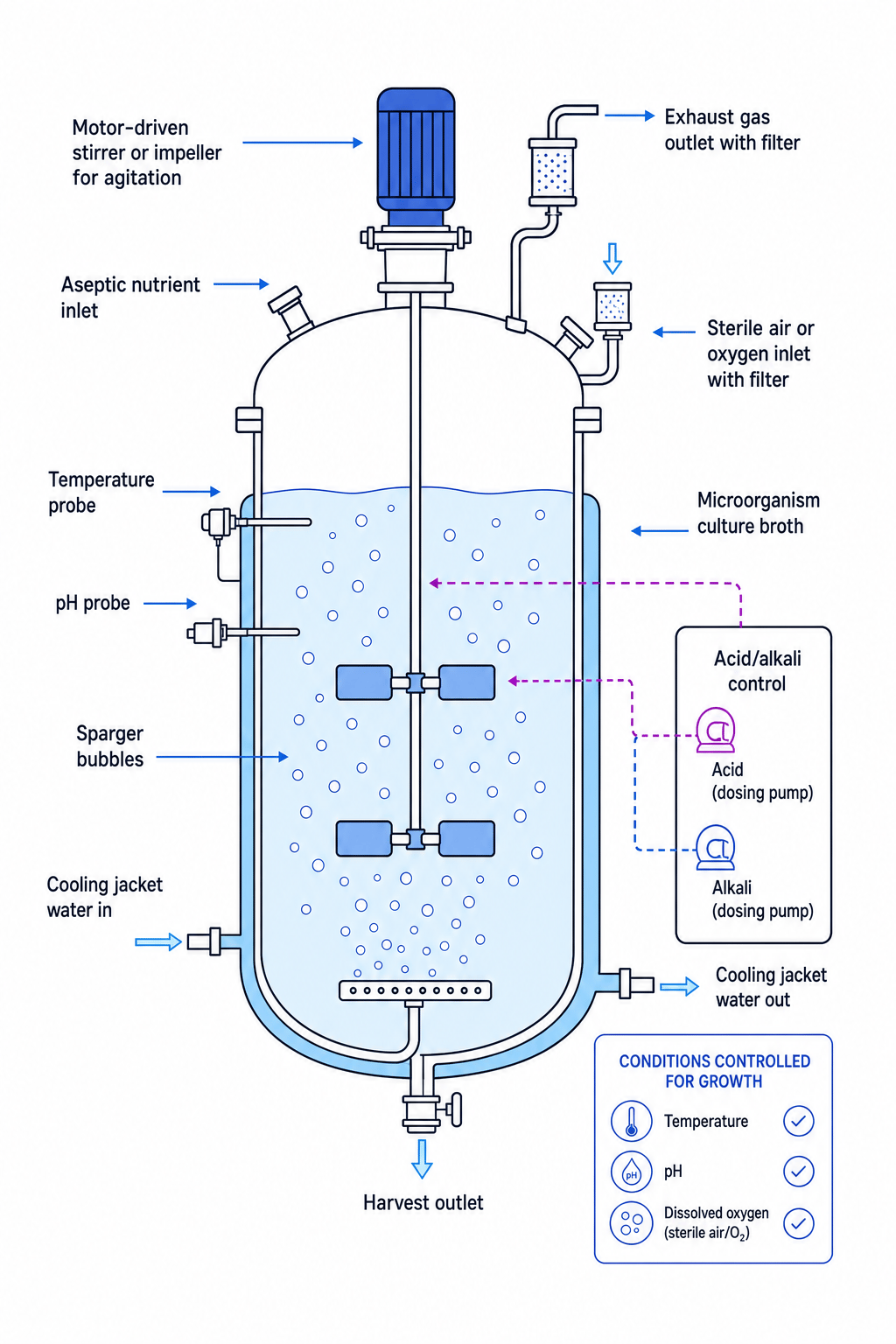
Why conditions must be controlled
Microorganisms grow best when conditions are suitable. In a fermenter, the conditions are controlled to maximise growth and product formation.
Key conditions include:
- Aseptic precautions: equipment and nutrients are sterilised to prevent contamination by unwanted microorganisms.
- Nutrients: microorganisms need a source of carbon, nitrogen, minerals and sometimes vitamins for growth.
- Optimum temperature: enzymes work fastest near their optimum temperature, but high temperatures may kill microorganisms.
- Optimum pH: enzymes are affected by pH, so pH is monitored and adjusted.
- Oxygenation: sterile air or oxygen is supplied when microorganisms need aerobic respiration for rapid growth.
- Agitation: stirrers mix the culture so oxygen, nutrients, temperature and pH are even throughout.
Oxygen depends on the process
Some processes need oxygen for aerobic growth, but yeast making ethanol needs anaerobic conditions. Always link oxygen supply to the microorganism and product in the question.
Fish farming (Paper 2 only)
Fish farming, also called aquaculture, is the rearing of fish in tanks, ponds or cages to provide food. Fish are a useful source of protein for human diets.
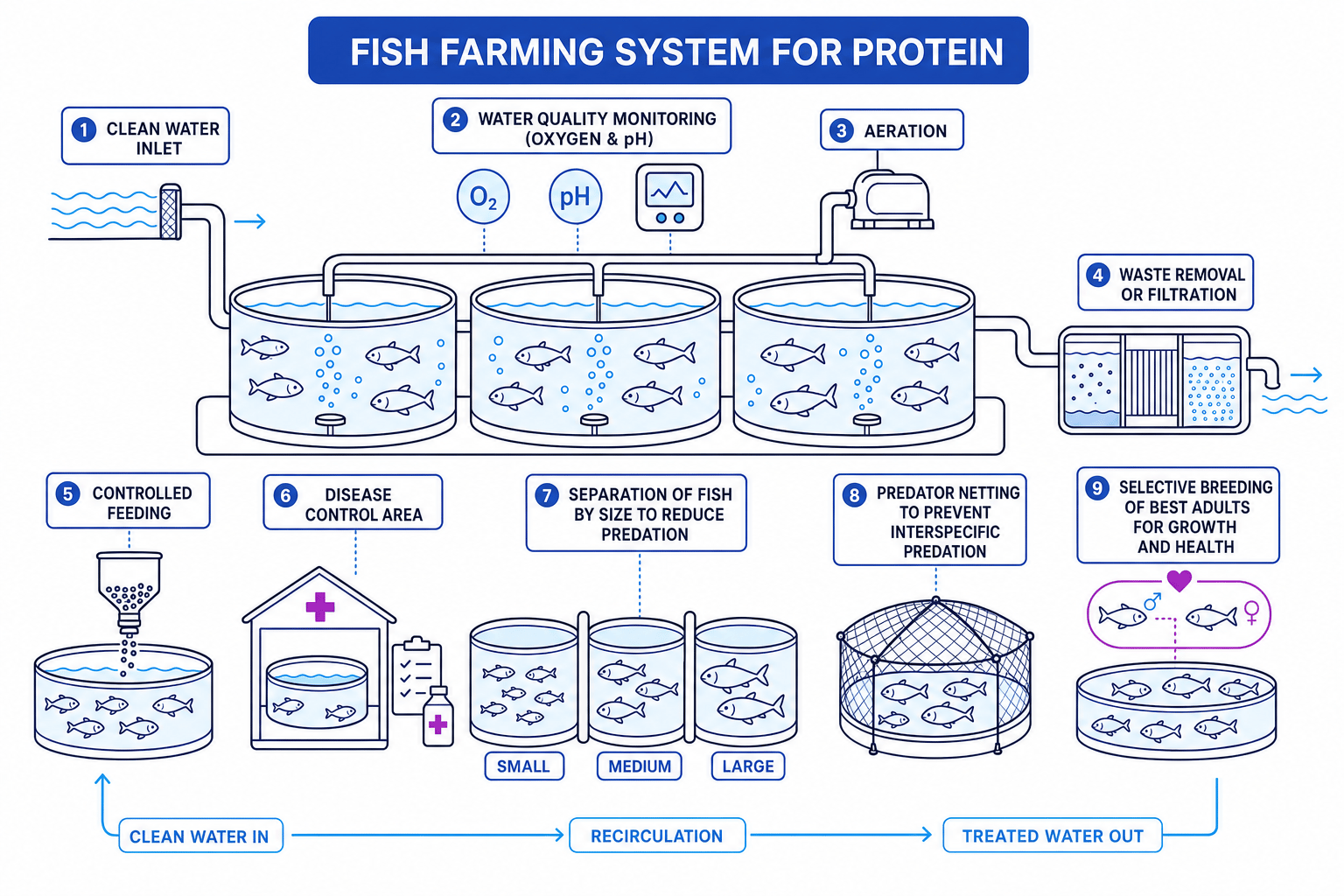
To farm large numbers of fish successfully, farmers must keep the fish healthy and growing quickly.
Maintaining water quality
Fish need clean water with enough dissolved oxygen. Farmers monitor oxygen concentration, pH, temperature and waste levels. Aeration and water flow help keep oxygen levels high.
Controlling predation
Intraspecific predation happens when members of the same species eat each other. In fish farms, larger fish may eat smaller fish. Farmers reduce this by separating fish by size and feeding them regularly.
Interspecific predation happens when one species eats another species. Farmers use nets, cages and secure tanks to stop birds or wild fish eating the farmed fish.
Controlling disease
Disease spreads quickly when many fish are kept close together. Farmers reduce disease by keeping tanks clean, removing dead or sick fish, using vaccines or medicines where appropriate, and avoiding overcrowding.
Removing waste products
Fish release waste, and uneaten food can decay. This can reduce oxygen levels and increase harmful substances such as ammonia. Filters and regular water replacement help keep conditions suitable.
Controlling feeding
Fish are given food of suitable quality and in the right amount. Protein-rich food supports growth. Feeding too little reduces growth, but feeding too much wastes money and pollutes the water.
Selective breeding
Selective breeding means choosing parents with desirable features and breeding from them. In fish farming, desirable features include fast growth, disease resistance, good muscle yield and efficient conversion of food into body mass.
Fish farming management
Successful fish farming is about controlling the environment, reducing losses from disease and predation, and using selective breeding to improve the fish stock over generations.
In the exam
- For crop yield questions, link the condition to photosynthesis or growth, not just “more food is produced”.
- For fermenter questions, explain why each condition is controlled: contamination, enzyme activity, respiration, mixing or nutrient supply.
- For pest control and fish farming, give both the method and the reason it increases yield or reduces loss.
Check yourself
- Why can adding more carbon dioxide fail to increase crop yield in a glasshouse?
- How does yeast make bread rise?
- Give two ways fish farmers reduce losses from disease or predation.