Skip to content
MathsGenie logo
Open app

Course home

  1. IGCSE
  2. Biology Edexcel
  3. Question bank

Cycles within ecosystems

EasyMediumHard
1234567891011121314151617181920212223242526
Question 10

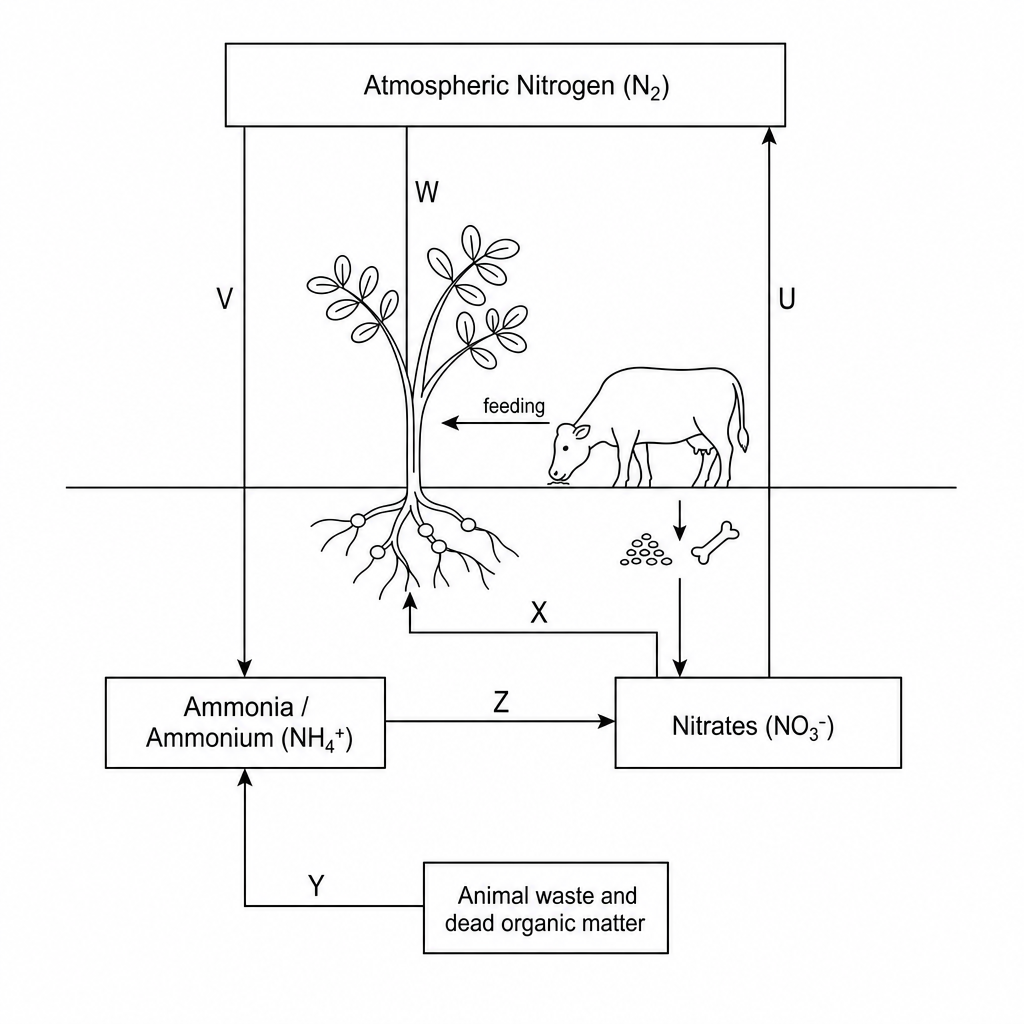
The diagram below shows a simplified representation of the nitrogen cycle in an agricultural field.


![A diagram of the nitrogen cycle showing several pools of nitrogen and pathways between them. At the top is a box labeled 'Atmospheric Nitrogen (N2)'. A box in the soil layer is labeled 'Ammonia / Ammonium (NH4+)'. A box to the right is labeled 'Nitrates (NO3-)'. A leguminous plant is shown with roots containing root nodules. The labeled pathways are:

  • Pathway U: From Nitrates (NO3-) back to Atmospheric Nitrogen (N2).
  • Pathway V: From Atmospheric Nitrogen (N2) to Ammonia / Ammonium (NH4+) in the soil.
  • Pathway W: From Atmospheric Nitrogen (N2) into the root nodules of the plant.
  • Pathway X: From Nitrates (NO3-) in the soil into the plant roots.
  • Pathway Y: From animal waste and dead organic matter into Ammonia / Ammonium (NH4+) in the soil.
  • Pathway Z: From Ammonia / Ammonium (NH4+) to Nitrates (NO3-) in the soil. An animal is also shown feeding on the plant, labeled with an arrow 'feeding'.](https://assets.mathsgenie.co.uk/aqa-qb/914e0f47-6497-4e7b-9b51-3bae036cd85d.png)
a.

Complete the table below by matching each biological process to the correct letter (UUU, VVV, WWW, XXX, YYY, or ZZZ) from the diagram.

ProcessLetter
Assimilation
Decomposition (Ammonification)
Denitrification
Nitrification
Nitrogen fixation (by mutualistic root bacteria)
[5]
b.

The absorption of nitrates by plant root hair cells occurs via active transport.

Describe the mechanism of active transport.

[2]
c.

Explain why waterlogged soil (which lacks oxygen) significantly reduces the rate of active transport in root hair cells.

[2]
d.

Crop rotation often involves planting leguminous crops, such as clover, which are then ploughed back into the soil. Explain how this practice increases soil fertility and subsequent crop yield without the addition of synthetic chemical fertilisers.

[5]

Cycles within ecosystems Questions

  1. IGCSE
  2. /Biology
  3. /Cycles within ecosystems