Question 6
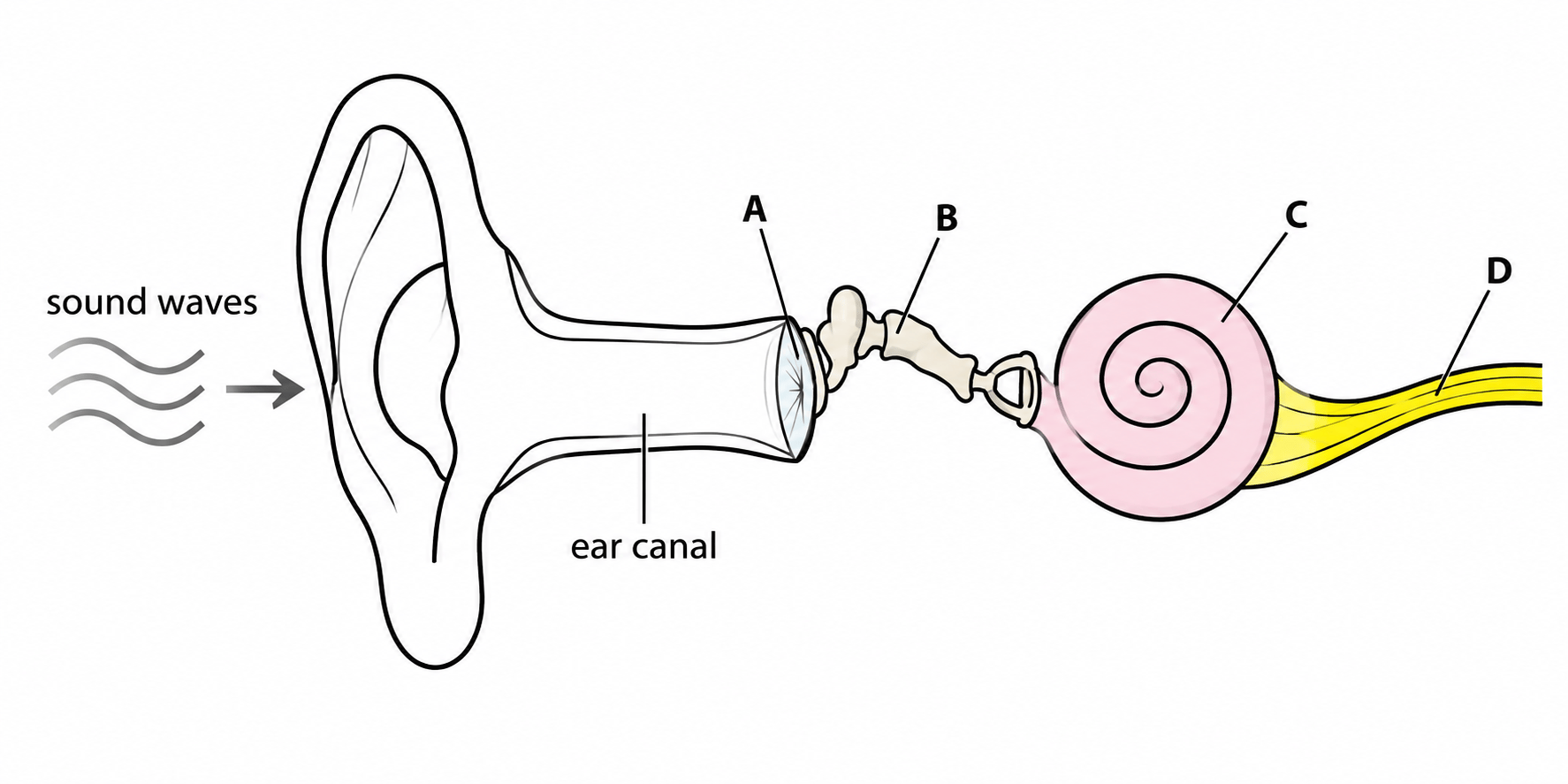
HThe Figure shows a simplified diagram of the human ear.
Figure
a.[3]
Name the parts labelled A, B and C.
b.[4]
Explain how the ear converts a sound wave in air into vibrations in solids and then detects them.
c.[2]
Some people have a condition in which the parts labelled B become stiff and cannot move easily.
Suggest how this affects their hearing. Explain your answer.
5.1 Wave behaviour Questions
52 exam-style questions on OCR GCSE Physics 5.1 Wave behaviour, covering 5.1.1 Describing wave motion, 5.1.2 Wavelength and frequency, 5.1.3 Wave speed, frequency and wavelength, 5.1.4 Wave speed problems, 5.1.5 Transverse and longitudinal waves, 5.1.6 Sound waves crossing between media, 5.1.7 Reflection, transmission and absorption at interfaces, 5.1.8 Sound waves and vibrations in solids, 5.1.9 Frequency range and human hearing, 5.1.10 Modelling waves with water ripples and sound, and 5.1.11 Evidence that the wave travels, not the medium. Each one has a worked solution and a mark scheme showing where the marks go.