A student investigates the electromagnetic principles behind a dynamic (moving-coil) microphone and a moving-coil loudspeaker. Both devices share a common design containing a light coil of wire suspended in a radial magnetic field, as shown in the diagram below.
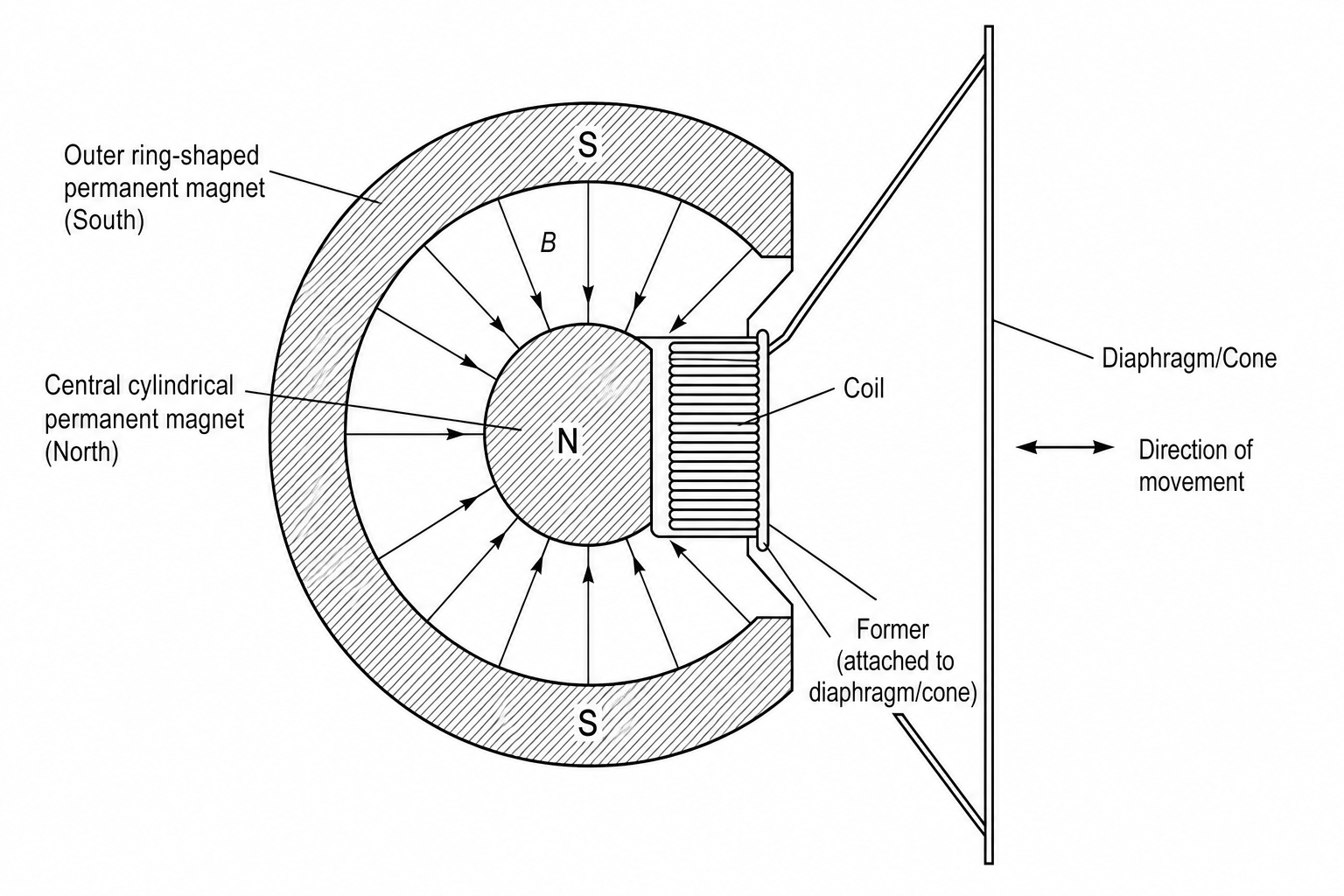
Which of the following correctly identifies the primary physical operating principle and the relationship between the mechanical and electrical variables for each device?
Microphone: Motor effect, where the induced electromotive force is proportional to the velocity of the coil (E∝v\mathcal{E} \propto vE∝v).
Loudspeaker: Electromagnetic induction, where the driving force on the cone is proportional to the current in the coil (F∝IF \propto IF∝I).
Microphone: Electromagnetic induction, where the induced electromotive force is proportional to the displacement of the coil (E∝x\mathcal{E} \propto xE∝x).
Loudspeaker: Motor effect, where the driving force on the cone is proportional to the square of the current in the coil (F∝I2F \propto I^2F∝I2).
Microphone: Electromagnetic induction, where the induced electromotive force is proportional to the velocity of the coil (E∝v\mathcal{E} \propto vE∝v).
Loudspeaker: Motor effect, where the driving force on the cone is proportional to the current in the coil (F∝IF \propto IF∝I).
Microphone: Electromagnetic induction, where the induced electromotive force is proportional to the rate of change of current in the coil (E∝dIdt\mathcal{E} \propto \frac{dI}{dt}E∝dtdI).
Loudspeaker: Motor effect, where the driving force on the cone is proportional to the displacement of the coil (F∝xF \propto xF∝x).