An engineering student is testing custom-built transformers for a renewable energy microgrid simulator. The schematic diagram of the experimental setup is shown below:
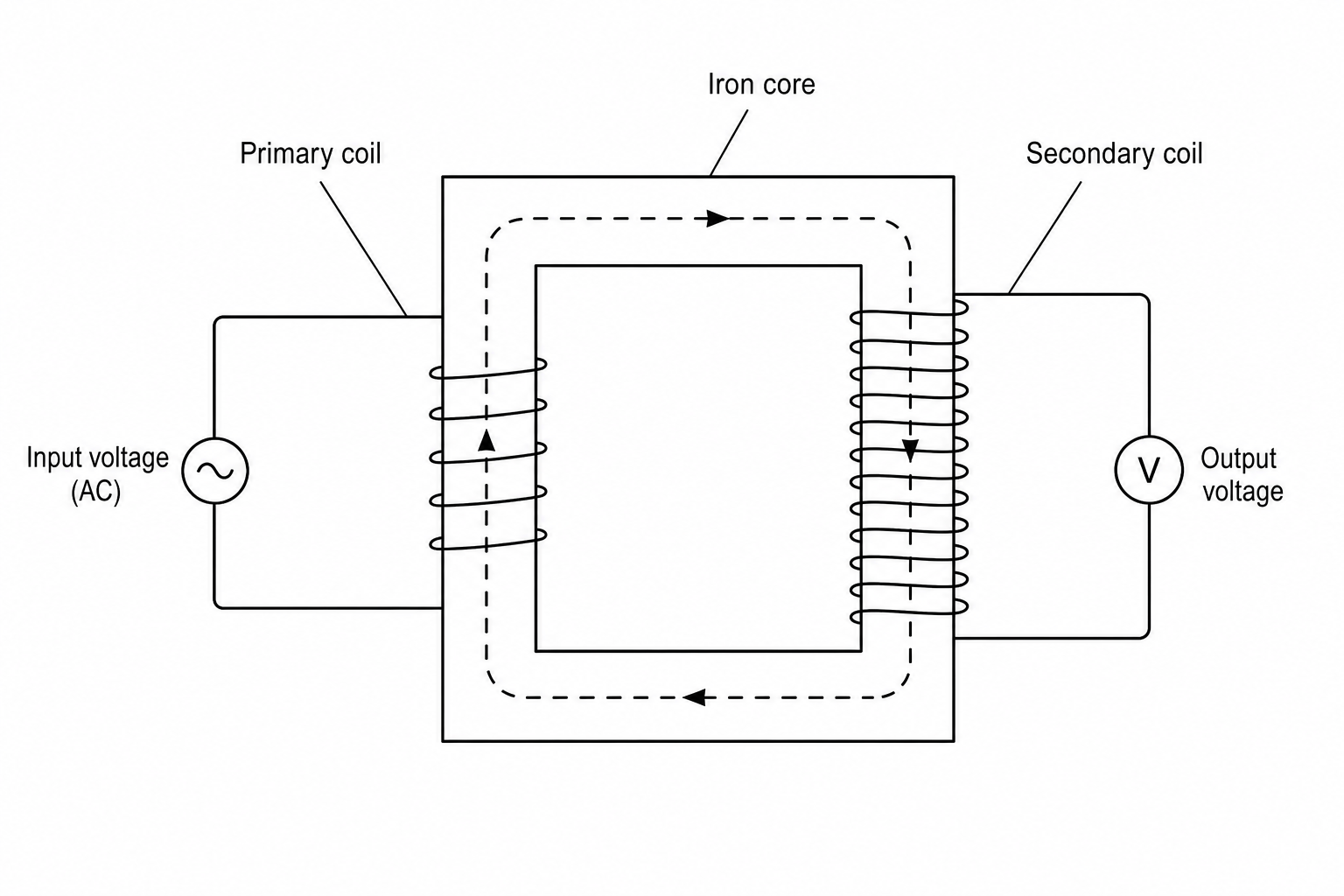
The student tests four prototypes using an alternating input voltage of 24 V24\text{ V}24 V. The number of turns in each coil and the measured output voltages are recorded in the table below:
| Prototype | Number of turns in primary coil (NpN_pNp) | Number of turns in secondary coil (NsN_sNs) | Measured output voltage (VsV_sVs in V\text{V}V) |
|---|---|---|---|
| A | 120 | 480 | 93.6 |
| B | 480 | 120 | 5.9 |
| C | 200 | 600 | 70.2 |
| D | 600 | 150 | 5.9 |
Explain how a transformer works and analyze whether this experimental data supports the expected theoretical relationship between the number of turns and the voltages.
The same student writes a summary about how a moving-coil microphone works but makes some errors in their explanation. Look at their description of a dynamic microphone's operation:
"When sound waves hit the flexible diaphragm, they cause it and the attached coil of wire to vibrate. As the coil moves through the magnetic field of the permanent magnet, a direct current is induced in the coil due to the motor effect. This electrical signal can then be amplified or recorded. A moving-coil microphone operates on the same fundamental principle as an electric motor."
Identify one of the incorrect words or phrases in the student's summary and write a correct sentence to replace the mistake.
Name a device which uses this physical effect in reverse.