Question 1
HA student uses the apparatus in the Figure to measure the magnetic flux density between the poles of a magnet.
Figure
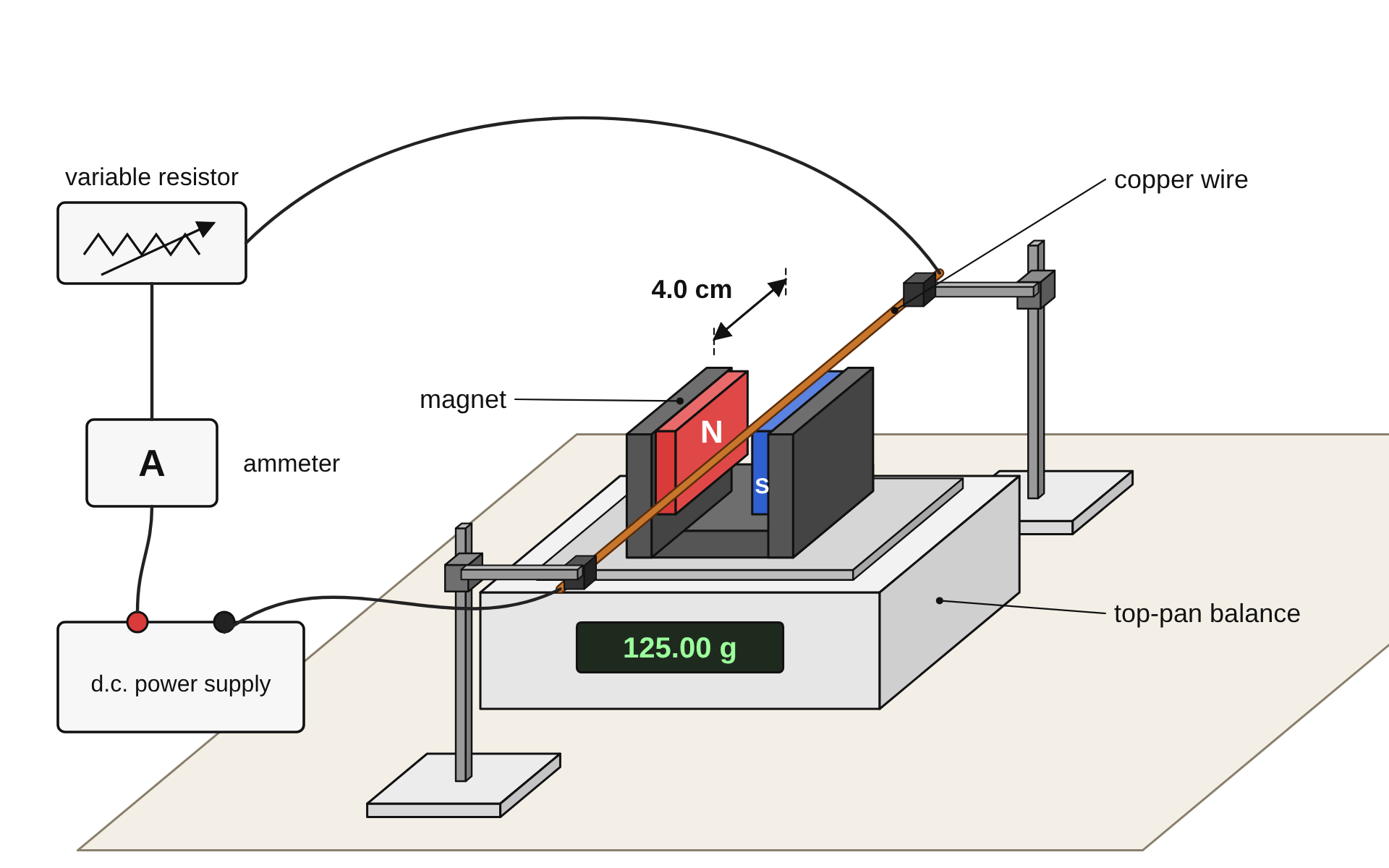
The length of wire between the poles of the magnet is 4.0 cm.
With no current in the wire, the balance reads 125.00 g.
When the current in the wire is 2.5 A, the balance reads 126.20 g.
a.[2]
Explain why the balance reading increases when there is a current in the wire.
b.[4]
The gravitational field strength g=10 N/kgg = 10\ \text{N/kg}g=10 N/kg.
Use the equation: force=magnetic flux density×current×length\text{force} = \text{magnetic flux density} \times \text{current} \times \text{length}force=magnetic flux density×current×length
Calculate the magnetic flux density between the poles of the magnet.
c.[1]
The student reverses the direction of the current. The size of the current stays at 2.5 A.
Predict the new reading on the balance.
4.2 Uses of magnetism Questions
48 exam-style questions on OCR GCSE Physics 4.2 Uses of magnetism, covering 4.2.1 The motor effect, 4.2.2 Fleming's left-hand rule, 4.2.3 The force on a current-carrying conductor, 4.2.4 The electric motor, 4.2.5 Electromagnetic induction, 4.2.6 Alternators and dynamos, 4.2.7 How transformers work, 4.2.8 Transformer turns ratio, 4.2.9 Potential differences and turns in transformers, and 4.2.10 Microphones, loudspeakers and headphones. Each one has a worked solution and a mark scheme showing where the marks go.