Question 5
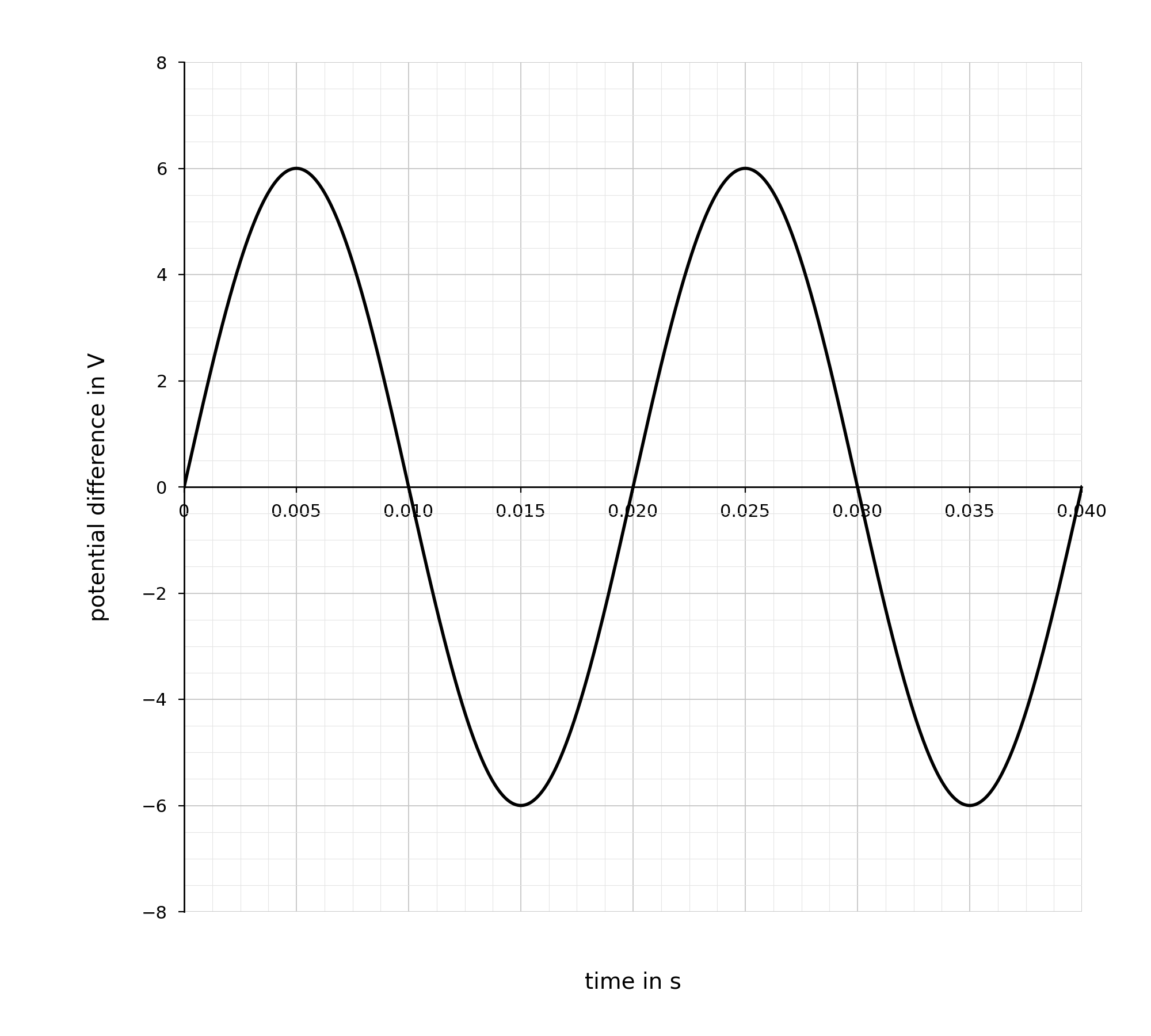
HThe Figure shows how the output potential difference of an alternator changes with time.
Figure
a.[1]
Write down the maximum potential difference produced by the alternator.
b.[2]
One complete cycle of the potential difference is produced by one complete turn of the coil.
Use the Figure to determine the number of complete turns the coil makes each second.
c.[2]
The coil is now turned at half the speed.
Describe two ways in which the graph would change.
d.[2]
The alternator is changed into a dynamo by connecting the coil to a split-ring commutator instead of slip rings. The coil is turned at the original speed.
Describe and explain how the graph of the output potential difference would be different.
4.2 Uses of magnetism Questions
48 exam-style questions on OCR GCSE Physics 4.2 Uses of magnetism, covering 4.2.1 The motor effect, 4.2.2 Fleming's left-hand rule, 4.2.3 The force on a current-carrying conductor, 4.2.4 The electric motor, 4.2.5 Electromagnetic induction, 4.2.6 Alternators and dynamos, 4.2.7 How transformers work, 4.2.8 Transformer turns ratio, 4.2.9 Potential differences and turns in transformers, and 4.2.10 Microphones, loudspeakers and headphones. Each one has a worked solution and a mark scheme showing where the marks go.