Question 3
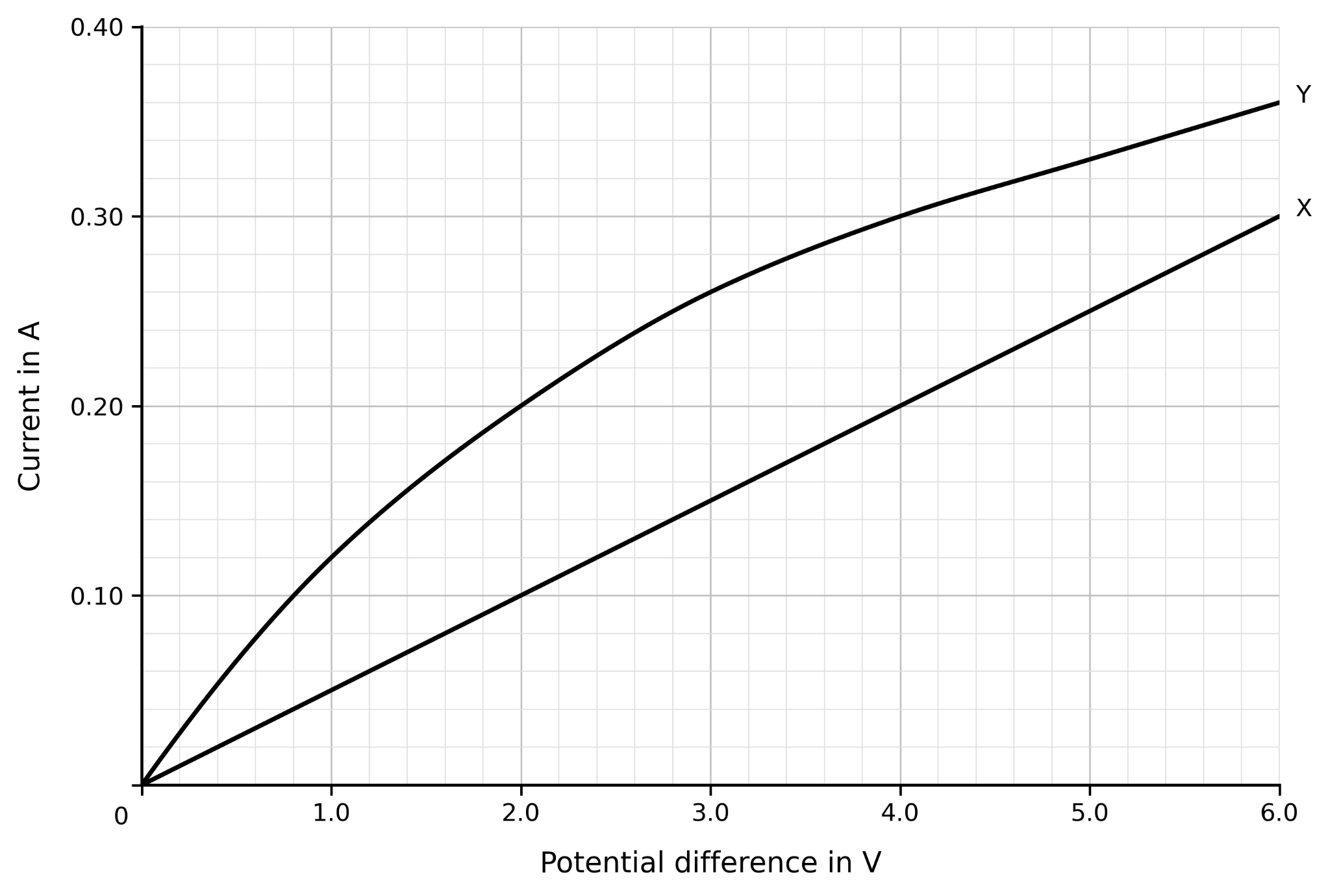
FA student measures the current in two components, X and Y, for different values of potential difference.
The Figure shows her results.
Figure
a.[2]
Which component, X or Y, is a linear component? Give a reason for your answer.
b.[1]
Use the Figure to find the current in component X when the potential difference is 4.0 V.
c.[2]
Use the equation: potential difference=current×resistance\text{potential difference} = \text{current} \times \text{resistance}potential difference=current×resistance
Calculate the resistance of component X.
d.[1]
Component Y is a filament lamp.
Describe how the resistance of the filament lamp changes as the potential difference across it increases.
3.2 Simple circuits Questions
42 exam-style questions on OCR GCSE Physics 3.2 Simple circuits, covering 3.2.1 Series and parallel circuits, 3.2.2 Circuit symbols and circuit diagrams, 3.2.3 Current, potential difference and resistance, 3.2.4 Ohm's law, 3.2.5 Ohmic and non-ohmic resistors, 3.2.6 Designing circuits to investigate resistance, 3.2.7 Linear and non-linear circuit components, 3.2.8 Current-potential difference graphs for components, 3.2.9 Resistance in series and parallel, 3.2.10 Series and parallel circuit problems, 3.2.11 Circuits for measurement and testing, 3.2.12 Power transfer in circuit devices, and 3.2.13 Energy and power in resistor circuits. Each one has a worked solution and a mark scheme showing where the marks go.