The Figure shows part of a decay series on a graph of the number of neutrons in a nucleus against the number of protons. Nucleus P decays to nucleus Q, and nucleus Q decays to nucleus R.
Figure
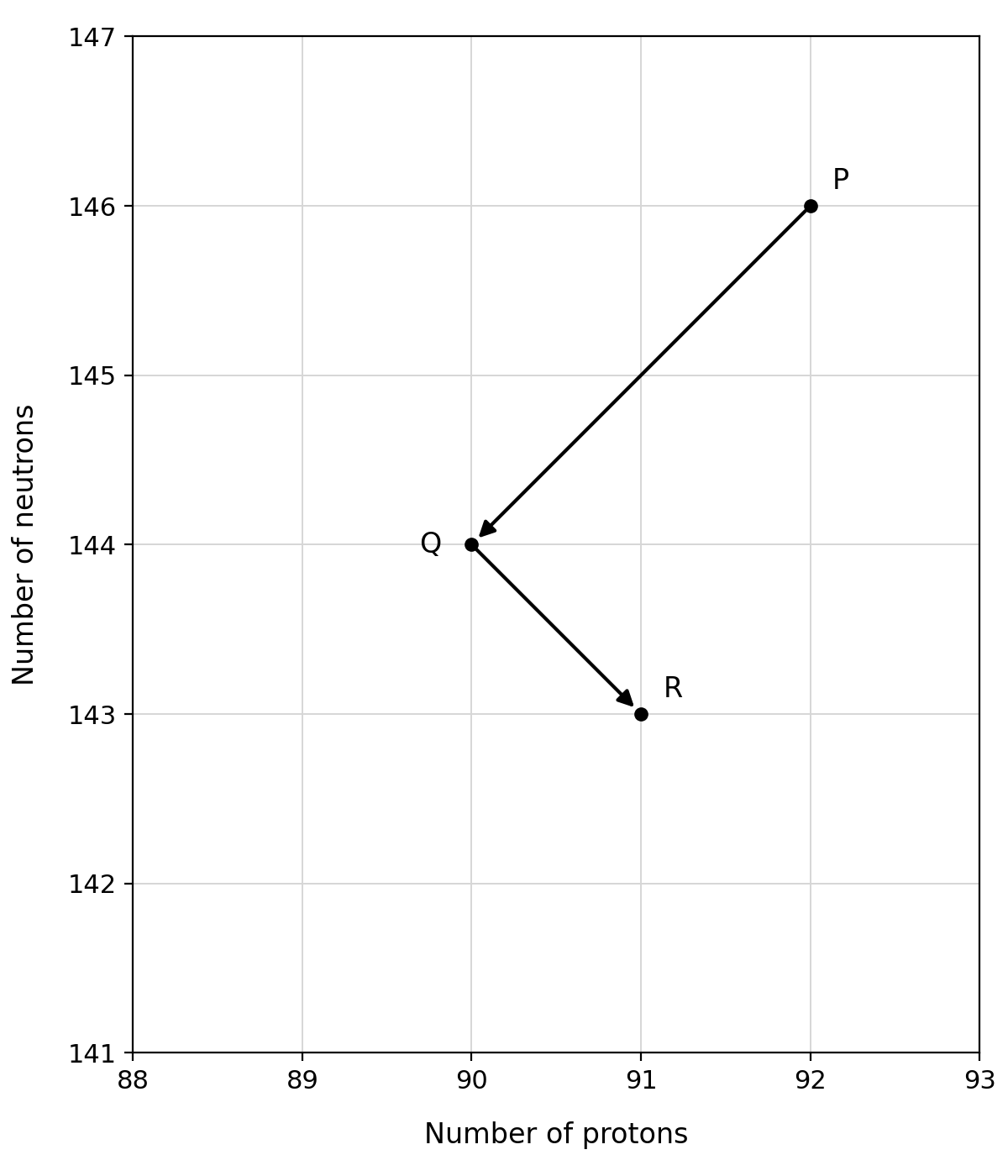
Identify the type of emission that changes nucleus P into nucleus Q.
Give a reason for your answer.
Explain how the decay of nucleus Q into nucleus R shows that it is a beta decay.
Nucleus R is a nucleus of element X.
Write the symbol for nucleus R in the form ZAX{}^{A}_{Z}\text{X}ZAX.
Nucleus R also emits a gamma ray.
Describe how the position of R on the graph changes when it emits the gamma ray.
48 exam-style questions on OCR GCSE Physics 6.1 Radioactive emissions, covering 6.1.1 Protons, neutrons and nuclear charge, 6.1.2 Isotopes and nuclear mass, 6.1.3 Representing nuclei and isotopes, 6.1.4 Unstable nuclei and radioactive emissions, 6.1.5 Changes to the nucleus during decay, 6.1.6 Representing radioactive decay, 6.1.7 Balancing mass and charge in decay, 6.1.8 Electron arrangements, ions and radiation, 6.1.9 Radiation absorbed and emitted by atoms and nuclei, 6.1.10 Half-life and random decay, 6.1.11 Net decline over several half-lives, and 6.1.12 Penetration of alpha, beta and gamma radiation. Each one has a worked solution and a mark scheme showing where the marks go.

