A student uses a dipping compass to investigate the magnetic field of a strong bar magnet. The dipping compass is aligned so that its needle can pivot in a vertical plane parallel to the long axis of the bar magnet.
Describe how the orientation of the dipping compass needle changes as it is moved along a line directly above the bar magnet, starting from the center (equator) of the magnet and ending directly over its North pole.
Explain how this observation relates to the direction of the magnetic field lines near the surface of the bar magnet.
A student sets up an experiment to investigate the magnetic field around a vertical current-carrying wire that passes through a horizontal cardboard sheet.
Describe how the student can use a single plotting compass to map the shape of the magnetic field line on the cardboard sheet.
The diagram below shows a vertical wire passing through a horizontal sheet. The current is flowing vertically upwards through the wire.
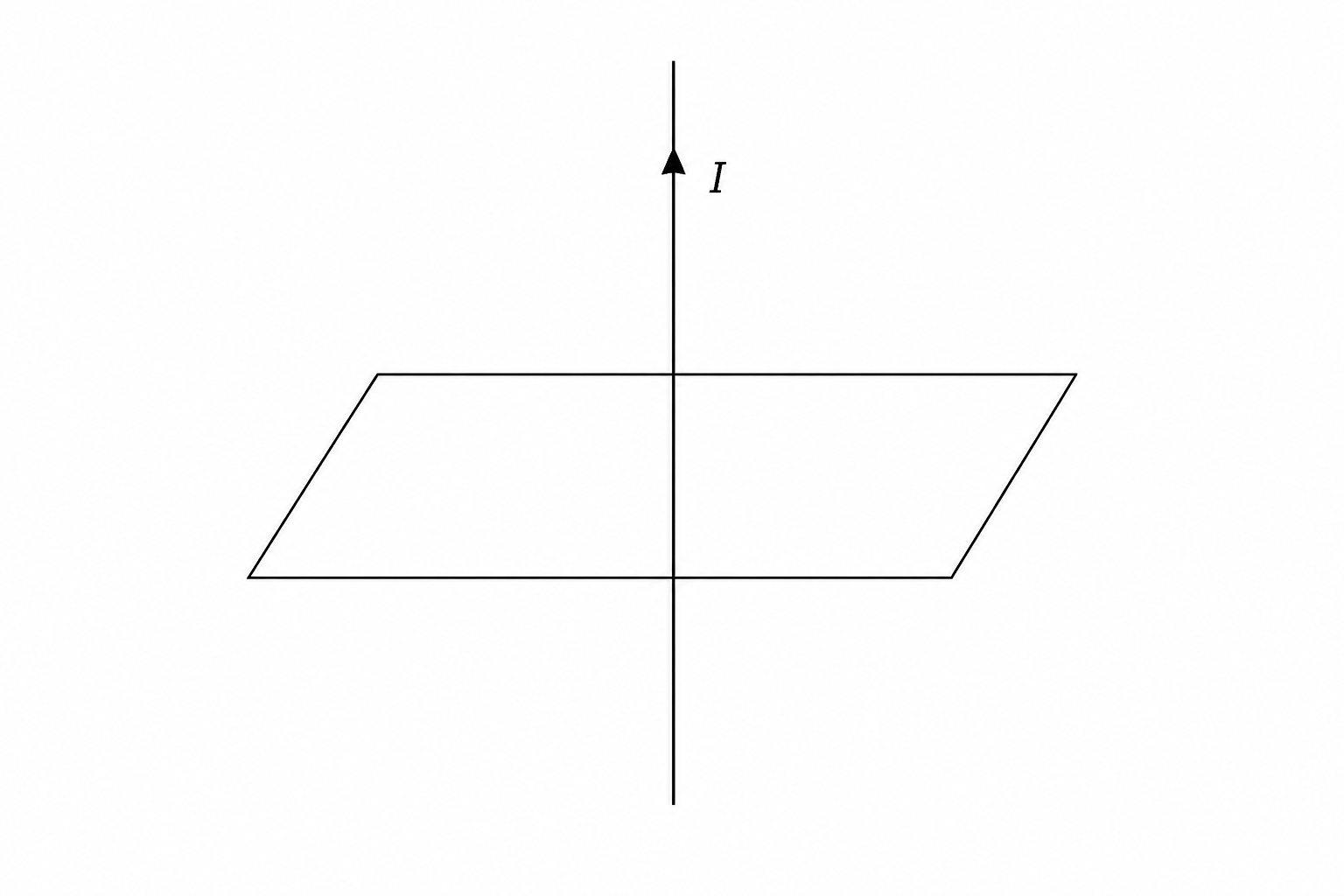
State the shape of the magnetic field lines and their direction (clockwise or anticlockwise) as viewed from directly above.