Figure 1 shows two absorption spectra with a key spectral line, Line X, highlighted.
One spectrum is recorded from a laboratory source on Earth.
The other spectrum is recorded from a distant galaxy.
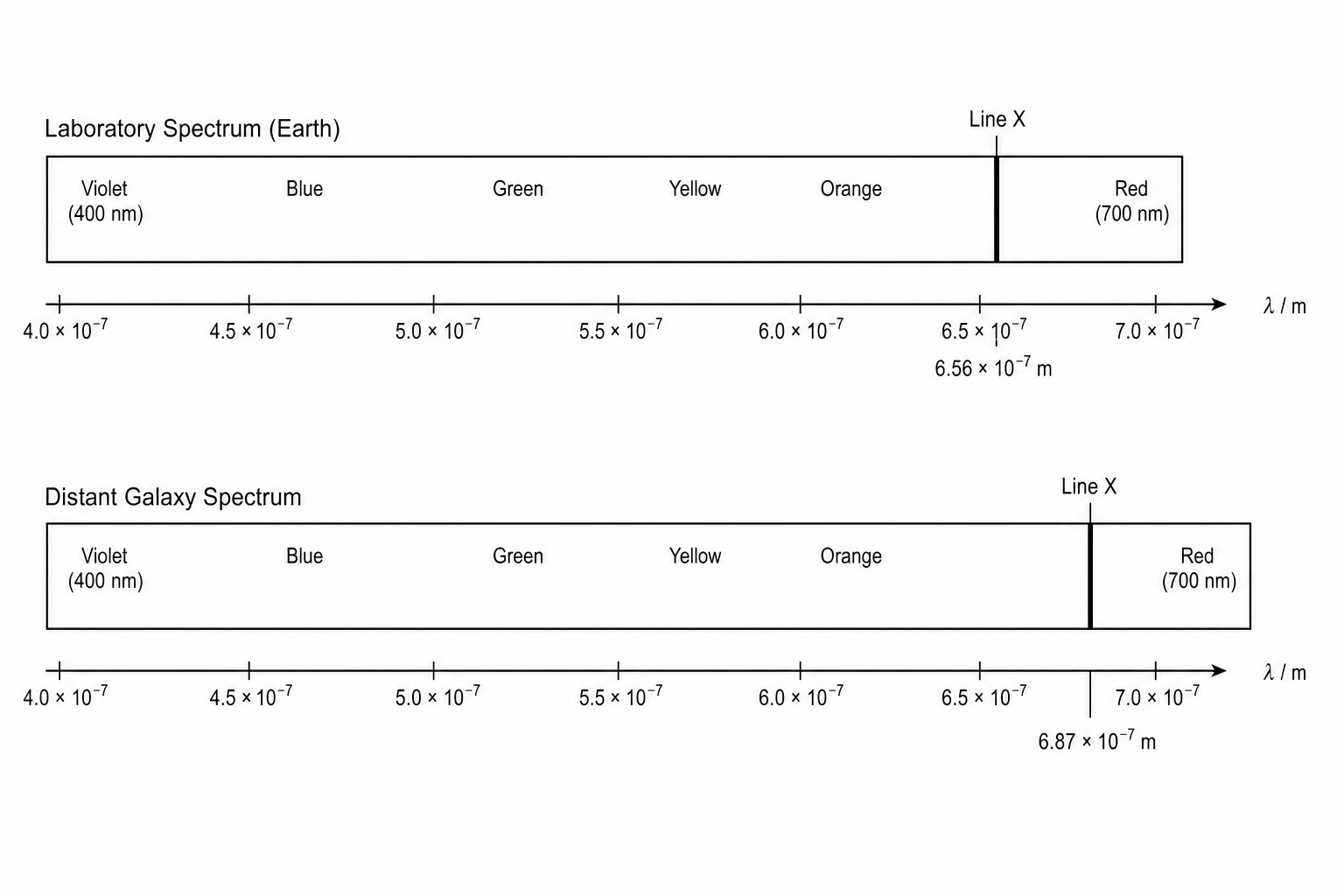
The wavelength of Line X on Earth, λo=6.56×10⁻⁷ m\lambda_o = 6.56 \times 10^{-7} \text{ m}λo=6.56×10⁻⁷ m
The wavelength of Line X from the distant galaxy, λg=6.87×10⁻⁷ m\lambda_g = 6.87 \times 10^{-7} \text{ m}λg=6.87×10⁻⁷ m
The redshift (zzz) is given by the equation:
z=λg−λoλo z = \frac{\lambda_g - \lambda_o}{\lambda_o} z=λoλg−λoShow that the redshift for the light from this distant galaxy is approximately 0.047.