The Big Bang, red-shift and the expanding Universe

EasyMediumHard
12345678910111213141516171819202122232425262728293031
Question 22
Medium

A student investigates the light spectra from four distinct galaxies, P, Q, R, and S, and compares them to a reference spectrum obtained in a laboratory.
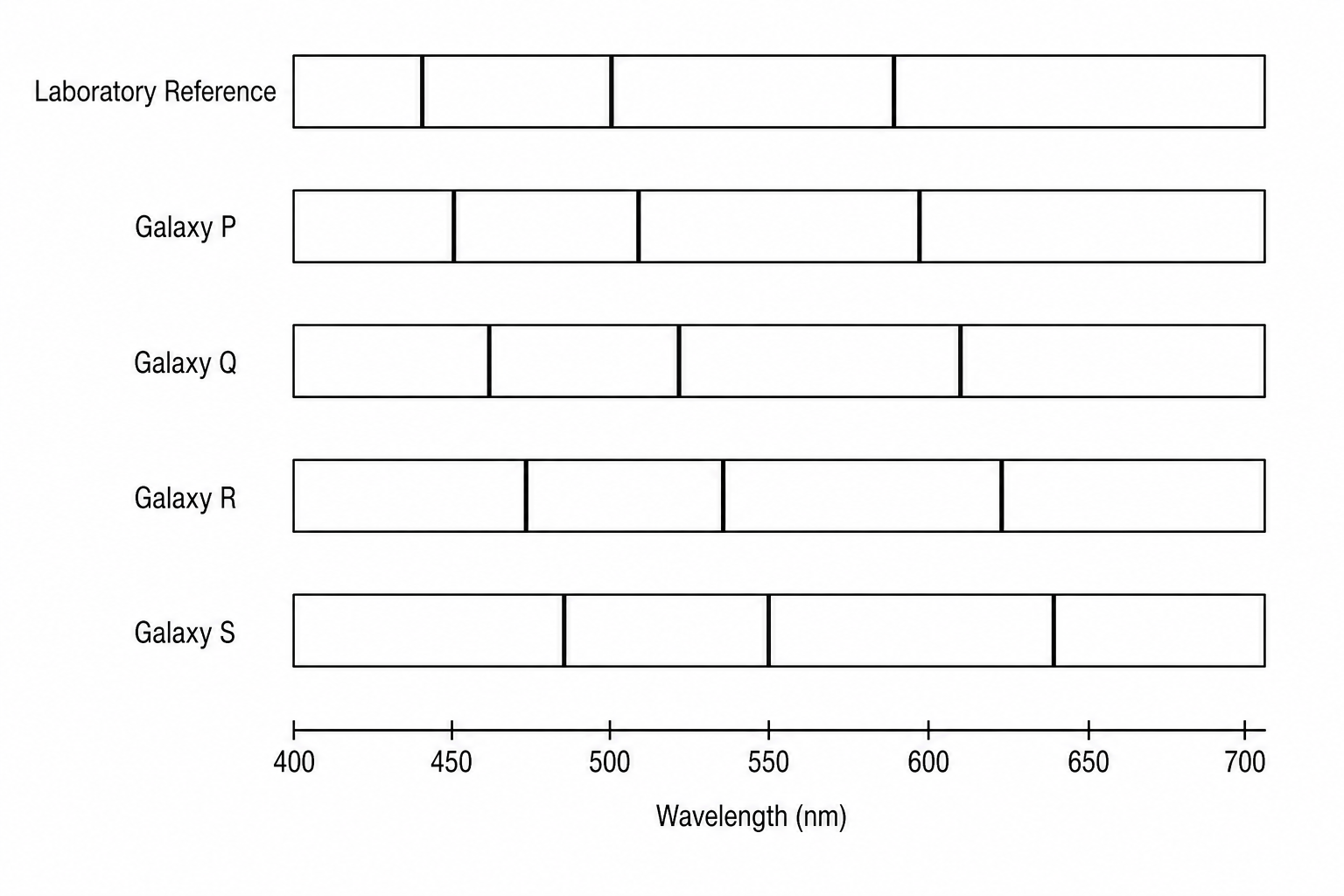
Spectra of a laboratory reference and four galaxies (P, Q, R, S). The x-axis represents wavelength in nanometers (nm), ranging from 400 nm to 700 nm. The laboratory reference has three dark absorption lines. In the spectra for galaxies P, Q, R, and S, these dark lines are shifted towards the red end (longer wavelengths) of the spectrum. Galaxy S shows the greatest shift to the right, followed by Galaxy R, then Galaxy Q, and Galaxy P has the smallest shift.

Explain, using the diagram, which galaxy is furthest away from Earth.

[3]

The Big Bang, red-shift and the expanding Universe Questions

  1. GCSE
  2. /Physics
  3. /The Big Bang, red-shift and the expanding Universe